

Quick Answer
A unit price contract pays the contractor a fixed price per unit of work, such as per cubic yard or per linear foot, multiplied by the quantity actually installed, so the owner carries the quantity risk and the contractor carries the price risk on every unit. Margin depends on unit rates that carry every cost. Below are how unit price contracts compare with lump sum and cost-plus, when owners use them, how to read a bid schedule, how to build a unit rate that holds, a worked example, the federal rules on quantity variation and unbalanced bids, and a checklist.
What you'll find below:
- How a unit price contract works, with a simple bid schedule
- Who carries quantity risk and price risk under unit price, lump sum and cost-plus
- When federal rules say unit pricing fits, and what the 15 percent variation clause does
- How to build a unit rate that carries direct cost, fixed cost, overhead and profit
- A worked example where a 15 percent quantity drop leaves $1,200 of fixed cost unpaid
- A checklist for bidding and running a unit price job
What Is a Unit Price Contract?
A unit price contract is a construction contract where the owner lists the work as pay items with estimated quantities, the contractor bids a price per unit for each item, and payment is the unit price times the quantity actually installed and measured. The total in the bid is an estimate. The unit prices are the commitment.
A simple bid schedule looks like this:
| Pay item | Unit | Estimated quantity | Unit price | Extended |
|---|---|---|---|---|
| Excavation and backfill | Cubic yard | 2,000 | Your price | Quantity x price |
| 12 inch storm pipe | Linear foot | 850 | Your price | Quantity x price |
| Catch basin | Each | 9 | Your price | Quantity x price |
| Asphalt paving, 3 inch | Square yard | 4,200 | Your price | Quantity x price |
Bids are compared on the extended total, but the contractor is paid on measured quantities. If the job uses 1,700 cubic yards of excavation instead of 2,000, the contractor is paid for 1,700.
Unit Price vs Lump Sum vs Cost-Plus: Who Carries Which Risk?
Under a unit price contract the owner carries the quantity risk and the contractor carries the price risk, under a lump sum contract the contractor carries both, and under cost-plus the owner carries both, with the contractor's fee on top. That split decides how you price.
| Contract type | Quantity risk | Price risk | How you're paid |
|---|---|---|---|
| Unit price | Owner | Contractor | Unit price x measured quantity |
| Lump sum | Contractor | Contractor | One fixed price for the defined scope |
| Cost-plus | Owner | Owner | Actual cost plus a fee |
Our guide to GMP vs lump sum vs cost-plus contracts compares those models in more depth. Some jobs combine them, with lump sum items for defined work and unit price items for work whose quantity can't be known at bid time.
When Do Owners Use Unit Price Contracts?
Owners use unit price contracts when the quantity of work can't be known with confidence at bid time, which is common on sitework, utilities, paving and earthwork. Federal contracting rules spell this out.
Under FAR 36.207, federal construction is normally bought on firm-fixed-price contracts, priced lump sum, unit price or both, with lump sum preferred unless one of four conditions applies:
- Large quantities of work are involved, such as grading, paving, building outside utilities or site preparation.
- Quantities of work, such as excavation, can't be estimated with enough confidence to allow a lump sum offer without a substantial contingency.
- Estimated quantities can change significantly during construction.
- Offerors would have to spend unusual effort to develop adequate estimates.
State and local public owners use unit price bids for the same kinds of work, and many private site packages follow the same pattern.
How Do You Read a Bid Schedule?
Read a bid schedule item by item, checking each pay item's unit of measure, its estimated quantity, and the pay item definition in the specifications that says exactly what the unit price includes and how it will be measured. The definition decides what your rate must cover.
For each pay item, confirm:
- The unit. Cubic yard, linear foot, square yard, each, ton or lump sum.
- The measurement method. For example, whether pipe is measured through structures or between them, or whether excavation is measured in place or as loose material.
- What's included. Many pay item definitions fold in work with no separate item, such as bedding, backfill, compaction or testing.
- What's paid separately. Rock excavation, unsuitable soil or dewatering are sometimes separate items, and sometimes not.
A pay item definition that includes work you didn't price is a loss on every unit. Read the schedule of values and pay item sections together.
Run Your Own Takeoff, Don't Trust the Owner's Quantities
Run your own takeoff on every unit price bid, because the owner's quantities are estimates, and knowing which items are likely to run over or under changes how you spread fixed costs and how much risk you price. The bid schedule tells you what the owner expects, not what the drawings show.
Compare your quantity takeoff with the bid schedule item by item. Where your quantity is lower, fixed costs spread over the owner's quantity won't all be recovered. Where yours is higher, the item can overrun, and the variation clause can apply. Our guide on how to read a site plan covers taking off sitework quantities from the civil set.
Building a Unit Rate That Holds
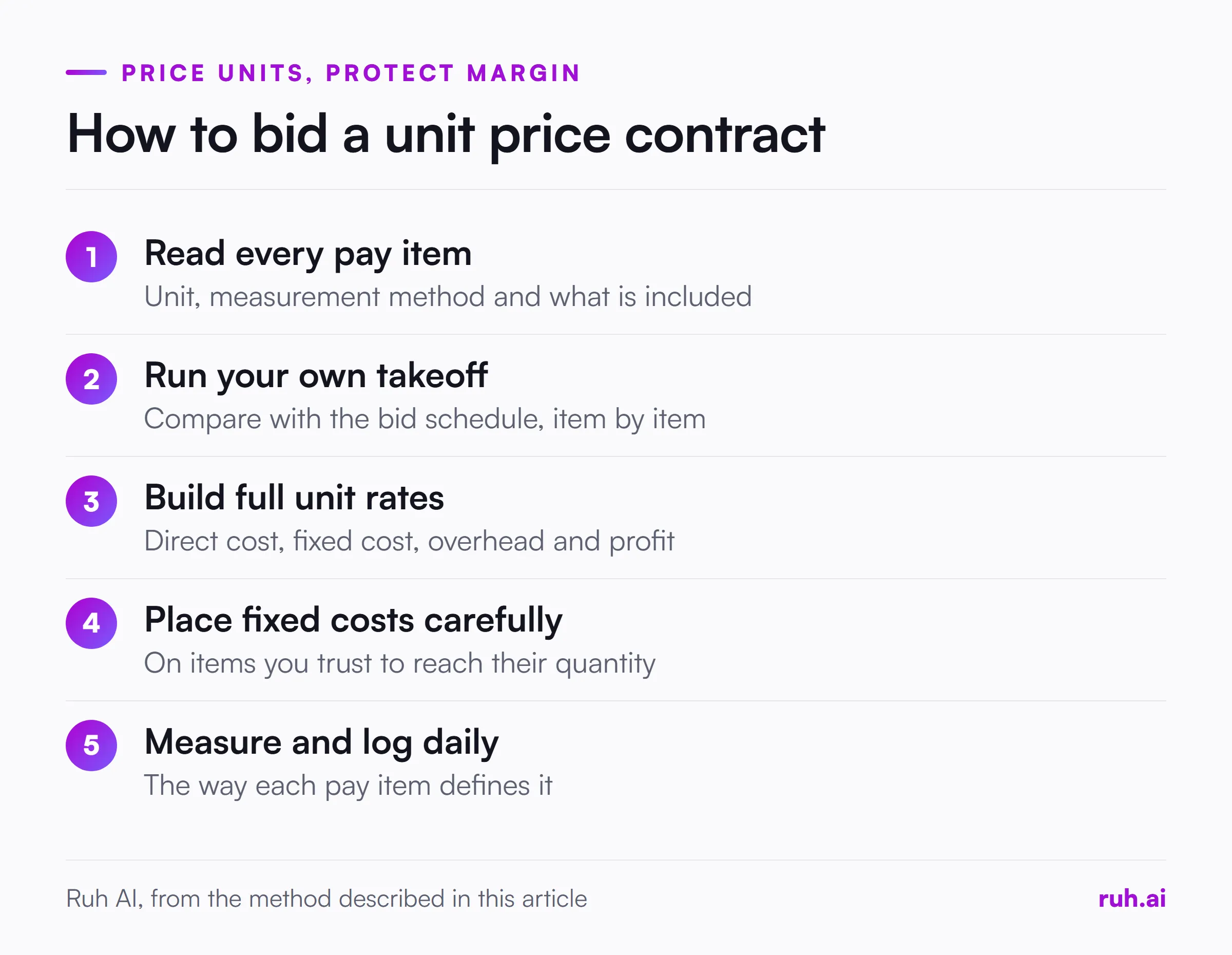
Build each unit rate from the direct cost of one unit, plus its share of fixed costs, overhead and profit, so every unit installed pays its full share of the job. A rate that carries only direct cost loses money on every unit.
A unit rate needs:
- Direct cost per unit. Labor and equipment from your crew's production rate, plus material, waste and disposal for one unit. Our unit cost glossary entry covers the build-up.
- Fixed cost per unit. Mobilization, setup, traffic control and other costs that don't change with quantity, spread across the units that will carry them.
- Overhead. The job's share of running the company.
- Profit. Your margin on the work.
Production rates matter more on unit price work than anywhere else, because the price is per unit and the crew's output per day sets the cost per unit. Use your own job history, not a published average.
Where Do Fixed Costs Go in a Unit Price Bid?
Fixed costs go into the unit rates when the bid schedule has no separate mobilization or general conditions item, spread across the pay items most likely to reach their estimated quantity. Where you put them decides how much you recover if quantities fall.
If the bid schedule has a mobilization item, price it honestly. If it doesn't, the cost has to ride on the unit rates. Spreading it over items whose quantities you trust protects you. Spreading it over items likely to underrun leaves fixed cost unpaid when the quantity drops, as the worked example below shows.
Worked Example: A Unit Rate and a 15 Percent Underrun
A worked example shows how fixed costs hidden in a unit rate go unpaid when the quantity falls. The numbers are illustrative, so redo them with your own costs.
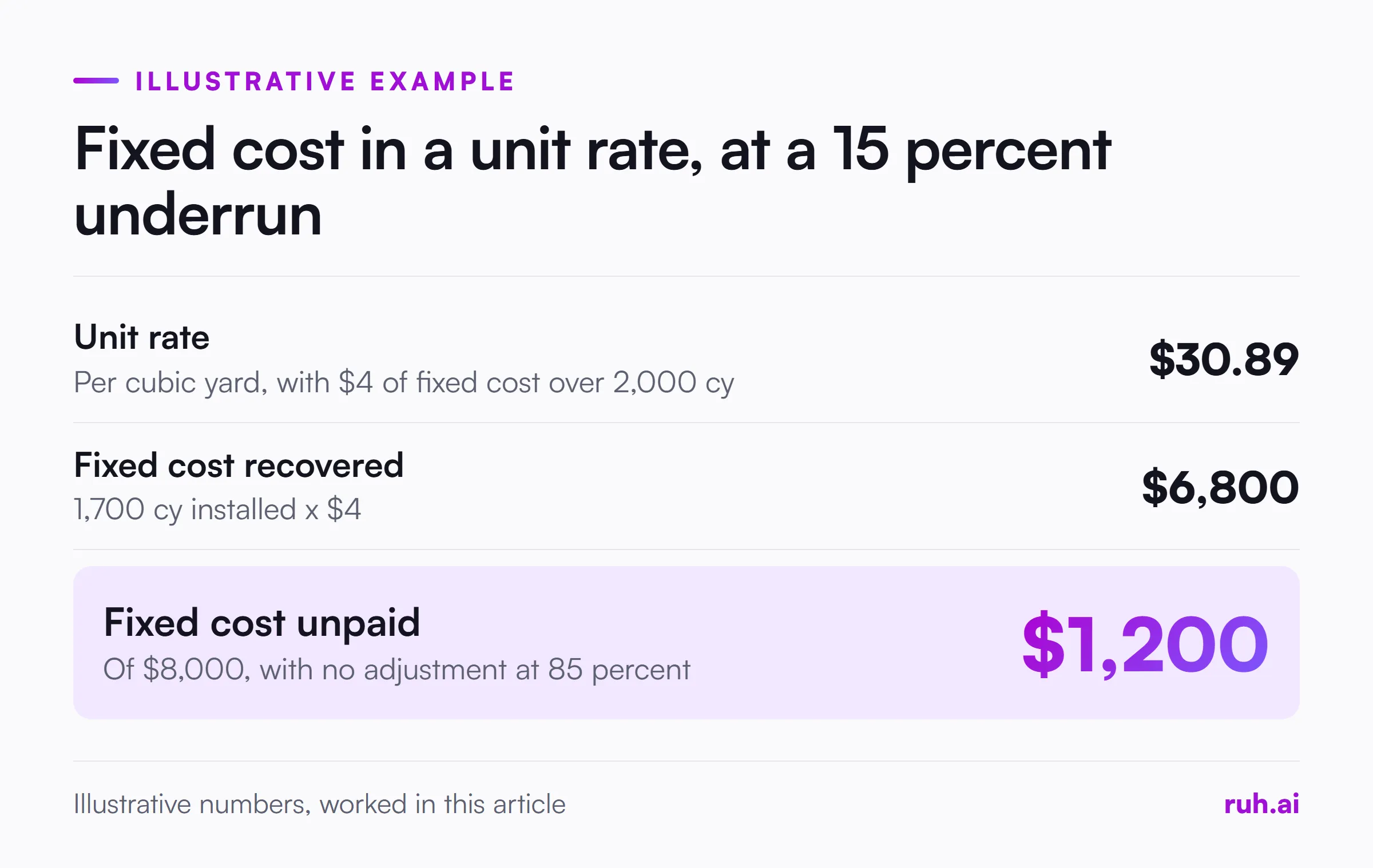
The bid schedule lists 2,000 cubic yards of excavation and backfill. Your own takeoff shows 1,700 cubic yards. Direct cost is $22 per cubic yard. There is no mobilization item, so $8,000 of fixed costs goes into this rate, spread over the owner's 2,000 cubic yards: 8,000 / 2,000 = $4 per cubic yard.
The rate: with an illustrative 10% overhead and 8% profit, (22 + 4) x 1.10 x 1.08 = $30.89 per cubic yard.
At 2,000 cubic yards: revenue is 2,000 x 30.89 = $61,780. Direct and fixed cost is 2,000 x 22 + 8,000 = $52,000, leaving $9,780 for overhead and profit.
At 1,700 cubic yards: revenue is 1,700 x 30.89 = $52,513. Direct and fixed cost is 1,700 x 22 + 8,000 = $45,400, leaving $7,113. Only 1,700 x 4 = $6,800 of the $8,000 fixed cost was recovered, so $1,200 went unpaid.
1,700 is exactly 85 percent of 2,000, which matters on federal work, as the next section explains.
What Happens When Quantities Vary? The 15 Percent Clause
Most unit price contracts include a variation clause that allows repricing when the actual quantity of an item moves far from the estimate, and on federal construction work that threshold is 15 percent above or below. Inside the band, the unit price stands.
The federal clause, FAR 52.211-18, Variation in Estimated Quantity, says that if the actual quantity of a unit-priced item varies more than 15 percent above or below the estimated quantity, either party can demand an equitable adjustment. The adjustment is based only on the cost changes caused by the variation beyond 115 percent or below 85 percent of the estimate. The clause also allows a written request for more time if the variation delays completion.
In the worked example, 1,700 cubic yards is exactly 85 percent of the estimate, so on a federal job no adjustment applies. The $1,200 is yours to absorb. Private and state contracts set their own thresholds and methods, so read the clause in each contract before you bid.
What Is an Unbalanced Bid?
An unbalanced bid prices some items well above their cost and others well below it, while the total looks reasonable, and owners can reject one. Contractors sometimes do it to collect money early or to profit from items they expect to overrun.
FAR 15.404-1(g) defines unbalanced pricing as an offer where, despite an acceptable total price, one or more line items are significantly overstated or understated. It names mobilization and startup work as separate line items among the highest-risk cases.
Keep your rates defensible: each item should carry its own direct cost plus a reasonable share of fixed cost, overhead and profit. If you load fixed cost onto certain items, have a reason you can explain, such as putting it on items you are confident will reach their quantity.
Tracking Installed Quantities in the Field
Track installed quantities every day, measured the way each pay item definition says, so you can see an overrun or underrun early enough to act and bill exactly what you installed. On a unit price job, measurement is billing.
- Measure daily by pay item, using the same method the specs define.
- Agree measurements with the owner's inspector as work goes in, especially for items that get buried, like pipe and excavation.
- Compare against the estimate each week, item by item, so a variation approaching the contract threshold is visible before it's passed.
- Log the reason for every significant difference: design changes, field conditions or measurement differences.
- Request adjustments in writing within the contract's time limits when a variation clause applies.
Unit Price Contract Checklist
Run this before you bid and through the job:
- Every pay item's unit, measurement method and inclusions have been read in the specs.
- Your own takeoff has been compared with the bid schedule, item by item.
- Each unit rate carries direct cost from your own production rates.
- Fixed costs are priced on a mobilization item, or spread over items you're confident will reach quantity.
- Overhead and profit are in every rate.
- No item is priced far above or below its cost without a reason you can explain.
- The variation clause, its threshold and its notice rules are understood.
- Field measurement matches the pay item definitions, and quantities are logged daily.
- Installed quantities are compared with the estimate every week.
- Anything without a price is carried as a labelled allowance, never a zero.
What Contractors Get Wrong About Unit Price Contracts
Four positions on unit price contracts, argued as our view, not as data.
The bid schedule is the owner's guess, not your quantity. Run your own takeoff every time.
Fixed cost is the hidden risk. On a unit price job, mobilization buried in rates is the first money lost when quantities fall.
Production rate is the price. The cost per unit is set by what the crew installs in a day.
Measurement is billing. If the field doesn't measure the way the spec defines, you lose money you earned.
The Honest Assessment: What Still Falls Short
A unit price contract protects the owner from paying for work that isn't installed, but it doesn't protect the contractor from bad unit rates. A thin rate loses on every unit, however the quantities turn out.
Variation clauses also only help beyond their thresholds, and private contracts set those thresholds themselves. And measurement disputes are common on buried work, which is why agreeing quantities as work goes in matters as much as pricing them.
How Ruh Fits
Ruh AI's Estimating Agent carries your takeoff quantities into a priced estimate, pricing from your own sources first: this job's supplier quotes, your rate book and your price files, so you can check the owner's bid schedule against your own numbers. Any line left without a price is flagged and blocks approval until someone on your team prices it.
Your team can edit every quantity and price, and a person on your team approves the bid before it goes out. Ruh AI's Takeoff Agent reads drawing PDFs and CAD files and won't give a length or area for a sheet with no scale. Ruh works with your stack, built per customer.
Frequently Asked Questions
Q: What is a unit price contract? A: It is a construction contract where the contractor bids a price per unit for each pay item, such as per cubic yard or linear foot, and is paid that price times the quantity actually installed and measured.
Q: What is the difference between a unit price and a lump sum contract? A: A lump sum contract pays one fixed price for the defined scope, so the contractor carries both quantity and price risk. A unit price contract pays per measured unit, so the owner carries the quantity risk and the contractor carries the price risk.
Q: When are unit price contracts used? A: When quantities can't be known with confidence at bid time, such as grading, paving, outside utilities, site preparation and excavation. Federal rule FAR 36.207 lists those conditions for choosing unit pricing over lump sum.
Q: What happens if quantities change on a unit price contract? A: The contractor is paid for the measured quantity. On federal work, FAR 52.211-18 allows an equitable adjustment when an item varies more than 15 percent above or below the estimate. Other contracts set their own thresholds.
Q: What is an unbalanced bid? A: It is a bid where some items are priced well above cost and others well below, while the total looks reasonable. FAR 15.404-1(g) defines unbalanced pricing, and owners can reject unbalanced offers.
Q: How do you price mobilization in a unit price bid? A: Use the mobilization pay item if there is one. If not, spread fixed costs across items you're confident will reach their estimated quantity, so an underrun on one item doesn't leave fixed cost unpaid.
See how Ruh prices your takeoff from your own rate book on the construction estimating software page.