
TL;DR / Summary
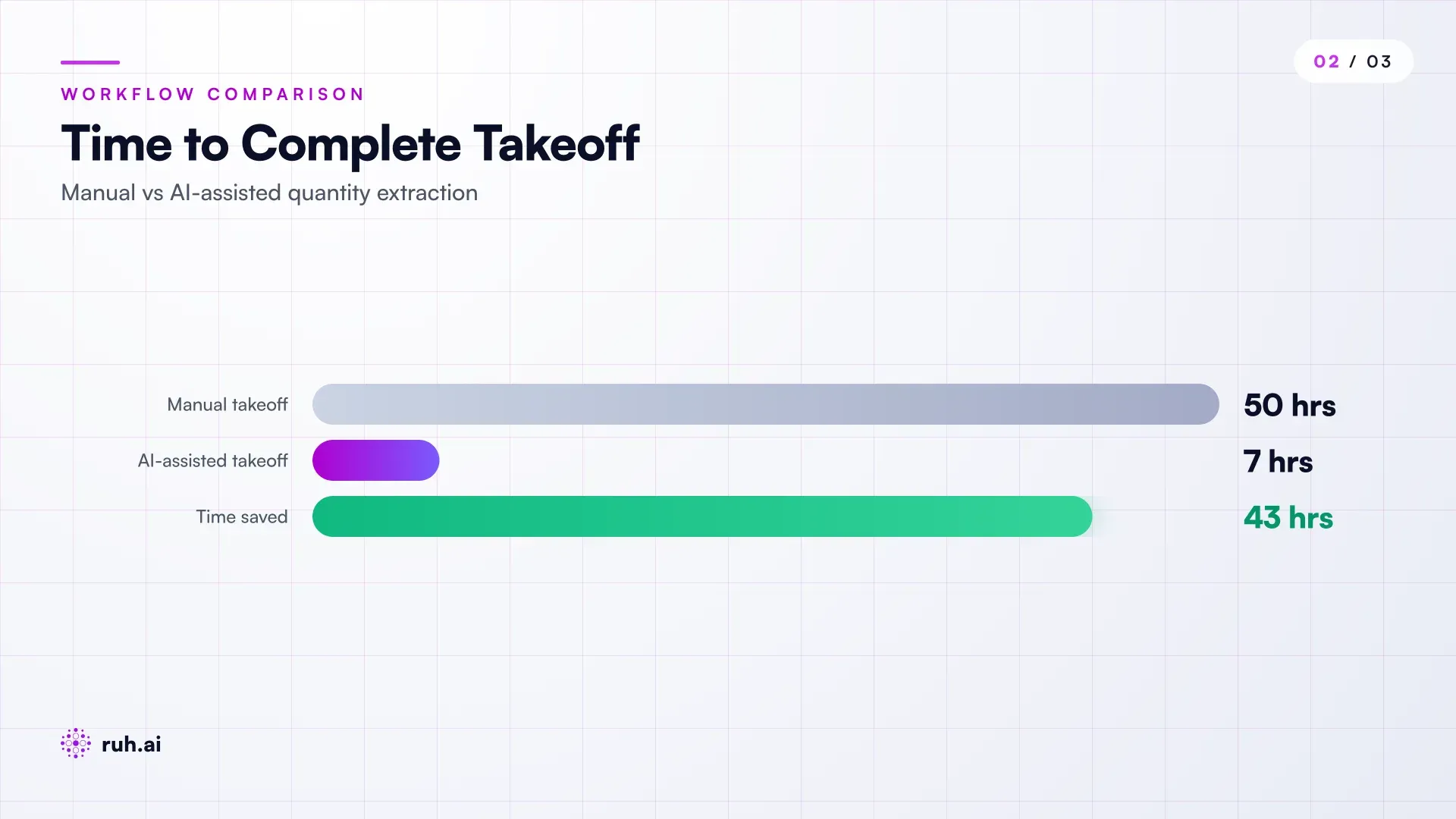
Traditional plumbing estimating software requires manual takeoff, measuring pipe runs, counting fixtures, calculating loads, on every single set of plans. AI quantity extraction automates this entirely, cutting plumbing bid timelines from 40-60 hours down to 6-8 hours while improving accuracy that costs contractors real money in change orders and post-bid scope disputes.
What you'll learn:
- Why manual takeoff is plumbing estimating's biggest time sink and accuracy trap
- How AI extracts plumbing quantities from plans, and why it's more complex than structural takeoff
- The financial impact of accurate quantity extraction on bid win rates and margin protection
- Where traditional plumbing software still falls short
- How AI agents are reshaping plumbing preconstruction workflows in 2026
The Manual Plumbing Takeoff Trap
Your plumbing estimator is still sitting down with a 30-sheet architectural set, a calculator, and a highlighter. Measuring copper lines inch by inch. Counting elbows, tees, unions, and valves. Multiplying fixture counts per floor by typical load calculations. Then, after 40-60 hours of this, typing all of it into your estimating software so you can price it.
And if the plans change? You start over.
This workflow is not just slow, it's a margin killer. A miscounted cold water riser, an overlooked fixture load, a missed valve rough-in. These aren't big mistakes; they're $500-2,000 hits per missed item on a commercial plumbing scope. For a $200K plumbing contract on a 50,000 sq ft commercial building, a 5% takeoff error means you've just given away $10,000 in gross margin before you even broke ground.
Traditional plumbing estimating software automates pricing, not extraction. You still need humans to do the reading.
Why Plumbing Takeoff Is Harder Than Contractors Realize
Structural takeoff is relatively clean: lineal feet of beam, cubic yards of concrete, square feet of deck. Plumbing is a different animal.
Your plumbing plans show:
- Supply lines (hot, cold, recirculation) with diameters that change based on fixture load and riser height
- Drain lines with slope, size transitions, and trap configurations
- Vent stacks with different sizing rules per code jurisdiction
- Rough-in schedules that list fixtures and their attributes (type, fixture units, connection size)
- Isometric or plan views that don't always align perfectly
- Manufacturer callouts for specialty items (backflow preventers, pressure reducers, water heaters)
A manual estimator reads these layers separately, cross-references them, and reconciles discrepancies. An estimator who misses that a commercial restroom fixture schedule calls for low-flow fixtures instead of standard ones just cut the supply line size incorrectly, and that ripples through the entire riser sizing calculation.
AI doesn't just count faster, it reads all these relationships simultaneously and flags inconsistencies that a tired human misses on the 15th floor of a 20-story plan set.

How Plumbing Software Has Stalled
Current plumbing estimating software (think Bluebeam, Trimble Prolog, Stack, MC2 Estimating) does exactly one thing well: it stores your labor rates, material prices, and typical waste factors, so once quantities are in the system, pricing is fast and consistent.
They do not extract quantities. That is still a human job.
Over the last decade, these platforms added 2D planimetry tools and on-screen takeoff: you can mark up a plan PDF in-app, and the software calculates lineal feet or counts symbols. This is marginally faster than paper, but it's still manual. You are still the extraction engine.
The bottleneck is not software limitation, it's the source material. Plumbing plans are scanned PDFs, CAD drawings in various states of detail, or 3D BIM models where plumbing is often lower-fidelity than structural. Every plan is a different puzzle.
The industry assumed this was unsolvable at scale. It isn't anymore.
The AI Shift: Machine Learning Reads Plans Like an Estimator
Here's what changed in 2026: AI models trained on thousands of plumbing plan sets now recognize pipe symbols, fixture callouts, size notations, and valve types in context. They don't just detect an elbow; they read the diameter from nearby dimension text, trace the pipe run across multiple sheets, and associate it with the fixture schedule to confirm load requirements.
This is materially different from traditional OCR or automated measurement. It's structured extraction.
A plumbing AI reads a CAD drawing or scanned plan and produces:
- A bill of quantities by system (supply, drain, vent), with lineal feet by diameter and fitting counts by type
- A fixture register mapped to each supply/drain/vent connection with load calculations
- A rough-in schedule with locations and specifications
- Flag items where plan details conflict or where code assumptions need estimator review
All of this in the time it takes to upload the plan and wait for processing, typically 2-5 minutes for a multi-sheet commercial set.
The estimator then reviews the output in a structured view, makes adjustments where code compliance or local practice requires it, and moves to pricing. Total elapsed time for a typical commercial plumbing scope: 6-8 hours instead of 40-60.
Accuracy and the Margin Difference
Speed is nice. Accuracy is money.
A human estimator working under deadline pressure on a complex commercial building will miss things. Industry benchmarks suggest professional estimators working on typical commercial projects have a 3-8% error rate on labor quantities and a 5-12% error rate on material items. Not because they're careless, because they're working from plans designed by architects and engineers who don't always think like cost estimators.
An AI system extracts everything it can detect and flags ambiguities. This shifts the workflow: the estimator spends their time on judgment calls, interpreting vague plan notes, applying local code practice, deciding between material substitutes, not on transcription and measurement.
The result: takeoff accuracy improves to 1-2% error rate. For a $500K plumbing contract where a 1% error translates to $5,000 in lost margin, that's not academic.
This is where bid win rates move. Better accuracy means tighter bid prices. Tighter prices win more jobs against competitors still using manual takeoff.
The Workflow Cascade: Faster Bids Compound Downstream
A plumbing estimator who spent 50 hours on a single bid now spends 8. What happens to the other 42 hours?
They estimate more projects. For a mid-size GC or plumbing subcontractor, this means 4-5x more bids per estimator per quarter. That's not just volume, it's strategic optionality. You can pursue faster-turnaround bids. You can do value-engineer iterations for a customer without eating a week of labor cost.
Field operations see tighter scope documents because the quantities are more reliable. Fewer RFIs asking "did you include the backflow preventer?" because it was detected automatically and flagged for coordination.
Project managers see fewer change orders on plumbing when the base estimate was built from accurate extraction rather than hand measurement and mental math.
The Honest Assessment: Where AI Quantity Extraction Still Needs Human Judgment
AI quantity extraction is not a walk-on replacement for estimators. Three categories of work still require expert judgment:
1. Plan quality and interpretation. If a plumbing plan is incomplete, contradictory, or uses non-standard symbols, AI will flag it, but the estimator still has to call the architect or read between the lines. This is unavoidable; plans are often works in progress when you're bidding.
2. Code compliance and local practice. An AI extraction might show copper supply lines, but your jurisdiction requires PEX or PVC in certain applications, or your subcontractor standardizes on CPVC for cost reasons. The AI doesn't know your local codes or your standard practices. It provides the data; the estimator applies the rules.
3. Material and labor standards. If the plan shows "4 gallon water heater" and your standard is 50 gallon, or if a plumbing crew typically finishes fixtures faster than the plan's timeframe suggests, the AI won't know. These are business decisions, not extraction decisions.
What AI removes is the measurement work, the 30 hours of tedium. It doesn't remove the thinking.
How Ruh AI Fits Into This
Ruh Estimator is built on this exact principle: the Takeoff Agent reads your plans, architectural, structural, MEP, and extracts quantities in category. For plumbing, this means pipe by diameter, fittings by type, fixtures with load calculations, and roughin details all pulled and organized in a few minutes.
You review the output, make local code adjustments, apply your material standards, and hand it to pricing. From there, Ruh Estimator templates your labor rates and material costs across all line items, so the final bid proposal generates in hours, not days.
The workflow: plans uploaded → Takeoff Agent extracts → Estimator reviews and adjusts → Pricing automated → Bid ready.
For plumbing contractors running lean preconstruction teams, this moves the needle. A 3-person estimating crew can now handle the volume a 7-person crew used to manage, with higher accuracy and faster turnaround.
Ruh Work-Lab lets you build agents for your specific plumbing workflows, custom fixture schedules, your material preferences, local code rules, without writing code. You define the rules once; the agents apply them to every bid.
Frequently Asked Questions
Q: Will AI quantity extraction put plumbing estimators out of work? A: No. Estimators using AI will put estimators not using it out of work. The shift is not job elimination, it's job redefinition. Estimators who spend 50% of their time measuring will spend 100% of their time on pricing strategy, value engineering, and customer relationships. This is a skill upgrade, not a replacement.
Q: How accurate is AI at reading scanned or low-quality plumbing plans? A: Accuracy depends on plan quality. Crisp CAD or modern PDFs typically yield 95%+ accuracy on fixture counts and pipe runs. Scanned, faded, or hand-drawn plans are lower-fidelity, and AI will flag ambiguities for human review. The key: AI tells you what it's uncertain about. A human estimator wouldn't.
Q: Can AI extract plumbing quantities from BIM models? A: Yes, and it's often cleaner than 2D plans because BIM carries structured data. However, plumbing BIM models vary widely in detail, some are rich and coordinated, others are placeholder geometry. AI can leverage that structure when it exists, but it still requires estimator review for completeness and code compliance.
Q: Does AI quantity extraction work for renovation and retrofit work? A: Harder than new construction. Retrofit work often involves partial plans, as-built drawings that don't match site conditions, and undocumented existing systems. AI helps organize what's on the plans; on-site verification is still necessary. The speed gain is still real, but less dramatic than greenfield work.
Q: What happens if the AI misses fixtures or quantities? A: The estimator catches it during review, same as with manual takeoff, except the estimator is now reviewing a complete generated list rather than generating from scratch. This shifts the cognitive load from production to quality control, which is where the better accuracy comes from.
Q: How do I get started with AI quantity extraction if my plans are all PDFs? A: Most AI extraction tools work directly with PDFs. Upload, let the agent read, review the output. No format conversion needed. If your plans are fragmented across different file formats, a platform that handles both PDFs and CAD (like Ruh Estimator) simplifies the workflow.
Q: Is there a cost difference between AI extraction and traditional on-screen takeoff tools? A: Typically no, or lower. You're replacing software licenses and labor hours with an AI service fee. For a mid-size plumbing contractor, the math favors AI: 30-40 fewer manual hours per project × your estimator's loaded rate beats a $500-1,500 per-project extraction fee.
Practical Implementation: Moving From Manual to AI Extraction
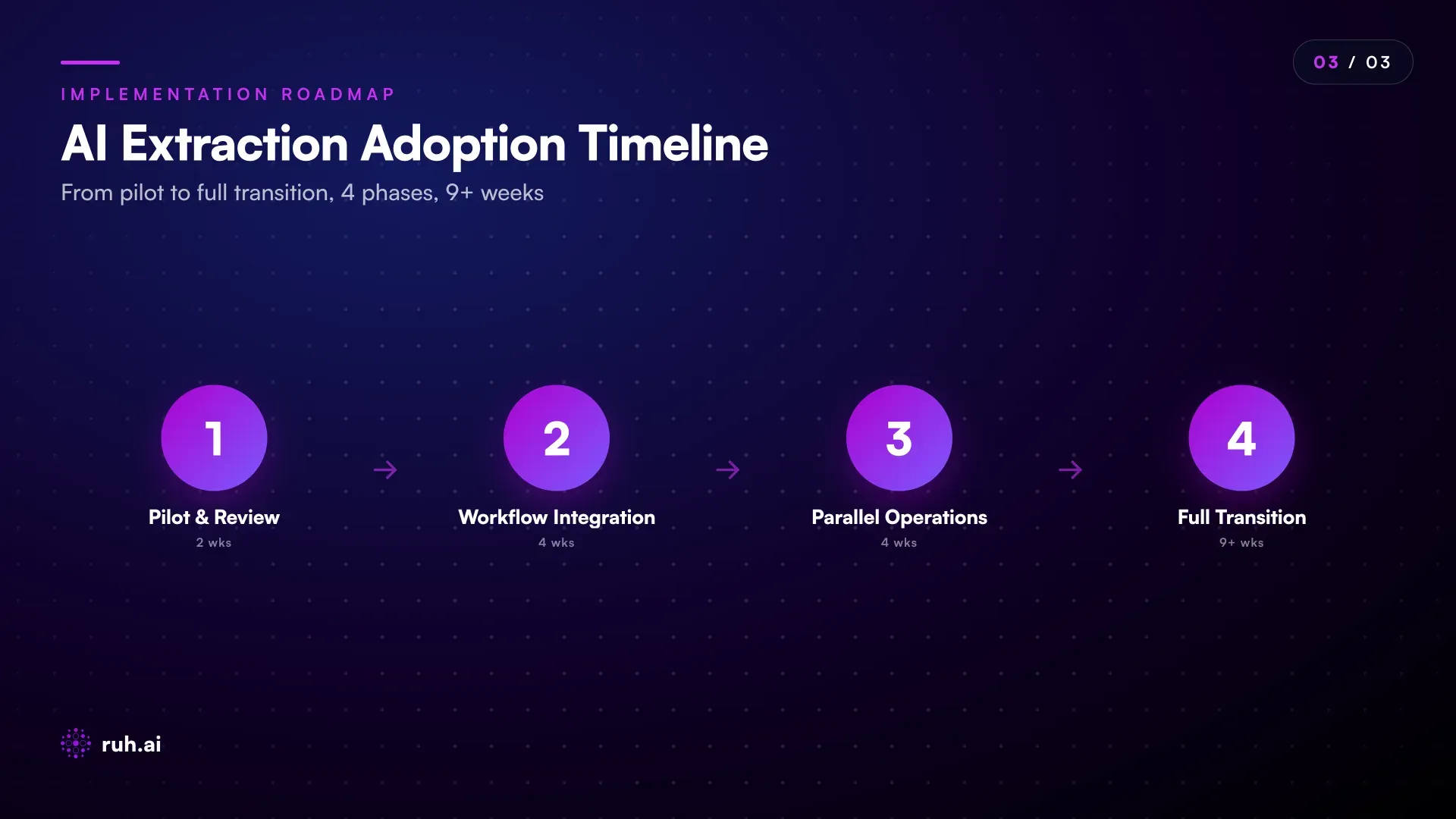
If your team is considering AI quantity extraction, the path is straightforward:
Pick a tool that integrates with your existing software. Ruh Estimator works directly into your quoting and billing pipeline, no parallel workflows, no manual re-entry of quantities.
Start with a pilot project. Run AI extraction on a recent plumbing scope you've already completed. Compare the AI output to your original estimate. This calibrates your team to the output format and identifies any adjustments you'll need for your market.
Establish review workflows. Define who approves AI quantities before they hit the estimate. This is usually your senior estimator or plumbing superintendent, someone who knows your standards and local codes.
Capture your preferences as rules. If you always use PEX instead of copper, or if your labor productivity on finish work is higher than typical, encode these as standing adjustments. Over time, your system learns your business.
Track cycle time and accuracy. Measure bid turnaround and margin variance before and after. Most teams report 70-80% reduction in takeoff cycle time and measurable improvement in bid accuracy.
The Competitive Reality in 2026
Your plumbing estimating software hasn't materially changed in five years. The pricing engine is excellent; the quantity extraction is still a human job. Meanwhile, AI agents are reading plans and extracting plumbing data faster and more accurately than hand measurement.
This isn't theoretical. Contractors and plumbing subcontractors who've adopted AI-powered takeoff in 2025-2026 are bidding 3-4x faster, winning more competitive bids, and protecting margins better than peers still running manual takeoff.
The question isn't whether AI quantity extraction will become standard. It's whether you'll adopt it before your competitors do.
Explore Ruh Work-Lab and deploy your first construction agent without writing code →
See Ruh Estimator in action and watch quantity extraction automate your takeoff →
Talk to the Ruh AI team about plumbing automation for your workflow →