


Quick Answer
NECA labor units are the installation times published in the National Electrical Contractors Association's Manual of Labor Units, given per item in three condition columns, which electrical estimators use as a benchmark and then correct with their own job-costing history. Below are how the manual is organized, how its three columns and score sheet work, how a labor unit becomes labor hours and then labor dollars, how to build your own electrical labor units from completed jobs, a worked example, the fields a labor history record needs, a pre-bid checklist and our view on what estimators get wrong.
What you'll find below:
- The manual's three columns, Normal, Difficult and Very Difficult, and what each assumes
- How the Labor Factor Score Sheet's 30-plus factors pick a column
- A worked example from 120 book hours to $8,415 of labor
- A 2000 example from Electrical Contractor magazine of two estimators reaching the same labor total
- The fields a labor history record needs
- A pre-bid checklist for applying labor units
What Are NECA Labor Units, and What Aren't They?
NECA labor units are benchmark installation times, not a prediction of how long your crew will take. Each item in the manual carries the hours it takes to install one unit of work, so an estimator can multiply quantities by units and get a starting labor total.
The units assume a typical installer. Stephen Carr, in "Laboring Over Columns: Which Should I Use?" (Electrical Contractor magazine, 15 April 2018), explains that the units in NECA's Manual of Labor Units are created for a journeyman with average productivity. Your crew may be faster or slower, and the job may be easier or harder.
George Hague made the same point in "Understanding Labor Units" (Electrical Contractor, 15 January 2000): a labor unit is a benchmark, or starting point, not an absolute. Three contractors doing the same job won't finish in the same time, so a standard set of units only works once each company corrects it with its own records.
What NECA labor units are not:
- Not a price. They give hours. Dollars come from your crew rates.
- Not your crew. They describe average productivity, not yours.
- Not this job. They describe stated conditions, and the job decides how far it differs.
How Is the NECA Manual of Labor Units Organized?
The NECA Manual of Labor Units is organized into three labor columns, labeled Normal, Difficult and Very Difficult, with a labor unit for each item in each column. Carr's 2018 article describes this layout and stresses reading the manual's introduction and the notes at the front of each section, where the assumptions behind the units are set out.
The three columns, and the project types they are commonly matched to:
| Column | In plain terms | Project types Hague suggested in 2000 |
|---|---|---|
| Normal | Favorable conditions | Residential and commercial: homes, apartments, offices, stores, malls |
| Difficult | Slower conditions | Institutional: schools and hospitals |
| Very Difficult | The slowest conditions | Industrial: manufacturing plants, power plants, treatment plants |
Hague's article calls the third column "Most Difficult", the label used at the time. His suggestions are for new, unoccupied construction, and he notes they are a starting point for a company's own standard.
How Do You Choose the Right NECA Column?
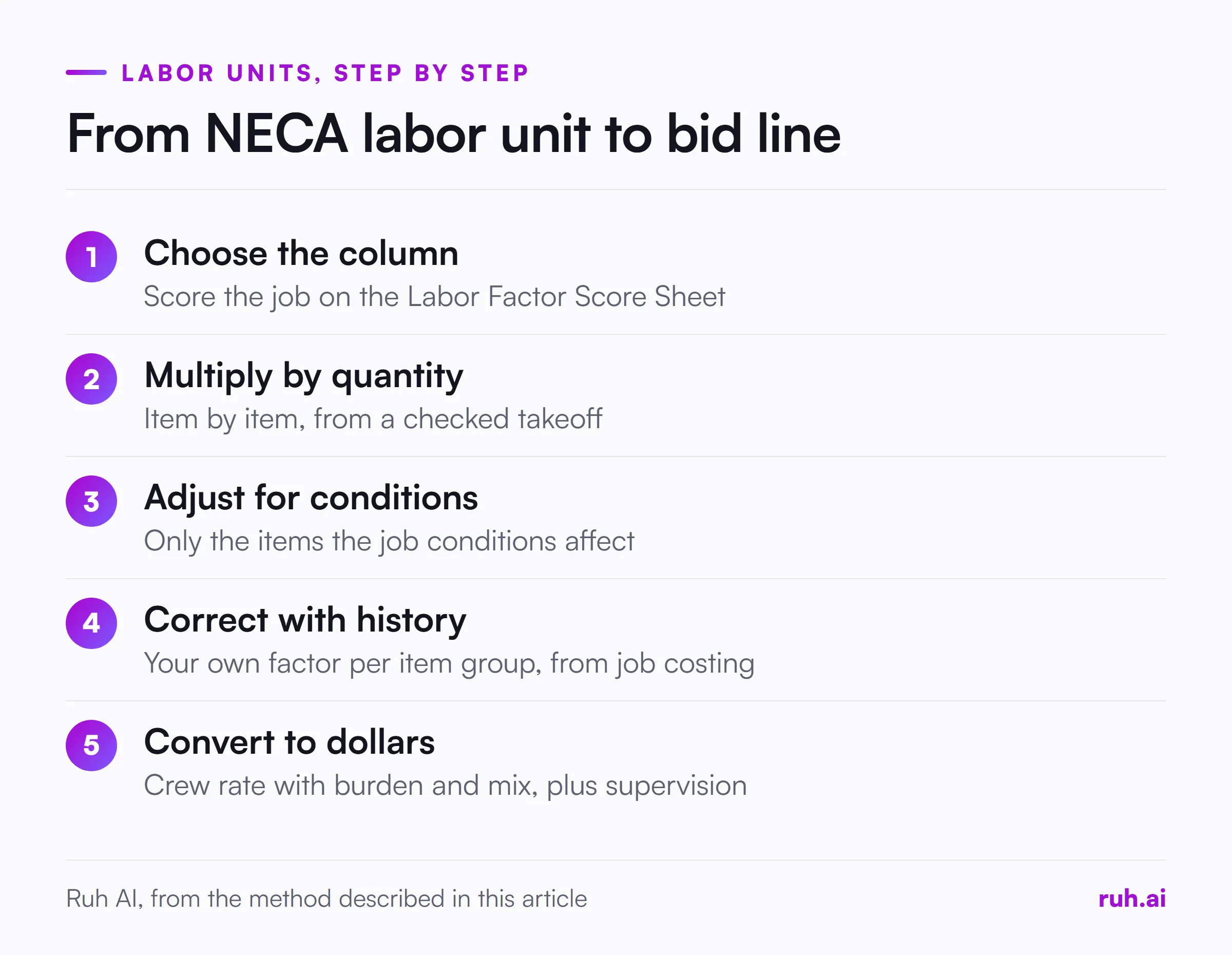
Choose the column with the manual's Labor Factor Score Sheet: score each labor condition from 1 to 5, add the scores, and the total selects the column. Carr's 2018 article counts more than 30 factors on the sheet, such as working height.
A few habits make the score sheet useful:
- Score the whole job, then the exceptions. One column rarely fits every area. A school with a finished, occupied wing may need two columns.
- Keep the scored sheet with the estimate. It records why you chose the column, which matters when the job comes back for review.
- Turn it into a spreadsheet. Carr suggests this so the math is automatic and every estimator scores the same way.
- Treat the column as the start of the adjustment, not the end. Specific conditions on specific items still need their own factors.
The column is one decision, and the score sheet makes it a recorded one. That record is what lets a second estimator check the choice.
How Does a Labor Unit Become Labor Hours?
A labor unit becomes labor hours by multiplying it by the quantity of that item, item by item, then adjusting for the job conditions that differ from the column's assumptions. The quantity side comes from the takeoff, and a perfect unit times a wrong count is still a wrong number.
The job-condition adjustments, such as working height, access, existing construction, occupancy, phasing and congestion, are the same ones every electrical estimate needs. Our guide on how to estimate electrical work has a table of eight conditions and how to adjust for each, so we won't repeat it here.
Hague's January 2000 article adds one point worth keeping: not every factor adds labor. Duplication, such as identical floors or repeated units, reduces it.
How Do Labor Hours Become Labor Dollars?
Labor hours become labor dollars by multiplying them by a crew rate that includes wages, burden and the crew mix, then adding supervision as its own line. The labor unit says nothing about cost, so this step is where your company's numbers take over.
Build the crew rate from four parts:
- Wages for each role on the crew: journeyman, apprentice, foreman.
- Burden on each wage: payroll taxes, insurance and benefits.
- Crew mix. A crew of one journeyman and one apprentice has a different average rate per hour than two journeymen.
- Premiums for overtime or shift work, only where the schedule calls for them.
Supervision belongs as a separate line, sized to the job's duration and crew size, not buried in the crew rate. That way a reviewer can see it and change it.
How Do You Build Your Own Electrical Labor Units From Job History?
Build your own electrical labor units by tracking installed quantities and hours against the same items you estimate, then comparing actual hours per unit with the benchmark to get a correction factor per item group. Job-costing records are what turn a published manual into your company's manual.
Hague's January 2000 example shows why the method works. Two estimators price the same load center. The first uses a 4-hour unit for the whole installation, including breakers. The second uses 4 hours plus a unit for each breaker, for 6 hours in total. In Hague's example, job costing shows the company typically installs it in 2 hours, so the first applies a 50% discount factor and the second discounts by two thirds. Both land on the same labor total, because both corrected their units against the same job history.
The fields a labor history record needs:
| Field | What goes in it |
|---|---|
| Job and area | Which job, and which floor, wing or phase |
| Item group | The same grouping you use in the estimate, such as devices, fixtures, branch conduit |
| Column used | Normal, Difficult or Very Difficult, and the score sheet total |
| Estimated quantity and hours | From the bid |
| Installed quantity | Counted at the end, not copied from the bid |
| Actual hours | From time cards coded to the item group |
| Actual hours per unit | Actual hours divided by installed quantity |
| Factor vs benchmark | Actual hours per unit divided by the book unit |
| Conditions | Anything unusual: height, occupancy, weather, crew changes |
A factor from one job is a note. Factors from five similar jobs are a standard you can bid with.
Worked Example: From Book Hours to Labor Dollars
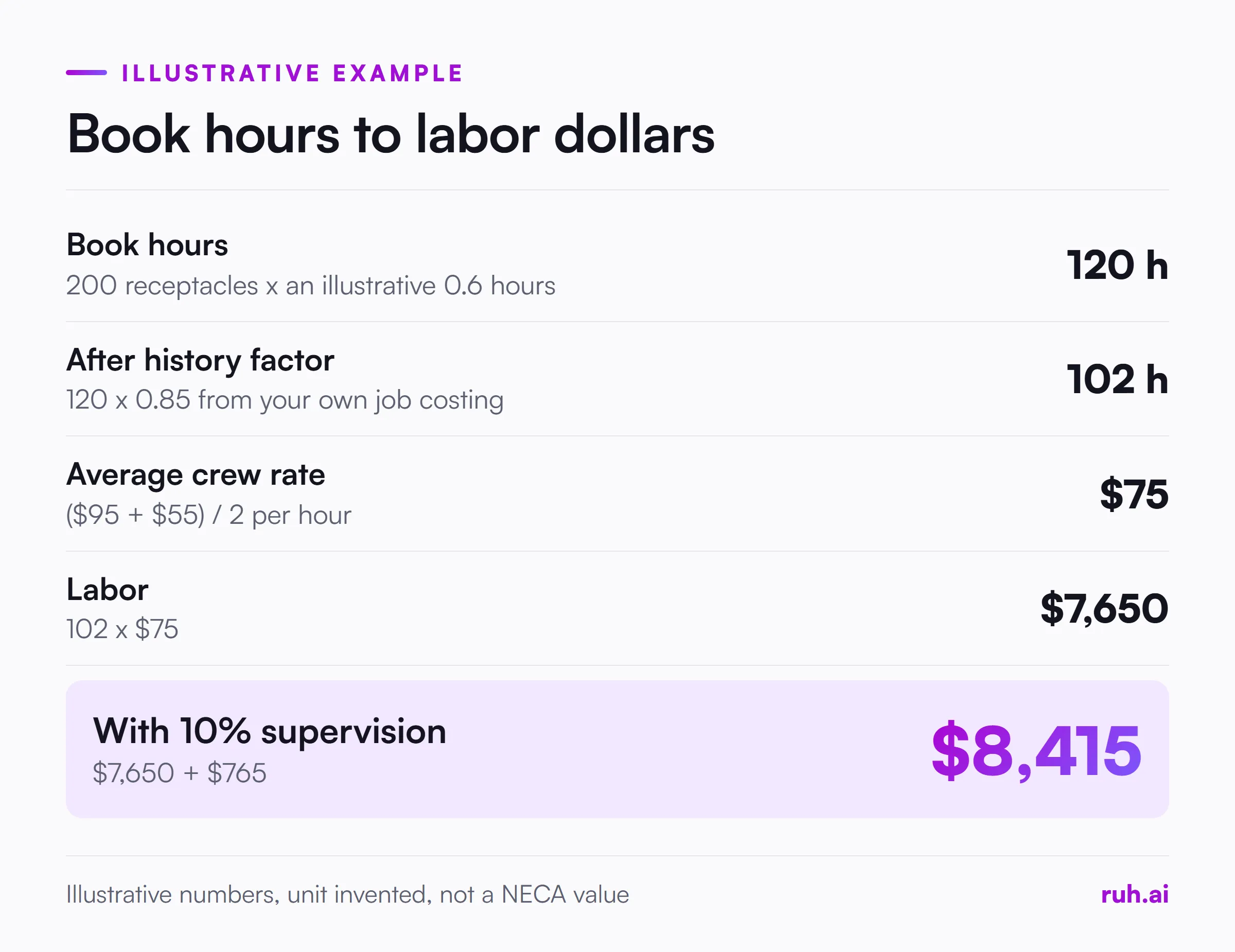
A worked example shows how book hours turn into labor dollars, using illustrative numbers only and a labor unit invented for the arithmetic, not taken from NECA's manual. Redo it with your own manual, quantities and crew rates.
A school job has 200 duplex receptacles. The score sheet puts the job in the Difficult column, and the illustrative unit for the item is 0.6 hours.
- Book hours: 200 x 0.6 = 120 hours
- Your job history shows a factor of 0.85 on device work in occupied schools: 120 x 0.85 = 102 hours
- Crew of one journeyman at an illustrative $95 per hour loaded and one apprentice at $55, so the average rate is ($95 + $55) / 2 = $75 per hour
- Labor: 102 x $75 = $7,650
- Supervision at an illustrative 10%: $7,650 x 0.10 = $765, for a total of $8,415
Without the job history factor, the same item would carry 120 x $75 = $9,000 of labor before supervision, $1,350 more. Whether that's padding or protection depends entirely on whether your records back the factor.
Pre-Bid Checklist for Applying Labor Units
Run this before electrical labor goes into a bid:
- The manual's introduction and section notes have been read, so the units' assumptions are known.
- The Labor Factor Score Sheet has been scored, and the sheet is saved with the estimate.
- Areas with different conditions have their own column or factor.
- Every quantity comes from a checked takeoff.
- Job-condition adjustments apply only to the items they affect, each with a written reason.
- Duplication has been credited where the work repeats.
- Company factors from job history are applied by item group, not as one factor for everything.
- The crew rate includes wages, burden and the real crew mix.
- Supervision is a separate, visible line.
- A second estimator has checked the column choice and the five largest labor lines.
What Electrical Estimators Get Wrong About Labor Units
Four positions on labor units, argued as our view, not as data.
A book unit copied straight into a bid is a guess with a citation. The manual is the benchmark. The bid needs your crew and your job.
One company-wide factor hides more than it fixes. Your crews may beat the book on devices and lose to it on feeders. Factor by item group.
Job costing that nobody reads is wasted effort. If time cards aren't coded to the same groups as the estimate, the history can't correct anything.
Arguing about who is faster misses the point. Carr's 2018 article says there is no simple answer to which units to use. The useful question is whether your units match your own completed jobs.
The Honest Assessment: What Still Falls Short
Building your own units takes discipline most companies find hard to keep. It needs time cards coded to estimate items and installed quantities counted at the end, and both slip when a job gets busy.
The score sheet makes the column choice consistent, not correct. Two estimators can score the same job differently, and a company standard for scoring is the only fix.
Conditions also change after the bid. A schedule compression or an occupied area that wasn't occupied at bid time moves productivity in ways no unit predicted.
How Ruh Fits
Ruh AI's Estimating Agent carries takeoff quantities into a priced estimate built on your company's own rate book and history. Your company keeps its own assemblies, and edits create a new version while a budget line keeps the version it was built from.
A trade with nothing priced gets a labelled allowance line, never a silent zero. Ruh AI's Takeoff Agent reads the drawing PDFs, so the quantities under your labor units start from the drawings.
Your estimator approves every scope line before Ruh measures it and can edit any quantity or price, and each stage is approved before the next one opens. Ruh works with your stack, built per customer. For how AI reads electrical plans in more detail, see our post on electrical estimating software and AI plans.
Frequently Asked Questions
Q: What are NECA labor units? A: They are the installation times in the National Electrical Contractors Association's Manual of Labor Units, listed per item in three condition columns. Estimators multiply them by takeoff quantities for a benchmark labor total, then correct it with their own job history.
Q: What are the three columns in the NECA Manual of Labor Units? A: Normal, Difficult and Very Difficult. Older articles call the third column "Most Difficult".
Q: How do you choose a NECA labor column? A: Use the manual's Labor Factor Score Sheet. Score each labor condition from 1 to 5, add the scores, and the total selects the column. Electrical Contractor magazine counted more than 30 factors on the sheet in 2018.
Q: Are NECA labor units accurate? A: They are a benchmark for a journeyman with average productivity, not a prediction for your crew. Accuracy comes from correcting them with your own job-costing records, item group by item group.
Q: How do you convert electrical labor units to labor cost? A: Multiply quantities by labor units for hours, adjust for job conditions and your job-history factor, then multiply by a crew rate that includes wages, burden and crew mix. Add supervision as a separate line.
Q: How do you build your own electrical labor units? A: Code time cards to the same item groups you estimate, count installed quantities at the end of each job, and divide actual hours by installed quantity. Compare that with the book unit to get a factor, and trust it once several similar jobs agree.
See how Ruh prices your takeoff from your own rate book on the construction estimating software page.