
Quick Answer
Construction labor shortage solutions are the ways a contractor keeps winning and delivering work when it cannot hire enough people, from raising pay and training to standardizing methods and automating the repetitive office work that eats estimators' and managers' hours. This guide sets out the 2025 and 2026 survey figures on who is hardest to hire, compares the main solutions and their limits, and works through how much estimating capacity automation can give back.
What you'll find below:
- AGC, NCCER and ABC figures on the shortage, including how hard estimators are to hire
- A table of labor shortage solutions, what each fixes and where each falls short
- A worked example of the bids one estimator gains when repetitive work is cut
- A checklist of which office work to automate first
- Our view on what contractors get wrong about the shortage
Why Is the Construction Labor Shortage an Office Problem Too?
The labor shortage is an office problem because the salaried roles that win and run work, estimators, project managers and superintendents, are almost as hard to fill as the craft roles. When the estimating desk is short, the firm bids less, whatever the crews could build.
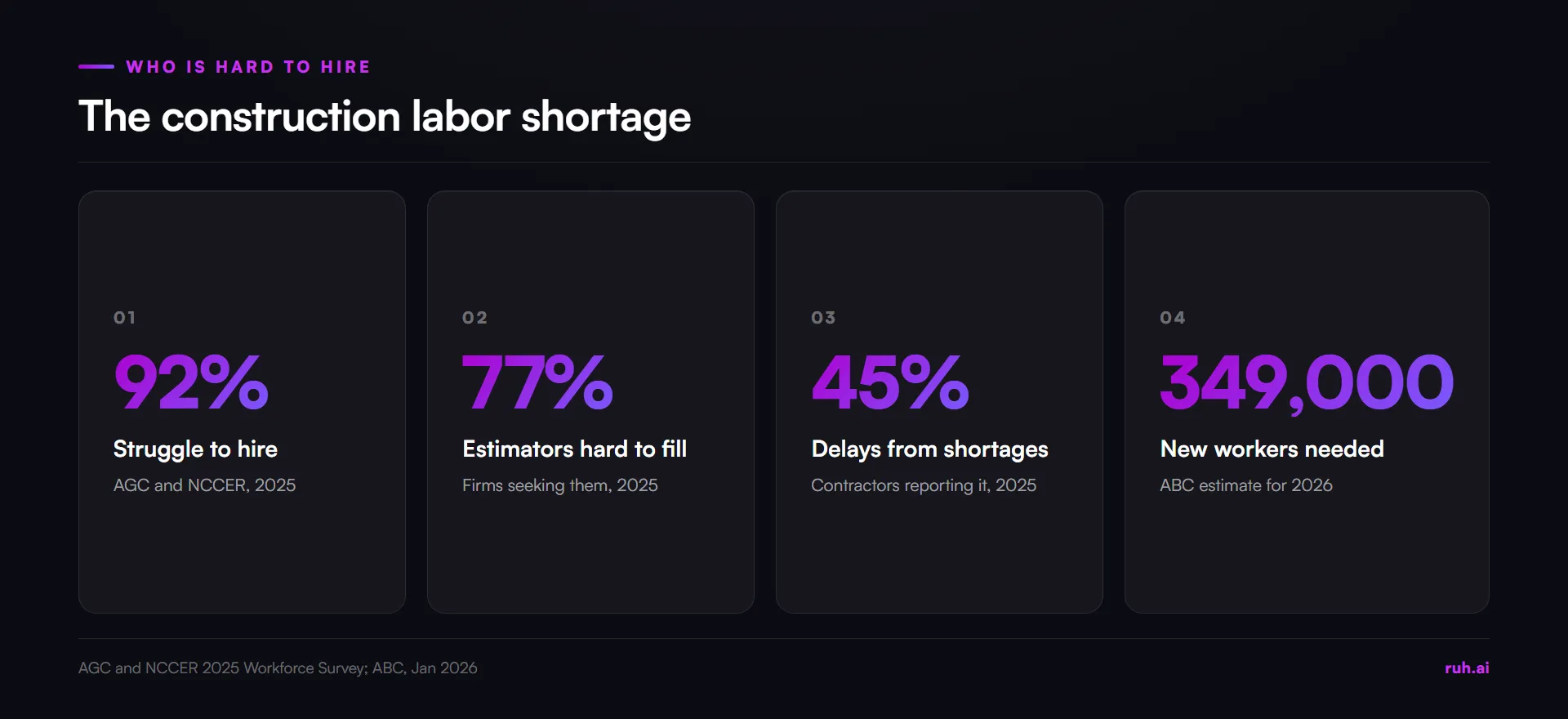
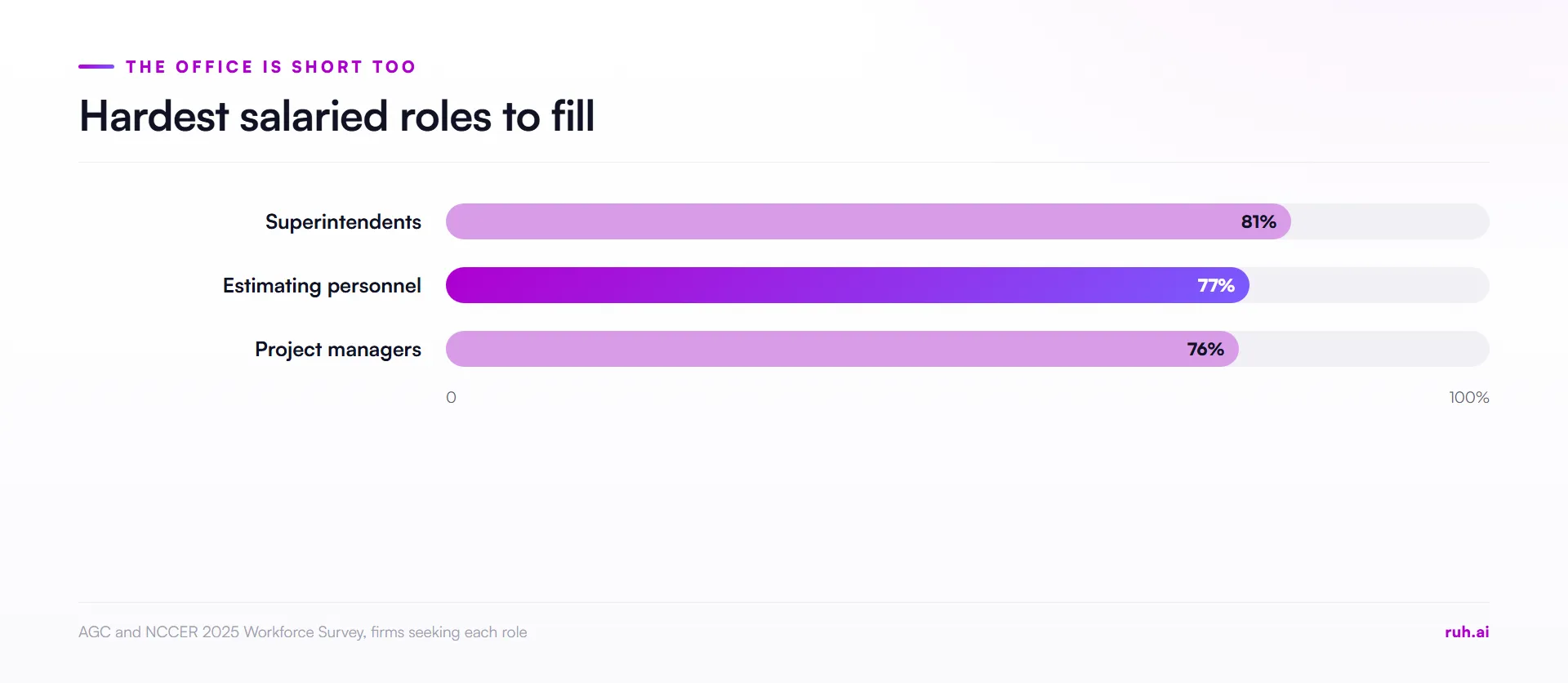
Estimators are among the hardest people to hire. The Associated General Contractors of America and NCCER found in their 2025 Workforce Survey that 77% of firms seeking estimating personnel had difficulty filling those roles, behind superintendents at 81% and level with project managers at 76%.
It is getting harder, not easier. The same 2025 AGC and NCCER analysis found 84% of firms with salaried openings said those positions were as hard or harder to fill than a year earlier.
How Bad Is the Construction Labor Shortage in 2026?
The shortage in 2026 is broad and persistent: most firms that are hiring cannot find the people they need. The AGC and NCCER 2025 Workforce Survey found 92% of companies reported difficulty hiring for open positions, and worker shortages were the leading cause of project delays, reported by 45% of contractors.
The 2026 outlook shows the same picture. The AGC and Sage 2026 Construction Hiring and Business Outlook reported that 82% of firms with openings had a hard time filling hourly craft positions and 80% salaried openings, the highest share in three years.
Demand keeps adding to the gap. Associated Builders and Contractors estimated in January 2026 that the industry must attract 349,000 net new workers in 2026 to meet demand for construction services.
What Are the Construction Labor Shortage Solutions?
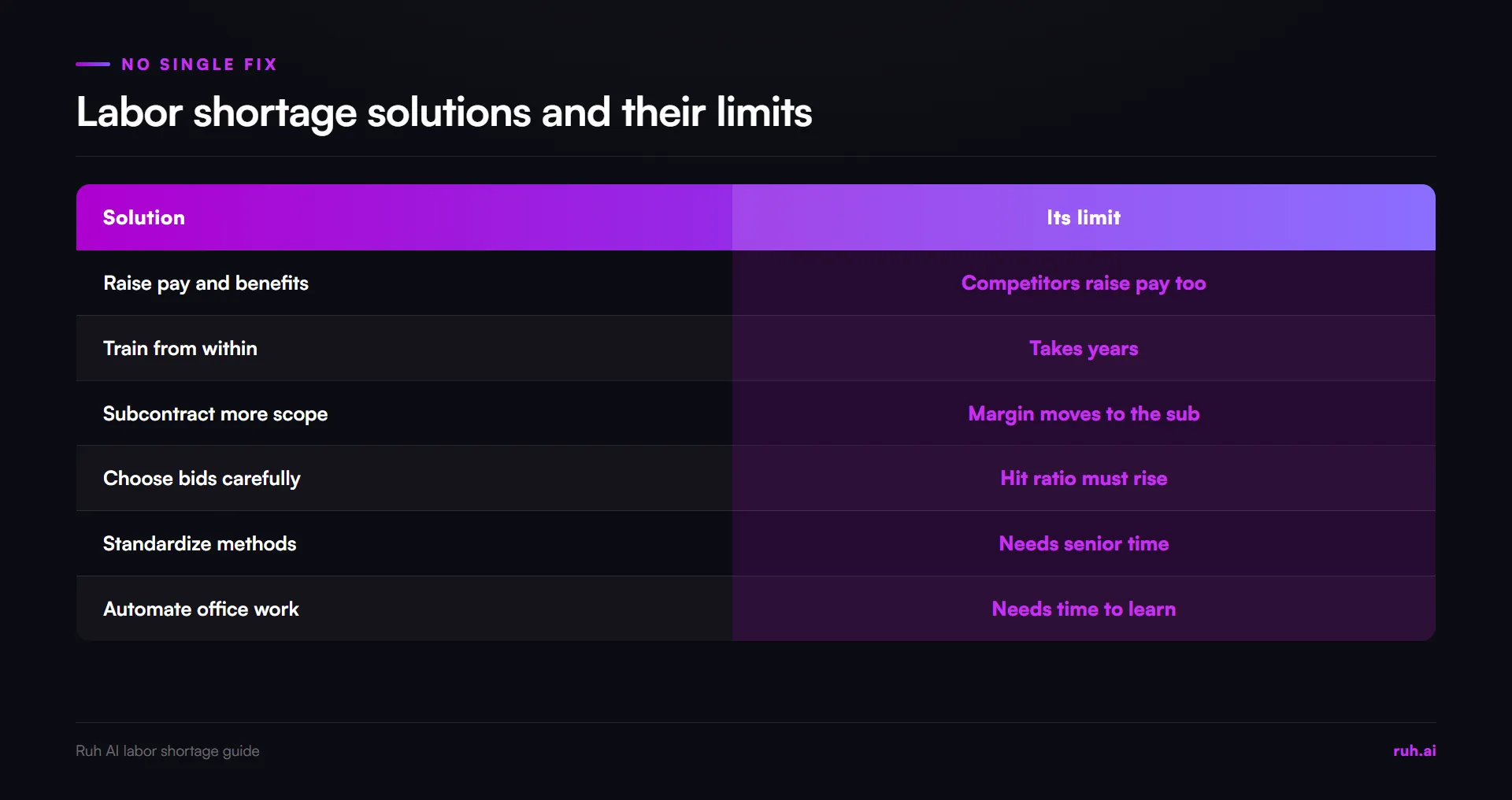
The main construction labor shortage solutions are paying more, training from within, subcontracting, choosing bids carefully, standardizing methods and automating repetitive office work, and each one fixes a different part of the problem. Most firms need more than one.
Labor shortage solutions, what each fixes and where each falls short:
| Solution | What it fixes | Its limit | How fast it helps |
|---|---|---|---|
| Raise pay and benefits | Retention and hiring odds | Competitors raise pay too. AGC and Sage reported in 2026 that 40% of firms raised base pay by more than the year before | Fast, but recurring cost |
| Train and promote from within | Long-term supply of skilled people | Takes years, and trained people can leave | Slow |
| Subcontract more scope | Short-term capacity | Margin moves to the sub, and good subs are short-staffed too | Medium |
| Choose bids carefully | Wasted estimating hours | Fewer bids means the hit ratio must rise | Fast |
| Standardize methods | Knowledge stuck in one person's head | Takes senior time to write down | Medium |
| Automate repetitive office work | Hours lost to re-keying, formatting and counting | Needs time to set up and learn | Medium |
Productivity is the lever that does not need new people. The AGC and Sage 2026 outlook found 32% of firms reported productivity improved over the past 12 months, while 24% said it declined. The firms that improved got more out of the people they already had.
How Much Capacity Can Automation Give Back?
Automation gives back capacity by removing the repetitive hours from skilled people's weeks, and on an estimating desk those hours turn directly into bids. The worked example below shows the size of it. Every input is illustrative, so use your own.
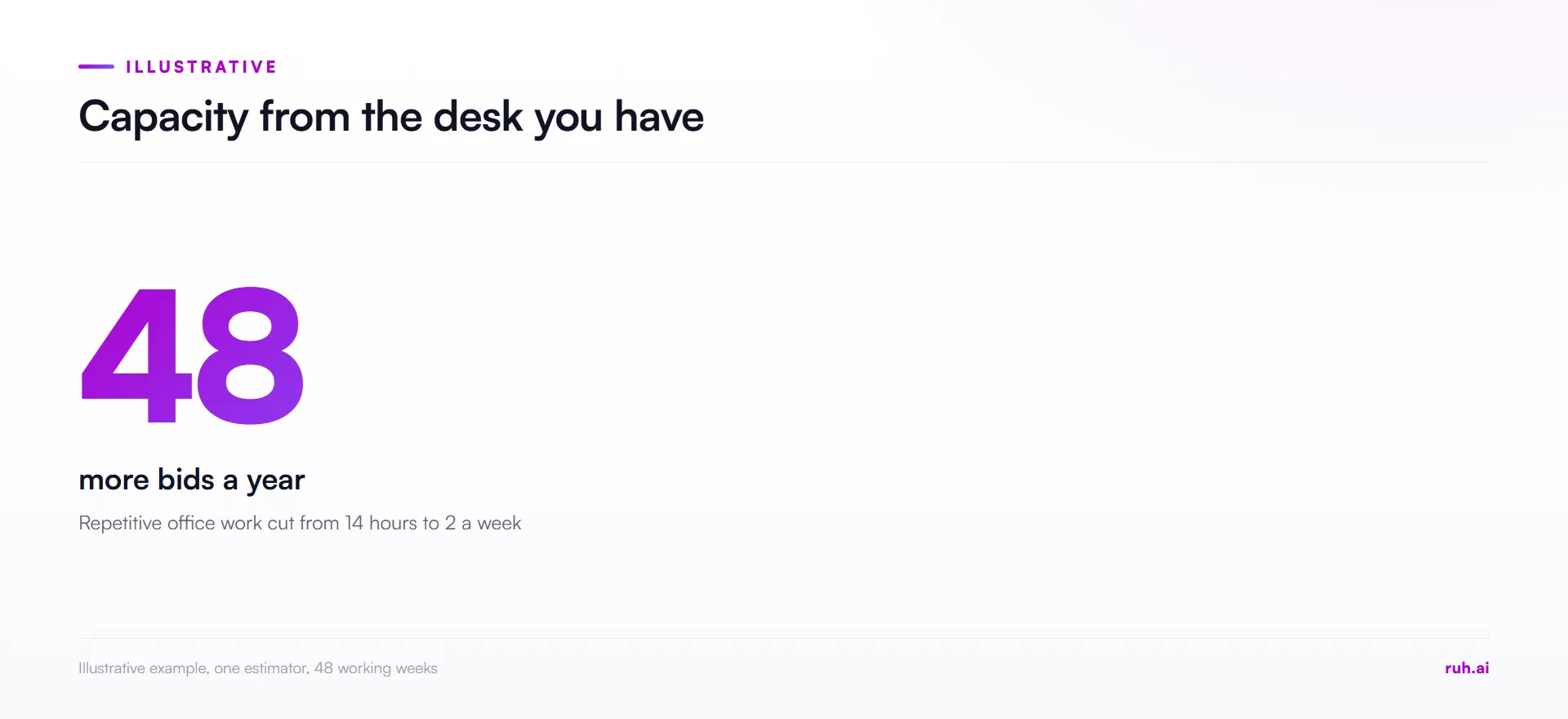
- The week. One estimator works 50 hours: 3 bids at 12 hours each (36 hours) plus 14 hours of repetitive office work, re-keying quantities, formatting proposals and chasing documents.
- The change. Standard templates and automation cut the repetitive work from 14 hours to 2.
- The hours freed. 14 − 2 = 12 hours a week.
- The bids. 12 hours ÷ 12 hours per bid = 1 more bid a week.
- The year. 1 extra bid × 48 working weeks = 48 more bids a year from the same estimator.
The hours do not have to become more bids. If your bid volume is already right, the same 12 hours can go into a second review of the largest scopes, earlier questions to the design team, or training a junior estimator. Each of those protects margin or builds the bench, which is its own answer to the shortage.
Either way, that is close to the output of another part-time estimator, without a hire. When 77% of firms seeking estimating personnel struggled to fill those roles in the AGC and NCCER 2025 survey, getting more from the desk you have is often the only fast option.
Before you choose bids to spend those hours on, the bid go/no-go scorer helps rank which invitations are worth it.
Which Office Work Should You Automate First?
Automate the work that repeats every week, follows the same steps every time and causes errors when people rush, before anything that needs judgment. Contractors already see this: the AGC and NCCER 2025 survey found 45% expect AI and robotics to help construction jobs by automating manual, error-prone tasks.
Start with the tasks that score highest on this checklist:
| # | Question | If yes |
|---|---|---|
| 1 | Does it happen on every bid or every project? | High priority |
| 2 | Is it copying data from one place to another? | High priority |
| 3 | Does a rushed mistake here cost money later? | High priority |
| 4 | Does it follow the same steps every time? | Good candidate |
| 5 | Does it need judgment about price, scope or risk? | Keep it with a person |
| 6 | Can you check the result quickly? | Safe to automate |
Typical first candidates on the estimating side are quantity counting from drawings, re-keying quantities into a pricing sheet, formatting proposals and logging documents and addenda. The guide to estimating labor costs shows where the judgment calls sit, which stay with your estimator.
Plan time to learn the tool. The AGC and Sage 2025 outlook found 39% of contractors named finding the time to implement and train on new technology as one of their biggest IT challenges, and 36% cited employee resistance. Our buyer's checklist for construction software covers how to choose a tool your team will keep using.
Measure the hours before and after. Before you change anything, have each estimator log a normal week: hours on bids, and hours on copying, formatting and chasing. Log the same week again a month after the change. If the repetitive hours have not fallen, the tool or the method is not working, and you know within weeks rather than at renewal time. The same log tells you which task to tackle next.
How Do You Keep the Method When People Leave?
You keep the method by writing it down and building it into your tools, so it stays with the company when an estimator or manager leaves. In a tight labor market, every departure takes knowledge with it.
- Written procedures. How you measure, which waste factors you use, how you set markup.
- A shared rate book. Unit prices and crew rates held centrally, not in one person's spreadsheet.
- Bid history. What you bid, what you won and what the job actually cost.
- Review steps. The same checks on every bid, so a newer estimator follows the same path as a senior one. The bid accuracy guide includes a review you can copy.
What Contractors Get Wrong About the Labor Shortage
In Ruh's opinion, contractors get four things wrong about the labor shortage. These are our positions, not survey findings.
It is not only a field problem. The estimating desk sets how much work you can bid. A short office limits growth before a short crew does.
Hiring is not the only answer. When most firms are competing for the same few people, the faster gains come from getting more out of the team you have.
Automating before standardizing makes a mess faster. If every estimator works a different way, automating that variation locks it in. Write the method down first.
Tools without time fail. Buying software and expecting people to learn it between bids is how it becomes shelfware.
The Honest Assessment: What These Solutions Cannot Fix
Labor shortage solutions help a lean team do more, and they cannot replace the skilled people the industry still needs. Four limits are worth stating.
- Automation does not pour concrete. Office automation frees estimating and management hours. It does nothing for a crew that is three people short.
- Pay rises compound. Higher wages help retention, and they also raise every future bid's labor cost.
- Training takes years. It is the long-term answer, and it does not fill this year's openings.
- Every tool needs setup time. The first weeks of any new system cost hours before they save any.
How Ruh AI Fits Into This
Ruh AI's Takeoff Agent takes the counting and measuring work off the estimating desk, and it withholds a figure when a sheet has no scale instead of guessing.
The Estimating Agent prices from your company's own rate book and history, which keeps your pricing method in the company rather than in one person's head. Your estimator can change any price or add their own costs, and a person approves the budget before the next stage. Ruh also has free construction calculators for quick checks.
Frequently Asked Questions
Q: What are the best construction labor shortage solutions? A: The best solutions combine paying competitively, training from within, choosing bids carefully, standardizing methods and automating repetitive office work. Most firms need several, because each fixes a different part of the problem.
Q: How bad is the construction labor shortage in 2026? A: The AGC and Sage 2026 outlook found 82% of firms with openings struggled to fill hourly craft roles and 80% salaried roles, the highest in three years. ABC estimated the industry needs 349,000 new workers in 2026.
Q: Can technology solve the construction labor shortage? A: Technology cannot replace skilled trades, but it can give office staff back hours spent on repetitive work. On an estimating desk, those hours turn into more bids from the same team.
Q: Which construction roles are hardest to fill? A: Among salaried roles, the AGC and NCCER 2025 survey found superintendents hardest to fill at 81% of firms seeking them, then estimating personnel at 77% and project managers at 76%.
Q: Does raising pay solve the labor shortage? A: Raising pay helps hiring and retention, but competitors raise pay too, so it rarely closes the gap alone. It also raises the labor cost in every future bid.
Q: Where should a contractor start? A: Start with the work that repeats on every bid, copies data from place to place and causes costly errors when rushed. Write the method down, then automate it.
The Bottom Line
When you cannot hire enough people, get more from the people you have. Write your methods down, choose bids carefully, and automate the repetitive office work that eats your estimators' weeks. The labor shortage will not end soon, and the firms that grow through it will be the ones whose best people spend their time on judgment, not re-keying.
See how Ruh AI supports the estimating team. Explore Ruh AI for estimators and precon.
Sources
- AGC and NCCER, 2025 Workforce Survey Analysis: agc.org
- NCCER, "Report: 92 percent of construction firms struggling to hire workers", 9 September 2025: nccer.org
- AGC and Sage, 2026 Construction Hiring and Business Outlook: agc.org
- AGC and Sage, 2025 Construction Hiring and Business Outlook: agc.org
- Associated Builders and Contractors, "Construction Industry Must Attract 349,000 Workers in 2026", 15 January 2026: abc.org