


Quick Answer
How to bid more construction jobs as a small contractor comes down to estimating capacity: measure how many bids the desk can price, choose bids by rule, cut repeat hours per bid, and write the method down before hiring, outsourcing or automating. Below are the NCCER, AGC and BLS figures on small firms and scarce estimators, a bid capacity formula worked through before and after, a table comparing hire, outsource and automate, a 30-day plan with a bid log template, and our view on what small contractors get wrong.
What you'll find below:
- A data table on estimating capacity, from NCCER firm sizes to BLS estimator jobs
- The bid capacity formula, worked from 10 bids a month to 15
- A comparison of hiring, outsourcing, automating and choosing bids better
- A 30-day plan to bid more construction jobs, with the fields for a weekly bid log
- Our view on what small contractors get wrong about bidding more work
Why Does Bid Volume Stop Growing at the Estimating Desk?
At a small contractor, bid volume stops growing at the estimating desk because every bid needs a takeoff, pricing and a proposal, and one or two people do all of it. When their hours are full, new invitations get passed on, whatever the market is doing.
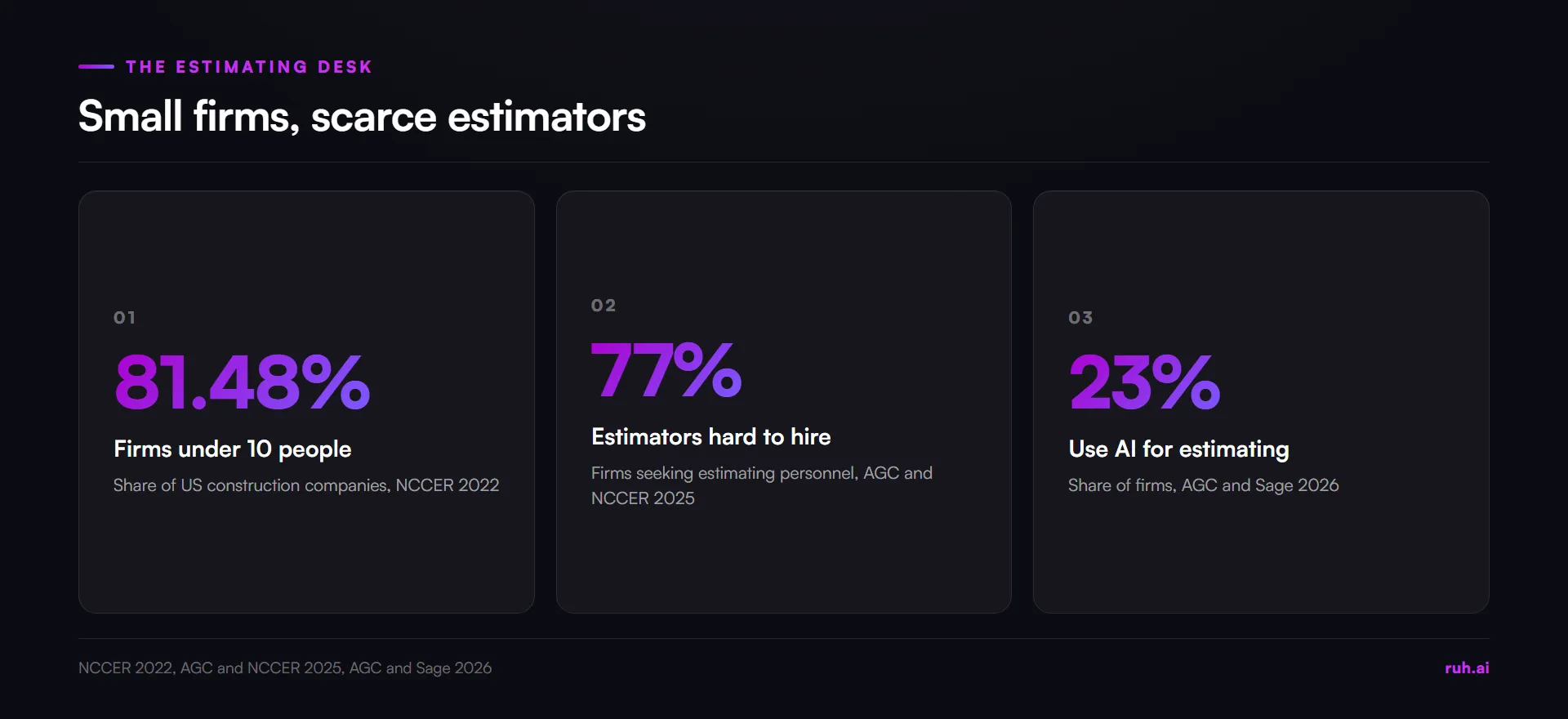
Most contractors are small, so most estimating desks are thin. NCCER's 2022 analysis of construction company size found that 81.48% of the 745,205 US construction companies had fewer than 10 employees, and 90.81% had fewer than 20. In a firm that size, the estimator is often also the project manager, the buyer or the owner.
The work is there. Associated Builders and Contractors reported in its September 2026 backlog release that year-over-year backlog gains were concentrated in the smallest contractors, those under $30 million in revenue, with the national indicator at 8.5 months in August 2026. Small firms have work to bid. What they lack is hours to price it.
Hiring is slow. The Associated General Contractors of America and NCCER found in their 2025 Workforce Survey that 77% of firms seeking estimating personnel had difficulty filling those roles. The AGC and Sage 2026 Construction Hiring and Business Outlook reported that 80% of firms had trouble filling salaried positions, the highest share in three years.
What the data says about estimating capacity at small contractors:
| Finding | Figure | Source and year | What it means for you |
|---|---|---|---|
| Construction companies with fewer than 10 employees | 81.48% | NCCER, 2022 | Most estimating desks are one or two people |
| Firms seeking estimators that find them hard to hire | 77% | AGC and NCCER, 2025 | Hiring your way to more bids takes months |
| Cost estimator jobs in the US | 226,400 | BLS, 2025 | A small pool, and every contractor is fishing in it |
| Projected change in cost estimator jobs | down 3% | BLS, 2025 to 2035 | BLS expects software to do more of the work |
| Firms using AI for estimating | 23% | AGC and Sage, 2026 | Most competitors do not use AI for estimating yet |
| Average hit rate, construction firms | 37.9% | SMPS Foundation, 2017 | Most bids and proposals lose, so each one must be worth the hours |
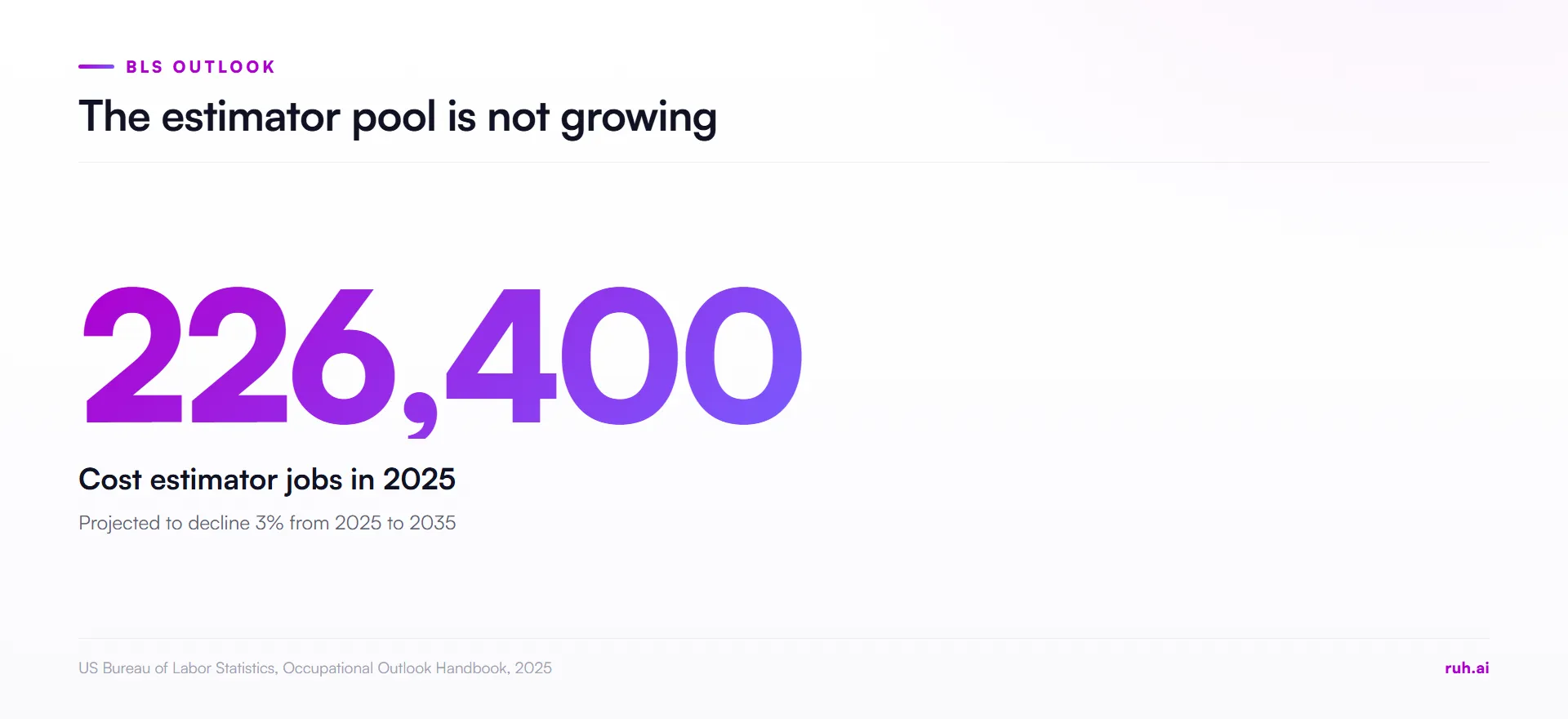
The estimator pool is not getting bigger. The US Bureau of Labor Statistics counted about 226,400 cost estimator jobs in 2025 and projects that number to decline 3% from 2025 to 2035, with about 17,600 openings a year, all of them to replace people who retire or change careers. BLS gives the reason plainly: estimation software is improving the productivity of these workers, so fewer estimators do the same work.
How Many Bids Can One Estimator Handle?
One estimator can handle as many bids as their bid hours allow: take their weekly hours, subtract the hours spent on everything that is not a bid, divide by the average hours per bid, and multiply by 4 for a month. Most owners have never written that number down, so they cannot tell whether the cap is real.
Here is the formula:
Bids per month = (weekly hours minus non-bid hours) divided by hours per bid, times 4
Worked example: one estimator, before and after (illustrative)
The numbers below are illustrative. Replace each one with your own from two weeks of time logs.
Before. Your estimator works 50 hours a week. 10 of those go to non-bid work: site visits, change pricing on live jobs, chasing documents and internal meetings. An average bid takes 16 hours: takeoff 7 hours, pricing 4 hours, sub quotes 3 hours (collecting and comparing them) and proposal 2 hours.
- Bid hours: 50 minus 10 = 40 hours a week
- Bids a week: 40 divided by 16 = 2.5
- Bids a month: 2.5 times 4 = 10 bids
After. You move the document chasing and meeting notes off the estimator, which cuts non-bid hours from 10 to 5. You stop measuring from scratch on repeat building types and standardize pricing from a rate book, which cuts takeoff from 7 hours to 4 and pricing from 4 to 3. Sub quotes and the proposal stay at 3 and 2 hours. An average bid now takes 12 hours.
- Bid hours: 50 minus 5 = 45 hours a week
- Bids a week: 45 divided by 12 = 3.75
- Bids a month: 3.75 times 4 = 15 bids
That is 5 more bids a month from the same person, without longer weeks. At an illustrative win rate of 1 in 5, it moves the firm from 2 wins a month to 3.
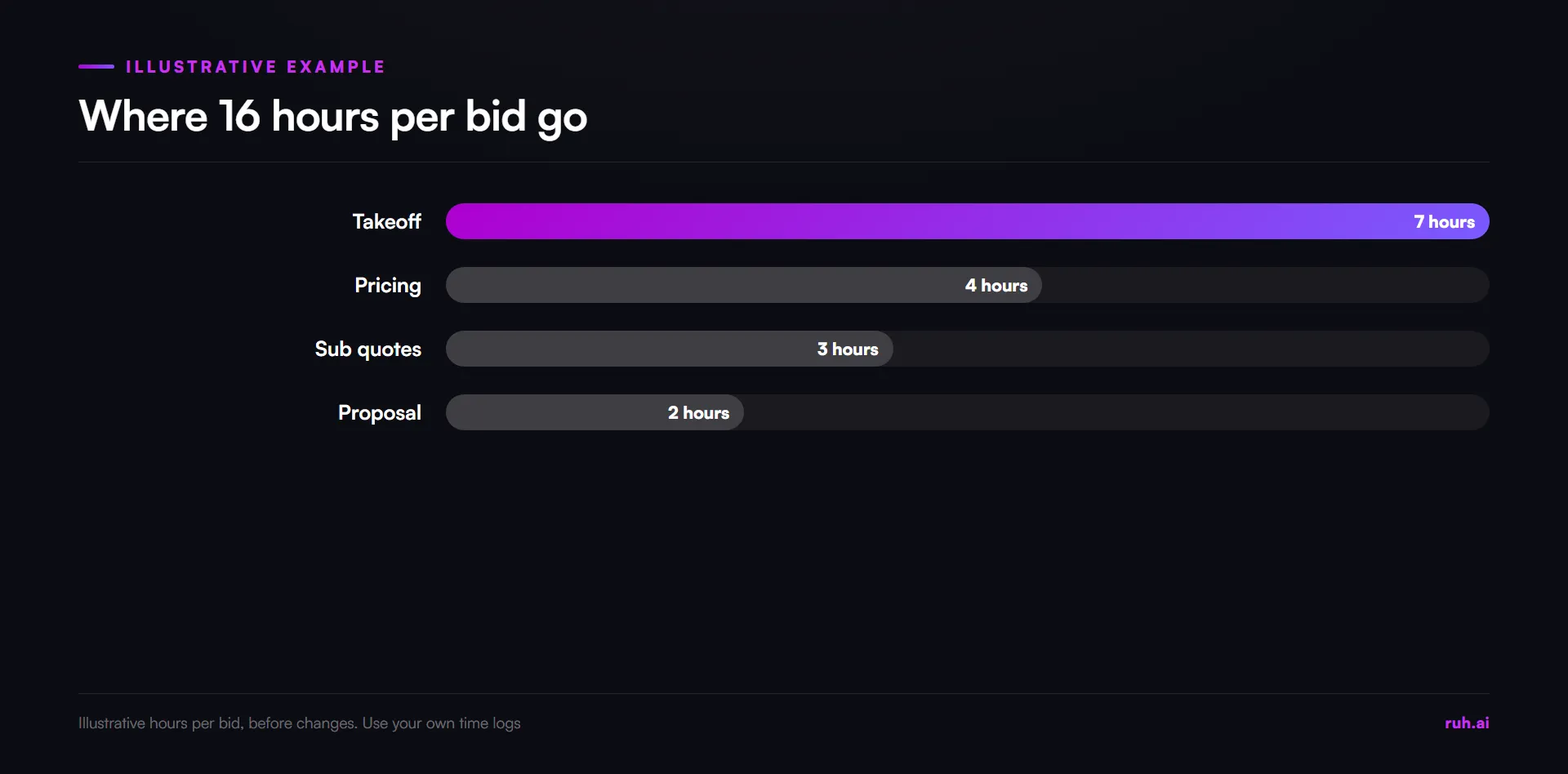
Two things stand out in this example. First, the takeoff is the biggest single block of hours, so it is the first place to look. Second, half the gain came from non-bid hours, which cost nothing in software to fix. If you want to sanity-check the quantities in a faster takeoff, our guide to takeoff accuracy covers how to test a count against your own.
Where Does an Estimator's Week Go?
An estimator's week at a small contractor splits between the four parts of every bid, takeoff, pricing, sub quotes and the proposal, plus a long tail of non-bid work that nobody tracks. The tail is where capacity hides.
Ask your estimator to log one week in half-hour blocks. The common finds:
- Takeoff from scratch on familiar work. Measuring the same wall types, the same fixture counts and the same slab details on every bid.
- Re-keying. Copying quantities from the takeoff into a spreadsheet, then into a proposal template, then into an email.
- Sub quote chasing. Phone calls and emails to get a number from a sub who has not replied, then comparing quotes that are scoped differently.
- Live-job work. Pricing changes, answering field questions and buying materials on jobs already won.
- Bids that should never have been started. Hours sunk into jobs with a poor owner, a bad fit or a price that was never going to win.
The last item is often the largest, and it is the one fix that needs no tool at all.
Should You Hire, Outsource or Automate Estimating?
Whether to hire, outsource or automate estimating depends on what is actually full: if the estimator's judgment is the limit, hire, and if the repetitive hours are the limit, automate or outsource the counting while you keep the pricing. Choosing bids better comes first in every case, because it frees hours at no cost.
Ways to add estimating capacity at a small contractor:
| Option | What it costs | How fast it helps | Who controls the number | What happens to the know-how |
|---|---|---|---|---|
| Hire an estimator | Full salary. BLS put the median cost estimator wage at $78,740 in May 2025 | Slow: recruiting plus months of learning your pricing | You | Grows, but walks out if they leave |
| Outsource estimating | A fee per bid or per hour | Fast for takeoff, slower for pricing your way | Shared: you must check their quantities and prices | Stays with the service, not with you |
| Automate the repetitive work | Software and setup time | Medium: weeks to set up and learn | You, if the estimator can change every figure | Stays in your system if it prices from your rate book |
| Choose bids better | Nothing but discipline | Fast | You | Grows: your bid rules get sharper |
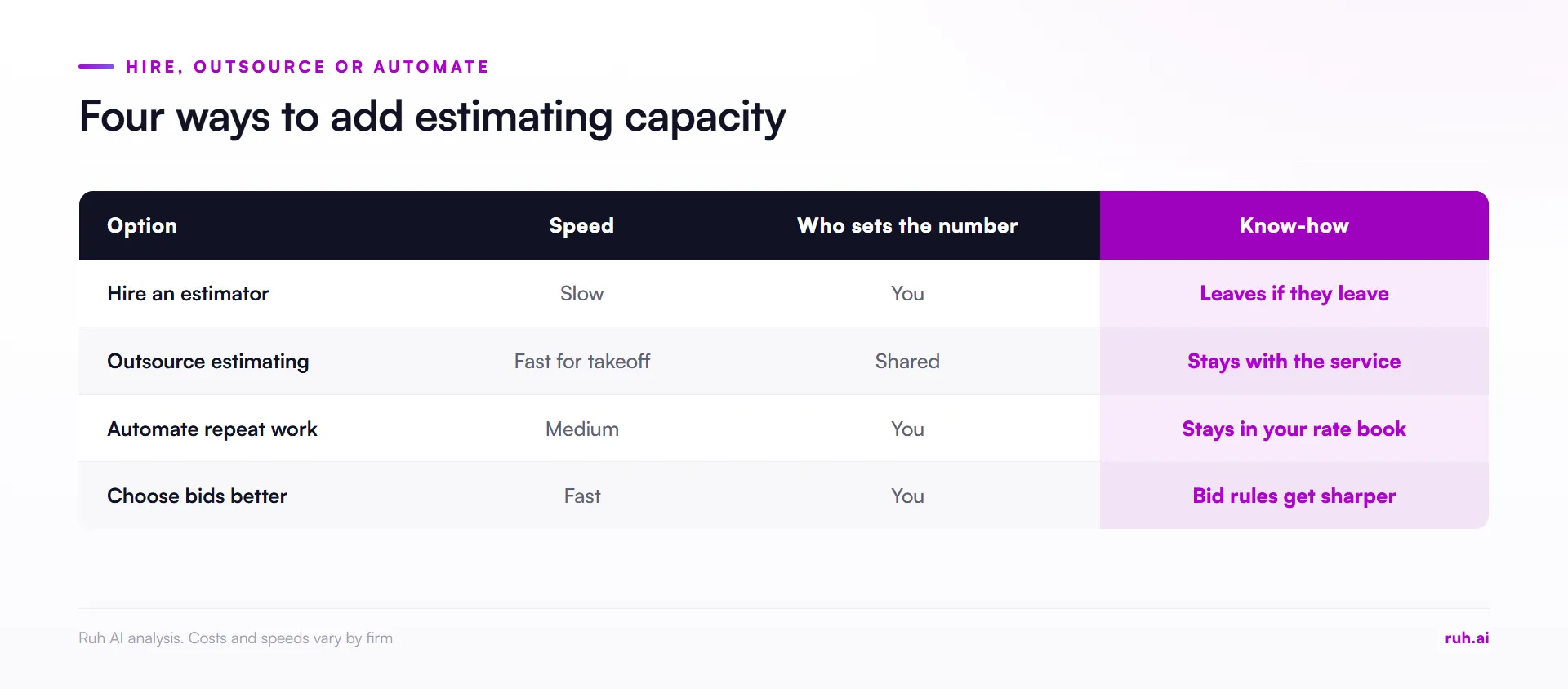
Outsourcing works best for quantities, not prices. An outside estimator can count fixtures and measure walls from a drawing set. They do not know what your crews produce in a day, which subs you trust or what margin a given owner will accept. If you outsource construction estimating, keep the pricing and the final number in house.
Automation works best when the method is written down. A tool that measures and prices can only follow a method that exists. If the pricing lives in your estimator's head, start by writing it into a rate book, then automate. The guide to estimating labor costs is a good starting point for the labor side of that rate book.
How Do You Choose Which Construction Jobs to Bid?
You choose which construction jobs to bid by scoring each invitation against a short set of rules before anyone opens the drawings: owner, scope fit, size, location, competition and your current workload. The rules turn a gut call into a ten-minute check.
Workload belongs on that list. A 2022 study by Zaqout, Islam, Hadidi and Skitmore in Engineering Applications of Artificial Intelligence weighted the factors behind bid markup decisions with 31 construction experts, and current workload and the need for work were among the critical ones. A firm that is full should bid fewer jobs at better margins. A firm that is hungry bids more, and often too low.
A simple bid rule set for a small contractor:
- Owner. Have we been paid on time by this owner or GC before? If not, what do we know?
- Scope fit. Is at least most of the scope work our crews do every week?
- Size. Is the job inside the range we can bond, staff and carry?
- Distance. Can our crews reach it without paying travel on every day?
- Competition. How many bidders? A long list with a low-price owner is a hard win.
- Workload. If we win, who runs it, and what drops?
Bid selection protects margin as well as hours. Our guide to construction bid accuracy covers why winning the wrong job can cost more than losing a bid.
How Do You Get Estimating Know-How Out of One Person's Head?
You get estimating know-how out of one person's head by writing it into things the whole firm can use: a rate book, a set of standard assemblies, a scope checklist and a bid log. Each one turns a judgment into a reference the next person can follow.
Start with what repeats:
- Rate book. Your labor rates, crew productivity and material prices by item, with the date each was last checked.
- Standard assemblies. The items that make up a wall type, a slab or a fixture rough-in, so the estimator prices an assembly instead of ten line items.
- Scope checklist. What you always include, always exclude and always ask about.
- Bid log. Every bid, its result and why it won or lost.
None of this needs software to begin. A shared spreadsheet is enough. What matters is that the method stops depending on one person's memory, so a vacation week or a resignation does not stop the bidding.
What Should a Small Team Look for in an Estimating Tool?
A small team should look for an estimating tool that cuts the repetitive hours, prices from its own rate book and leaves every figure in the estimator's hands. Feature lists matter less than whether your estimator trusts the output enough to send it.
Questions to ask before you sign:
- Does it measure from my own drawings? Test it on a recent bid you already priced, and compare the quantities.
- Does it refuse to guess? A tool that measures a sheet with no scale is guessing. You want one that flags it.
- Does it price from my numbers? Generic cost data does not know your crews. Your rate book and past jobs do.
- Can my estimator change any figure? If the estimator cannot change a price, they will not trust the total.
- Does it fit what we already use? Ask how it connects to your current files and accounting, and get it shown, not promised.
- What does it cost to leave? Our buyer's checklist on vendor lock-in covers data export and exit terms.
For quick checks before you commit to anything, Ruh's free construction calculators cover common quantity and cost estimates.
A 30-Day Plan to Bid More Construction Jobs
A 30-day plan to bid more construction jobs spends the first two weeks measuring and choosing, and only the last two changing how bids are built. Most firms skip straight to the changes and never learn which ones worked.
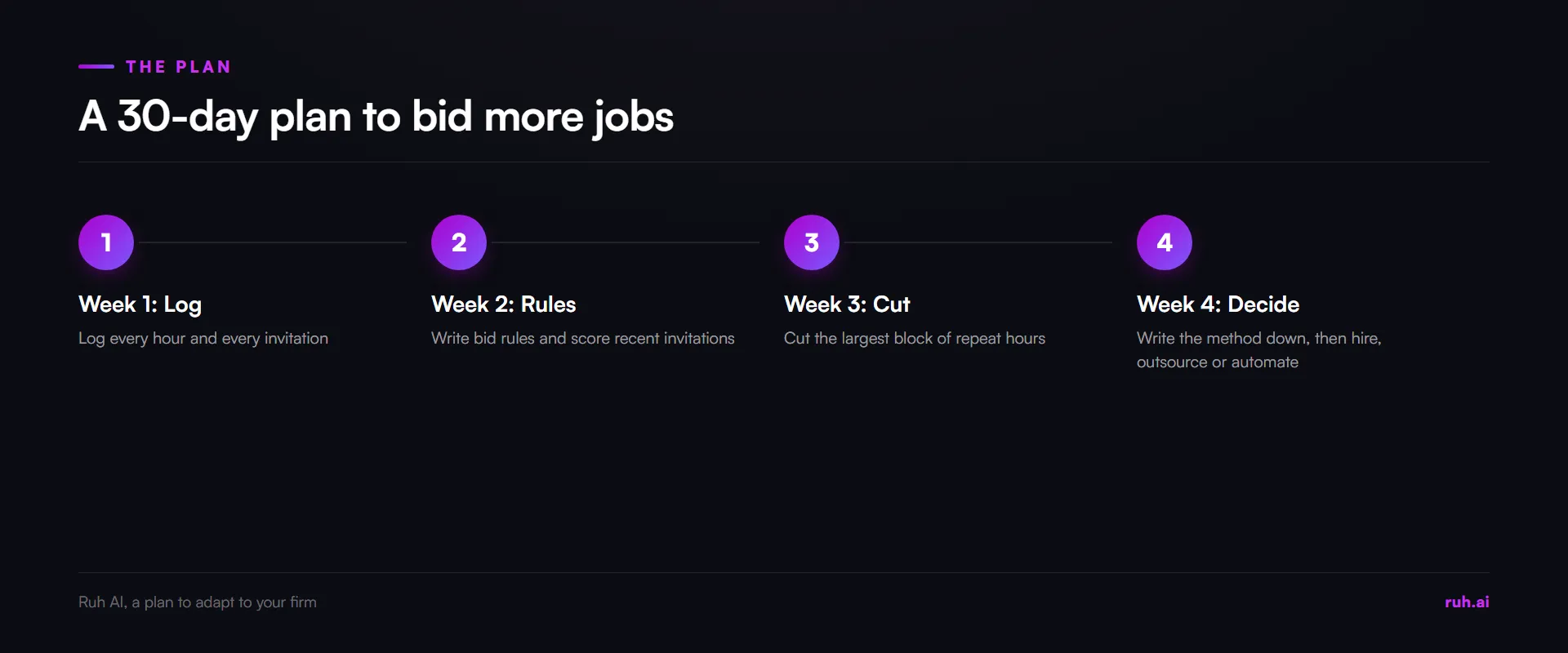
Week 1: Log everything. The estimator logs hours in half-hour blocks, split into takeoff, pricing, sub quotes, proposal and non-bid work. Log every invitation received, including the ones you pass on.
Week 2: Write your bid rules. Using the six rules above, score the last 20 invitations. Note how many you would have dropped and how many hours that would have freed.
Week 3: Cut the repeat hours. Pick the largest block from week 1. If it is non-bid work, move it to someone else. If it is takeoff, build standard assemblies for your most common building types. If it is sub quotes, send one standard scope sheet with every request.
Week 4: Write the method down and decide. Put your rate book and scope checklist in one shared place. Rerun the bid capacity formula with your new numbers. Then decide whether the remaining gap needs a hire, an outside estimator for takeoff or a tool.
Fields for your weekly bid log:
| Field | Example |
|---|---|
| Project name and owner or GC | Clinic fit-out, the GC's name |
| Date received and bid due date | 6 Oct, 20 Oct |
| Bid rule score (out of 6) | 5 |
| Bid or pass, and why | Bid: repeat GC, scope fit |
| Hours: takeoff, pricing, sub quotes, proposal | 6, 3, 3, 2 |
| Bid amount | Your number |
| Result and reason | Lost on price, second of four |
After a quarter, the log tells you your real hit rate, your real hours per bid and which owners are worth the hours.
What Small Contractors Get Wrong About Bidding More Work
In our view, most small contractors who try to bid more work make it harder for themselves in the same four ways. These are our positions, not survey findings.
They chase bid count instead of good bids. Fifteen bids on poor-fit jobs lose more money than ten on the right ones. The goal is more wins at a margin you want, and bid count is only the means.
They hire first. A new estimator in a firm with no written method spends months learning one person's habits, and when that senior person is busy, the new hire waits. Write the method down before you hire, and the hire is productive sooner.
They outsource the judgment. Sending out a takeoff is reasonable. Sending out the pricing means your number is set by someone who does not know your crews, your subs or your owners. Keep the price in house.
They buy a tool before fixing the process. A tool speeds up whatever process you feed it. If the process is a stack of sticky notes and one person's memory, the tool speeds up confusion. Log, choose and write it down first.
The Honest Assessment: What Still Falls Short
No plan removes the need for an experienced estimator's judgment on scope, risk and price. A faster takeoff does not tell you that the owner has a history of slow payment or that the spec calls for a product your supplier cannot get.
Small-firm data is thin. The best public figures cover construction broadly. The SMPS Foundation hit rate of 37.9% comes from a 2017 survey of 303 architecture, engineering and construction firms, measured as proposals submitted against projects won, so it is not a hard-bid win rate. Your own bid log will tell you more than any benchmark.
Automation takes setup time. Building a rate book and standard assemblies takes senior hours that a stretched team does not have spare. Budget for it, or the tool sits unused.
More bids can mean more risk. A firm that doubles its bids without tightening its bid rules can win jobs it cannot staff.
How Ruh AI Fits Into This
Ruh AI's Takeoff Agent takes the counting and measuring off your estimating desk, and it withholds a figure when a sheet has no scale instead of guessing. Your estimator approves every scope line before Ruh measures it.
The Estimating Agent prices from your company's own rate book and history, so the method stays in the firm rather than in one person's head. Your estimator can change any price or add their own costs, and a person approves the budget before the next stage. Ruh works with your stack, built per customer.
Frequently Asked Questions
Q: How do I bid more construction jobs without hiring? A: Choose bids with written rules, move non-bid work off your estimator, and cut repeat takeoff and pricing hours with a rate book and standard assemblies. Measure your bid capacity before and after so you know what worked.
Q: How many bids can one estimator do a month? A: It depends on hours per bid. Use the formula: weekly hours minus non-bid hours, divided by hours per bid, times 4. A small job with a known scope takes far fewer hours than a large commercial bid.
Q: Is it worth outsourcing construction estimating? A: Outsourcing is worth it for takeoff on busy weeks or unfamiliar building types. Keep the pricing and the final number in house, because an outside estimator does not know your crews, subs or margins.
Q: What is a good bid hit rate in construction? A: A good hit rate is one you track and improve, because published benchmarks vary by trade and bid type. Your own bid log, kept for a quarter, gives you the number that matters.
Q: How do I decide which construction jobs to bid? A: Score each invitation on owner, scope fit, size, distance, competition and current workload before anyone opens the drawings. Pass on the low scores and spend the hours on the jobs you can win at a margin.
Q: Can AI do estimating for a small contractor? A: AI can take on the measuring and first-pass pricing, which are the most repetitive parts of a bid. The estimator still checks the scope, changes the prices that need it and approves the number.
The Bottom Line
At a small contractor, the estimating desk sets how many jobs you bid. Measure how many bids it can price, choose bids by rule, strip out the repeat hours and write the method down. Then decide whether the remaining gap needs a person, an outside takeoff or a tool.
See how Ruh AI supports the estimating team. Explore Ruh AI for estimators and precon.
Sources
- NCCER Research Department, "Construction Company Size and Employment", 2022: nccer.org
- AGC and NCCER, 2025 Workforce Survey Analysis: agc.org
- AGC and Sage, 2026 Construction Hiring and Business Outlook: agc.org
- US Bureau of Labor Statistics, Occupational Outlook Handbook, Cost Estimators (bls.gov)
- SMPS Foundation hit rate study, reported by Building Design + Construction, 3 January 2017: bdcnetwork.com
- Zaqout, Islam, Hadidi and Skitmore, Engineering Applications of Artificial Intelligence 113, 104982, 2022
- Associated Builders and Contractors, Construction Backlog Indicator, 15 September 2026