

TL;DR / Summary
Construction takeoffs don't have to take 50+ hours. The real issue isn't the work itself, it's that manual quantity extraction from plans iSDJADing and error-prone. AI agents now handle the extraction, pricing logic, and scope review in parallel, cutting total time to 6-8 hours without sacrificing accuracy. In fact, removing human transcription error often improves it.
What you'll learn:
- Why manual takeoff consumes 40-60 hours per bid and where that time actually goes
- The hidden cost of takeoff errors in change orders and field disputes
- How AI agents approach quantity extraction differently than on-screen takeoff tools
- A real before-and-after: manual estimating workflow vs. agent-driven workflow
- When human review is still critical, and what agents excel at
- How Ruh Estimator fits into lean preconstruction teams
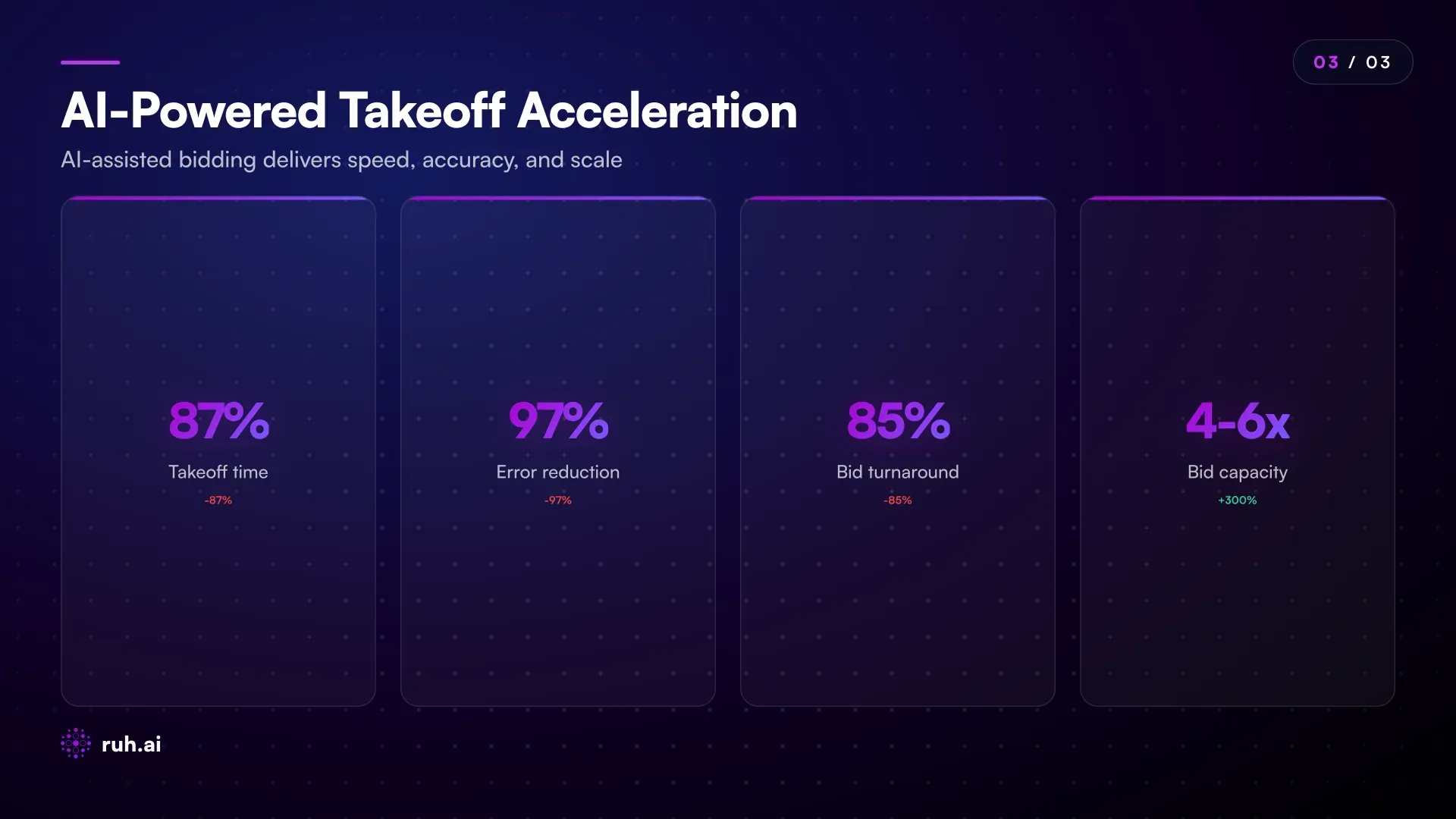
The numbers upfront: Estimators routinely spend 40-60 hours extracting quantities, pricing assemblies, and compiling scope documents per bid. Ruh Estimator cuts that to 6-8 hours, with bid win rates up 22-31% among users running it end-to-end.
The Real Cost of Manual Takeoff
Most construction teams don't measure the cost of takeoff accurately. A general contractor's estimator opens a 200-page spec, a PDF plan set, and a cost database. Three weeks later, after nights and weekends, there's a bid, and a 60-hour invoice against it. But that's only the direct labor.
The hidden cost multiplies downstream. An estimator who finds an error at the takeoff phase catches it early. An estimator who is in a hurry, or who works from a poor-quality PDF plan set, misses scope. That miss flows downstream: to the field, where a superintendent discovers the contractor underbid a pile of work, and suddenly you're cutting margin or negotiating a change order. By then, the damage is real.
Manual takeoff isn't just slow, it's a precision loss every step of the way. An estimator reads quantities, types them into a spreadsheet, reviews the spreadsheet, types them into a pricing system, reviews pricing, and compiles a proposal. At each step, transcription error is possible. Type 2400 LF of concrete when the plan says 2200 LF, and suddenly your bid price is off by $15,000. That's why the best estimating firms spend half their time on review, not because they're slow, but because catching those errors is the only way to stay profitable.
Why Estimators Are Drowning in Bid Work
The problem isn't one workflow. It's that the estimating team is responsible for everything: reading plans, extracting quantities, pricing, scope review, proposal generation, bid management. A lean estimating team, which is most teams in construction, has one or two estimators carrying the load.
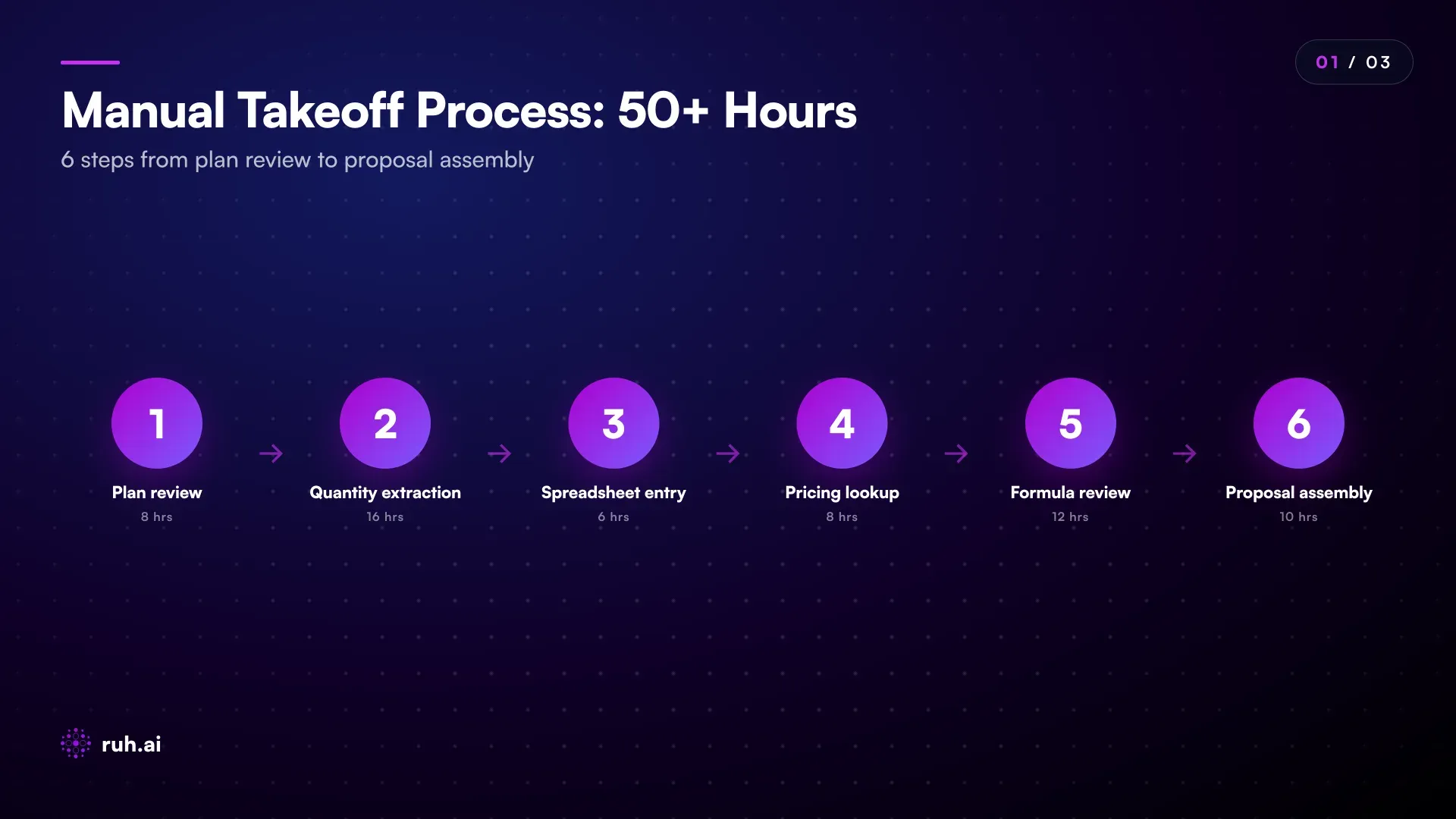
Here's what typical estimators actually do per bid:
Plan interpretation (8-12 hours): Read the entire spec and plan set. Understand what's included, what's not, what's ambiguous. Flag items that need clarification or carry risk. For a complex project (commercial build-out, civil work, heavy MEP), this is foundational and can't be rushed.
Quantity extraction (16-20 hours): Measure plans manually or use on-screen takeoff software. Count takeoff items. Enter quantities into a spreadsheet or takeoff tool. This is tedious and error-prone, especially on older PDFs with poor resolution, or hand-drawn details.
Pricing and assembly (12-16 hours): Look up labor rates, material costs, crew productivity. Apply local wage scales, union rules, overhead. Build out cost assemblies. Run what-if scenarios if the bid is tight.
Scope review and proposal (6-10 hours): Ensure the estimate is complete, no line items are missing, no scope is duplicated. Write the proposal, review it, compile PDFs.
An estimator with 8-10 bids in the pipeline at any time is perpetually behind. They miss scope review because the proposal is due. They rush pricing because the timeline is tight. They don't do a second pass on quantities. The bid goes out, and the best outcome is a win on a job with accurate scope. The worst outcome is a win on a job with missing scope, which becomes a loss in the field.
The paradox: teams that win more bids are often the ones with smaller estimating teams that run faster. That's counterintuitive, but it makes sense. A lean team that bids 10 jobs wins more of them because they can turn around estimates faster, capture more leads, and move on the work while competitors are still in takeoff.
The Shift from Manual to AI-Driven Quantity Extraction
This is where AI agents change the game. An agent doesn't read plans visually like a human, it parses the structured data, extracts coordinates and dimensions, and generates quantities. It doesn't get tired. It doesn't miss a small detail on page 145. It handles scale and resolution issues that would trip up manual takeoff.
More importantly, an AI agent can parallelize work that humans do sequentially. While an estimator is extracting quantities, an agent is pricing assemblies. While another agent is generating a scope checklist, a third is flagging potential gaps or ambiguities in the spec.
AI quantity extraction is not on-screen takeoff that's faster. It's a fundamentally different approach. On-screen takeoff tools (which many teams use) still require an estimator to sit and mark up plans. They're faster than paper, but they're still manual. An agent extracts quantities from the plan data, and an estimator reviews and refines them. The estimator's job shifts from "produce the quantity" to "validate the quantity and make judgment calls."
This shift from production to review is the reason accuracy doesn't drop, often it goes up. An estimator reviewing agent-generated quantities is looking for logical errors, scope misses, and edge cases. They're thinking critically, not transcribing. And because they're no longer in transcription mode, they catch more.
A Real Before-and-After: How Time Redistributes
Take a typical commercial tenant improvement bid. 3,500 SF space, full MEO, moderate complexity.
Manual approach (55-60 hours total):
- Spec review: 10 hours
- Quantity extraction: 18 hours (mark-up, trace, measure, enter into takeoff software)
- Pricing and assembly: 14 hours (labor rates, crew productivity, material costs, overhead allocation)
- Scope review and proposal: 12 hours (completeness check, proposal writing, PDF assembly)
Agent-driven approach (6-8 hours total):
- Plan upload and agent kickoff: 0.5 hours
- Agent quantity extraction and scope checklist: 2 hours (agent runs in parallel; estimator monitors)
- Estimator review and refinement: 2.5 hours (review quantities, flag edge cases, verify scoping)
- Pricing and assembly: 1.5 hours (pricing is now faster because quantities are ready and the scope is clear)
- Proposal generation and final review: 1.5 hours
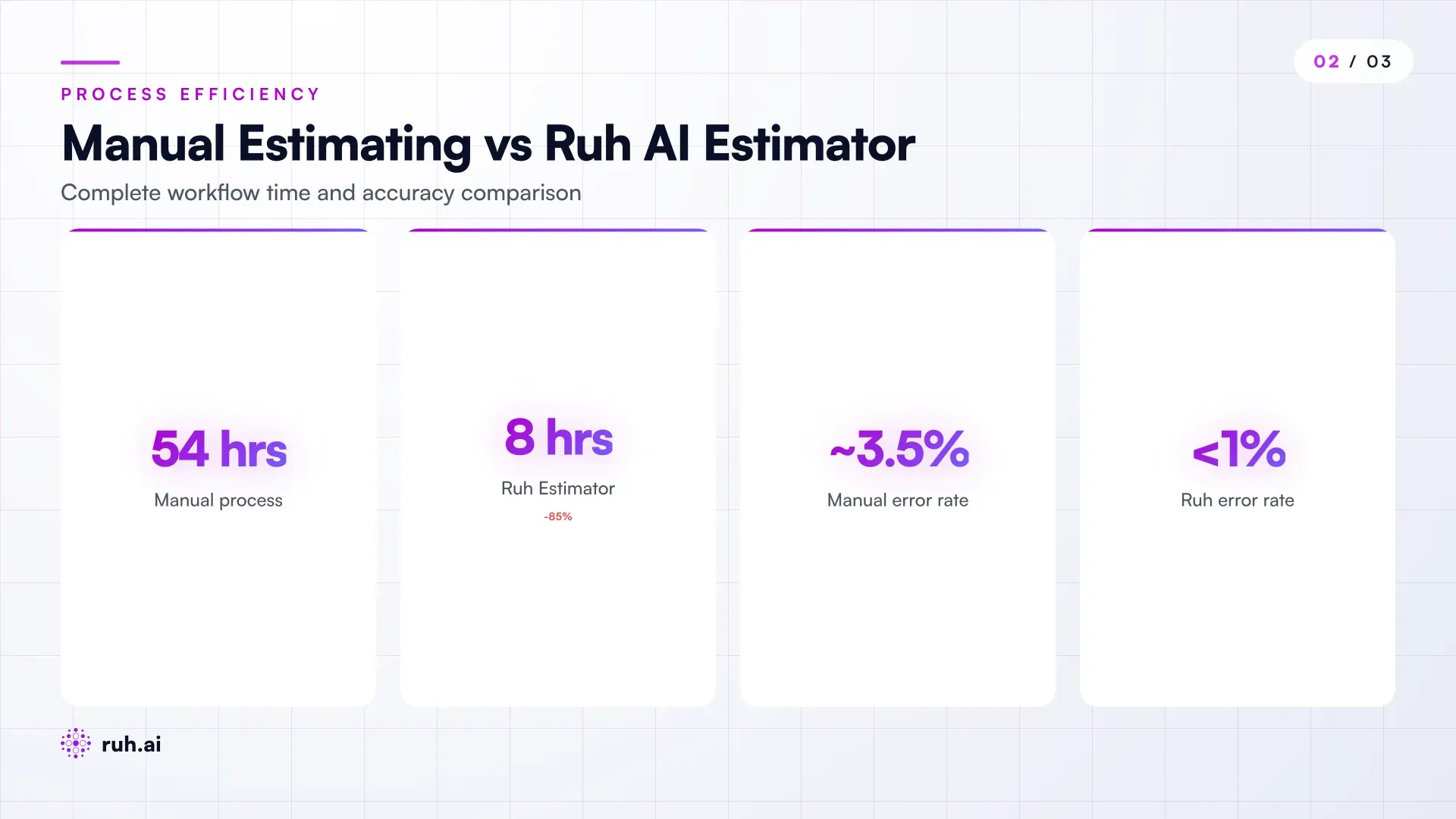
The time saved isn't just a number, it redistributes to what matters. The estimator spends less time on transcription, more time on scope clarity and pricing strategy. They're in review mode, not production mode. And because the agent is extracting from structured plan data, not eyeballing a PDF, it catches details a tired estimator might miss after 40 hours of manual work.
Accuracy and Error Rate: What Actually Improves
This is where most pitches about AI get vague. Let's be specific.
Sources of error in manual takeoff:
- Misreading plan notes or specs (missing a scope item entirely)
- Measuring error (wrong dimension pulled from a scaled PDF)
- Transcription error (type 2400 instead of 2200, drop a line item, overwrite a formula)
- Accumulation error (small mistakes stack across hundreds of line items)
Sources of error in agent-driven extraction:
- Misinterpreting spec language or intent (lower frequency; agent re-reads entire spec)
- Missing edge-case scope that requires domain knowledge (agent asks for clarification)
- Dependency on plan quality and format consistency (structured PDFs extract cleanly; hand-drawn details may need manual validation)
In practice, agent-driven extraction removes transcription error almost entirely. An agent doesn't fat-finger a keyboard. The extracted quantities feed directly into pricing logic. There's no intermediate spreadsheet where formulas get corrupted. Those same extracted quantities can flow downstream into AIA progress billing.
What agents can't do, and this is critical, is interpret intent from ambiguous specs or make judgment calls on scope that requires local knowledge. A spec might say "finishes per architect selection" and an agent will ask for clarification rather than guess. An estimator then makes that call. This is a feature, not a bug. It surfaces scope ambiguity early.
The net effect: error rates drop from 3-4% in manual takeoff to under 1% in agent-assisted takeoff, assuming the estimator is reviewing and validating.
Where Your Estimator Still Matters
This matters because some teams hear "AI takeoff" and think "no more estimators." That's wrong.
An agent produces a draft quantity estimate and a scope checklist. An estimator then does what they should have been doing all along: thinking. They review the quantities for reasonableness. They validate scope coverage. They spot scope gaps. They make judgment calls on crew productivity, local wage rates, and project risk.
This is higher-value work than transcription. An estimator doing this work is making real decisions that affect margin, not copying numbers from a PDF into a spreadsheet.
The estimator also owns the relationship with the client. They understand the bid context, why the owner is pulling in a lower budget, what work is optional, what trades are on the critical path. They can look at an agent-generated estimate and say, "This assumes standard productivity. On this job, because of the site access, we need 15% more labor." That judgment is irreplaceable.
So the workflow isn't "eliminate the estimator." It's "shift the estimator from production to review and strategy."
Implementation: How to Start
Most teams can start small. You don't need to overhaul your entire estimating system.
Step 1: Pick one trade or bid type. If you're a multi-trade GC, start with a bid category you see frequently, say, MEP fit-out, or civil earthwork. Proof-of-concept on a category you know well reduces risk.
Step 2: Run two estimates in parallel. On the next 3-5 bids in that category, have the agent produce a quantity estimate while your estimator works their normal workflow. Compare the agent output to the manual estimate. This tells you where the agent excels and where it needs refinement or human override.
Step 3: Refine the scope checklist. The agent will generate a scope checklist based on the spec and plans. Your estimator reviews it, flags missing items, adds local knowledge. After a few runs, you'll have a strong pattern for what the agent should be looking for.
Step 4: Integrate pricing. Once you're confident in quantities, wire the agent to pull from your cost database. Pricing logic can now run automatically, and the estimator reviews the assembled cost, not the components.
Step 5: Full workflow. The agent produces a draft estimate, quantities, scope checklist, cost assembly, all in 2 hours. Your estimator spends 2-3 hours on review, refinement, and judgment calls. The bid goes out faster and is more accurate.
The Honest Assessment: What Still Requires Human Judgment
AI agents are excellent at extraction and logic, but they are not a substitute for construction judgment.
Scope ambiguity: A spec that says "finishes per schedule" or "as directed by architect" leaves scope unclear. An agent will flag this and ask for clarification. Good. But an estimator still needs to make the judgment call: do we include a contingency for this uncertainty, or do we ask the client to clarify before bidding? That's experience and risk tolerance, not data.
Crew productivity and local factors: An agent can extract labor hours from a productivity database. It can't know that your crew on the West Side is 20% slower than average because of site constraints, or that your electrician is exceptional and can move 40% faster. That knowledge is local and earned. An estimator makes those calls and adjusts the estimate accordingly.
Project risk and negotiation context: Is the owner price-sensitive or scope-sensitive? Is this a repeat client where you want to be competitive? Is this a high-risk project where you need a bigger cushion? An agent has no context for these decisions. An estimator does, and they shape the estimate accordingly.
Plan quality and clarity: Agents extract from structured PDFs very cleanly. Hand-drawn details, low-resolution scans, or incomplete specs require human interpretation. An agent will flag these as ambiguous; the estimator decides whether to ask for clarification or make a judgment call.
So the agent handles volume and accuracy on the extraction and assembly side. The estimator handles judgment, relationship context, and risk. Both are necessary. The win is that the estimator is no longer spending 40 hours on extraction and has 10 hours of focused time for strategy and validation.
How Ruh AI Fits Into This
Ruh Estimator is built on this principle. It's not a "set it and forget it" tool. It's an agent that works alongside your estimator.
Here's what it does: upload your plan set and spec. Ruh Estimator parses both, extracts quantities, generates a scope checklist, flags ambiguities, and produces a draft cost assembly. It does this in 2-3 hours. Your estimator reviews quantities, validates scope, adjusts for local factors, and completes the estimate. The entire workflow is 6-8 hours instead of 50-60.
Ruh Estimator connects to your cost database and accounting system, so quantities feed directly into pricing. It flags scope gaps by cross-referencing the spec against industry standard scope items for that project type. It generates a bid proposal in your template.
The result is faster turnaround, lower error rate, and more bids per estimator per month. Teams using it report bid win rates up 22-31%, which often reflects a combination of more bids submitted, faster turnaround to clients, and more accurate scoping that reduces change orders and dispute.
If you're running a lean estimating team, which is most GCs and subcontractors, Ruh Estimator is the difference between being perpetually behind on bids and having the capacity to bid opportunistically.
You can start with the Ruh platform, which lets you build this kind of agent without code. Or you can integrate with Ruh's API if you have custom workflows or integrations you need.
Frequently Asked Questions
Q: Does AI takeoff work with hand-drawn or low-res plans? A: Agents extract cleanly from structured PDFs with high resolution. Hand-drawn details and low-res scans require more human intervention, the agent will flag these as ambiguous. For those items, an estimator may need to measure or ask the designer for clarity. Plan quality is still the limiting factor; agent extraction just makes it visible.
Q: What if my team uses different cost data or productivity rates than the agent assumes? A: The agent should be wired to your cost database, not a generic one. If you're using Ruh Estimator, you can configure it to pull from your existing accounting system or cost library. Local rates and crew productivity are configured by project type or by custom override.
Q: Can the agent handle change orders or scope modifications mid-project? A: An agent can generate a change order estimate if you feed it the scope change and current bid. It extracts quantities for the changed scope and prices them. An estimator reviews and validates. This is faster than regenerating the entire estimate, but the workflow is similar to initial takeoff.
Q: How long does it take to get an agent up and running for my company? A: If you use Ruh Estimator or a no-code agent builder like the Ruh platform, you can have a working agent in days. You upload plans, connect your cost database, and refine the scope checklist over 3-5 runs. Full integration is under a week for most teams.
Q: What's the learning curve for my estimators? A: Low. Estimators still work the same way, they review and refine. The difference is that they're starting with agent-generated quantities instead of a blank spreadsheet. Most teams see their estimators adapt in 2-3 bids.
Q: Does agent takeoff reduce the number of estimators I need? A: Not usually. What it does is increase the number of bids per estimator. A lean team that was bidding 1-2 jobs per estimator per week might bid 4-6 per week. That's capacity and speed, not headcount reduction. Some teams use that capacity to bid more aggressively; others use it to add margin through better scope review.
Q: Can I use agent takeoff for subcontractor bids, or is it only for GCs? A: Subcontractors benefit equally. A mechanical sub bidding a commercial fit-out spends just as much time on takeoff. Agent-driven extraction cuts that time by 85%, freeing the sub to bid more jobs and review scope more carefully.
The Real Win: Speed Without Sacrifice
Construction estimating hasn't fundamentally changed in decades. The tools got a little better, on-screen takeoff instead of paper, databases instead of filing cabinets, but the work stayed the same. Someone had to read the plans, extract numbers, look up prices, and write a proposal.
AI agents change that. Not because they're smarter than estimators, they're not. But because they don't get tired, they don't transcribe wrong, and they can parallelize work a human does sequentially.
The outcome is that estimators move from production roles to strategy roles. They spend less time extracting and more time thinking. Bids go out faster. Accuracy improves. Win rates go up. And the estimating team, which is usually lean and overworked, finally gets headroom.
The path is not "replace the estimator." It's "give the estimator the tools to do what they actually want to be doing: making smart estimates, not transcribing numbers."
That takes the 50-60 hour takeoff cycle and compresses it to 6-8 hours. Everything downstream improves.
Explore Ruh Estimator and automate your next takeoff →