EstimatingExplore estimating
Construction glossary · Process and Contract Terms

What is a surety bond in construction?

A surety bond in construction is a three-party guarantee: a surety promises the owner that the contractor will meet its obligations, such as finishing the work or paying its subcontractors. Below: the three bonds you meet on construction work, a premium worked out for a $2.5 million job, our view, and a link to a free bond cost calculator.

Free 30-minute walkthrough on your own drawings. No card.

Updated November 2026 · Reviewed by the Ruh construction team

The definition

Surety Bond, Explained.

The contractor is the principal, the owner is the obligee, and the surety is the company that issues the bond. The contractor pays a premium, and if it defaults the surety steps in up to the bond's penal sum.

A bond is not insurance for the contractor. Whatever the surety pays out, it recovers from the contractor, and usually from its owners too, under an indemnity agreement signed before the first bond is written. That is why sureties underwrite a contractor's finances and experience the way a lender would.

Three bonds cover most construction work: a bid bond with the bid, then a performance bond and a payment bond once the contract is signed.

To price a bond premium and its penal sums, use the free construction bond cost calculator.

How it is measured

A surety bond is measured in two amounts. The penal sum caps what the surety can be made to pay and is set by the owner as a share of the bid or contract, and the premium is what the contractor pays, priced on the surety's rate schedule per $1,000 of contract.

The Three Construction Bonds

Each bond protects a different promise, and federal work sets the amounts in the Federal Acquisition Regulation.

More on each in performance bond and bid bond.

BondWhen it is givenWho is protected
Bid bondWith the bidThe owner, if the winner walks away
Performance bondAt contract signingThe owner, if the work is not finished
Payment bondAt contract signingSubcontractors and suppliers who go unpaid

Federal penal sums come from FAR 28.101-2 and 28.102-2, set out in the bond cost calculator. Typical practice, not legal advice.

Our View

In our view, treat your surety like a lender, because it underwrites like one. Send clean financial statements on time and talk to your surety before you bid a job bigger than any you have done.

Worked example

A Worked Surety Bond Example

Illustrative example. A general contractor wins a $2,500,000 public job that needs performance and payment bonds, and its surety's rate schedule is the bond cost calculator's default.

A $2,500,000 contract with 100% performance and payment bonds: $28,500 premium on the illustrative schedule, 1.14% of the contract, against $2,500,000 penal sums.

ItemAmount
Performance bond penal sum, 100%$2,500,000
Payment bond penal sum, 100%$2,500,000
Premium: $100,000 at $25 + $400,000 at $15 + $2,000,000 at $10 per $1,000$2,500 + $6,000 + $20,000 = $28,500
Premium as a share of the contract$28,500 / $2,500,000 = 1.14%

The contractor pays $28,500, and the surety stands behind up to $2,500,000 on each bond.

Illustrative rates, not a quote. Only your surety can price your bonds.

How Ruh handles it

How Ruh Handles Surety Bond.

Try Ruh on a real bid.

Start with a walkthrough

Surety Bond: Frequently Asked Questions

What is a surety bond in construction?+

A three-party guarantee in which a surety promises the owner that the contractor will perform its contract or pay its subcontractors and suppliers.

Is a surety bond the same as insurance?+

No. Insurance pays for losses the insured suffers. A surety pays the owner and then expects the contractor to pay it back under the indemnity agreement.

Who pays for a construction bond?+

The contractor pays the premium and usually carries it as a line in its bid, so the owner pays for it in the contract price.

When are bonds required on federal work?+

The Miller Act requires both on federal construction jobs worth more than $150,000 (FAR 28.102-1).

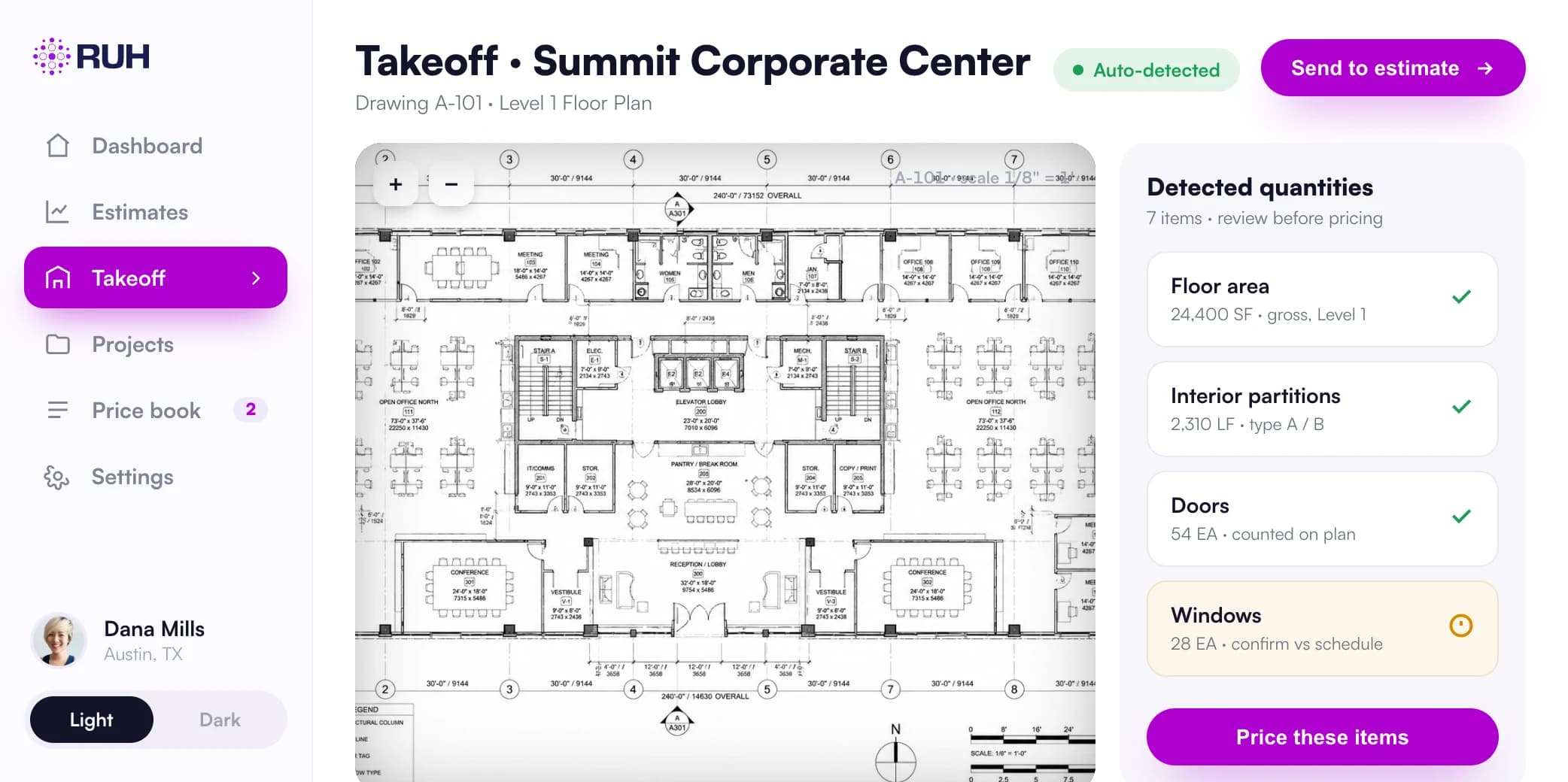
Still measuring by hand? Your next takeoff can run while you review this one.

See it on your plans

Related Terms

Keep going: A Worked Surety Bond Example, the free construction bond cost calculator or explore General Contractor Software.

The Construction Estimating Cheat Sheet
Every unit, waste factor, and conversion on one page. Free PDF.

Figures on this page are illustrative. Construction estimates depend on project-specific conditions, source documents, market pricing, and professional judgment. Ruh's AI assists the estimator and does not replace professional review: your team reviews, validates, and approves every estimate, bid, and pricing decision.
Try Ruh on a Bid You Are Pricing Now.

Put Your Next Takeoff on Ruh.