Construction glossary · Process and contract terms
What is lien waiver in construction?
A lien waiver is a signed document in which a contractor, subcontractor, or supplier gives up the right to file a mechanics lien against the project property in exchange for a payment. There are four standard types: conditional progress, unconditional progress, conditional final, and unconditional final, exchanged at each pay application and at closeout. On US commercial work, waivers travel with the pay app, and money generally does not move until they are in hand.
Updated June 2026 · Reviewed by the Ruh construction team
How a lien waiver clears payment
Estimating process and contract terms scope this week? Watch Ruh take off a real plan in 30 minutes.
Book a walkthroughA lien waiver is the payment-side counterpart to the pay application. On a US commercial job, every application for payment travels with waivers: the general contractor collects them from subcontractors and suppliers, and the owner or lender collects them from the general contractor, before money moves. There are four standard types. A conditional progress waiver releases lien rights for one billing period, effective only when the payment actually clears. An unconditional progress waiver releases those rights immediately, paid or not. Conditional final and unconditional final waivers do the same for the full contract value at closeout. The waiver shows up in the subcontract exhibits, in the monthly pay app package, and on the closeout checklist. New estimators make two common mistakes: ignoring waiver requirements when reviewing subcontract terms (some owners require notarized or state-statutory forms, which adds administrative cost), and confusing the waiver amount with the gross billing. The waiver tracks the payment, net of retainage, not the work in place. Estimators should also flag jobs where lower-tier waivers are required, since chasing supplier waivers affects payment timing and the cash flow assumptions behind the bid.
Lien waivers are measured in dollars and dates. Each waiver states a dollar amount (the payment it covers) and a through date (the end of the billing period it releases). Progress waivers track the net payment after retainage, so a $100,000 gross billing with 10% retainage produces a $90,000 waiver. The documents appear as exhibits to the subcontract, as required attachments to each AIA G702/G703 pay application package, and in closeout submittals. Several states, including California and Texas, mandate statutory waiver forms, so the wording is not negotiable there. Estimators do not take off waivers, but they should price the administration: notarization, lower-tier waiver collection, and the staff time to chase them belong in general conditions when the contract demands monthly waiver packages.
Worked example
Say your subcontract value is $500,000 with 10% retainage (illustrative numbers). Work completed through May 31 totals $333,333. Retainage held: $333,333 x 0.10 = $33,333. Earned less retainage: $333,333 minus $33,333 = $300,000. Previous payments received: $220,000. Current payment due: $300,000 minus $220,000 = $80,000. The correct exchange: sign a conditional waiver and release on progress payment for $80,000 with a through date of May 31, and submit it with the pay application. That waiver only takes effect when the $80,000 actually clears. Once funds arrive, the GC will typically request an unconditional progress waiver for the same $80,000 along with next month's billing. Never sign the unconditional version before the money clears; if the check fails, you have released lien rights on $80,000 of work with nothing in hand. The $33,333 retainage stays outside the waiver until the conditional final waiver at closeout.
Try Ruh on a real bid. 100% money-back guarantee if you are not satisfied.*
*Scoped delivery, terms apply. Read the guarantee terms
How Ruh handles lien waiver
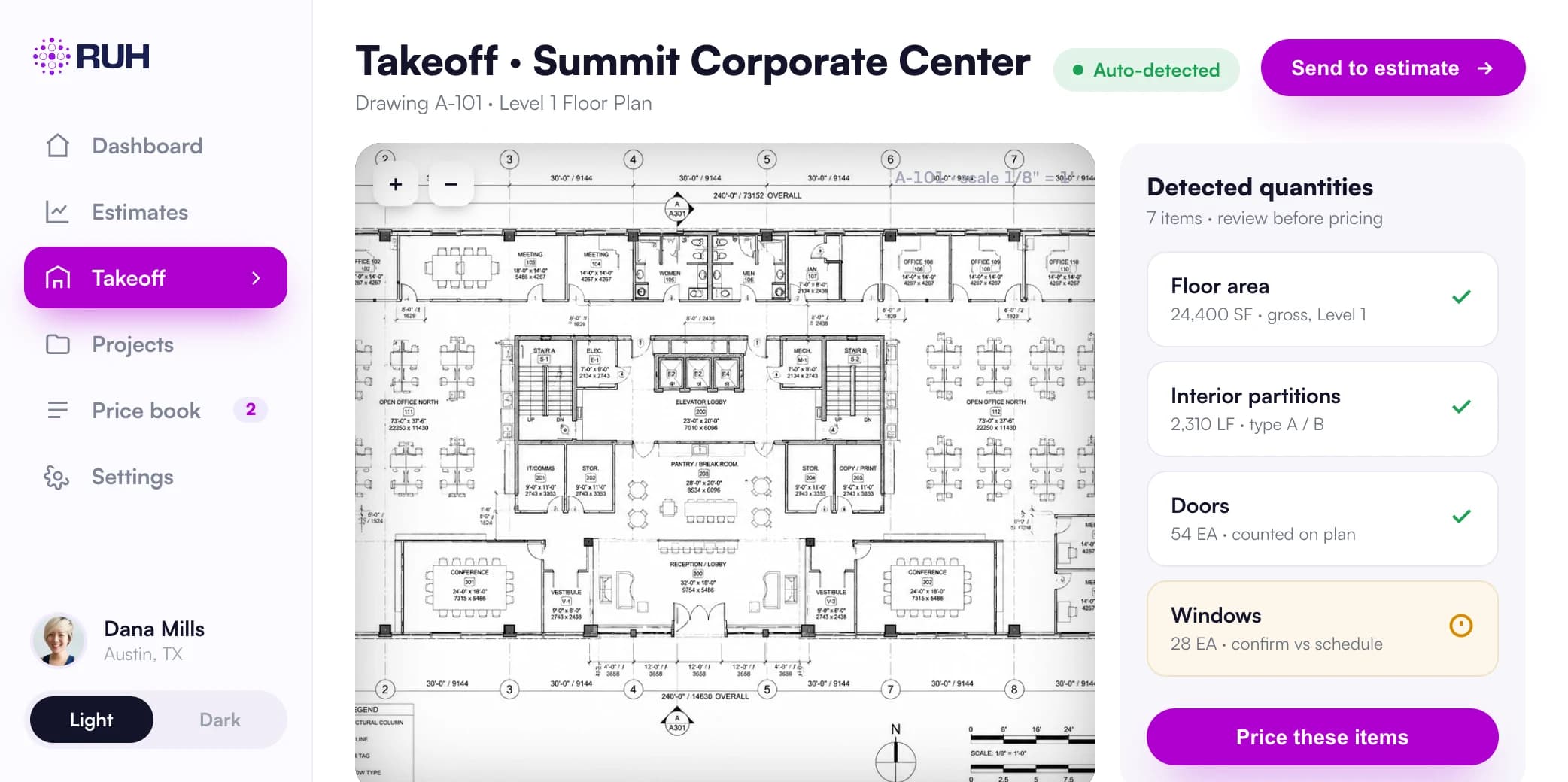
Lien waivers live downstream of the estimate, but every waiver dollar traces back to the schedule of values, and the schedule of values traces back to the estimate. Ruh reads the contractor's drawings, runs the takeoff, and prices quantities against the contractor's own price book, handing the estimator a line-item draft whose cost codes map cleanly to SOV lines, so progress billings and the waiver amounts tied to them reconcile without manual re-sorting. The estimator still reviews, adjusts, and signs off; Ruh supports that judgment rather than replacing it.
See construction invoice and pay app softwareLien waiver: frequently asked questions
What is the difference between a conditional and an unconditional lien waiver?+
A conditional waiver only takes effect once the payment it describes actually clears the bank, so the signer keeps lien rights if the check fails. An unconditional waiver releases lien rights the moment it is signed, whether or not payment ever arrives. Standard practice is conditional before payment, unconditional after funds clear.
When should a subcontractor sign an unconditional lien waiver?+
Only after the payment has actually cleared, not when the check is handed over. Many GCs request the unconditional progress waiver for last month's payment alongside the conditional waiver for the current billing, which keeps the exchange safe for both sides. Signing unconditional waivers in advance to speed up payment is the most common and most expensive waiver mistake.
Does a progress lien waiver release retainage?+
Normally no. A properly drafted progress waiver covers the net payment received and carves out retainage, unbilled change orders, and disputed claims. Retainage stays lien-able until it is paid and released through the final waiver at closeout, so check the through date and the exclusions language before signing.
Still measuring by hand? Your next takeoff can run while you review this one.
See it on your plansSee Ruh price a bid from your own drawings.
AI takeoff and estimating on your price book, your estimator signs off.
Figures on this page are illustrative. Construction estimates depend on project-specific conditions, source documents, market pricing, and professional judgment. Ruh's AI assists the estimator and does not replace professional review: your team reviews, validates, and approves every estimate, bid, and pricing decision.