
Construction glossary · Wood framing
What is king stud in construction?
A king stud is a full-height stud that runs continuously from the bottom plate to the top plate on each side of a wall opening, framing the opening and anchoring the header assembly. King studs are nailed to the jack studs that carry the header, and together they form the structural edges of a door or window opening. They are cut from the same stock as the field studs, typically 2x4 or 2x6.
Updated June 2026 · Reviewed by the Ruh construction team
King studs flank the opening, full plate to plate
Estimating wood framing scope this week? Watch Ruh take off a real plan in 30 minutes.
Book a walkthroughKing studs define and stabilize the sides of a framed opening. Unlike the jack stud, which is cut shorter to sit under the header and carry its load down to the bottom plate, the king stud runs the full wall height uninterrupted, from bottom plate to top plate, on the outboard side of each jack. Its job is lateral: it resists the racking and overturning forces at the opening and gives the jack stud and header assembly something rigid to fasten against. Every opening has at least one king stud on each side, with the jack stud nailed to its inboard face. Wider or heavily loaded openings call for doubled or tripled kings and jacks, as set by the framing plan or header schedule. King studs are full-length studs, so they are counted at the wall's stud length and never get cut down, which is what distinguishes them from cripples and jacks in the takeoff. The estimator picks them up as part of the opening assembly along with jacks, the header, and the cripples above and below.
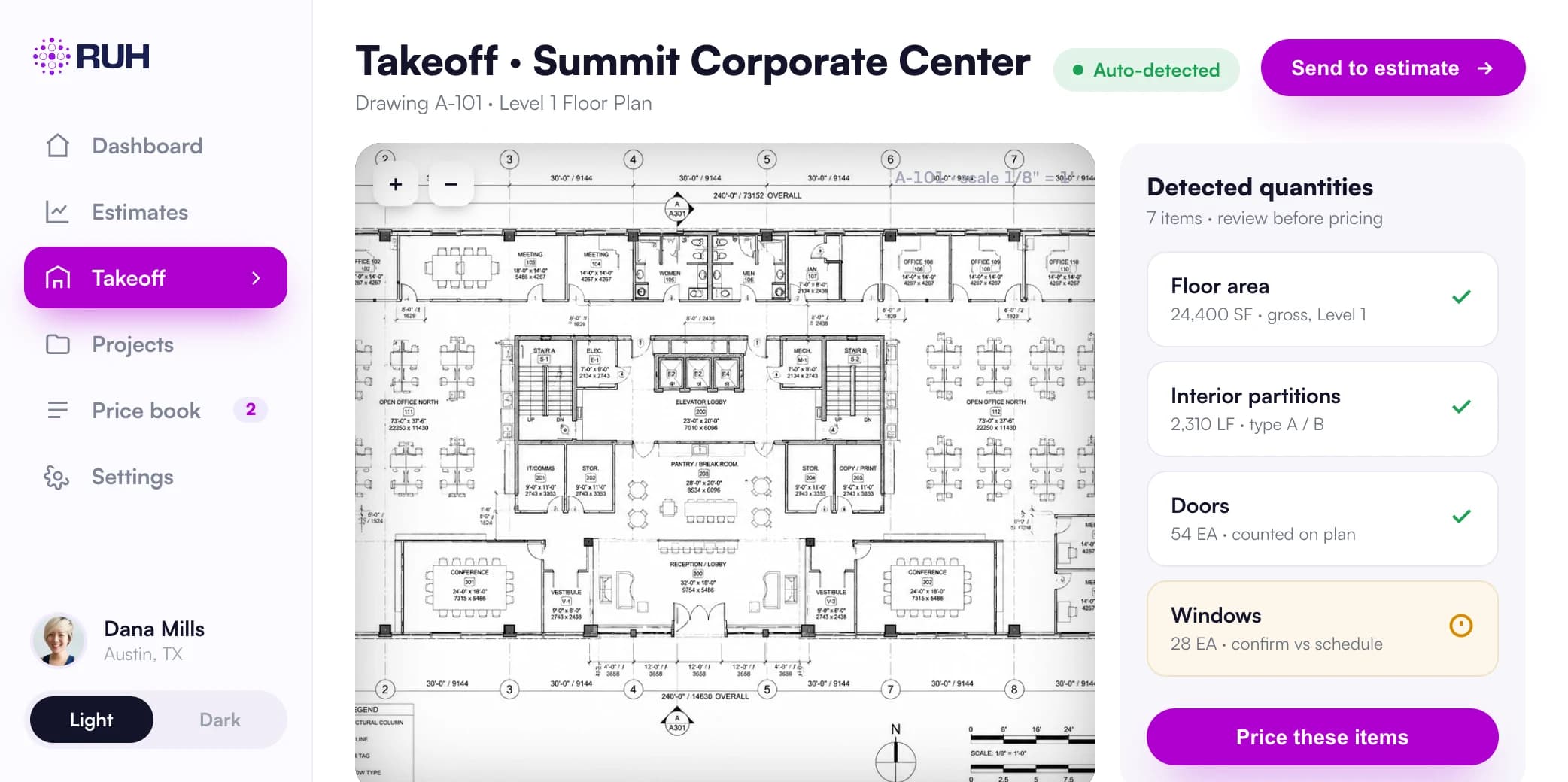
King studs are counted as full-height pieces, two per simple opening, and converted to linear feet at the wall stud length for pricing. On the drawings, read the framing elevations and the window and door schedules, which show how many kings and jacks each opening requires. Count one king on each side for a standard opening and add kings where the schedule or header note calls for doubles on wide spans. Multiply the king count by the full stud length to get linear feet, then convert to board feet. Because kings are full length, they carry no special waste beyond normal stud waste, unlike the cut cripples and jacks.
Worked example
Frame a 4 ft wide window opening in a 9 ft tall 2x4 wall. A standard opening takes 2 king studs, one on each side, each running the full 9 ft wall height. That is 2 x 9 ft = 18 lf of full-height 2x4. Pair each king with 1 jack stud carrying the header; the jacks here run about 7 ft to the underside of the header, so 2 x 7 ft = 14 lf of jack stock. King stock alone at 0.667 board feet per linear foot is 18 lf x 0.667 = 12 board feet. At an illustrative $0.85 per board foot, 12 x $0.85 = $10.20 for the two kings on this opening, before the jacks, header, and cripples are added to complete the assembly.
Try Ruh on a real bid. 100% money-back guarantee if you are not satisfied.*
*Scoped delivery, terms apply. Read the guarantee terms
How Ruh handles king stud
Ruh reads the framing elevations and window and door schedules, counts the king studs per opening (doubling them where the header schedule requires), and multiplies by the full wall stud length to get linear feet and board feet. It prices the king stock on the contractor's own price book and rolls it into the complete opening assembly with jacks, header, and cripples. The estimator checks the king count against the spans and signs off.
See framing estimating softwareKing stud: frequently asked questions
What is the difference between a king stud and a jack stud?+
The king stud runs full height from bottom plate to top plate and resists lateral forces at the opening. The jack stud, nailed to the king's inboard face, is cut shorter to sit under the header and carry its load down to the bottom plate.
How many king studs does an opening need?+
A standard opening uses one king stud on each side, so two per opening. Wide or heavily loaded openings call for doubled or tripled kings, as set by the framing plan or header schedule. Always confirm against the drawings.
Are king studs cut to length like cripples?+
No. King studs run the full wall stud height and are never cut down, so they are counted as full-length studs. Jacks and cripples are the cut members in an opening, which is why they carry a different waste factor in the takeoff.
Still measuring by hand? Your next takeoff can run while you review this one.
See it on your plansRelated terms
Keep going: read the full guide or explore framing estimating software.
See Ruh price a bid from your own drawings.
AI takeoff and estimating on your price book, your estimator signs off.
Figures on this page are illustrative. Construction estimates depend on project-specific conditions, source documents, market pricing, and professional judgment. Ruh's AI assists the estimator and does not replace professional review: your team reviews, validates, and approves every estimate, bid, and pricing decision.