Construction glossary · Wood framing
What is cripple stud in construction?
A cripple stud is a short vertical stud that fills the framing gap above a header or below a window sill in a wall opening. It is not full height because the opening interrupts the wall, but it still carries load and maintains stud layout so sheathing and finishes have continuous backing. Cripples are cut from the same stock as the wall studs and held to the same on-center spacing.
Updated June 2026 · Reviewed by the Ruh construction team
Cripple studs above header and below sill
Estimating wood framing scope this week? Watch Ruh take off a real plan in 30 minutes.
Book a walkthroughCripple studs keep a framed wall continuous through and around an opening even though no full-height stud can occupy that space. There are two kinds. Top cripples, also called header cripples, run between the top of the header and the bottom of the top plate, transferring the load from the plate down into the header. Bottom cripples, also called sill cripples, run between the bottom plate and the underside of the rough sill at a window opening, supporting the sill and the framing below the window. Both are cut from the same dimensional stock as the wall studs, typically 2x4 or 2x6, and are spaced to maintain the wall's on-center layout so panel edges and drywall land on framing. Their length depends on the header height and the sill height, which in turn come from the rough opening and the header size. The estimator counts cripples separately from full studs because they consume short cut lengths and affect both the piece count and the waste factor on stud orders. Cripples work alongside king studs and jack studs to make up the complete opening assembly.
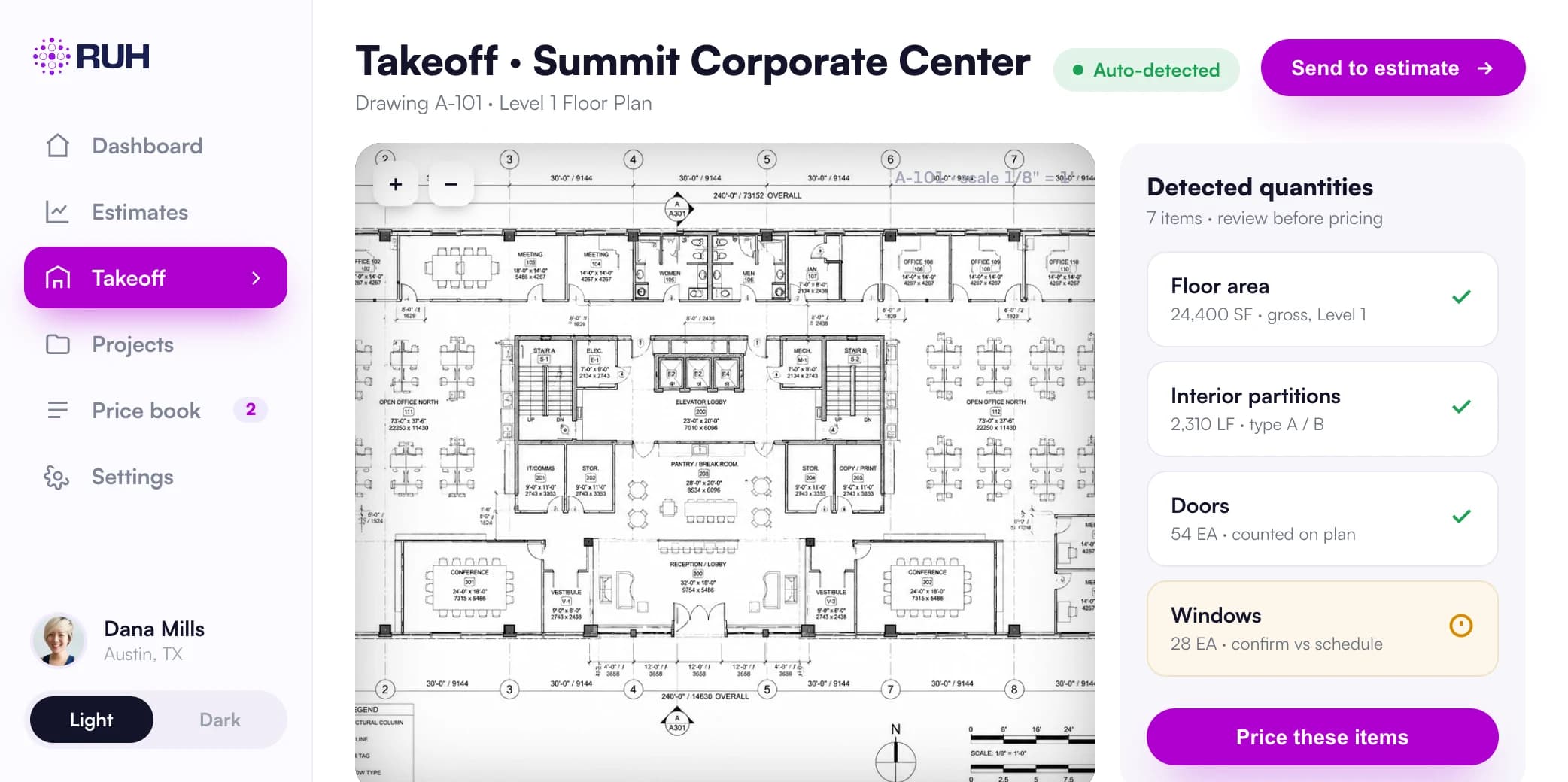
Cripple studs are counted as pieces and converted to linear feet of stud stock for pricing. On the drawings, read the framing elevations and the window and door schedules, which give rough opening widths, header heights, and sill heights. For each opening, divide the opening width by the wall's on-center spacing to find how many cripples fall above the header and below the sill, then add the end cripples at the opening edges. Multiply the count by the cut length for each location to get linear feet, and apply a waste factor since cripples come from cut-down studs. Confirm header and sill heights against the wall height to get accurate cut lengths.
Worked example
Frame a 4 ft wide window opening in a 9 ft tall 2x4 wall framed at 16 in on center. The header sits high, leaving a 12 in gap to the top plate, and the rough sill leaves a 36 in gap down to the bottom plate. Top cripples across the 4 ft (48 in) opening at 16 in on center: 48 / 16 = 3 spaces, so 3 + 1 = 4 top cripples, each 12 in (1 ft) long, giving 4 x 1 ft = 4 lf. Bottom cripples at the same spacing: 4 cripples, each 36 in (3 ft) long, giving 4 x 3 ft = 12 lf. Total cripple stock is 4 + 12 = 16 lf of 2x4. At an illustrative $0.85 per board foot and 0.667 board feet per linear foot, 16 lf x 0.667 x $0.85 = $9.07 for this opening, before waste.
Try Ruh on a real bid. 100% money-back guarantee if you are not satisfied.*
*Scoped delivery, terms apply. Read the guarantee terms
How Ruh handles cripple stud
Ruh reads the framing elevations and the window and door schedules, derives header and sill heights, and counts the top and bottom cripples for each opening from the rough opening width and the wall's on-center spacing. It computes the cut lengths, totals the linear feet of stud stock, applies the waste factor, and prices it on the contractor's own price book. The estimator verifies the opening assembly and signs off.
See framing estimating softwareCripple stud: frequently asked questions
What is the difference between a top cripple and a bottom cripple?+
A top cripple, or header cripple, runs from the header up to the top plate and carries load into the header. A bottom cripple, or sill cripple, runs from the bottom plate up to the rough sill and supports the framing below a window.
Do door openings have cripple studs?+
Doors have top cripples above the header when the header sits below the top plate, but no bottom cripples because the opening runs to the floor. Windows have both top cripples above the header and bottom cripples below the sill.
Why count cripples separately from full studs?+
Cripples are short cut lengths taken from full studs, so counting them separately keeps the piece count and the waste factor accurate. Lumping them with full-height studs understates how many sticks the opening actually consumes.
Still measuring by hand? Your next takeoff can run while you review this one.
See it on your plansRelated terms
Keep going: read the full guide or explore framing estimating software.
See Ruh price a bid from your own drawings.
AI takeoff and estimating on your price book, your estimator signs off.
Figures on this page are illustrative. Construction estimates depend on project-specific conditions, source documents, market pricing, and professional judgment. Ruh's AI assists the estimator and does not replace professional review: your team reviews, validates, and approves every estimate, bid, and pricing decision.