100% money-backBook a walkthrough

Construction glossary · Wood framing

What is LVL (laminated veneer lumber) in construction?

LVL (laminated veneer lumber) is an engineered structural member made from thin wood veneers glued together with the grain running the same direction along the length, used for beams, headers, and rim board. In framing it carries heavy point and uniform loads where dimensional lumber would be undersized or unavailable in the needed length.

Updated June 2026 · Reviewed by the Ruh construction team

Ply thickness 1-3/4 inStock depths 9.5 to 18 inCommon Fb 2,600 psiUse Headers, beams

LVL beam section, veneers glued grain-parallel

Thin wood veneersGrain all run lengthwiseWaterproof adhesive bondBuilt up to depth1-3/4 in plies9-1/2 to 18 in deep

Estimating wood framing scope this week? Watch Ruh take off a real plan in 30 minutes.

Book a walkthrough
Definition

LVL is built by bonding parallel wood veneers under heat and pressure into a billet, then ripping it to standard depths. Because the veneers run lengthwise and defects are dispersed, LVL is stronger and far more consistent than sawn lumber, with no crown to chase. It comes in a fixed thickness, usually 1.75 in per ply, and in depths matched to framing such as 9.25, 9.5, 11.25, 11.875, 14, 16, and 18 in. Beams are commonly built as 2-ply or 3-ply members fastened together per the manufacturer table to share load. LVL is specified by an Fb bending value and E modulus stamped or noted on the member, and it must be installed with the wide face vertical for a beam. In framing it shows up as flush and dropped beams, garage door headers, long-span window headers, and ridge support. For estimating, LVL is counted by piece, by ply, and priced per linear foot at the specified depth.

How it is measured

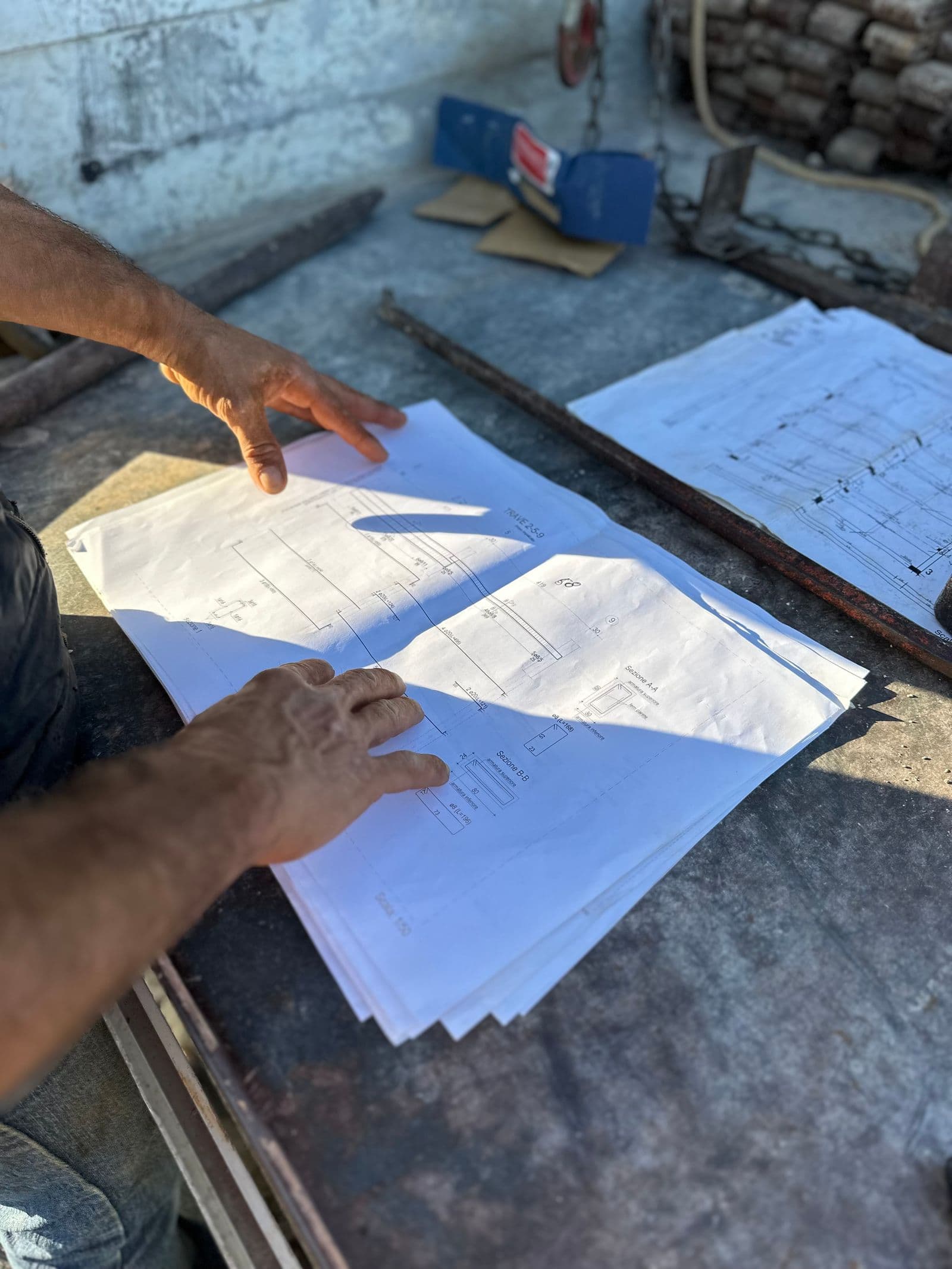
LVL is taken off the framing plan and beam schedule by reading each callout, which gives the ply count, thickness, depth, and length, for example (2) 1.75 in x 11.875 in x 16 ft. Count plies separately because pricing is per linear foot per ply at a given depth. Add a small length allowance so beams can bear fully on their supports and be trimmed clean. Check the schedule for connection hardware such as hangers and the through-bolt or nail pattern joining plies, since those are separate line items. Confirm bearing length called out at each end, commonly 1.5 to 3.5 in, because insufficient bearing changes the support framing. Quantities roll up as total linear feet by depth.

Worked example

Worked example

A plan calls for a (2) 1.75 in x 11.875 in LVL beam over a 16 ft span carrying a garage opening. The member is 2 plies, so total LVL is 2 x 16 ft = 32 linear feet of 11.875 in depth material. At an illustrative US price of $9 per linear foot for that depth, the LVL itself is 32 lf x $9 = $288. The two plies are joined per the manufacturer schedule with rows of nails, and each end bears 3.5 in on a trimmed post, so the ordered length is 16 ft 0 in to land on bearing. If the same opening were spanned with a 3-ply beam, material would be 3 x 16 = 48 lf x $9 = $432, a $144 increase for the added capacity. The estimator confirms ply count and depth against the beam schedule before ordering.

100%

Try Ruh on a real bid. 100% money-back guarantee if you are not satisfied.*

*Scoped delivery, terms apply. Read the guarantee terms

Start with a walkthrough
How Ruh handles it

How Ruh handles LVL (laminated veneer lumber)

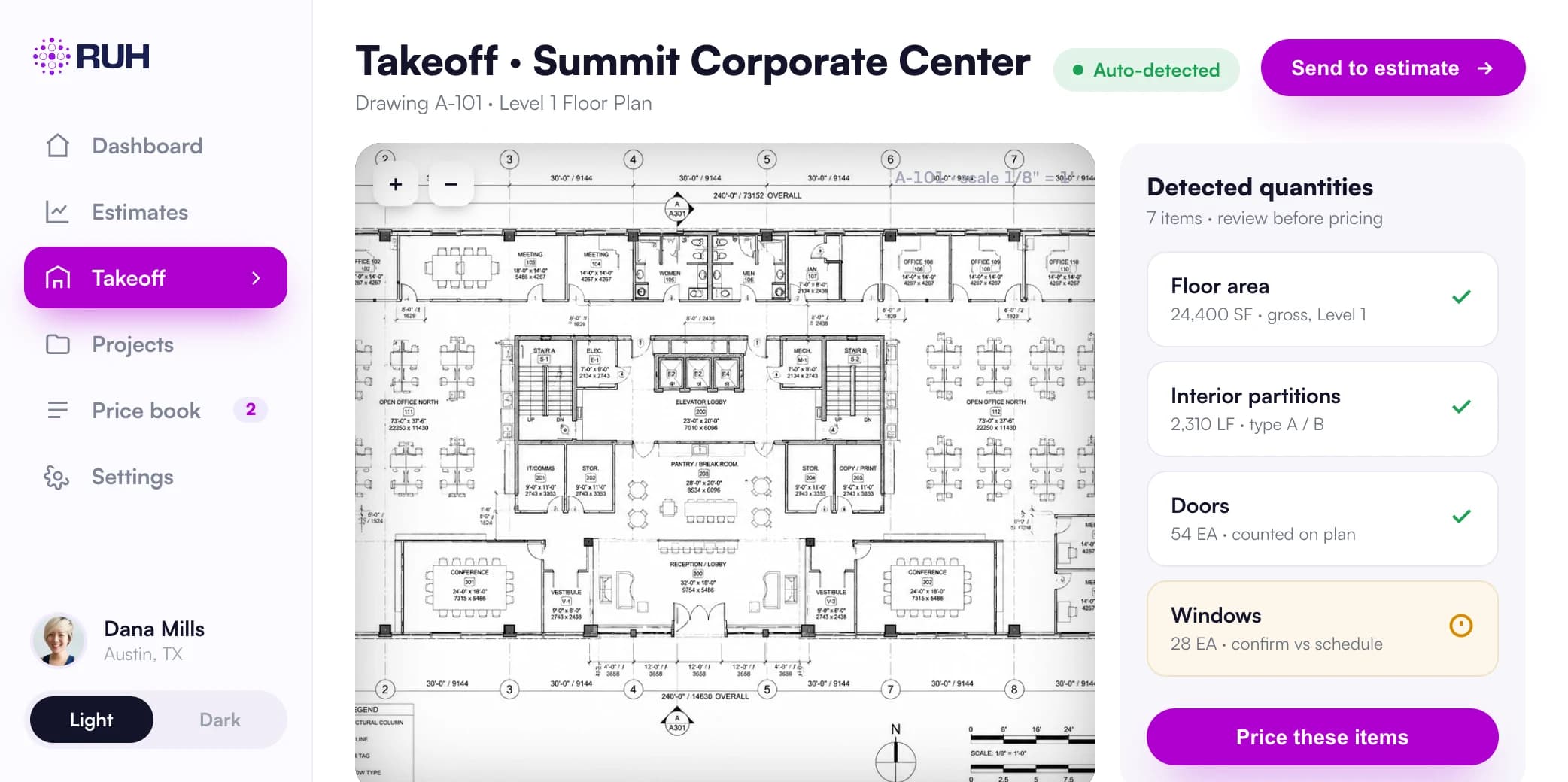
Ruh reads the framing plan and beam schedule, pulls each LVL callout with its ply count, depth, and length, and converts it to total linear feet per ply at each depth. It prices those linear feet on your own price book and flags the connection hardware and bearing notes so they are not missed. The estimator reviews ply count, depth, and span against the schedule and signs off.

See framing estimating software

LVL (laminated veneer lumber): frequently asked questions

How is LVL different from glulam?+

LVL is made from thin veneers glued with the grain all running lengthwise, while glulam is made from stacked dimensional lumber laminations. LVL comes in fixed thicknesses and ships in handy plies, while glulam is made in larger custom sections for longer spans and exposed work.

How many plies of LVL do I need for a beam?+

Ply count comes from the engineer or the manufacturer span table based on load and span, not a rule of thumb. Common framing beams are 2-ply or 3-ply at 1.75 in each. Always build to the beam schedule callout.

Can LVL be left exposed as a finished beam?+

LVL is an industrial-looking product with visible veneer lines and is normally hidden in walls or floors or wrapped. When an exposed architectural beam is wanted, glulam or a wrapped assembly is the usual choice.

Still measuring by hand? Your next takeoff can run while you review this one.

See it on your plans

Related terms

Keep going: read the full guide or explore framing estimating software.

The Wood framing estimating cheat sheet
Every unit, waste factor, and conversion on one page. Free PDF.

See Ruh price a bid from your own drawings.

AI takeoff and estimating on your price book, your estimator signs off.

Figures on this page are illustrative. Construction estimates depend on project-specific conditions, source documents, market pricing, and professional judgment. Ruh's AI assists the estimator and does not replace professional review: your team reviews, validates, and approves every estimate, bid, and pricing decision.