
Quick Answer
To find construction projects to bid earlier, a contractor checks the places public work is announced first, such as federal presolicitation notices on SAM.gov and state and local portals, on a fixed schedule against written fit criteria, and logs every opportunity found. Below are a table of the federal notice rules and timelines, AGC and Sage 2026 figures on where contractors expect work, a worked example of the days you gain by finding a project at the notice stage, a weekly discovery routine with an opportunity log, and our view on what contractors get wrong.
What you'll find below:
- The federal notice rules, from the $25,000 posting threshold to the 30-day response minimum
- Where contractors expect more work to bid in 2026, by market
- A worked example: 45 days to prepare instead of 20
- A weekly bid discovery routine, a fit scorecard and the fields for an opportunity log
- Our view on what contractors get wrong about finding bids
Why Do Contractors Find Good Projects Too Late?
Contractors find good projects too late because public work is announced across many separate portals, and the person checking them is an estimator with bids already due. The search happens when there is time, which means a project gets found after the pre-bid meeting or with too few days left to price it well.
The work itself is not hard. Someone opens the federal site, the state transportation department, three counties, two cities, the school district and a plan room, and scrolls each one. Every portal has its own login, its own search and its own way of posting addenda.
The cost is not the scrolling. It is the timing. A project found a week late leaves less room to read the documents, line up subs, walk the site and decide whether to pursue it at all. The bid goes in rushed, or it does not go in.
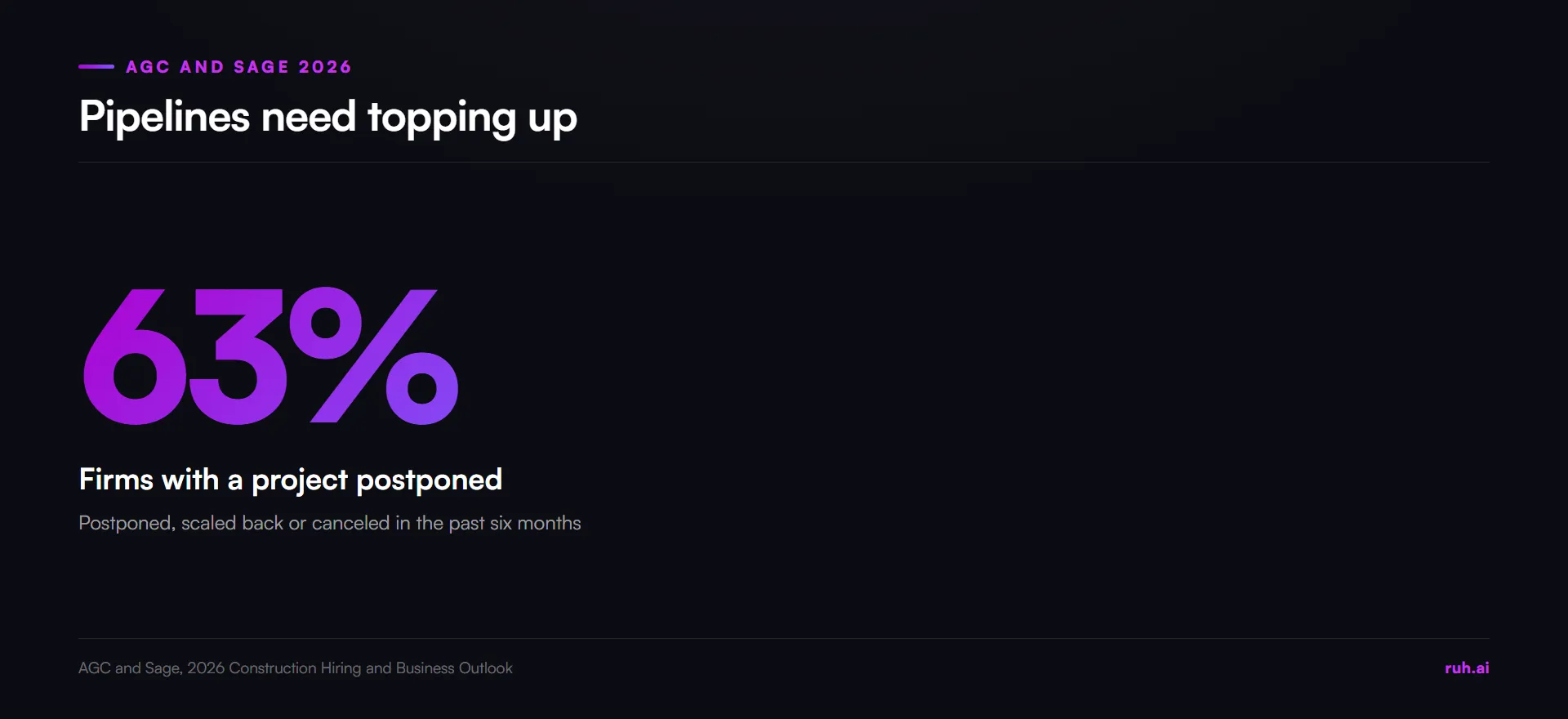
Demand is still there to find. The AGC and Sage 2026 Construction Hiring and Business Outlook found that 76% of firms were at least moderately confident in their backlog and bidding pipeline going into 2026. The same survey found that 63% had a project postponed, scaled back or canceled in the previous six months, so the pipeline needs topping up more than it used to.
Where Are Public Construction Projects Posted?
Public construction projects are posted on the federal government's SAM.gov site for federal work, and on each state agency, county, city, school district and utility's own procurement portal for everything else. There is no single national list for state and local work, which is why the search spreads so thin.
Federal work has one front door. The Federal Acquisition Regulation, as it stood in 2026, defines the Governmentwide point of entry as the single place where federal business opportunities over $25,000 can be accessed by the public, and names sam.gov as its location (FAR 2.101 and 5.201).
State and local work has many doors. Each owner runs its own procurement, so a contractor working across a region checks a list of portals that grows with every new county or agency it chases. Plan rooms and paid aggregators collect some of these, but none can promise to see everything.
Private work is not posted at all. Private owners and GCs invite bidders they know. That work is found through relationships, prequalification and referrals, which our guide to how to bid more construction jobs covers from the capacity side.
How Early Can You See a Federal Construction Project?
You can see a federal construction project before it goes out for bid, because federal rules require a notice ahead of the solicitation and a minimum response window after it. Contractors who watch for notices, not just solicitations, get the most time.
The federal notice rules that set your preparation window:
| Rule | What it says | Figure | Source |
|---|---|---|---|
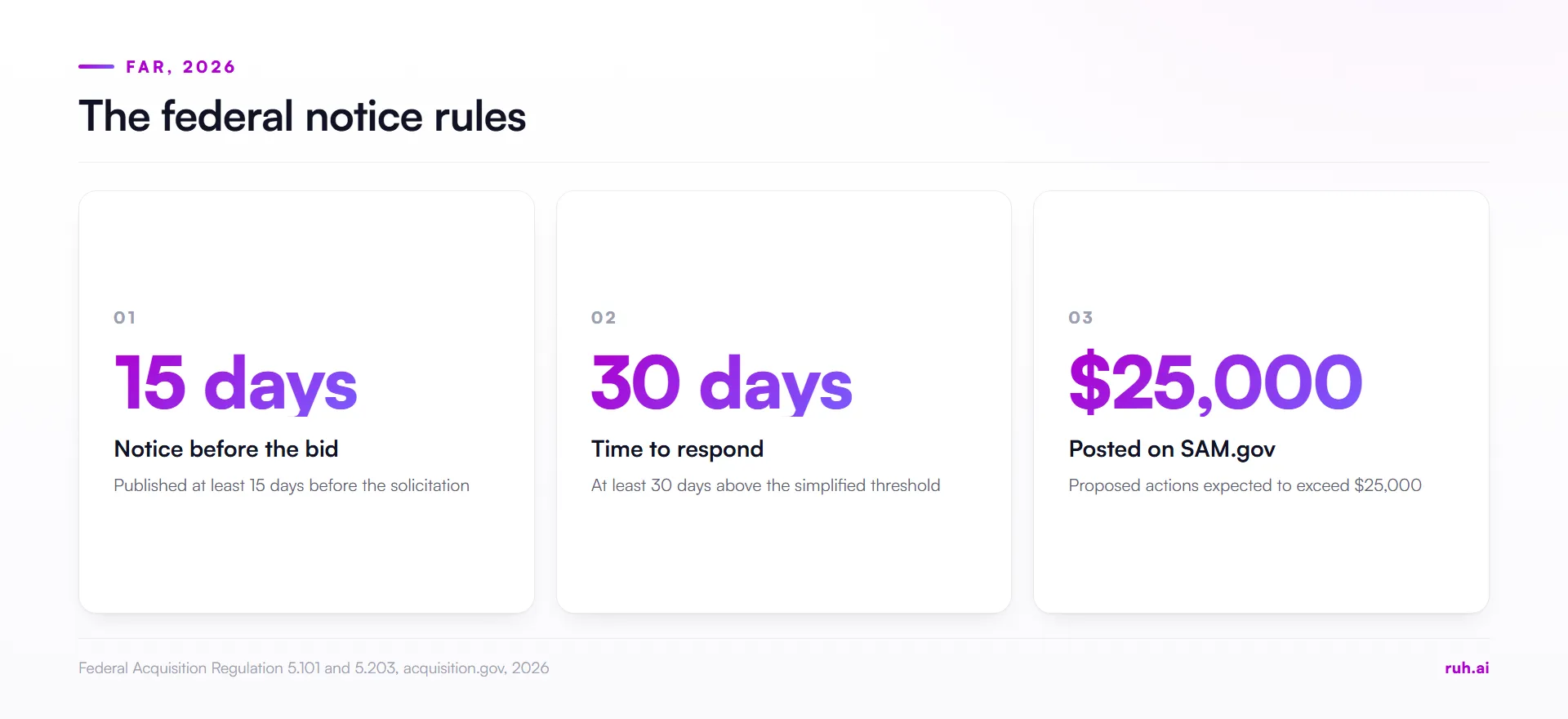
| Synopsis on the federal site | Proposed actions expected to exceed this amount are synopsized on SAM.gov | $25,000 | FAR 5.101, 2026 |
| Public display for small actions | Actions over $20,000 and up to $25,000 are posted in a public place for at least 10 days | $20,000 to $25,000 | FAR 5.101, 2026 |
| Notice before the solicitation | The notice is published at least this many days before the solicitation is issued | 15 days | FAR 5.203, 2026 |
| Minimum response time | Above the simplified acquisition threshold, bidders get at least this long to respond | 30 days | FAR 5.203, 2026 |
| Simplified acquisition threshold | The line above which the 30-day minimum and construction presolicitation notices apply | $350,000 | FAR 2.101, 2026 |
| Construction presolicitation notice | Required above the threshold, with a description, location, estimated price range, tentative dates and where plans can be inspected free | text | FAR 36.213-2, 2026 |
The presolicitation notice is the early signal. Under FAR 36.213-2, as read in 2026, a federal construction presolicitation notice gives an estimated price range, the work location and tentative dates for issuing the invitation and opening bids. That is enough to decide whether a project fits before a single drawing is downloaded.
Worked example: finding a project at the notice vs finding it late (illustrative)
The numbers below use the federal minimums from the table. Real timelines run longer on many projects, so treat this as the floor, not the rule.
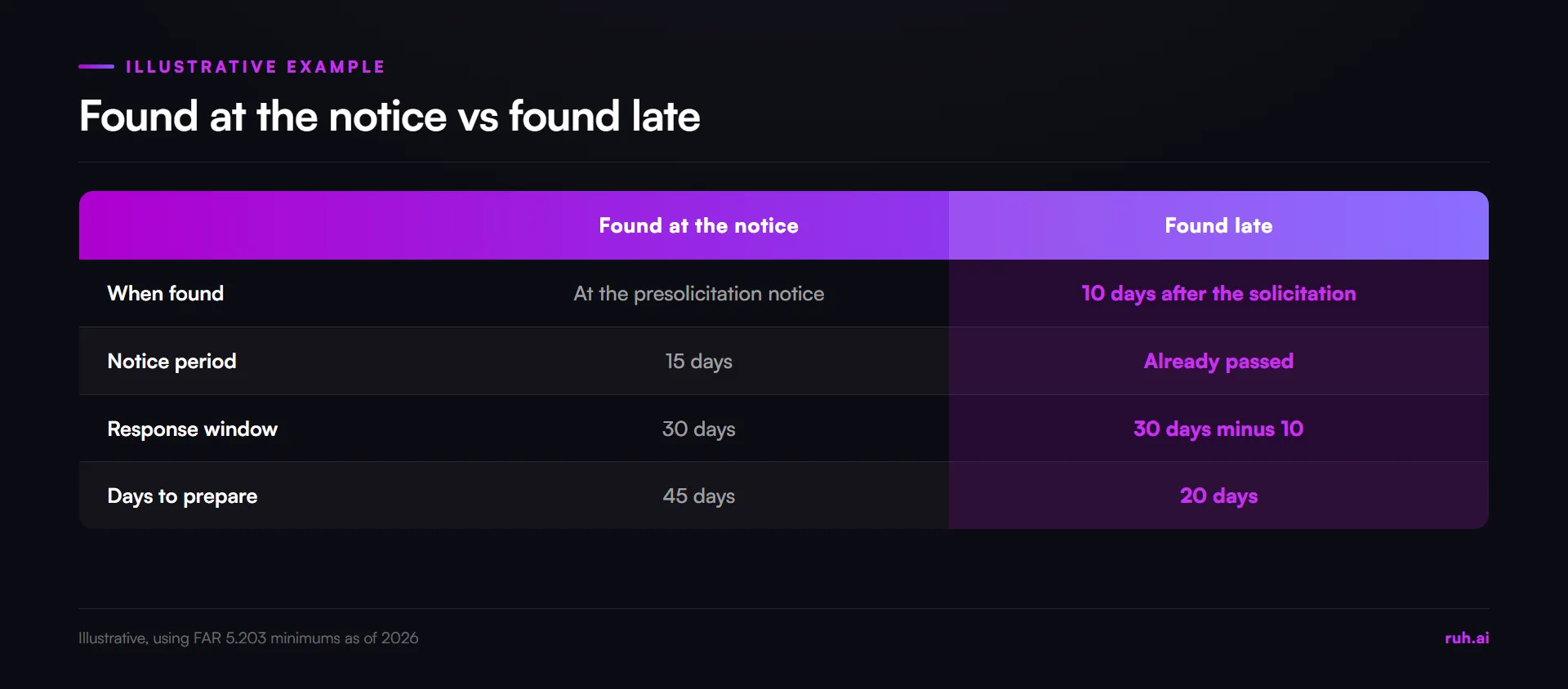
Found at the notice. A notice appears on SAM.gov. The solicitation follows at least 15 days later, and bidders then get at least 30 days to respond.
- Days to prepare: 15 plus 30 = 45 days
Found late. The same project is found 10 days after the solicitation was issued, with the minimum 30-day response time.
- Days to prepare: 30 minus 10 = 20 days
That is 25 extra days to read the documents, ask questions, line up subs and plan the takeoff, from the same project. How often you check matters too. A team that checks once a week is up to 7 days behind a posting. Checking twice a week cuts the worst case to about 4 days.
Which Markets Have the Most Work to Bid in 2026?
The markets with the most work to bid in 2026, by contractors' own expectations, are data centers and power, followed by healthcare, water and sewer, and manufacturing. Federal and public building work is still positive but much flatter than a year earlier.
The AGC and Sage 2026 outlook measured a net reading for each market: the share of firms expecting the dollar value of available projects to grow, minus the share expecting it to shrink.
Net reading by market, AGC and Sage 2026 Construction Hiring and Business Outlook:
| Market | Net reading 2026 | What it means for your search |
|---|---|---|
| Data centers | 57% | The strongest expectations of any market |
| Power | 34% | Second only to data centers |
| Hospitals | 20% | Positive but cooler than 2025 |
| Water and sewer | 16% | Public owners, so portals and notices matter |
| Bridge and highway | 10% | Down 14 points from the year before |
| Federal work | 5% | Down from 22% a year earlier. Watch notices closely |
| Public building | 1% | Close to flat in AGC's 2026 survey |
| Retail | -18% | More contractors expect less work than more, per AGC 2026 |
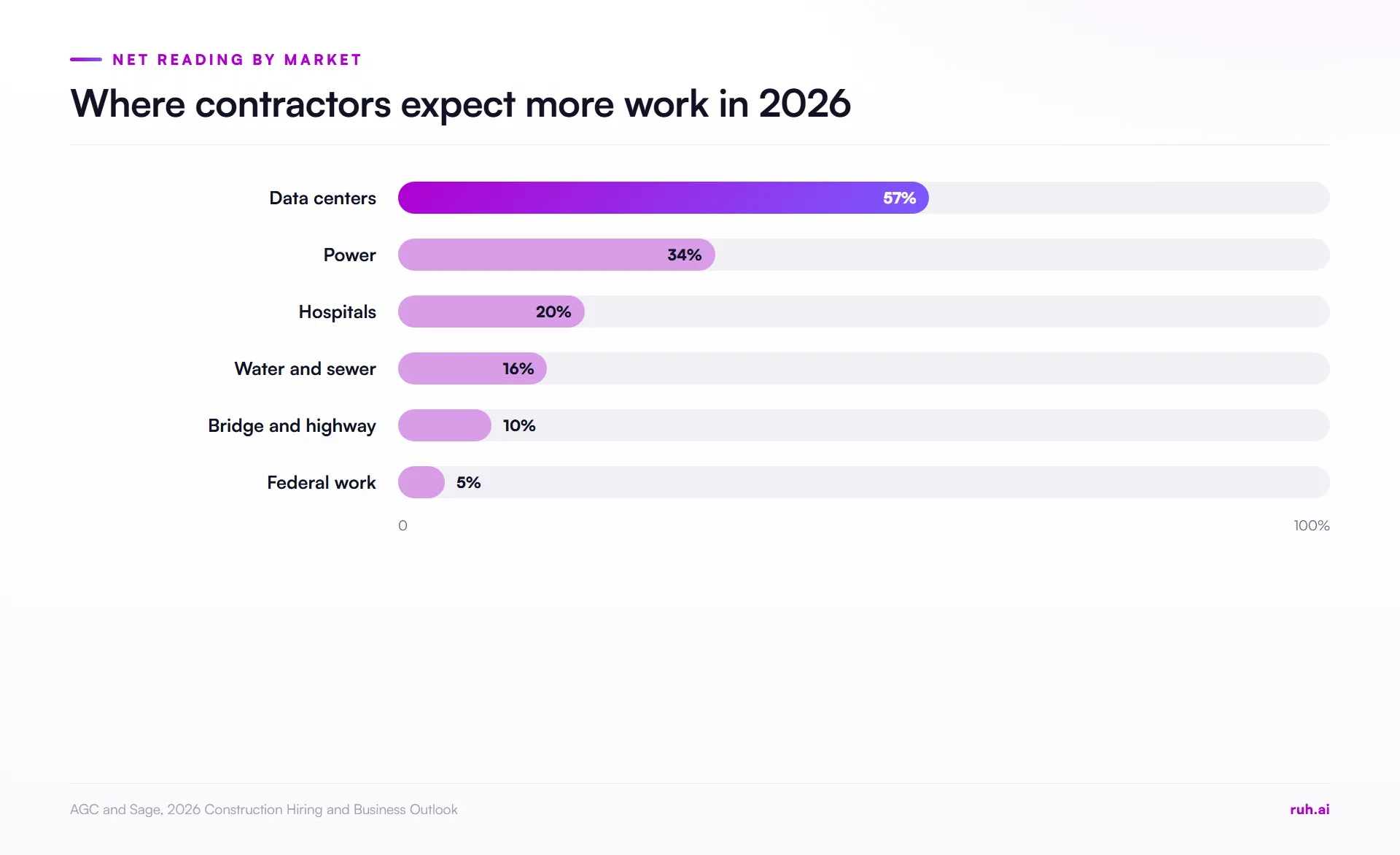
Use this to decide which portals deserve a daily look and which can wait for the weekly sweep. A water utility's portal in a growing region earns more attention than a retail developer's list.
What Should a Public Bid Portal Aggregator Do for You?
A public bid portal aggregator should collect notices and solicitations from the portals you care about into one feed, filter them by your trades, region and size, and alert you the day something new appears. If it cannot do those three things, it is just another portal to check.
Questions to ask before you pay for one:
- Coverage. Which federal, state and local portals does it read, and how often? Ask for the list for your region, not a national total.
- Notices, not just bids. Does it pick up presolicitation and sources-sought notices, or only open solicitations?
- Filters. Can you filter by trade codes, location, estimated value and owner type?
- Addenda. Does it track addenda and date changes, or only the first posting?
- Exports. Can you move found projects into your own log without retyping?
Even the best aggregator misses portals. Keep a short list of the owners you most want to work for and check their sites directly.
How Do You Build a Weekly Bid Discovery Routine?
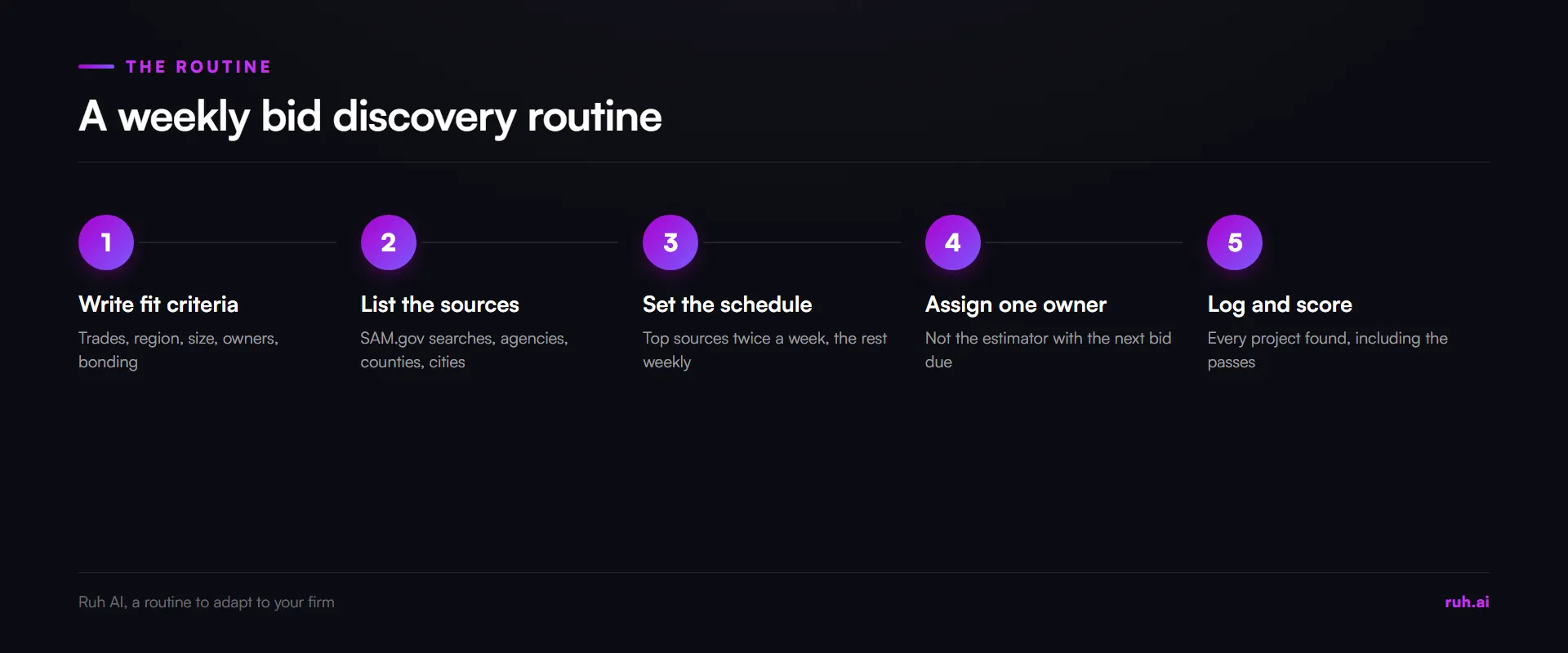
You build a weekly bid discovery routine by writing your fit criteria first, assigning one person to check a fixed list of sources on fixed days, and logging every project found, including the ones you pass on. The routine matters more than the tool.
The weekly routine:
- Write the fit criteria. Trades, geography, size range, owner types and bonding limit, on one page.
- List the sources. SAM.gov saved searches, the state agencies you work for, your top counties, cities and districts, and any aggregator you use.
- Set the schedule. High-value sources twice a week, the rest once a week, on the same days every week.
- Assign one owner. Someone other than the estimator with the nearest bid due, so the search does not stop on busy weeks.
- Log and score. Every project found goes into the log with a fit score, whether you pursue it or not.
The fit scorecard (one point each, out of 6):
- Trade fit: most of the scope is work your crews do every week
- Size: inside your bonding and staffing range
- Location: reachable without paying travel every day
- Owner: an owner or GC you know pays, or one you want to win
- Timing: enough days to prepare a proper bid
- Competition: a bidder list you can realistically beat
Fields for your opportunity log (the example row is illustrative):
| Field | Example |
|---|---|
| Project and owner | Water treatment upgrade, county utility |
| Source and date found | County portal, 6 Oct |
| Stage when found | Notice, solicitation or addendum |
| Bid due date and days left | 14 Nov, 39 days |
| Estimated value | From the notice's price range |
| Fit score (out of 6) | 5 |
| Pursue or pass, and why | Pursue: repeat owner, scope fit |
| Result | Won, lost and why, or passed |
After a quarter, the log shows which sources produce the projects you win, so you can drop the ones that only produce noise.
How Do You Turn Found Projects Into Qualified Pursuits?
You turn found projects into qualified pursuits by scoring each one against your fit criteria the day it is found, and only then downloading documents and assigning an estimator. Found is not the same as worth bidding.
Every lost bid costs estimating hours. SMPS Foundation research reported in 2017 found an average hit rate of 37.9% for construction firms, measured as proposals submitted against projects won, which means most pursuits do not convert. Earlier discovery does not change that math. It gives you time to choose better.
The days you gain from earlier discovery are best spent on three things: reading the documents properly, asking questions before the deadline, and checking the scope against your own takeoff. Our guide to construction bid accuracy covers why the wrong win can cost more than a loss, and our piece on takeoff accuracy covers checking quantities before you price.
What Contractors Get Wrong About Finding Bids
In our view, most contractors who struggle to find bids make the same four mistakes. These are our positions, not survey findings.
They add sources instead of fixing the routine. Twenty portals checked whenever someone remembers will find fewer good projects than eight portals checked on fixed days.
They make the estimator the searcher. The estimator is the person with the least spare time and the most bids due. Searching is a task anyone trained on your fit criteria can do.
They do not log the passes. A project you decided not to bid is information. Without the pass log, you cannot tell whether you are missing good work or rightly skipping bad work.
They treat found as qualified. A long list of opportunities feels like a full pipeline. It is not one until each project has been scored against your criteria.
The Honest Assessment: What Still Falls Short
No routine or aggregator sees every public project. Small owners post on their own websites, in local papers or on bulletin boards, and some work never reaches a portal at all.
Federal rules set minimums, not promises. The 15-day notice and 30-day response are floors under FAR 5.203 as published in 2026, and there are exceptions, including shorter periods for commercial items. State and local rules vary by owner.
Earlier discovery does not make estimating faster. It gives you more calendar days, but the takeoff and pricing still take the same hours unless you change how they are done.
The market data is national. The AGC and Sage 2026 net readings describe contractors' expectations across the US. Your region can differ.
How Ruh AI Fits Into This
Once you have found a project worth bidding, the short window goes on takeoff and pricing, and that is where Ruh AI works. Ruh's Takeoff Agent measures quantities from your drawings and withholds a figure when a sheet has no scale instead of guessing. Your estimator approves every scope line before Ruh measures it.
The Estimating Agent prices from your company's own rate book and history. Your estimator can change any price or add their own costs, and a person approves the budget before the next stage. For quick checks while you decide whether to pursue, Ruh's free construction calculators cover common quantity and cost estimates.
Frequently Asked Questions
Q: How do I find construction projects to bid? A: Check SAM.gov for federal work and the procurement portals of the state agencies, counties, cities and districts you want to work for, on a fixed schedule. Write your fit criteria first and log every project you find.
Q: Where can I find government construction bids? A: Federal construction opportunities over $25,000 are posted on SAM.gov under the Federal Acquisition Regulation as it stood in 2026. State and local bids are posted on each agency's own procurement portal, and some appear in plan rooms and paid aggregators.
Q: How early are federal construction projects announced? A: Above the simplified acquisition threshold, a federal construction project usually gets a presolicitation notice before the solicitation. FAR 5.203 sets a notice at least 15 days before the solicitation and at least 30 days to respond, with some exceptions.
Q: Are bid aggregators worth paying for? A: An aggregator is worth it if it covers the specific portals in your region, picks up notices as well as solicitations and filters by your trades. Ask for its source list for your area before you sign.
Q: How often should I check bid portals? A: Check your highest-value sources at least twice a week and the rest weekly, on the same days. A weekly check can leave you up to 7 days behind a new posting.
Q: How do I decide which found projects to pursue? A: Score each project on trade fit, size, location, owner, timing and competition the day you find it. Pursue the high scores and log the passes with a reason.
The Bottom Line
Finding construction projects to bid earlier is a routine, not a search. Watch for notices as well as solicitations, check a fixed list of sources on fixed days, score every project against written criteria and log what you pass on. The days you gain are worth more than any single new portal.
See how Ruh AI supports the estimating team once you have found the right project. Explore Ruh AI for estimators and precon.
Sources
- Federal Acquisition Regulation 5.203, Publicizing and response time: acquisition.gov
- Federal Acquisition Regulation 36.213-2, Presolicitation notices: acquisition.gov
- AGC and Sage, 2026 Construction Hiring and Business Outlook: agc.org
- SMPS Foundation hit rate study, reported by Building Design + Construction, 3 January 2017: bdcnetwork.com
- Federal Acquisition Regulation 2.101, 5.101 and 5.201 (acquisition.gov)