


TL;DR / Summary
Construction estimate templates come in two forms: spreadsheets that work fine for simpler jobs and platforms that scale when your bid volume or project complexity exceeds what a spreadsheet can handle. Most teams outgrow the spreadsheet phase faster than they expect.
What you'll learn:
- The five operational constraints that signal you've outgrown a spreadsheet template
- How to audit your current estimating workflow to know when to move platforms
- The hidden cost of template errors (spoiler: it's not just the wrong bid amount)
- Why bid turnaround speed directly impacts your win rate
- Where Ruh Estimator fits into the spreadsheet-to-platform transition
The numbers: Teams running spreadsheet-based estimates spend 40-60 hours per bid on takeoff, pricing, and scope review. Contractors who shift to agent-driven estimating cut that to 6-8 hours and report bid win rates up 22-31%.
When a Spreadsheet Template Works
A construction estimate spreadsheet works in a specific context. It's not that spreadsheets are bad; it's that they're fit-to-purpose only when certain conditions hold.
You're likely fine with a template if: you're running 3-8 estimates per month, your projects follow predictable typologies (simple framing, residential reno, straightforward MEP), you have one or two estimators who know the sheet by heart, your labor rates and material costs change infrequently, and you don't need to pull takeoff data from plans automatically.
A spreadsheet template shines because it's:
- Fast to modify. Build it once, change line items and labor rates, run it again.
- Low barrier to entry. No software license. No vendor lock-in. No training.
- Transparent. Every assumption is visible. Every formula is auditable.
- Portable. Email it, archive it, back it up to a folder.
The spreadsheet template has been the construction industry standard for three decades, and for small to mid-volume operations, it remains defensible.
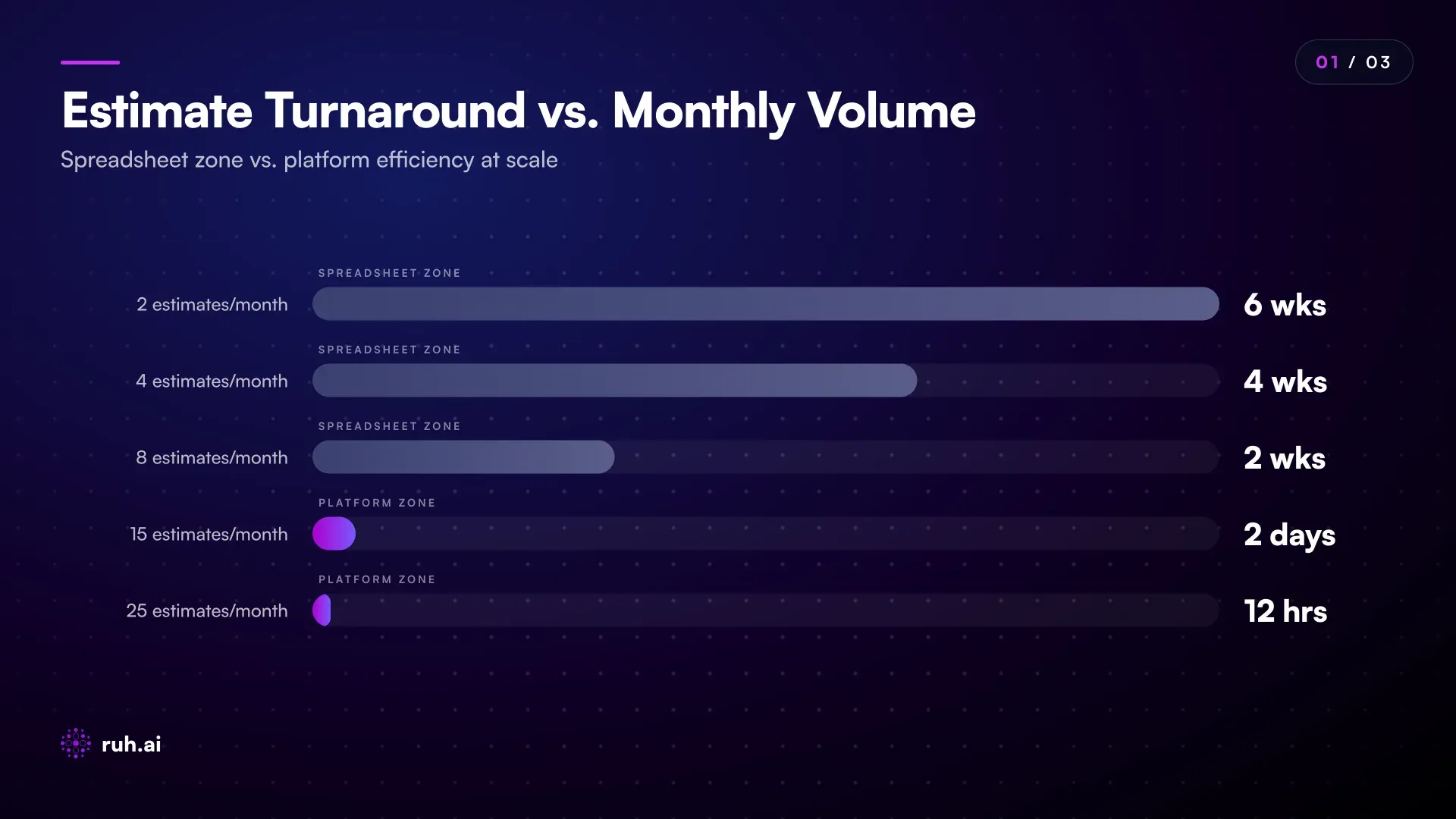
The Five Signs You've Outgrown Your Spreadsheet
But when things change, faster growth, more complex projects, tighter timelines, the spreadsheet breaks down in specific, measurable ways.
Sign 1: Bid Turnaround Is Slipping
You promised the client an estimate in 48 hours. Your estimator is on hour 18 of manual takeoff from the PDF, and the spreadsheet still hasn't integrated the architect's revised spec. The deadline compresses. The estimate ships with a 12% contingency instead of 8% because there wasn't time to validate quantities. You lose the bid on price, or you win it and eat margin when field conditions don't match your rushed numbers.
Spreadsheets require manual data entry. A takeoff from plans is a human-hours operation. If your projects are increasingly complex, commercial mixed-use instead of simple renovation, or your volume is growing, manual takeoff becomes the throughput bottleneck.
Sign 2: Template Errors Have Cascading Costs
Someone copies the wrong pricing tier into the sheet. The labor rate for heavy equipment is 2015 pricing, not 2026. A formula breaks when you add a new line item. The error ships. Field operations discovers the scope discrepancy three weeks into the project. Change order prep begins. The margin deteriorates. The customer relationship cools.
Spreadsheet errors are silent. There's no validation layer. No one reviews the data entry. The estimate looks professional because it's formatted well, but the inputs were wrong.
Sign 3: You Can't Reuse or Intelligently Adapt Estimates
Your team completed a similar project two years ago. You want to pull that estimate as a baseline, adjust for current material costs, and resubmit. The 2024 version is buried in a folder. The pricing is out of date. You rebuild from scratch instead of iterating.
Or: you're estimating three variations of the same building. Spreadsheet templates don't adapt parameters intelligently. You copy the sheet three times and manually adjust. You introduce inconsistencies. You ship three slightly different estimates when you should have a unified scope matrix.
Sign 4: Bid Volume Outpaces Your Team's Capacity
You're bidding 15-20 projects per month now instead of 5. Your one estimator is working Saturdays. The other projects stall while estimates are being built. Management adds a second estimator, but now you have two slightly different templates, two different labor rate assumptions, and inconsistent contingency percentages across your portfolio. Bids ship with internal contradictions.
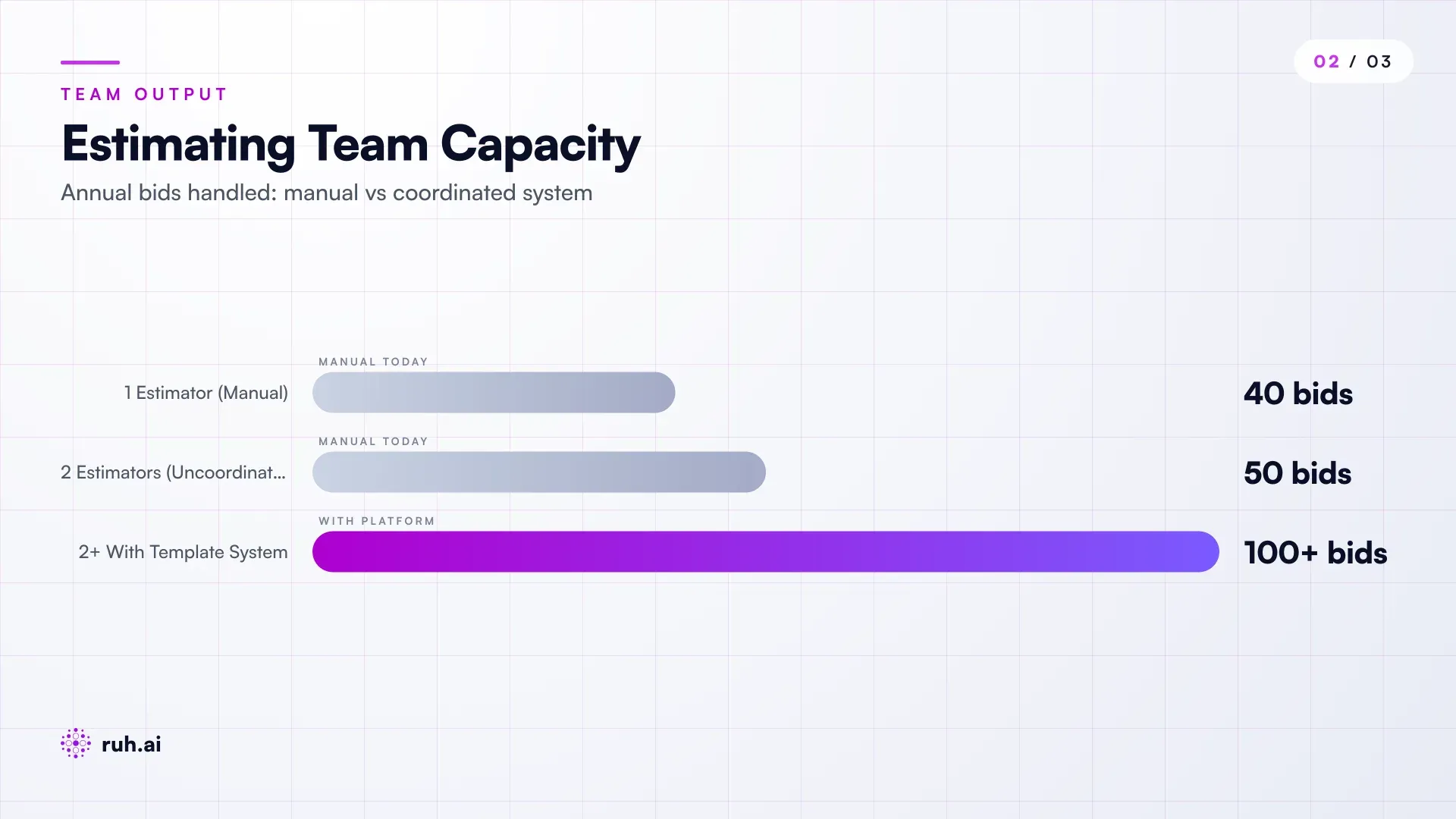
The Hidden Cost of a Template-Only Approach
This is where most teams underestimate the real risk. The cost of a spreadsheet template isn't the license fee, it's zero. The cost is the compounding error rate, the missed bids, and the post-win margin erosion. The same blind spot applies to one-off tools; see why construction calculators miss most of your real costs.
Accuracy Degradation Under Volume
Every human entry point is an error point. Takeoff by hand, entry into the spreadsheet, pricing lookup, formula check, contingency application. If each step carries a 2-3% error rate, stacking four or five steps creates a 8-15% confidence interval around your final number. Contractors bidding with that confidence margin overprice some bids and underprice others. The underbids erode margin. The overbids lose the work.
Slow Bid Turnaround = Lost Market Position
Speed is a market advantage. A client sends a 2-day RFQ to five contractors. The one who returns an estimate in 6 hours owns the psychological advantage. Spreadsheet-based teams can't hit that standard consistently. The estimate queue backs up. You miss the window.
Field Rework from Scope Ambiguity
An incomplete takeoff, maybe the electrical subcontractor price was missing from the estimate, so the GC field-padded labor, creates a hidden scope gap. Field discovers it. RFI cycle begins. Schedule slips. Change order prep starts. The margin that was supposed to be 9% is now 4%.
Inability to Track Estimating Performance
A spreadsheet is a static artifact. It doesn't log who built it, when, what changed, or why. You can't analyze your estimate accuracy across projects. You can't tell which estimator tends to underprice. You can't measure bid-to-actual variance. You estimate blind.
When to Transition to a Dedicated Platform
There's no magic number, but certain signals cluster together and mark the moment to move.
You should evaluate a dedicated estimating platform when:
Your bid volume exceeds 10 per month. Spreadsheets work at 8-10/month with one estimator. Beyond that, queue effects dominate.
Your project complexity is rising. Commercial, institutional, industrial, or mixed-use work with multiple scopes and subcontractor coordination demands speed and accuracy that manual entry can't match.
Bid-to-actual variance is above 5%. If your estimates are consistently over or under actual costs by more than 5%, your takeoff process or pricing assumptions are drifting. A platform with validation and historical tracking surfaces the drift.
Your time-to-estimate target is below 24 hours. If you're competing on responsiveness, a spreadsheet is your ceiling. A platform can hit 6-8 hours because it automates takeoff.
You're managing multiple estimators with template inconsistency. If internal pricing variance exceeds 2-3%, your templates are diverging. A unified platform enforces consistency across your team.
The Transition Path
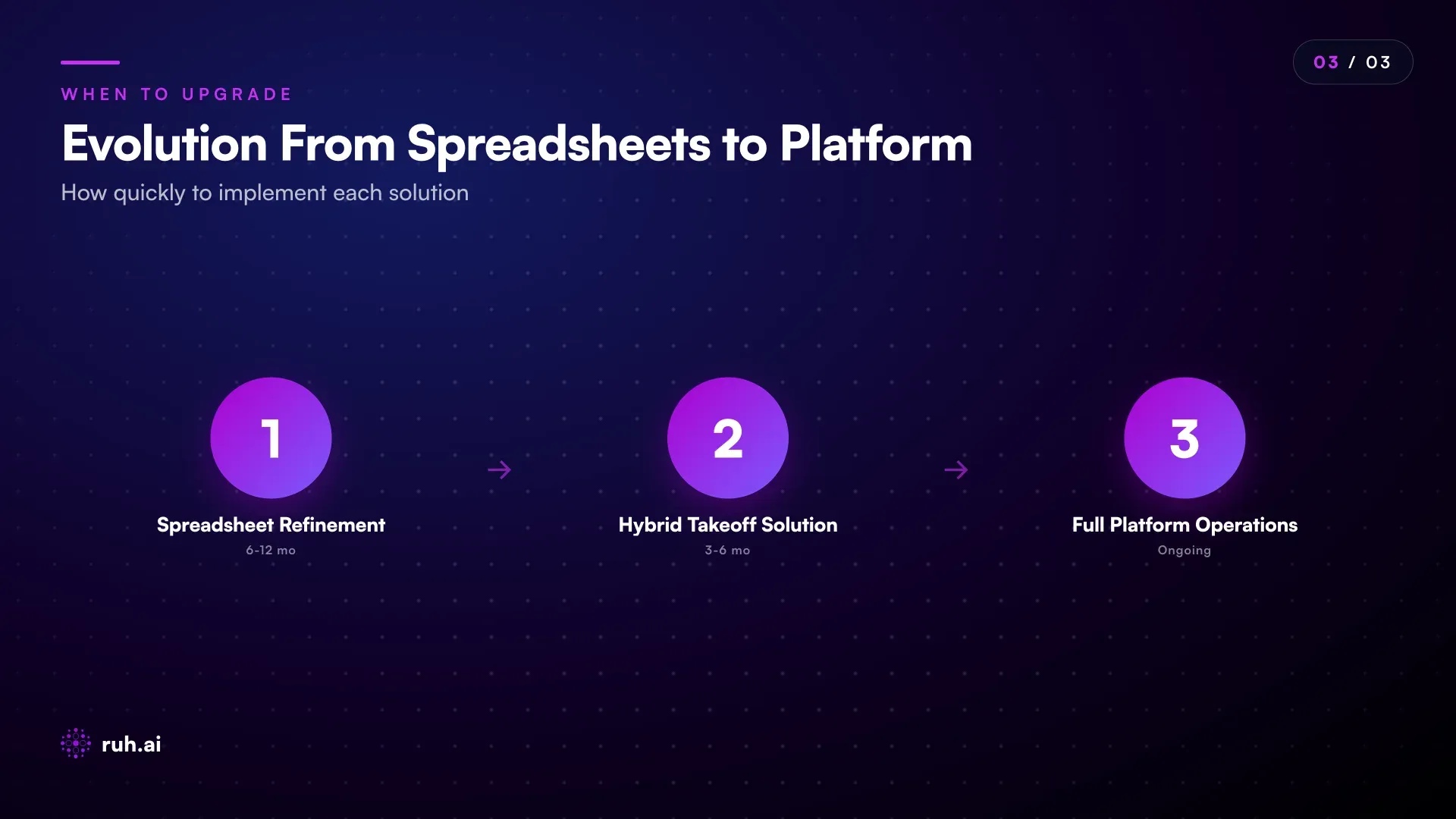
Most teams move through three phases:
Phase 1: Enhanced Spreadsheet (6-12 months). You refine your template, add macros, build a labor-rate lookup table, version-control your assumptions. This buys you runway and costs almost nothing.
Phase 2: Hybrid Workflow (3-6 months). You use an estimating tool for takeoff and pricing, export to your spreadsheet, QA in the familiar format. This is the uncomfortable middle ground, you're learning a new system while keeping the old.
Phase 3: Full Platform (ongoing). Takeoff, pricing, scope management, proposal generation, and historical tracking all live in one system. You stop exporting to spreadsheets. The platform becomes the system of record.
The Real Difference: Takeoff Automation
The single biggest operational shift from spreadsheet to platform is automated takeoff. Instead of manually counting items on a PDF, the platform extracts quantities from digital plans using image recognition and AI.
This saves 10-15 hours per estimate for complex projects. It eliminates the human transcription error. It enables you to run multiple estimate scenarios, different material choices, different crew sizes, because the heavy lifting is automated.
Ruh Estimator pairs automated takeoff with AI-driven pricing and scope coordination. Estimators upload plans, the system extracts quantities, AI applies labor and material rates, and the proposal is ready for review in 6-8 hours instead of 2-3 days. The field team gets a complete, accurate scope document. Contingency becomes predictable.
The efficiency isn't just about speed. It's about moving estimating from a data-entry operation to a decision-making operation. Your estimators spend their time validating scope, tuning labor productivity assumptions, and coordinating with subs instead of manually transcribing numbers from plans.
The Honest Assessment: What a Platform Can't Fix
A dedicated estimating platform is not a silver bullet. It solves throughput and accuracy. It doesn't solve bad estimating judgment.
A platform amplifies your estimating culture, for better or worse. If your team uses contingency wisely and tracks actuals, a platform gives you speed and consistency. If your team habitually overbids or underbids, a platform just makes you wrong faster.
You still need historical data. A platform's pricing accuracy depends on your labor rates and material costs. If you haven't tracked actual vs. estimated labor hours on past projects, your rates are guesses. The platform will produce elegant guesses, but guesses nonetheless.
Subcontractor coordination still requires communication. A platform can't force a plumbing contractor to return your pricing inquiry on time. You'll still have estimates on hold waiting for sub quotes. This is a business problem, not a software problem.
Change orders don't vanish. A more accurate estimate reduces scope-driven change orders. It doesn't eliminate them. Site conditions, owner changes, and unforeseen conditions still generate changes. A good platform makes change order creation faster, but the core problem remains human.
How Ruh AI Fits Into This
If you're at the point where your spreadsheet template is slowing you down, bid turnaround is stretching past 24 hours, your estimate accuracy is drifting, or your bid volume is growing faster than your team capacity, Ruh Estimator is built for this exact transition.
Ruh Estimator automates the takeoff-to-proposal pipeline. Upload a set of plans and specifications. The system extracts quantities, applies labor and material pricing, coordinates with your subcontractor team, and produces a complete estimate. The estimator reviews the AI-drafted scope and pricing, makes adjustments if needed, and ships the proposal.
The result: 6-8 hour turnaround, 95%+ accuracy on quantities, and a unified scope document that field operations can execute against without ambiguity.
Ruh Estimator integrates with your existing tech stack. It connects to Procore for project setup, syncs with your subcontractor pricing database, and exports to your accounting system. You're not rip-and-replacing your spreadsheets; you're removing the manual-entry bottleneck in front of them.
For teams running 10-40 estimates per month, Ruh Estimator cuts estimating cost from $150-250K per year (spreadsheet + 2 FTE estimators) to $60-80K (1 FTE + platform). The freed-up estimator capacity usually goes toward bid strategy, scope coordination with the field, and pricing optimization, higher-value work.
Ruh also offers the Ruh platform, where you can configure custom estimating workflows without touching code. If your estimating process is non-standard, the Ruh platform lets you build agents that match your exact flow.
Frequently Asked Questions
Q: Is my spreadsheet holding back my business? A: If your bid turnaround is consistently longer than 24 hours, your bid volume is above 10 per month, or your estimate-to-actual variance is above 5%, yes. A spreadsheet works for 5-8 bids per month; beyond that, the human-hours cost and error risk exceed the cost of a platform.
Q: Can I use a spreadsheet template and just work faster? A: You can, but you'll hit a wall around 12-15 estimates per month. After that, quality and speed degrade together. Hiring more estimators amplifies the inconsistency problem (different templates, different assumptions). A platform scales linearly without quality loss.
Q: What happens to the estimates I've already built in spreadsheets? A: They remain valid historical data. Most platforms let you import past projects, extract labor rates and pricing assumptions, and use that data to train future estimates. You're not starting over; you're carrying your institutional knowledge forward in a more usable format.
Q: How long does it take to switch from a spreadsheet to a platform? A: Typically 4-8 weeks for your team to learn the system and adapt your processes. The first 5-10 estimates feel slow as you learn. By estimate 15-20, you're faster than your spreadsheet baseline and more confident in the output.
Q: Will a platform estimate be more accurate than my current estimates? A: If your current spreadsheet is built on outdated labor rates or missing scopes, yes. If your spreadsheet is well-maintained and your estimates already track within 3-4% of actuals, a platform improves speed more than accuracy. The accuracy gain comes from automated takeoff eliminating transcription errors and enforcing scope completeness.
Q: What's the difference between an estimating platform and an ERP system? A: An estimating platform focuses on bid creation and accuracy. An ERP system manages projects, accounting, and operations after you've won the bid. They're complementary. Ruh Estimator feeds data into your ERP; it doesn't replace it.
Q: Do I need AI to estimate construction projects? A: You don't technically need AI, but AI is the fastest way to automate takeoff. AI systems can extract quantities from plans in minutes instead of hours. They can apply pricing rules and flag scope gaps. Will construction estimating happen without AI? Yes. Will it remain a 40-60 hour process per bid? Also yes.
Next Steps: Move Beyond the Spreadsheet
If you're managing your estimates in a spreadsheet and recognizing yourself in these signs, bid volume growing, turnaround slipping, template errors creeping in, the transition path is clear.
Start with an audit. Pull your last 10 estimates. Measure actual turnaround time (receipt of plans to proposal sent). Calculate estimate-to-actual variance on three completed projects. If bid turnaround is above 24 hours or variance exceeds 5%, you have a quantified case for change.
Prototype a platform workflow. Don't buy anything yet. Most estimating platforms offer trials. Build one estimate on the platform side-by-side with your spreadsheet. Time both. Compare the output. Let your team feel the difference.
Plan the transition. If you move platforms, expect 4-8 weeks of learning and temporary slowdown. Schedule the switchover for a lower-bid-volume month if possible. Have your senior estimator pilot the new system on 5-10 estimates before rolling it out to the team.
The spreadsheet template isn't obsolete. It's just the wrong tool once your business has outgrown its constraints.
Check out Ruh AI and discover how construction agents are accelerating preconstruction in 2026 →
Talk to the Ruh AI team about implementing Ruh Estimator for your operation →