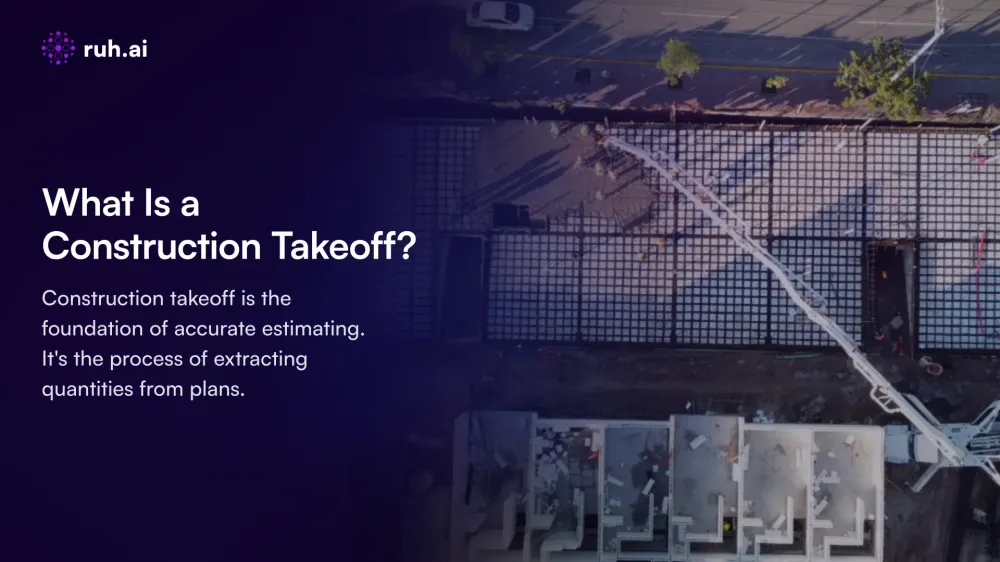


TL;DR / Summary
Manual counting in on-screen takeoff tools works, but it leaves 90% of the value on the table. Construction teams are switching to AI takeoff agents because they extract quantities end-to-end, catch scope discrepancies field teams would miss, and eliminate the bottleneck of an estimator hunched over Bluebeam for 30-40 hours per bid. By 2026, the speed advantage is real, but the reliability gain is what's changing behavior.
What you'll learn:
- Why on-screen takeoff tools stalled at "faster counting" instead of "automated counting"
- How AI agents handle scope parsing and exception detection that human estimators still do manually
- The specific accuracy gains and timeline compression teams report when switching
- The honest limitations of current AI takeoff implementations
- How Ruh Estimator and the Takeoff Agent fit into the modern preconstruction stack
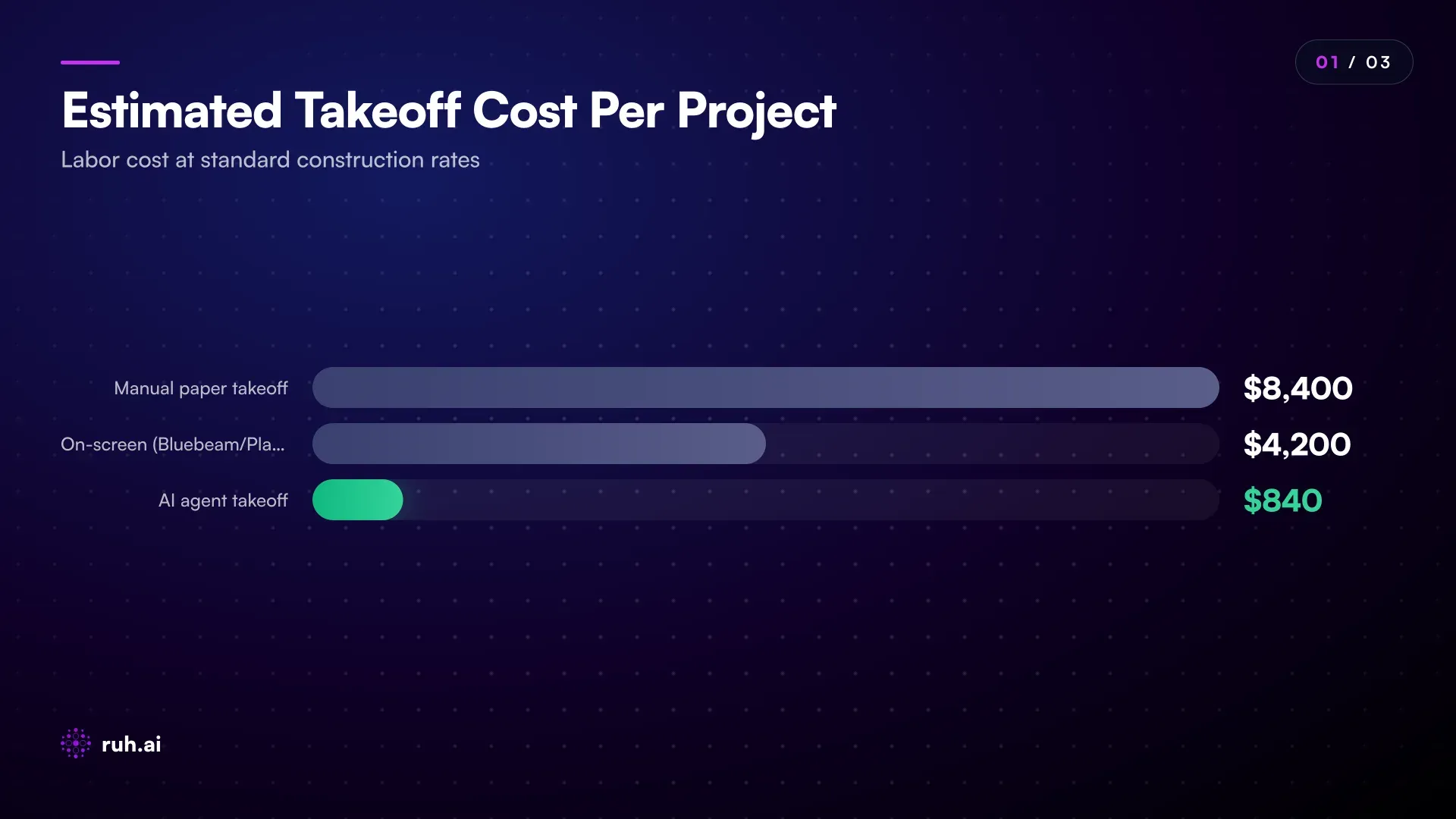
The numbers upfront: A typical general contractor's estimating team spends 40-60 hours manually counting and pricing per bid. On-screen takeoff tools cut that to 30-40 hours. AI agents cut it to 6-8 hours and flag scope issues field operations teams would have caught, expensively, on the job.
The Manual Counting Trap: Why On-Screen Takeoff Stopped Scaling
Estimators adopted on-screen takeoff tools because they worked. Bluebeam, Takeoff, PlanGrid, and similar platforms let them mark up digital plans, count items directly on screen, and feed numbers into their estimating database. No more printing. No more paper marks and transcription errors. The move from paper to pixels was a real productivity jump.
But here's what nobody talks about: on-screen takeoff tools stopped at faster counting. They didn't solve the underlying problem.
A typical estimating workflow for a concrete subcontractor or general contractor looks like this:
- Receive plans and specs
- Walk every drawing systematically
- Extract quantities (rebar, concrete volume, embedded items, finishes)
- Cross-reference specs for material callouts
- Flag scope gaps and mismatches
- Compile a scope document
- Price items and prepare the bid
On-screen tools accelerated steps 2 and 3. An estimator with Bluebeam can mark up a plan and count faster than with a pencil. But steps 4, 5, 6, and 7 still happen at human speed. An experienced estimator is still the bottleneck.
The second problem is silent: on-screen tools introduced a new manual step. An estimator now has to open the PDF, decide what to count on each sheet, manually mark areas or line items, then export the data. For a large project (50-100 sheets), this is still 30-40 billable hours of focused work. The tool sped up the counting. It didn't eliminate the counting.
AI Agents Change the Economics (And the Speed Isn't the Headline)
Construction teams ditching manual counting aren't chasing speed alone. They're chasing completeness.
An AI takeoff agent does four things on-screen tools don't:
Extracts across all sheets systematically, no human decision about what to count on each page. The agent scans all drawings and specs, identifies all takeoff-relevant items, and extracts them as a structured list.
Catches scope gaps, a real job hazard. If the architectural plans call for a finish that isn't detailed in the structural specs, or if a spec says "provide partition lining to be determined by the architect," the agent flags it. Field teams hate discovering gaps mid-pour.
Cross-references by spec section, when the agent finds "concrete, 4,000 psi, 4-inch slab," it immediately links it to the material specification in Division 3 and flags any non-standard curing or additives. On-screen tools show you what you counted; agents show you what was specified.
Compiles a scope document automatically, by the time the estimator sees the data, there's a draft scope document. The estimator reviews it, not builds it from scratch.
Here's the real impact: A project estimator working from AI-extracted takeoff data spends their time on judgment calls and pricing strategy, not counting. That's 6-8 hours instead of 40-60. But the estimator also has higher confidence in the scope completeness, which means fewer bid addenda, fewer scope-creep RFIs during execution, and fewer field surprises.
The Takeoff Accuracy Problem Nobody Solves Perfectly
Here's the honest assessment: AI agents are 90-95% accurate on routine items and 70-80% accurate on complex or ambiguous scope. That's a real constraint.
A routine item is straightforward: count the 6-inch CMU blocks on a wall, measure the lineal feet of base trim, identify the flooring type and square footage. AI agents trained on construction documents handle these reliably.
Complex scope is different. If the architectural details are unclear, if a specification says "provide the following: [list of three items], to be finalized by the design team", the agent can flag it, but an estimator still has to call the architect. If a drawing shows a mechanical room with "HVAC and MEP systems by others," the agent extracts "MEP rough-in and finishes" as a takeoff item, but pricing that item requires someone on a call with the MEP engineer.
The other accuracy risk is unit mismatch. Agents trained on US construction default to feet and pounds. A set of plans with mixed metric and imperial measurements (especially for imported building materials or HVAC specs) can trip up extraction. The agent might pull "per drawing" when it should pull "per spec" or vice versa.
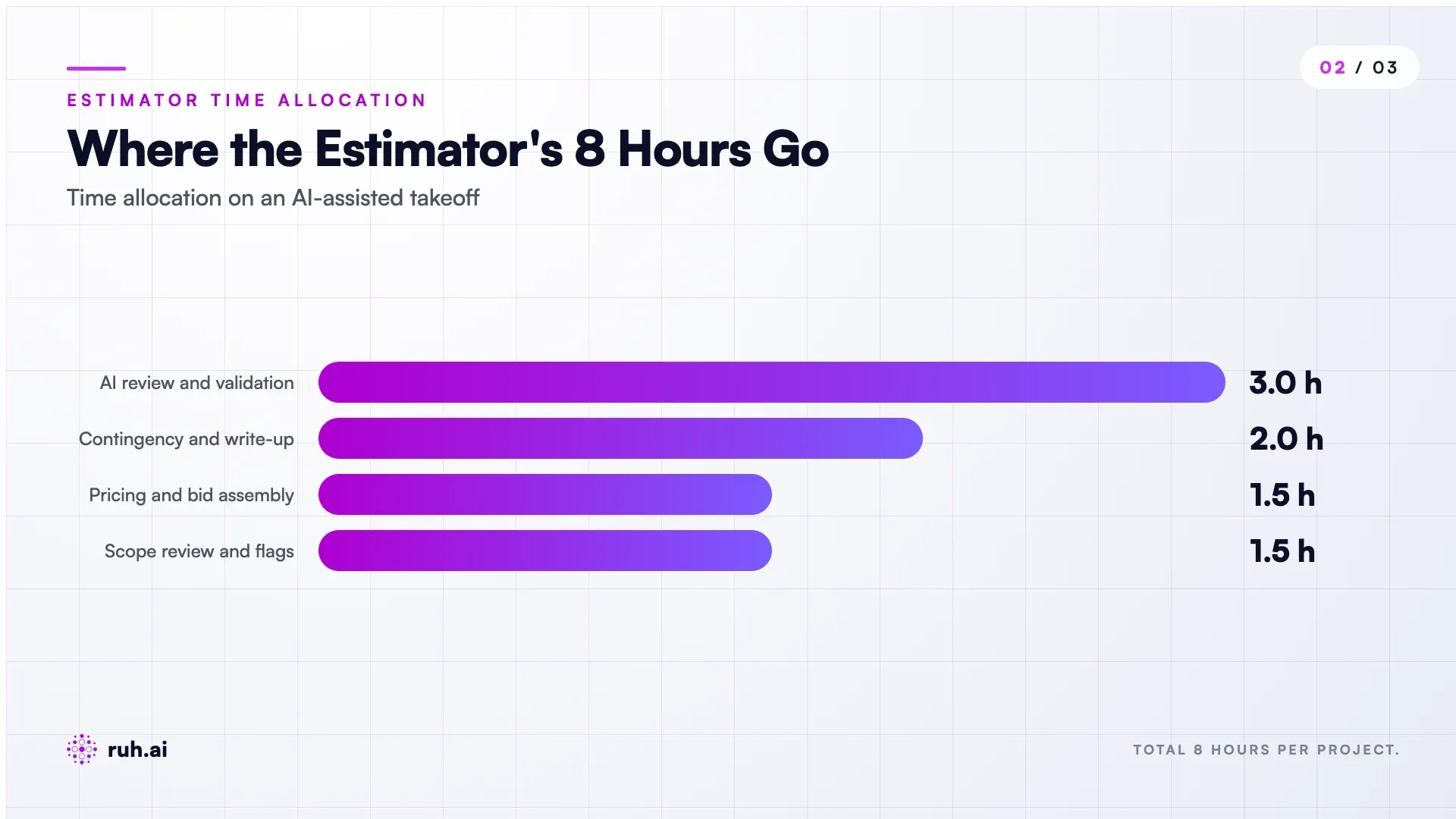
This is why the best implementations pair AI extraction with a validation step. The agent runs the takeoff end-to-end, flags ambiguous items in a report, and the estimator reviews and adjusts before finalizing the scope. That validation step is still 4-6 hours for a large project, but it's focused validation, not raw counting.
Why General Contractors and Subs Are Making the Switch Now
Three market forces converged in 2026 to make AI takeoff a business decision, not a novelty:
1. Bid volume pressure. Contractors are bidding more work to fill capacity as margins compress. A GC that bid 8-10 projects a month now bids 15-20. Without automation, the estimating team becomes the bottleneck. On-screen takeoff doesn't scale at this volume. AI agents do.
2. Labor availability. Experienced estimators are aging out of the workforce and aren't being replaced at the same rate. Training a junior estimator to work on-screen takeoff takes 6-12 months. A junior can validate AI-extracted takeoff data in 2-3 weeks. The math is forcing the change.
3. Integration with project systems. By 2026, most GCs and specialty contractors run Procore or similar project management platforms for field operations. AI-extracted takeoff integrates directly with these systems, scope feeds into RFIs, quantities feed into change order templates, takeoff documents live in the project folder. On-screen tools output a spreadsheet and a PDF. Integration wins.
Takeoff Agent Architecture: How It Actually Works
When a construction team deploys an AI takeoff agent, here's what runs:
Plan ingestion, PDF plans and spec documents are uploaded. The agent optically scans every sheet and builds a searchable, page-indexed database.
Specification parsing, the agent extracts all material and system callouts from the specifications and cross-references them to the detail drawings that show installation.
Systematic extraction, the agent walks every relevant drawing (architectural, structural, mechanical, electrical) and identifies all items that require a quantity or measurement: finishes, structure, MEP rough-in, embedded items, even site work mobilization.
Quantity calculation, for each item, the agent measures or counts automatically. Lineal feet of walls, square footage of finishes, count of openings, volume of concrete or fill.
Scope document generation, all extracted items are organized by CSI division and fed into a templated scope document with flagged ambiguities, unit conversions, and spec cross-references.
Estimator review, the estimator opens the scope document and validates. Typical review flags: "this item is estimate only, pending architect clarification" or "unit conversion looks wrong; spec is metric, plans show imperial."
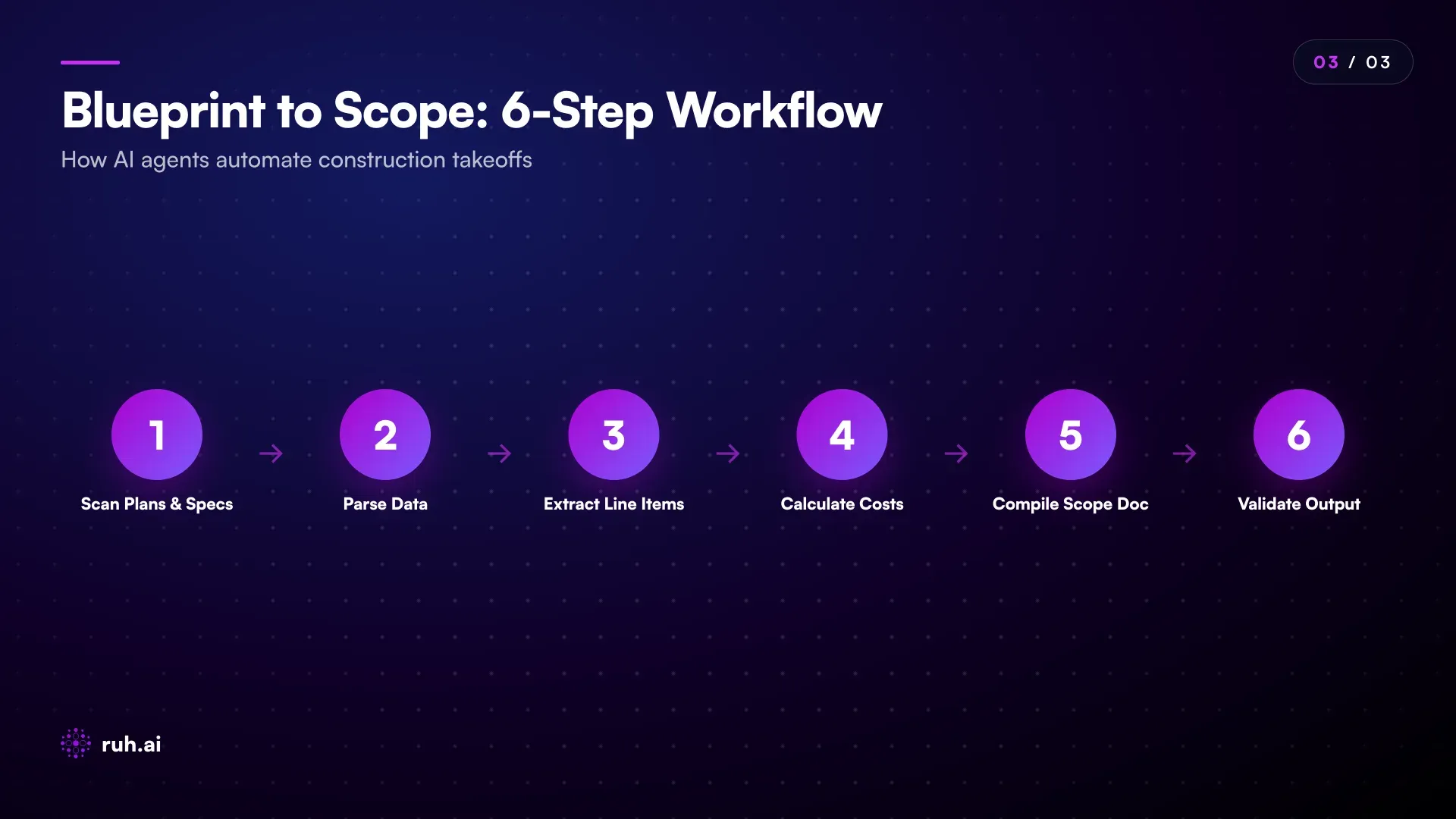
The whole process runs in 45 minutes to 2 hours depending on plan complexity. The estimator's 4-6 hour review window is where the actual risk lives.
The Cost Math: Bid Speed vs. Bid Accuracy
Let's talk money, because that's what drives the decision.
A typical general contractor's cost structure for bid preparation:
| Phase | Manual On-Screen | AI Agent + Review |
|---|---|---|
| Takeoff & scope | 35 hours @ $65/hr | 1 hour AI + 5 hours review @ $65/hr |
| Pricing & bid assembly | 20 hours @ $65/hr | 18 hours @ $65/hr |
| QA & estimator sign-off | 5 hours @ $65/hr | 2 hours @ $65/hr |
| Total direct cost | $2,730 | $1,404 |
| Cost per bid | $2,730 | $1,404 |
| Monthly bid cost (10 bids) | $27,300 | $14,040 |
The per-bid cost savings is real, but it's not transformative for a single bid. Where AI takeoff changes behavior is bid volume. If a team can prepare 15 bids per month instead of 10 (same staffing), the cost-per-bid drops. If margins on construction are 3-5%, winning one extra bid per month covers the AI agent subscription multiple times over.
The hidden cost is bid accuracy. A poorly scoped bid that underestimates scope loses margin or loses the job entirely. An AI-extracted scope with 90%+ accuracy and a flagged ambiguity list reduces bid surprises. Field teams report fewer scope-creep RFIs and change orders when the scope document came from AI extraction, not because AI is perfect, but because ambiguities are documented upfront.
The Honest Assessment: What Still Falls Short
AI takeoff agents are not magic. Here's what they don't do well:
Complex architectural details, if a specification says "provide custom woodwork per detail 7/A101 with finishes per paint schedule and hardware per the design team's approval," the agent can extract "custom woodwork" and point to the detail, but it can't price it. That requires an estimator conversation with the architect or a bid addendum.
Subjective scope decisions, when the plans show a column line with no clear indication of whether it's a building column, a screen, or a bracing element, the agent can flag the ambiguity but not resolve it. Construction is full of these judgment calls.
Site-specific constraints, the takeoff agent can extract what the plans show, but it can't know whether your concrete supplier can actually deliver 100 yards to a tight downtown site in January. That's an estimator insight, not a data extraction task.
Change-order pricing, if a contractor needs to extract scope for a potential change order based on an alternate design in the RFI, the agent can do it, but it needs clear updated drawings. Many RFIs describe changes in words, not sketches.
Subcontractor quotes and integration, the takeoff agent can extract what the general contractor is pricing directly. It can't automatically get quotes from the rebar sub or the MEP contractor and fold those into the bid. That integration is manual.
The other limit: AI agents are only as good as the plans you feed them. If the plans are from 1987, partially scanned, or have significant redlines, the extraction gets noisier. Modern, clear, PDF-native plans work best. Scanned plans work but require more validation.
How Ruh AI Fits Into Takeoff Automation
Ruh Estimator combines the Takeoff Agent with Ruh-R1, the proprietary AI model trained on construction documents, specifications, and estimating workflows. Here's where it sits:
Ruh Takeoff Agent extracts quantities and scope systematically from plans and specs, flags ambiguities, and compiles a scope document. The Takeoff Agent works as a standalone tool, you upload plans, get back a structured takeoff in minutes, or as the first phase of Ruh Estimator.
Ruh Estimator layers pricing intelligence on top. Once takeoff is complete and validated, Ruh applies historical cost data, supplier pricing integrations, and historical markup patterns from your own past projects to generate a preliminary pricing sheet. The estimator then refines it with project-specific factors (location, schedule, labor availability, schedule compression) and submits the bid.
The end-to-end cycle: upload plans → 45 minutes for Takeoff Agent extraction → 4-6 hours estimator validation → 2-3 hours pricing refinement with Ruh Estimator → final bid. Six to nine billable hours instead of 45-60.
Ruh Estimator integrates directly with Procore and Autodesk Build, so scope documents and estimates sync to the project the moment the bid is won. Field teams see the scope in the system they already use.
Frequently Asked Questions
Q: Will an AI takeoff agent replace my estimators? A: No. It replaces the manual counting and scope compilation phase of their work. Estimators shift to validating scope, pricing strategy, and risk assessment, the higher-value work. Teams using AI takeoff report estimators doing more bids per month with better accuracy, not losing headcount.
Q: How accurate is AI takeoff compared to a human estimate? A: AI agents are 90-95% accurate on routine items (lineal feet of walls, square footage of flooring, counts of openings). Complex or ambiguous scope runs 70-80% accuracy. The validation step (an estimator reviewing the AI scope) brings the final accuracy to 95%+. Accuracy is higher than a single human pass because the agent is systematic across all plans and never misses a sheet.
Q: Can AI takeoff handle metric plans or mixed-unit drawings? A: Modern AI takeoff agents handle metric and imperial conversions, but they need clear labeling in the source documents. If a plan is metric and your estimating database is imperial, the agent converts units but flags the conversion in the scope document for the estimator to verify.
Q: What happens if the plans are incomplete or preliminary? A: The agent flags incomplete or preliminary sections (e.g. "MEP by others" or "design to be determined by architect") and marks them as "estimate only" or "pending clarification." These items go into the scope document but are flagged for estimator follow-up before the bid is submitted.
Q: Do I need to change my estimating software or project management platform? A: No. AI takeoff agents output structured data (scope documents, CSV, JSON) that integrate with any estimating software. Ruh Estimator integrates with Procore and Autodesk Build directly; for other platforms, scope documents export as PDFs or spreadsheets that your estimators import manually, a 20-minute task instead of a 40-hour task.
Q: How long does it take to extract takeoff from a set of plans? A: End-to-end extraction runs 45 minutes to 2 hours depending on plan complexity (size, number of sheets, architectural detail level). The estimator validation step adds 4-6 hours for a typical project. Total: 5-8 hours instead of 40-60 hours with manual counting.
Move From Counting to Strategy
Construction teams are moving off on-screen takeoff not because the tools are bad, they work, but because manual counting stopped being the highest-value use of an estimator's time in 2026. AI agents extract the scope data. Estimators validate, price, and strategize.
The teams winning bids today are the ones treating estimation as a competitive moat: they bid faster, validate accuracy higher, and price smarter because they're freed from counting. Speed still matters for getting bids back before the deadline, but accuracy and scope completeness matter more for protecting margin and winning jobs.
If you're still counting items in Bluebeam for 35-40 hours per bid, the math of switching to AI takeoff is straightforward. If you're scaling bid volume or training junior estimators, it's non-negotiable.
Explore Ruh Estimator and watch the Takeoff Agent extract scope end-to-end →
See how Ruh Estimator integrates with your Procore or Build workflow →
Talk to the Ruh AI team about takeoff automation for your estimating process →