
TL;DR / Summary
Construction software has spent two decades promising to streamline operations through centralized data platforms. Procore, Autodesk Build, and similar tools collect information faster than ever before. But they've hit a wall: data collection and data use are not the same thing. In 2026, the inflection point is clear, companies are moving from platforms that manage information to agents that act on it.
What you'll learn:
- Why platform software stops short of actual problem-solving in construction
- The specific moment in 2026 when this limitation became undeniable
- How AI agents handle exception workflows that platforms push back to humans
- The real cost comparison: platform + manual labor vs. agents running autonomous
- Where traditional software still wins, and where agents are the only rational choice
- How to evaluate whether your workflows are ready for agents
The numbers: Construction estimators still spend 40-60 hours per bid using platform tools. RFI teams wait 5.2 days for responses. AP teams process 100+ invoices monthly at $15-26 cost per transaction. Platforms manage these workflows. Agents execute them.
Platforms Collect Data. Agents Make Decisions.
This is the core split in 2026 construction software. A platform centralizes information, takeoff data, submittals, schedules, invoices, change orders. It organizes it. Makes it searchable. Lets ten people access the same project data at once. That's useful. But it stops there. The human still has to decide.
A platform shows you an RFI. An agent answers it.
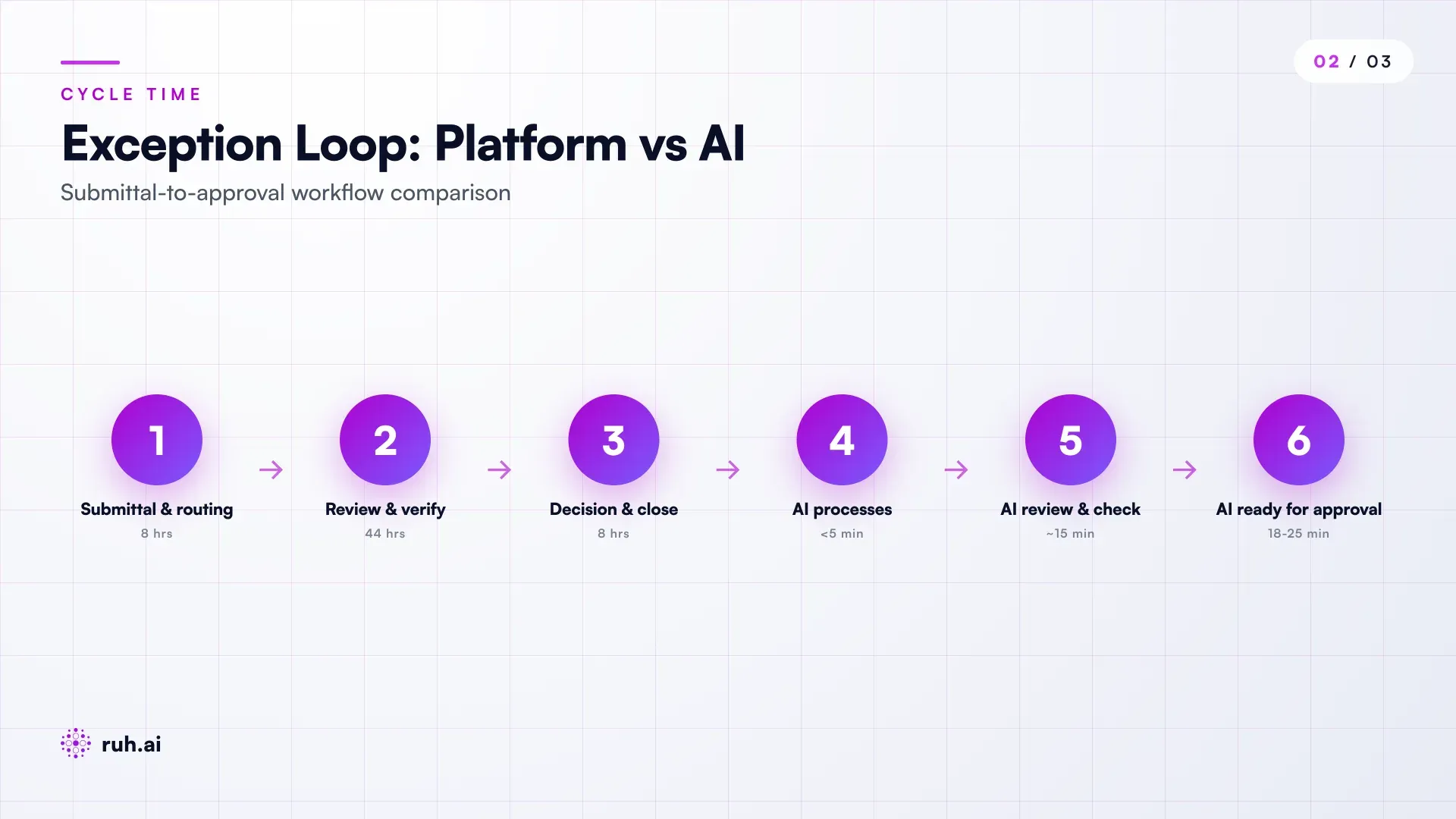
A platform shows you a takeoff with quantities. An agent reviews the quantities against the plans, flags missing items, adjusts for waste and overlap, and feeds it into pricing. A platform surfaces a submittal from a sub. An agent logs it, checks it against the spec, routes it, tracks approvals, and notifies the super when it's due back. A platform displays an invoice. An agent three-way matches it, verifies retainage, checks lien waivers, and flags exceptions.
The boundary is sharp. On the platform side: data storage, visibility, basic workflow routing. On the agent side: judgment, exception handling, follow-up, and completion.
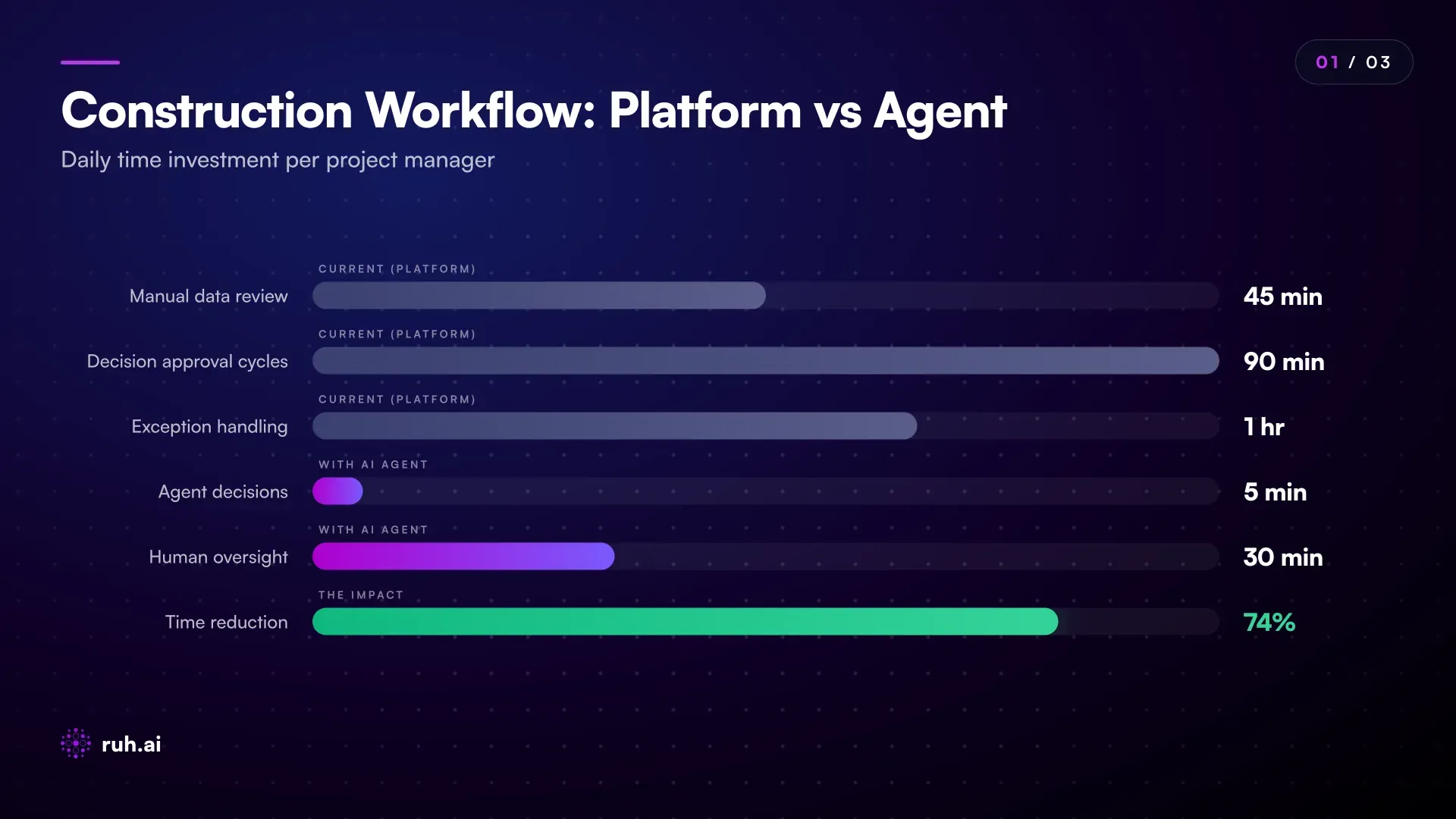
Most construction operations today use platforms heavily and still rely on human decision-makers for all the high-value work. That combination worked well when labor was cheap and plentiful. In 2026, when superintendents make $110K+ annually and quality coordinators are impossible to retain, paying that hourly rate to manually match invoices or chase submittals is economic nonsense.
The inflection point isn't that agents exist. It's that the platform-plus-humans model has become visibly more expensive than the platform-plus-agents model.
Why This Moment Is 2026, Not Earlier
AI agents in construction have been theoretically possible for years. The inflection happens when three conditions align at the same time: capable models exist, the labor crisis becomes non-negotiable, and the cost curves flip.
Capable models. Ruh-R1 and models like Claude Opus can now handle the kind of multi-step reasoning construction requires, reading a plan, matching it to takeoff quantities, applying waste factors, cross-checking against specs. This wasn't reliable enough in 2023. It is now. The models can handle ambiguity, ask clarifying questions, and route exceptions upward without hallucinating.
Labor crisis intensity. In 2025, construction unemployment was near record lows and field workers got harder to find every quarter. By mid-2026, the superintendents and coordinators running the back office are equally scarce. The cost of replacing a project coordinator who leaves is now $40-60K in recruitment and onboarding, plus the productivity hit while the position sits empty. That calculus forces companies to ask: what if we didn't need to fill some of these positions at all?
Cost crossover. An AI agent subscription is a fixed cost. A platform subscription plus the salary of the person using it is not. When the person cost stays flat and the agent cost drops, agents win. We're in that window now. Ruh's AP Invoice Agent, for example, handles 2/3-way matching and retainage tracking that a controller would otherwise do manually at $15-26 cost per invoice. At scale, the agent is $1.77-2.78 per invoice, including infrastructure and model inference. That's not close anymore.
The inflection point is economic, not technological.
The Architecture Problem With Platforms
Here's what happens when you push a complex workflow through a centralized platform:
Exception handling becomes manual. An invoice doesn't match three ways. The system flags it and waits for a human to intervene. An RFI requires a site visit to answer because the question isn't about the plans, it's about existing conditions. The platform routes it and waits. A submittal has conflicting spec requirements and needs judgment about intent. The coordinator has to call the architect.
Platforms are designed to standardize. They excel when your workflow fits the template. They break down when it doesn't, and construction almost never fits the template perfectly.
That means every real project generates manual exceptions. A general contractor's typical preconstruction cycle generates 15-40 RFIs, 20-50 submittals, 50-150 change-order requests, and 200-600 invoices per year across all trades. If each of those requires platform navigation plus human judgment, you've staffed a coordination desk. If each one is handled by an agent that can read context, ask questions, and route exceptions smartly, you've optionalized that position.
A second problem: integration tax. Platforms don't talk to each other well. Autodesk doesn't sync with Quickbooks without a third-party connector that costs money and creates data lag. Procore doesn't auto-populate schedule of values into AIA billing without manual entry. Bluebeam doesn't auto-update submittals into Autodesk Build. Construction teams have 4-8 platforms running in parallel and spend hours per week manually syncing data between them.
Agents don't have that constraint. An agent can read from Autodesk, write to Quickbooks, check Bluebeam, and flag to Procore in one step. No middleware. No manual sync. The data model exists in code, not in the platform vendor's architecture.
The third problem: knowledge decay. Platforms are historical records. They're good at answering "what happened?" They're bad at answering "what should happen next?" A platform can tell you that submittal SAM-14 was submitted on June 3. It can't tell you that you should chase approval now because the concrete order needs 14-day lead time and your schedule can only absorb 7 days of delay.
An agent can. An agent reads the submittal, the schedule, the purchase order history, and the supplier lead times, and makes a ranked list of what to follow up on today.
The Economics of Agents vs. Platforms
Let's build a real comparison. Take a 50-person contracting company with five estimators, one preconstruction manager, two project coordinators, and one AP/finance coordinator handling billing.
Platform-only model:
- Procore/Build subscription: at your current rate
- Quickbooks subscription: at your current rate
- Bluebeam subscriptions: at your current rate
- Salaries for preconstruction/coordination roles: ~$450K/year (five people at blended $90K, including fringe)
- Training and onboarding when turnover happens: $15-30K per replacement
- Time spent on manual coordination/routing/matching that could be estimating or site time: ~20% of those five people's capacity, or $90K/year in lost productivity
Total friction cost: ~$125K/year in direct software + ~$90K in lost time + turnover risk + quality variance as people leave mid-project.
Agent-enabled model:
- Procore/Build subscription: at your current rate (unchanged)
- Quickbooks subscription: at your current rate (unchanged)
- Bluebeam subscriptions: at your current rate (unchanged)
- Ruh Estimator + RFI Responder Agent + Submittal Agent + AP Invoice Agent + Change Order Agent: ~$8-12K/month for the company, all agents
- Salaries for preconstruction/coordination roles: ~$300K/year (three people for oversight, exception handling, client relationships)
- Turnover cost: lower, but staffing is smaller anyway
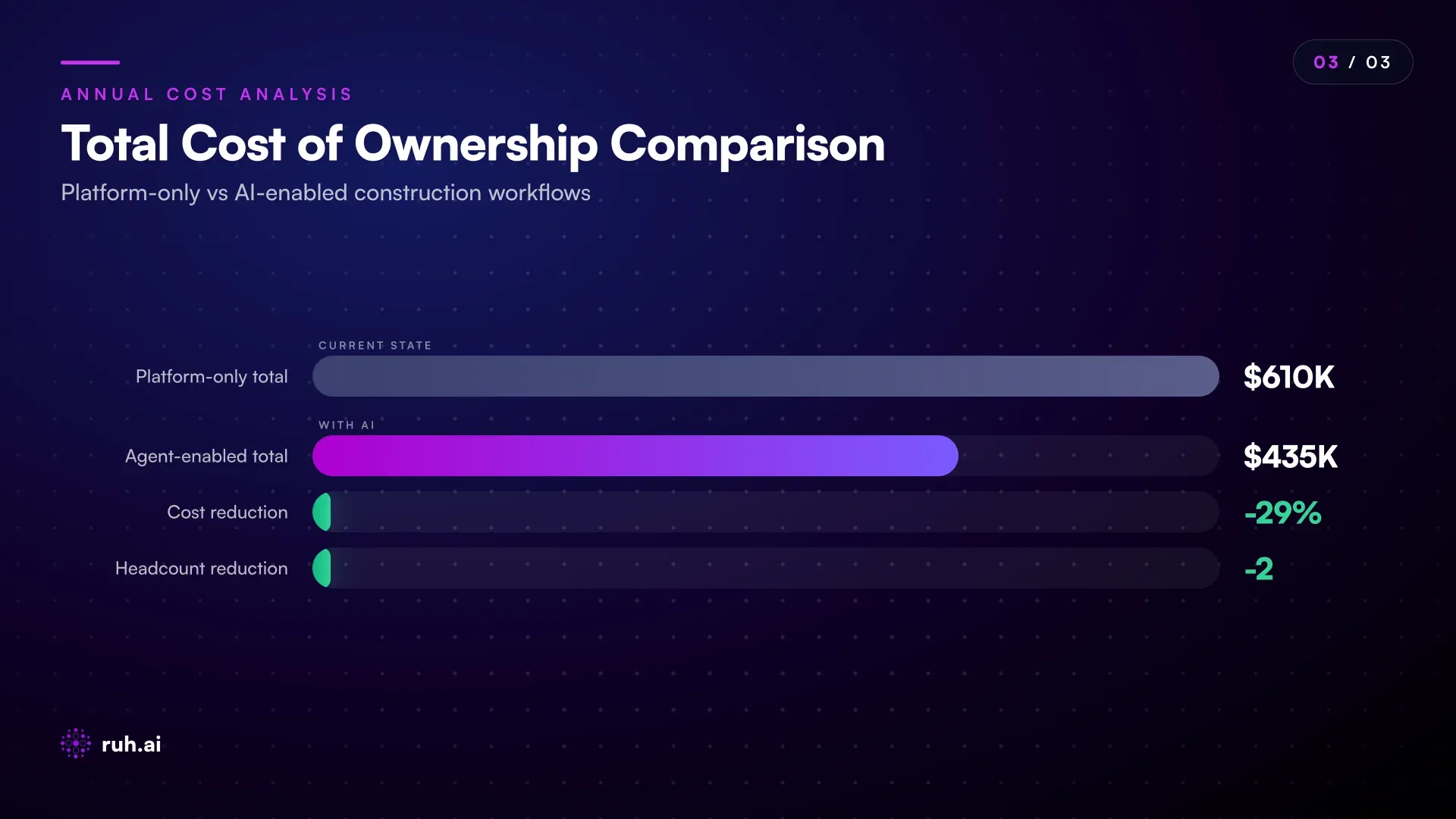
Total friction cost: ~$50K in subscriptions + $300K salaries + ~10% coordination buffer = $350K all in, with lower turnover risk and zero productivity loss to manual work.
The 50-person company saves $100-150K annually and eliminates the hiring/retention risk on roles that have become turnover traps. That math holds at any scale above 10 people.
Why Platforms Won't Become Agents
Some platforms are adding AI features. Autodesk added generative design tools. Procore rolled out some AI-assisted workflows. But they're not becoming agents, and they probably can't, for structural reasons.
Platforms are licensed, not deployed. Your data lives on Autodesk's servers, not yours. The model that works is: vendor maintains infrastructure, vendor adds features, you pay per user or per project. The economic model is recurring revenue, which means the vendor needs to keep you on the platform. That creates misaligned incentives when it comes to agents.
An agent that solves the RFI problem reduces demand for the RFI module. An agent that handles submittal routing reduces demand for the submittal module. A platform vendor's core business is maximizing the work that stays within their product. An agent's core business is minimizing manual work, even if that work is in someone else's system.
Second, agents need direct access to your data to work effectively. They need to read submittals, look at schedules, check invoices, update records, and send notifications all in one go. Platform APIs make that possible in theory, but in practice, the API is designed around the platform's workflow, not an agent's requirements. Building an agent on top of a platform API feels like building a house on a bridge, you can do it, but the bridge wasn't designed to support it.
Third, agents need to be updated and tuned based on your construction standards, not the platform vendor's generic logic. An agent for your company learns your RFI response templates, your spec priorities, your schedule assumptions, and your quality thresholds. That's not portable to someone else's project. A platform, by design, enforces a common logic across all users.
The best-case scenario is that platforms become integration points and the agents sit alongside them. The agent reads from Procore, writes to Quickbooks, checks Bluebeam, and lives in a separate service. That's the model Ruh has chosen, we integrate with the platforms you use, but the agent runs independently.
The Honest Assessment: Where Platforms Still Win
Agents are not replacements for platforms in their entirety. Platforms excel at visibility, at making information accessible to many people at once. An estimator in Boise, a super in Denver, and a project manager in the office can all open Autodesk Build and see the same project status in real time. That shared visibility has value.
Platforms also have network effects. Every trade sub, every supplier, every client has a login. The coordination flows through the platform. Replacing that would mean replacing the entire ecosystem, which is not rational for a single company.
Agents are narrower and deeper. They solve decision-making workflows, not information-sharing workflows. The gap between those two is real. A company in 2026 won't abandon Procore and run on agents. They'll use Procore for visibility and coordination, and agents for the decisions Procore punts to humans.
There's also a skill requirement. Agents need to be configured correctly. Someone has to define the decision rules, the thresholds, the escalation paths, the exceptions that route to humans. A contractor transitioning from "Procore does everything" to "Procore + agents" has to learn a new discipline. That's learnable but it's not frictionless.
Finally, there's the data quality problem. An agent is only as good as the data it reads. If your submittals in Procore are inconsistently filed, if RFIs don't have context attached, if invoices are missing PO references, the agent will propagate that chaos downstream. Platforms tolerate bad data. Agents amplify it. Cleaning up your data is a prerequisite that some contractors won't prioritize until the pain is undeniable.
How Ruh AI Fits Into This Inflection
Ruh AI is built on the assumption that construction workflow automation happens at the agent level, not the platform level. We don't try to replace Procore or Quickbooks. We integrate with them.
Ruh Estimator handles the preconstruction decision pipeline: it reads plans and specs, extracts quantities, applies your company's pricing logic and waste factors, checks against historical data, and generates a bid package ready for review. An estimator still reviews and adjusts the bid. But they're reviewing a complete, accurate foundation, not starting from scratch with a blank takeoff sheet.
RFI Responder Agent reads RFIs, checks the plans, checks the specs, checks the project schedule, and drafts responses with source references. The project manager reviews and sends. Same for Submittal Agent, it logs submittals, checks spec compliance, routes to the appropriate reviewer, and tracks approvals without manual tracking.
Change Order Agent does the same for CO management. AP Invoice Agent handles 2/3-way matching, retainage, and lien waiver tracking. Pay Application Agent generates AIA billing with proper schedule of values reconciliation.
The connective tissue is that all of these agents can read from your platforms and write back to them. An RFI response that the RFI Responder Agent drafts can be pulled into Procore without human data entry. An invoice that the AP Agent matches can automatically update Quickbooks. The agent does the decision work and the integration work simultaneously.
That's possible because agents aren't constrained by the platform's workflow model. They operate on your data where it lives and push decisions back into whatever system you use for visibility.
For a contractor looking at this inflection point right now, the question isn't "should I switch from platforms to agents?" It's "which workflows do I want agents to handle, and how do I integrate them with the platforms I already depend on?"
Frequently Asked Questions
Q: Is moving from a platform to agents a big technical lift? A: It doesn't require replacing your existing software. Agents integrate with platforms like Procore, Autodesk Build, and Quickbooks via APIs. A contractor can start with one workflow, RFI handling or estimating, and expand from there without disrupting the tools everyone already uses.
Q: What happens if an agent makes a mistake? A: Agents are configured to flag decisions that fall outside their confidence bounds and route them to a human. An RFI response that requires site inspection gets routed to the super. An invoice that fails 2/3-way matching gets escalated to the controller. The agent handles routine decisions and passes exceptions upward.
Q: Can I train an agent on my company's standards? A: Yes. Agents like Ruh Estimator learn your pricing model, waste factors, and scope thresholds. RFI Responder learns your response templates and decision priorities. Submittal Agent learns your spec priorities and approval routing. That customization is built into the product at deployment time.
Q: Will agents eliminate the need for coordinators and estimators? A: No. Agents eliminate the routine work that coordinators spend time on, which means coordinators focus on client relationships, exceptions, and schedule management. Estimators shift from manual quantity takeoff to estimating logic and bid strategy. The work doesn't disappear; it scales upward.
Q: How do I know if my workflows are ready for agents? A: Look for high-volume, repeatable workflows where the decision logic is clear but time-consuming, RFI response, submittal review, invoice matching, takeoff review, change order processing. If a person does the same type of work 20+ times per month, an agent probably handles it well.
Q: What's the difference between what Ruh does and what platforms are adding for AI? A: Platforms are adding AI features within their product. Ruh builds standalone agents that integrate with your entire stack, platforms, spreadsheets, email, Slack. An agent doesn't care which system the data came from; it can read and write across all of them in parallel.
Q: Do I need to hire a data scientist to deploy agents? A: No. Ruh's agents come pre-built for construction workflows. You configure them via Ruh Work-Lab, no coding required. For custom workflows, Ruh Developer provides API access and templates, but it doesn't require data science expertise, just API familiarity.
The Shift Is Unavoidable
In 2026, construction companies face a clear choice. Double down on hiring coordinators and estimators at $90K+ annually while competing for people who have better offers, or invest in agents that handle the repetitive decisions and let people focus on what actually requires human judgment.
The platforms that won the last decade, Procore, Autodesk, Bluebeam, did so by centralizing information and making it searchable. They solved visibility. They didn't solve decision-making, and they never will, because their business model depends on keeping human coordinators in the loop.
Agents solve decision-making. They cost less. They don't resign. They don't make typos on invoices. And they work with the platforms you already use.
The inflection point isn't a question of whether agents are better in theory. It's that they're cheaper in practice, and construction's margin pressure makes that rational choice undeniable.