EstimatingExplore estimating
Construction glossary · Estimating Concepts

What is a work breakdown structure (WBS) in construction?

A work breakdown structure divides a construction job into a coded tree of smaller pieces, ending in work packages small enough to hand to a single crew or subcontractor. Further on: WBS against cost codes, an office fit-out broken into eleven packages, our view, and a link to a free Excel WBS.

Free 30-minute walkthrough on your own drawings. No card.

Updated November 2026 · Reviewed by the Ruh construction team

The definition

Work Breakdown Structure, Explained.

Each element gets a code that shows its place: 1 is the project, 1.2 an element under it, 1.2.1 a work package under that. Budgets and schedule activities hang off the packages and roll up the tree, so cost and time report on the same breakdown.

In construction the second level is usually one of three things: CSI divisions, areas or phases, or building systems. A WBS dictionary sits beside it and says what each package includes and how it is accepted.

To build one with budgets that roll up, use the free work breakdown structure template.

How it is measured

A work breakdown structure is measured in levels and work packages. Budgets are entered on packages and summed upward, and the project total must equal the packages.

WBS vs Cost Codes

The WBS splits the deliverables. Cost codes split where money is recorded. On many jobs a work package maps to one cost code, and the two are kept in step.

Division numbers for the second level come from CSI MasterFormat.

Our View

In our view, stop where one party can be held to a package. A breakdown deeper than that becomes a task list nobody keeps up to date.

Worked example

A Worked Construction WBS

Illustrative example from the free template, an office build-out on Level 2: four elements holding eleven work packages.

Four elements roll up to a $695,100 project: $79,700, $269,200, $74,400 and $271,800.

Code and elementRolled-up budget
1.1 General requirements$79,700
1.2 Interior construction$269,200
1.3 Finishes$74,400
1.4 Mechanical, plumbing, electrical and fire protection$271,800
1 Project total$79,700 + $269,200 + $74,400 + $271,800 = $695,100

Package 1.2.1, framing and drywall, is $184,000 of it, 26.5 percent of the job.

Taken from the template's sample project.

How Ruh handles it

How Ruh Handles Work Breakdown Structure.

Try Ruh on a real bid.

Start with a walkthrough

Work Breakdown Structure: Frequently Asked Questions

What is a WBS in construction?+

A coded tree of the job's deliverables, running from the whole project down to packages that each belong to one party.

What are the levels of a construction WBS?+

Usually the project, then divisions, areas or systems, then work packages, and sometimes activities below them.

What is a WBS dictionary?+

A companion sheet giving each package's scope, deliverable and acceptance test, so the code and the scope stay together.

Is a WBS the same as a schedule?+

No. The WBS lists what will be delivered. The schedule says when, using activities that hang off the work packages.

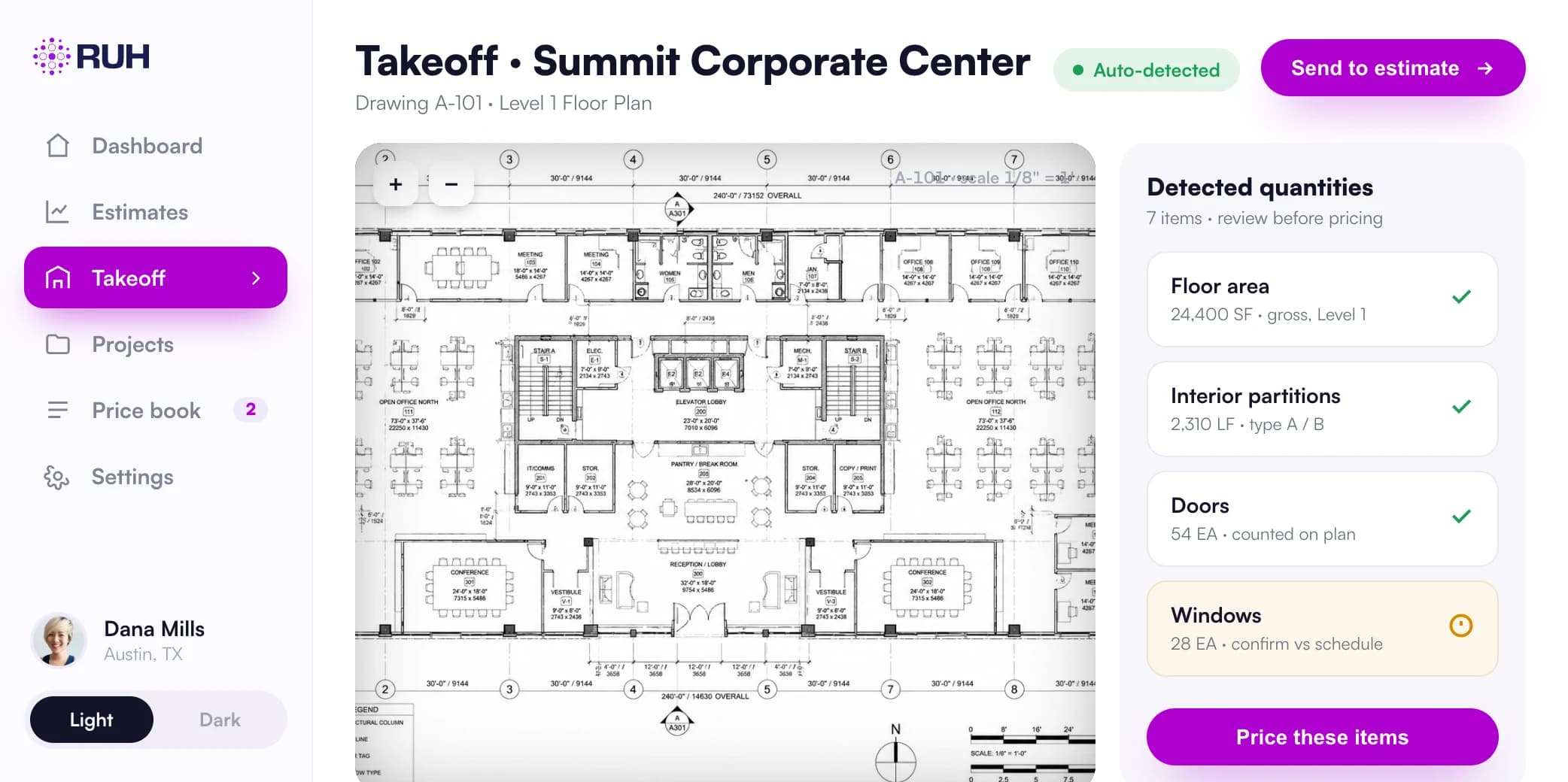
Still measuring by hand? Your next takeoff can run while you review this one.

See it on your plans

Related Terms

Keep going: A Worked Construction WBS, the free work breakdown structure template or explore General Contractor Software.

The Construction Estimating Cheat Sheet
Every unit, waste factor, and conversion on one page. Free PDF.

Figures on this page are illustrative. Construction estimates depend on project-specific conditions, source documents, market pricing, and professional judgment. Ruh's AI assists the estimator and does not replace professional review: your team reviews, validates, and approves every estimate, bid, and pricing decision.
Try Ruh on a Bid You Are Pricing Now.

Put Your Next Takeoff on Ruh.