100% money-backBook a walkthrough

Construction glossary · Process and contract terms

What is GMP (guaranteed maximum price) in construction?

A guaranteed maximum price (GMP) is a contractual cap on what the owner pays the contractor for a defined scope of work, covering the cost of the work plus the contractor's fee. If actual costs finish below the cap, the savings go back to the owner or get divided under a shared savings clause. If costs run over, the contractor absorbs the overrun unless an approved change order raised the cap.

Updated June 2026 · Reviewed by the Ruh construction team

GMP = guaranteed maximum priceOverruns on the contractorSavings often shared with owner

GMP caps cost; savings can be shared

Cost of work + fee under capOwner buffer contingencyContractor guarantees a not-to-exceed price

Estimating process and contract terms scope this week? Watch Ruh take off a real plan in 30 minutes.

Book a walkthrough
Definition

A GMP shows up most often on CM at risk and design-build work, usually written as a GMP amendment to an AIA A133 or similar agreement. The contractor builds the number open book: cost of work from the takeoff, general conditions, contractor contingency, and a stated fee, all itemized in a schedule of values that pay applications later bill against. Estimators usually set the GMP from incomplete documents, often 60% to 90% construction documents, which is why the qualifications, assumptions, and allowances pages carry as much weight as the numbers themselves. New estimators make two common mistakes. First, they treat a GMP like a lump sum and skip the scope narrative; on an open book contract the owner will audit costs, and vague qualifications turn document gaps into contractor losses. Second, they confuse contingency with scope growth: contractor contingency inside the GMP covers estimating misses and buyout shortfalls, not owner changes, which go through change orders that raise the cap.

How it is measured

A GMP is a single dollar figure stated in the contract or GMP amendment, supported by a line-item schedule of values. Estimators build it bottom up: quantity takeoff priced at real unit costs, plus subcontractor bids or budgets for unbought trades, plus general conditions (illustratively $40,000 to $80,000 per month on a mid-size US commercial job), plus contractor contingency (an illustrative 2% to 3% of cost of work), plus fee (an illustrative 3% to 5%). During construction, the team measures performance against the GMP through monthly pay applications and a cost report that compares committed and projected costs to each schedule of values line. The number that matters at closeout is final audited cost of work plus fee versus the cap.

Worked example

Worked example

Say a CM at risk contractor signs a GMP amendment at $5,000,000 with an 80/20 shared savings clause (80% to the owner, 20% to the contractor). At closeout, the audited cost of work plus fee totals $4,700,000. Savings: $5,000,000 minus $4,700,000 = $300,000. Owner's share: $300,000 x 0.80 = $240,000. Contractor's share: $300,000 x 0.20 = $60,000. The owner's final cost lands at $4,700,000 + $60,000 = $4,760,000, which is $240,000 under the cap. Now flip it: if the cost of work had finished at $5,200,000, the contractor would absorb the $200,000 overrun, because the GMP caps the owner's exposure. That asymmetry is exactly why the takeoff, contingency, and qualifications have to be right before the GMP is signed.

100%

Try Ruh on a real bid. 100% money-back guarantee if you are not satisfied.*

*Scoped delivery, terms apply. Read the guarantee terms

Start with a walkthrough
How Ruh handles it

How Ruh handles GMP (guaranteed maximum price)

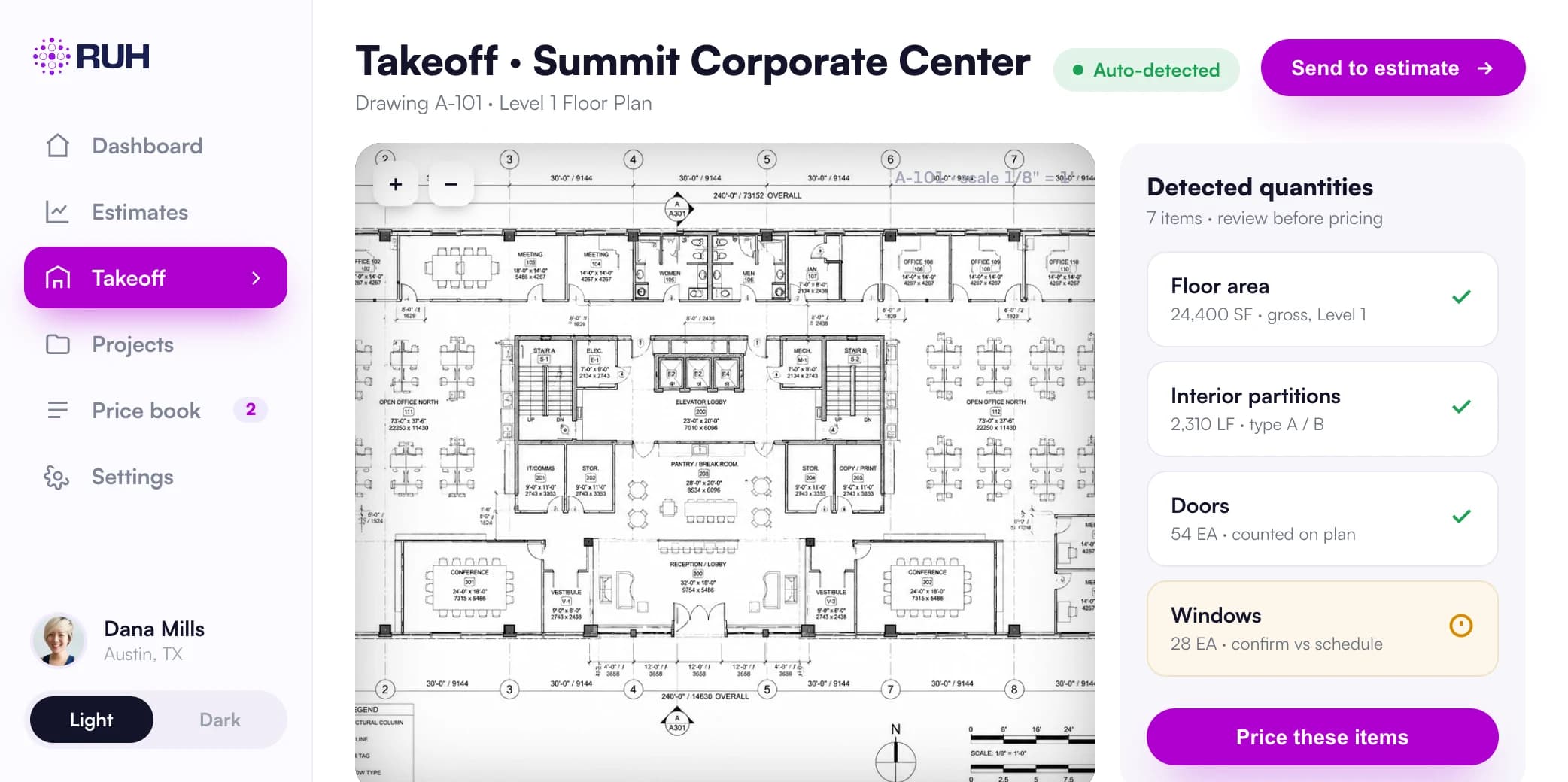
When you commit to a GMP, the takeoff behind it becomes a number you have to live with, so quantity errors come straight out of your fee or contingency. Ruh reads the drawing set, performs the takeoff, and prices the quantities against your own price book (your real unit costs, not generic data), then hands the estimator a line-item draft ready to organize into a GMP schedule of values. The estimator reviews, adjusts allowances and qualifications, and signs off before the number is guaranteed; the AI does the counting, the professional judgment stays with you.

See construction invoice and pay app software

GMP (guaranteed maximum price): frequently asked questions

What is the difference between a GMP and a lump sum contract?+

A lump sum is a closed book fixed price: the contractor keeps every dollar of savings and gives the owner no view into actual costs. A GMP is open book and cost reimbursable up to the cap, the owner typically holds audit rights, and underruns flow back to the owner in whole or in part. Lump sum bidding usually needs complete documents, while a GMP is commonly set earlier in design, with contingency and written qualifications covering the gaps.

What is a typical shared savings split in a GMP contract?+

There is no standard split; it is negotiated job by job. Splits favoring the owner, such as 100/0, 80/20, or 75/25, are common in US commercial work, with the contractor's share framed as an incentive to buy out trades aggressively and manage costs. Read how the clause treats unused contingency, because some contracts roll it into the savings pool while others return it entirely to the owner.

Who keeps the contingency in a GMP contract?+

Contractor contingency inside the GMP belongs to the contractor and covers estimating gaps, buyout shortfalls, and minor coordination issues, not owner-directed changes. Owner changes go through change orders that raise the GMP itself. At closeout, any unspent contingency usually feeds the savings calculation, so the contingency language in the contract draws real money.

Still measuring by hand? Your next takeoff can run while you review this one.

See it on your plans

Related terms

Keep going: read the full guide or explore construction invoice and pay app software.

The Process and contract terms estimating cheat sheet
Every unit, waste factor, and conversion on one page. Free PDF.

See Ruh price a bid from your own drawings.

AI takeoff and estimating on your price book, your estimator signs off.

Figures on this page are illustrative. Construction estimates depend on project-specific conditions, source documents, market pricing, and professional judgment. Ruh's AI assists the estimator and does not replace professional review: your team reviews, validates, and approves every estimate, bid, and pricing decision.
GMP (guaranteed maximum price) in construction | Ruh AI