Free construction template
Value engineering log template
A value engineering log is the running list of proposals to deliver the same function for less: what is designed, the alternative, the savings and the owner's decision. On this page: a free Excel VE log, a worked example with five proposals, how net savings are counted, and our view on running VE.
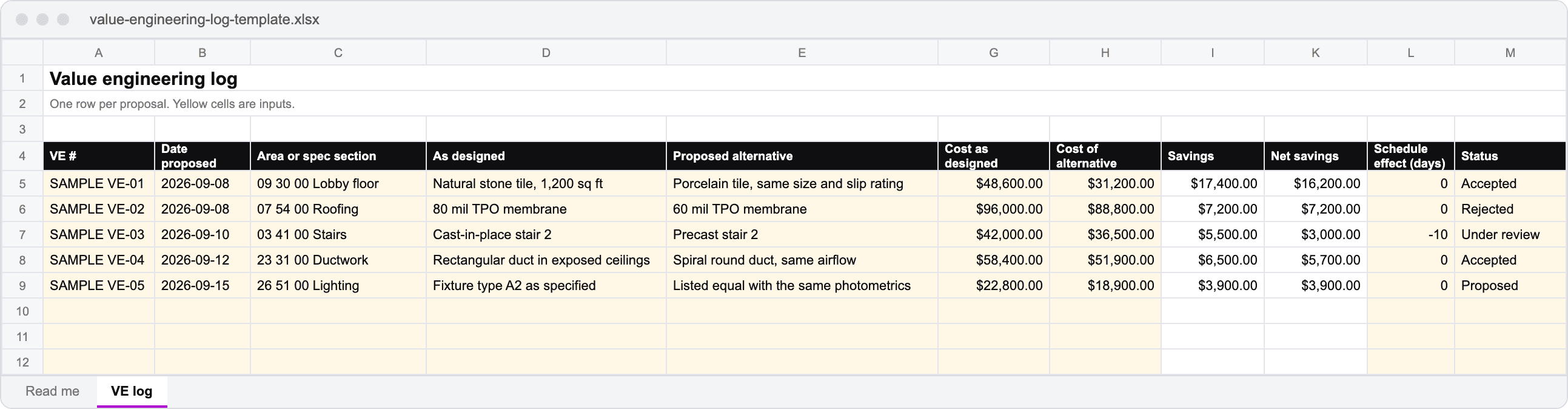
What is in the workbook
- One row per proposal: area or spec section, the item as designed, the proposed alternative and who proposed it
- Cost as designed and cost of the alternative, with savings, redesign cost and net savings worked out
- Schedule effect in days, status and decision date
- Totals of net savings by status, and an optional contractor's share for contracts with a shared savings clause
Pricing value engineering options? Get the takeoff behind each one, free.
Send one set of drawings from a job you are bidding and we take it off free, every quantity tied to the sheet it came from.
What a value engineering log tracks
Each row is one proposal, priced on both sides from the same quantities. The value engineering glossary entry explains the method behind it.
| Column | What goes in it |
|---|---|
| As designed | The item exactly as the drawings and specifications show it |
| Proposed alternative | What would replace it, and what stays the same, such as size, rating or warranty |
| Savings | Cost as designed minus the cost of the alternative |
| Redesign cost | Design fees, resubmittals and testing the change brings |
| Net savings | Savings minus redesign cost, the number the owner decides on |
| Schedule effect | Days gained or lost, minus for faster |
A worked value engineering log
Take an illustrative office build-out with five proposals logged. Together they would save $40,500 before redesign and $36,000 after it. The owner accepts two, worth $21,900 in net savings, keeps the specified roof, and still has two proposals open.
| VE # | Proposal | Savings | Redesign | Net savings | Status |
|---|---|---|---|---|---|
| VE-01 | Porcelain tile in place of stone, lobby | $17,400 | $1,200 | $16,200 | Accepted |
| VE-02 | 60 mil TPO in place of 80 mil | $7,200 | $0 | $7,200 | Rejected |
| VE-03 | Precast stair in place of cast-in-place | $5,500 | $2,500 | $3,000 | Under review |
| VE-04 | Spiral round duct in exposed ceilings | $6,500 | $800 | $5,700 | Accepted |
| VE-05 | Listed equal light fixture, type A2 | $3,900 | $0 | $3,900 | Proposed |
| Accepted | $21,900 |
Sample proposals from the workbook. VE-03 would also gain 10 days.
The rejected roof shows why the log keeps what stays the same: a thinner membrane saves money and shortens the warranty, and the owner chose the warranty.
Count savings net of redesign
A proposal that saves $5,500 in material but costs $2,500 in engineering saves $3,000, and that is the number the owner should see. Add any schedule effect too, since days saved also cut general conditions and days lost add to them.
Price both sides from the same takeoff. An alternative priced from a fresh quote against an as-designed number from the original estimate compares two different dates, not two designs. The construction estimate template keeps both on one sheet.
Value engineering vs a scope cut
| Value engineering | Scope cut | |
|---|---|---|
| Function | Kept, delivered another way | Reduced or removed |
| Examples | Spiral duct with the same airflow | Fewer outlets, a lower finish, no backup system |
| Logged as | A VE proposal | A scope change |
Typical practice. Both can be right if they are logged as what they are.
An owner who thinks they accepted VE and then finds they lost function is the start of a dispute.
Our view
Run value engineering during preconstruction, before the design is finished, not after bids come in over budget. Late VE buys redesign time and resubmittals with every dollar it saves.
Value engineering log FAQs
What is a value engineering log?+
It is the list of every value engineering proposal on a project, with what is designed, the alternative, the savings net of redesign, the schedule effect and the owner's decision.
Who can propose value engineering?+
Anyone on the team: the contractor, a subcontractor, the designer or the owner. The log records who proposed each item, and the owner and designer decide.
What counts as net savings?+
The cost as designed minus the cost of the alternative, minus any redesign, resubmittal or testing cost the change brings.
Is value engineering the same as cutting scope?+
No. Value engineering keeps the function and changes how it is delivered. Cutting scope removes function, and it should be logged as a scope change.
Is the value engineering log template free?+
Yes. Put your work email in the form above and the log downloads at once.
Use it to plan and track proposals, not as contract or engineering advice. Your contract decides how proposals are submitted, accepted and shared, and the designer of record decides whether an alternative meets the design intent.