
TL;DR
In 2026, AI is no longer an add-on to marketing — it is the operating layer. Per Salesforce's State of Marketing 2026, 87% of marketers now use generative AI in at least one workflow, up from 51% in 2024, and AI-driven campaigns deliver roughly 22% higher ROI with 29% lower acquisition costs than traditional ones. The tools that actually move the needle aren't the flashiest — they're the ones that fit a specific job: writing, SEO, design, automation, pipeline generation, or analytics.
After testing the major platforms across content, SEO, design, CRM, agentic execution, and outbound, our top 10 picks for 2026 are: Jasper AI, HubSpot Breeze, ChatGPT, Surfer SEO, Canva Magic Studio, Salesforce Agentforce + Einstein, Copy.ai, Frase, Writesonic, and Ruh AI SDR Sarah. Each wins a different use case — pick by job-to-be-done, not by hype.
Ready to see how it works:
- Why AI Has Become Non-Negotiable in Modern Marketing
- A Short History of How AI Found Its Way Into the Marketing Stack
- How We Picked the Top 10 (Our Methodology)
- The 10 AI Marketing Tools at a Glance
- Honorable Mentions Worth Watching in 2026
- Real Advantages of Using AI in Your Marketing Stack
- Honest Disadvantages and Limitations to Plan For
- How AI Tools Make Day-to-Day Marketing Easier
- How Ruh AI Is Adapting AI Marketing Tools for Smarter Results
- Final Take and Next Steps
- Frequently Asked Questions
Why AI Has Become Non-Negotiable in Modern Marketing
Three years after ChatGPT's public debut, the question marketers ask has flipped. It is no longer "Should we use AI?" It is "Which tools, in what stack, for which workflows — and what's the measurable lift?"
The data backs the urgency. In its January 2026 forecast, Gartner predicted that 60% of brands will use agentic AI to power one-to-one customer interactions by 2028, and a parallel Gartner survey of CMOs found that 65% expect AI to dramatically reshape their role within two years. Teams that aren't operationalizing AI are not just slower — they're producing measurably worse work.
But picking tools is harder than ever. The market is noisy, every vendor claims to be "AI-native", and most listicles read like sponsorships. This guide is built differently: a use-case-first ranking, written for marketers who care less about benchmarks and more about whether a tool will save them five hours next Tuesday — or fill the calendar with qualified meetings while they sleep. The deeper shift underneath all of this is that AI is now rewriting the classic 4 Ps of the marketing mix — not just speeding up tasks, but reshaping how product, price, place, and promotion get decided.
A Short History of How AI Found Its Way Into the Marketing Stack
To understand why the 2026 stack looks the way it does, it helps to trace how we got here.
The seeds were planted long before "AI marketing" was a category. As IBM's history of artificial intelligence notes, the foundational ideas of neural networks date to 1948, and the field was formally named at the 1956 Dartmouth workshop attended by John McCarthy, Marvin Minsky, and Claude Shannon. For decades, AI in marketing meant rules-based systems and statistical models — useful for segmentation, but invisible to most marketers.
The 1990s brought the first practical impact: CRM systems and data mining let marketers cluster customers and personalize campaigns at scale. The early 2000s ushered in recommendation engines — the algorithms that powered Amazon's product carousel and Netflix's home page. Personalization became a competitive advantage, not just a nice-to-have.
The decisive shift came in 2017, when researchers at Google published "Attention Is All You Need", introducing the transformer architecture that would underpin every modern large language model. OpenAI's GPT-3, released in 2020, demonstrated that a single model could write product descriptions, ad headlines, and blog drafts at a quality previously thought to require humans. Then in November 2022, ChatGPT crossed the chasm — within five days, it had a million users, and within months, every marketing team on earth was either piloting it or panicking about it.
By 2024, every major platform had embedded generative AI: HubSpot launched Breeze, Salesforce evolved Einstein into Agentforce, Adobe rebranded its creative AI as Firefly, and Canva absorbed multiple AI startups into Magic Studio. By 2025–2026, the frontier shifted again — from generation to agentic execution. A new category of autonomous AI workers, including AI SDRs that prospect, qualify, and book meetings without human intervention, became serious go-to-market infrastructure.
How We Picked the Top 10 (Our Methodology)
This list is not a popularity contest. We weighted four criteria:
- Job-fit: Does the tool solve a specific marketing problem better than its category peers?
- Output quality: Does the work it produces hold up to a senior practitioner's review without heavy rewriting?
- Integration depth: Does it plug into the rest of the modern marketing stack (CRM, CMS, analytics, ad platforms, calendar, email)?
- Time-to-value: How fast does it deliver measurable lift? Tools that take six months to onboard are deprioritized vs. tools that ship results in days.
We deliberately mixed all-in-one platforms (HubSpot, Salesforce) with best-in-class point tools (Surfer, Frase, Ruh AI SDR Sarah) because the right answer for most teams in 2026 is a hybrid stack: one platform spine, three or four specialist tools.
The 10 AI Marketing Tools at a Glance
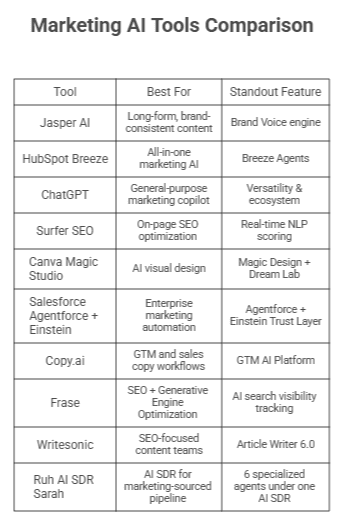
1. Jasper AI — Best for Brand-Consistent Long-Form Content
Jasper AI has positioned itself as the enterprise content platform for marketing teams that need brand-consistent copy at scale. Where general-purpose models like ChatGPT can drift, Jasper's Brand Voice engine learns your company's tone from existing content and enforces it across blog posts, ad copy, emails, and social.
What stands out in 2026:
- Brand Voice 2.0 — currently the most sophisticated tone-modeling engine in the writing-tool category.
- Marketing-specific templates for funnels, launch sequences, ABM emails, and SEO briefs.
- Team workspaces with role-based access, useful for content ops teams running 10+ writers.
- AI agents for marketing that go beyond drafting — Jasper's agents now run multi-step content workflows from research to publish.
Best for: Mid-market and enterprise marketing teams producing 20+ pieces of content per month who need brand consistency and editorial control.
Limitations: The depth of the platform can feel like overkill for solo founders or content-light teams. Jasper rewards investment — light users won't see ROI.
2. HubSpot Breeze — Best All-in-One Marketing AI
HubSpot Breeze is HubSpot's AI ecosystem — a suite of agents, assistants, and embedded features layered into the CRM that already runs marketing, sales, and service for hundreds of thousands of teams. Launched at INBOUND 2024 and dramatically expanded through 2025 and 2026, Breeze is the default starting point for teams that want one platform instead of a stack of point tools.
Three pillars define Breeze:
Breeze Copilot — a conversational assistant available throughout the HubSpot UI; it can answer questions about CRM data, draft content, summarize records, and trigger workflows in natural language.
Breeze Agents — autonomous workers including the Content Agent, Prospecting Agent, Customer Agent, Knowledge Base Agent, and Social Media Agent, each handling entire workflows on its own.
Breeze Intelligence — a data-analysis layer that powers predictive lead scoring, contact enrichment, and audience insights, replacing the broken MQL model that most teams still rely on.
Why it matters: Marketers don't have to leave HubSpot to research, write, optimize, and distribute. The Content Remix feature — which turns a winning blog post into a social cascade and an email — is a quiet productivity multiplier.
Best for: Teams already on HubSpot, or teams choosing a CRM-anchored stack from the start.
Limitations: Breeze is at its best inside HubSpot. Teams using a different CRM will get a fraction of the value. Outside the HubSpot ecosystem, you'll likely want a specialist for each job.
3. ChatGPT — Best General-Purpose Marketing Copilot
It is impossible to write a credible 2026 list without ChatGPT at the top tier. While specialized tools beat it on specific jobs, no other tool matches its breadth, ecosystem, and speed of capability rollout. According to OpenAI's marketing playbook, ChatGPT is now used across campaign planning, competitor research, creative development, audience analysis, and visual brand communication.
Where ChatGPT genuinely wins:
- Strategy and ideation — turning a vague brief into 20 angles, then narrowing to three.
- Custom GPTs — marketing teams now ship internal GPTs trained on their style guide, ICP, and past campaigns.
- Multimodal output — image generation, voice, document analysis, and code in one interface.
- Browsing and research — real-time data lookup with citations, increasingly useful for competitive monitoring.
Best for: Any marketer, at any stage, who needs a versatile copilot rather than a single-purpose tool.
Limitations: It will confidently invent statistics and citations if not corrected — every output needs human review. Without an enterprise tier, sensitive customer data should not be pasted into prompts.
4. Surfer SEO — Best for On-Page SEO Optimization
Surfer SEO remains the gold standard for on-page optimization. It reverse-engineers what's currently ranking for your target query, scores your draft against 500+ web signals, and tells you exactly what terms, headings, and structure are missing — in real time as you write.
What still makes Surfer the leader:
Content Editor with NLP-driven scoring — you can watch your content score climb as you add the right entities and structure.
Keyword Surfer + SERP Analyzer for end-to-end research, not just optimization.
AI Content writer integrated into the editor for drafts that already meet the brief.
Content Audit that flags ranking pages losing freshness signals.
Best for: SEO-driven content teams that publish weekly and need every post to compete.
Limitations: Surfer optimizes for Google. If your priority is appearing in AI Overviews and ChatGPT answers, pair Surfer with Frase (see #8).
5. Canva Magic Studio — Best for AI-Powered Visual Design
Canva Magic Studio is the suite of AI tools embedded across Canva — Magic Design, Dream Lab, Magic Write, Canva Sheets, and Magic Charts — and it has become the fastest path from "we need a creative" to "the asset is in the calendar".
The standout 2026 capabilities:
Magic Design generates fully editable layouts from a single text prompt and now learns your brand style.
Dream Lab produces commercially licensed AI images optimized for marketing use, with significantly more generations per month than competing tools at the same access tier.
Magic Write supports brand voice training, producing copy in your established tone.
Canva Sheets + Magic Charts turn marketing data into visual narratives without exporting to a separate BI tool.
According to Canva's AI in Marketing report (2026), 85% of marketers using these tools save at least 4 hours per week — equivalent to one workday every two weeks.
Best for: Solo founders, SMBs, and lean teams that need professional creative without a designer on staff.
Limitations: Magic Studio is excellent for digital and social formats but still trails Adobe's Creative Cloud + Firefly stack for high-end print and complex video.
6. Salesforce Agentforce + Einstein — Best for Enterprise Marketing Automation
For enterprise marketing teams, the question isn't whether to use AI — it's how to deploy it across a complex CRM, marketing cloud, and service stack without compromising governance. That is exactly the problem Salesforce Agentforce + Einstein is built to solve.
Salesforce's AI journey moved from the original Einstein prediction layer to Einstein GPT for generative output, and now to Agentforce, an agentic AI platform that builds enterprise-ready autonomous agents grounded in your CRM data. As Salesforce Ben's definitive Einstein guide explains, Einstein is now natively embedded into the Agentforce 360 Platform, leveraging both internal CRM data and external apps to provide insights, predictions, and generated content directly inside the workflow.
Why enterprises pick it:
Agentic execution — Agents qualify leads, route service cases, and personalize email journeys autonomously, in multi-step flows.
The Einstein Trust Layer — dynamic grounding, zero data retention with foundation model providers, and toxicity detection — features required for any regulated industry.
Multimodal AI combining text, image, and voice in customer touchpoints.
Best for: Enterprises already standardized on Salesforce, and regulated industries needing strong data governance.
Limitations: Implementation is non-trivial. Expect a 60–120 day setup with admin and architect involvement.
7. Copy.ai — Best for Go-to-Market and Sales Copy
Copy.ai began life as a short-form copy tool and has since rebranded into a GTM AI Platform — the system marketing and sales teams use together to drive revenue. Its sweet spot remains conversion-focused writing: ad copy, sales sequences, landing pages, and outbound emails.
What 2026 buyers love:
Workflows — multi-step automations that take a target account, research it, draft an outbound sequence, and push it into the CRM.
Conversion-optimized templates that beat generic AI outputs on click-through.
Integration with sales tools like Outreach, Salesloft, and HubSpot.
Bulk operations — generate hundreds of personalized variants in one batch instead of one prompt at a time.
Best for: Teams where marketing and sales share a revenue number and want shared AI workflows.
Limitations: Long-form blog content quality trails Jasper. Use Copy.ai for the funnel; use Jasper for the SEO library.
8. Frase — Best for SEO + Generative Engine Optimization (GEO)
Frase earned its place on this list by recognizing earlier than most that the future of search isn't just Google — it's AI answer engines. In 2026, Frase positions itself as an agentic SEO and GEO platform: it researches the market, drafts optimized content, and — critically — tracks visibility across Google and AI search engines like ChatGPT, Perplexity, and Google AI Mode.
Standout features:
AI Visibility tracking — see when your brand is being cited inside AI overviews and chatbot responses, not just blue-link rankings.
Question-first research — Frase mines Reddit, Quora, and "People Also Ask" for the actual questions your audience is typing.
Content brief builder that produces SEO-graded outlines in minutes.
80+ specialized skills for marketers covering every stage of the content lifecycle.
Best for: Content teams optimizing for both Google rankings and AI citations — i.e., every serious team in 2026.
Limitations: Pure on-page scoring is a notch behind Surfer; pure brand voice control is a notch behind Jasper.
9. Writesonic — Best for SEO-Focused Content Teams
Writesonic is the value-and-volume play in 2026 for teams who want serious AI writing capability without the heaviest enterprise overhead. Its Article Writer 6.0 integrates real-time SERP data so the output already has the semantic depth and structure search engines reward, and its Brand Voice 2.0 holds tone across batches.
Why it earns the slot:
SERP-aware drafts — content arrives with the right entities, headings, and FAQ blocks already in place.
Long-form quality that holds its own against tools costing several times more.
Built-in factcheck and grammar layers to reduce hallucinations.
AI Audit and refresh tools for keeping a content library current.
Best for: Freelancers, bloggers, SMBs, and content sites publishing volume where margin matters.
Limitations: Less polished brand voice than Jasper, fewer GTM workflows than Copy.ai.
10. Ruh AI SDR Sarah — Best AI Sales Development Representative for Marketing-Sourced Pipeline
For most teams in 2026, the biggest unsolved problem in marketing isn't writing — it's converting MQLs into booked meetings without burning out human SDRs. That gap is exactly where Ruh AI's SDR Sarah earns a top-10 spot. Sarah is a true AI Sales Development Representative: an autonomous AI employee built from six specialized agents under one AI SDR, designed to prospect, qualify, and book meetings 24/7.
This is the category most general-purpose marketing-tool listicles ignore — and the one that matters most for marketing teams under pressure to prove pipeline contribution.
What stands out in 2026:
Six specialized agents under one AI SDR — research, enrichment, ICP matching, outreach drafting, multi-channel sequencing, and meeting booking, all coordinated under a single Sarah profile.
Hyper-personalization at the core — Sarah drafts outreach in your brand voice using real-time research about each prospect's company, role, and recent triggers.
Instant integration with 50+ tools — CRM, calendar, email, and major sales-engagement platforms connect in minutes, not weeks.
Live in under a day with a 4-step setup: Connect, Define, Activate, Optimize.
Built-in continuous learning — Sarah tracks conversion outcomes per campaign and tunes targeting and messaging automatically.
Documented results from Ruh AI's published benchmarks:
3× more qualified leads vs. manual prospecting
15% higher win rates
80% time saved on top-of-funnel activities
95% improvement in response rates
2× faster outreach-to-meeting conversion
70% fewer missed follow-ups
10× outreach capacity per pipeline-generation cycle
Best for: B2B marketing teams that own a pipeline number and need to scale outbound without scaling headcount; marketing-sales orgs aligning around a shared revenue funnel; SaaS teams with defined ICPs and high-velocity sales motions.
Limitations: AI SDRs require disciplined ICP definition and clean CRM hygiene to perform at peak — Sarah amplifies whatever signal you give her, so a fuzzy ICP produces fuzzy outreach. Like every AI SDR category leader, Sarah does her best work as part of a marketing-sales workflow, not as a standalone tool.
Honorable Mentions Worth Watching in 2026
The top 10 list is tight, but several tools earn a serious nod:
Clearscope — long the gold standard for enterprise content optimization; cleaner SERP data than most competitors and the most intuitive scoring system for non-SEO writers. Worth evaluating if your team is allergic to Surfer's interface or wants premium SERP data.
Adobe Firefly — the strongest AI image and video model integrated with Creative Cloud; the choice if you live in Photoshop, Illustrator, and Premiere.
Anyword — a conversion-focused copy tool with predictive performance scoring on every variant.
Optimizely — AI-powered experimentation, A/B testing, and personalization, especially strong for product marketing teams.
Semrush — still the most comprehensive all-in-one SEO and competitive-intelligence platform, with growing AI search visibility features.
Hootsuite AI — smart scheduling and engagement prediction for social media teams managing multiple channels.
AdCreative.ai — AI-generated, performance-scored ad creatives for Meta and Google Ads.
Midjourney v7 — the highest-quality AI image model for hero campaign visuals.
Zapier and Gumloop — the connective tissue and AI-orchestration layer that ties the rest of the stack together.
11x, Artisan, and Qualified Piper — alternative AI SDR and inbound-engagement platforms worth comparing alongside Ruh AI's SDR Sarah.
Real Advantages of Using AI in Your Marketing Stack
The benefits at this point are well-documented and increasingly measurable.
Speed at scale. Marketers using AI save 4+ hours per week on average (Canva AI in Marketing report, 2026). Content cycles compress from days to hours, and the marginal cost of testing five ad variants instead of one collapses to near zero.
Higher ROI. Industry benchmark data for 2026 shows AI-driven campaigns deliver about 22% higher ROI, with 32% more conversions and 29% lower acquisition costs than traditional ones.
Pipeline you can actually measure. AI SDRs change the marketing-to-sales handoff entirely. Per Ruh AI's published benchmarks for SDR Sarah, teams see 3× more qualified leads, 95% better response rates, and 80% time savings at the top of the funnel — turning marketing-sourced pipeline from a debate into a dashboard.
Brand voice consistency at volume. Tools like Jasper's Brand Voice and Writesonic's Brand Voice 2.0 hold tone across hundreds of pieces — something humanly impossible at the same scale.
Smarter personalization. Predictive scoring and dynamic segmentation in Salesforce Einstein and HubSpot Breeze tailor messaging at the individual contact level rather than the segment level.
Lower cost of experimentation. A/B testing copy, subject lines, ad creative, and landing pages becomes near-zero marginal cost.
Accessibility. A solo founder with Canva Magic Studio, ChatGPT Plus, and Writesonic now produces work that previously required a designer, copywriter, and analyst.
Cross-channel orchestration. Agentic platforms like Agentforce, Breeze Agents, and Ruh AI SDR Sarah coordinate email, ads, social, chat, and calendar from a single brief or ICP.
Honest Disadvantages and Limitations to Plan For
Any marketer who tells you AI tools have no downsides hasn't shipped real campaigns yet.
Hallucinations and factual drift. Large language models will confidently invent statistics, sources, and quotes. Every AI-generated claim, especially anything numeric, needs human verification before it goes live. The brand cost of one viral fact-check thread can outweigh months of productivity gains.
Brand voice flattening. Without strict brand-voice training, AI output trends toward a generic, on-the-nose register that erodes differentiation. Two competitors using the same default Jasper or ChatGPT outputs start to sound identical. The fix is investing in custom voice training and editorial guardrails — not avoiding AI.
Measurement gaps. Despite near-universal adoption, only ~19% of organizations track KPIs specifically tied to generative AI output, per industry adoption surveys. Teams shipping AI-assisted content without measuring downstream conversion can confuse activity for impact.
Data privacy and IP risk. Pasting proprietary customer data into a non-enterprise model is a real exposure. Use enterprise tiers (ChatGPT Enterprise, Jasper Business, Salesforce's Einstein Trust Layer) when sensitive data is involved.
AI SDR deliverability and brand risk. A poorly configured AI SDR can damage sender reputation and brand trust faster than any other category of marketing tool. The fix is platforms like Ruh AI SDR Sarah that build deliverability guardrails, ICP matching, and continuous tuning into the core product — not retrofit them later.
Overreliance and skill atrophy. Junior marketers who let AI draft every brief, audit, and campaign risk losing core craft skills — research, narrative judgment, original thinking. Treat AI as a leverage tool, not a replacement for thinking.
How AI Tools Make Day-to-Day Marketing Easier
It's worth being concrete about what an AI-augmented marketing day actually looks like in 2026.
A content marketer opens a brief at 9 AM. Frase has already pulled SERP data, "People Also Ask" questions, and competitor outlines. By 9:30, Jasper has produced a first draft against the brief and the team's brand voice profile. By 10:15, Surfer has scored the draft and surfaced 12 missing entities and three structural improvements. Canva Magic Studio generates the hero image and a four-image carousel. HubSpot Breeze schedules the post, drafts a five-email nurture sequence, and creates social variants. This is what content marketing on autopilot actually looks like in practice — AI employees handling the full publishing loop while humans focus on direction and judgment.
Meanwhile, Ruh AI SDR Sarah has been running quietly in the background since the team logged off the night before. Overnight, Sarah identified 240 new accounts that fit the ICP, enriched them, prioritized 38, sent personalized first-touch emails to 26, and booked four meetings into the AE calendar. Marketing didn't write any of that copy by hand. Sales walks into Monday with four warm conversations already on the books.
What used to be a five-day workflow involving four people now takes three hours and one person — and the pipeline is filling itself. The marketer's job has shifted from production to orchestration, judgment, and editorial taste. The advantage doesn't accrue to teams that use AI; it accrues to teams that redesign their workflows around AI — and increasingly, redesign their team structure itself for a hybrid human-plus-AI organization.
How Ruh AI Is Adapting AI Marketing Tools for Smarter Results
At Ruh AI, we don't just observe the AI marketing wave — we engineer for it. Our approach to the modern marketing stack is built on three principles: specialization beats generalization, GEO is the new SEO, and every workflow should be auditable.
We treat foundation models as infrastructure, not features. Inside the Ruh AI workforce, ChatGPT-class models handle reasoning, but specialized AI employees sit on top of that infrastructure — each engineered for a specific job. SDR Sarah is the most visible of these: six coordinated agents under one AI SDR, designed to take an ICP and turn it into booked meetings without human keystrokes. The same architectural principle drives our approach to content, enterprise search, and workflow automation.
Our forward-looking bets for 2026 and beyond:
GEO-first content engineering. Every piece is scored for both Google ranking signals and AI citation worthiness. Quotable statements, structured data, and clear entity associations are built in, not bolted on.
Agentic content audits. We run on-page, technical, and EEAT audits as autonomous agents — not as one-off checklists. The same rigor that QAs a software release now QAs a blog post.
Brand-voice-aware automation. We pair tools like Jasper and Writesonic with internal brand-voice fine-tuning so output sounds like your brand, not a generic Jasper template.
Always-on pipeline generation. SDR Sarah replaces the brittle, rep-by-rep outbound motion with a 24/7 AI workforce that scales without scaling headcount.
Trust by design. Every claim is sourced. Every source is checked. The Ruh AI pipeline treats hallucination as a defect, not a quirk.
If you're building a 2026-grade marketing stack and want a partner who treats AI marketing tools as a system rather than a shopping list — and who can drop a fully-functional AI SDR into your pipeline in under a day — that's where we operate.
Final Take and Next Steps
The AI marketing landscape in 2026 isn't about picking one tool — it's about building a stack that fits your workflow. The 10 tools above are the ones that earn their seat for most teams. Start with the one or two jobs that hurt most today: blank-page content, slow design turnaround, no SEO scoring, fragmented automation, or pipeline that won't fill itself.
If pipeline is the gap, the fastest single move you can make in 2026 is deploying an AI SDR. Going from zero to a fully-functional AI SDR used to be a quarter-long project; with Ruh AI SDR Sarah, integration to live pipeline is under a day.
If you'd rather not figure out the stack alone — and want a content engine engineered for both Google ranking and AI citations, plus a 24/7 AI SDR feeding your calendar — talk to the team at Ruh AI. We'll show you what a 2026-grade marketing pipeline looks like when AI tools are treated as a system, not a shopping list.
Frequently Asked Questions
What is the best AI tool for marketing in 2026?
Ans: There is no single best AI tool — the right answer depends on the job. HubSpot Breeze is the strongest all-in-one platform, Jasper AI wins for brand-consistent long-form content, Surfer SEO leads on-page SEO optimization, Canva Magic Studio dominates AI visual design, Salesforce Agentforce + Einstein is the enterprise standard for marketing automation, and Ruh AI SDR Sarah is the leader for AI SDR–driven pipeline. Most serious teams in 2026 use a stack of three to five tools, not a single platform.
Are AI marketing tools worth using?
Ans: For most teams, yes — provided you redesign workflows around them. Industry data shows AI-driven campaigns deliver around 22% higher ROI and 29% lower acquisition costs than traditional ones, and 75% of marketing leaders report positive ROI from AI investments. The teams that don't see returns typically dropped tools into legacy workflows without rethinking the process.
What is an AI SDR and why does it matter for marketing?
Ans: An AI SDR (AI Sales Development Representative) is an autonomous AI worker that handles top-of-funnel sales activities — research, prospecting, outreach, qualification, and meeting booking — without constant human prompting. AI SDRs matter for marketing because they directly turn marketing-sourced leads into booked meetings, closing the gap between MQLs and revenue. Tools like Ruh AI SDR Sarah can deliver 3× more qualified leads and 95% better response rates compared to manual outbound, per published benchmarks.
What is the difference between SEO and GEO?
Ans: SEO (Search Engine Optimization) focuses on ranking on traditional search engine results pages, primarily Google's blue links. GEO (Generative Engine Optimization) focuses on getting cited inside AI-generated answers from ChatGPT, Perplexity, Gemini, and Google AI Overviews. In 2026, serious content teams optimize for both, because AI answer engines are absorbing an increasing share of informational queries.
Can AI tools replace human marketers?
Ans: No — and the data backs that up. AI tools dramatically increase a marketer's leverage but still require human judgment, brand taste, strategic direction, and fact-checking. The teams that win with AI are those that redesign roles toward orchestration and editorial leadership, not those that try to remove humans from the loop.
How do I build an AI marketing stack from scratch?
Ans: Start with the one or two jobs that hurt most today. For most teams that's: blank-page content (start with Jasper, Writesonic, or ChatGPT), SEO scoring (Surfer or Frase), visual design (Canva Magic Studio), and pipeline generation (Ruh AI SDR Sarah). Layer a CRM-anchored platform (HubSpot Breeze or Salesforce Agentforce) underneath as your spine. Pilot each new tool for 60 days, measure the lift honestly, and only then expand.
Are AI-generated marketing assets safe to publish without review?
Ans: No. Every AI output should be reviewed for factual accuracy, brand voice fit, and originality before it ships. AI models can hallucinate statistics, miscite sources, or produce generic copy that flattens differentiation. Treat AI output as a first draft from a fast junior teammate — useful, but not publishable without editorial review.
What does agentic AI mean for marketers?
Ans: Agentic AI refers to AI systems that don't just generate content but autonomously execute multi-step workflows — researching an account, drafting outreach, qualifying leads, routing them into the CRM, and triggering follow-up. According to Gartner's January 2026 forecast, 60% of brands will use agentic AI for one-to-one customer interactions by 2028, making it the defining shift in marketing automation for the next two years. This is also where the line between AI chatbots and full-fledged AI marketing employees matters — chatbots answer questions, AI employees execute campaigns. AI SDRs like SDR Sarah are among the clearest examples of the latter in action.