Construction glossary · Wood framing
What is hurricane tie in construction?
A hurricane tie is a galvanized metal framing connector that fastens a rafter or truss to the top plate or wall below, resisting the uplift and lateral forces that wind puts on a roof. It creates a continuous load path from the roof down into the wall. Quantity is a straight count, typically one tie at each rafter or truss bearing point.
Updated June 2026 · Reviewed by the Ruh construction team
Hurricane ties counted per roof
Estimating wood framing scope this week? Watch Ruh take off a real plan in 30 minutes.
Book a walkthroughA hurricane tie, sometimes called a hurricane clip or rafter tie connector, is a stamped galvanized steel connector that locks the roof framing to the wall in light-frame construction. It wraps from the side of a rafter or truss bottom chord down onto the double top plate and is fastened with the connector nails the manufacturer specifies, creating a rated uplift and lateral resistance at each bearing point. Toe-nailing alone does not hold a roof down in high wind, so codes in many wind regions require a tested connector at every rafter or truss seat to maintain a continuous load path from ridge to foundation. Ties come in different rated capacities, so the structural drawings or the connector schedule call out the specific model. Some assemblies use a tie on each side or a heavier connector where uplift is high. Estimators count hurricane ties as a unit item, one or more per rafter or truss, plus the matching connector nails or screws.
Hurricane ties are counted as a unit quantity, one per rafter or truss bearing point unless the connector schedule calls for two. Count the number of rafter or truss bearing points along each wall, then multiply by the ties per bearing called out on the structural plan or the connector schedule. For a gable roof, that is generally the truss or rafter count times the number of bearing walls each member lands on, usually two. Read the tie model and nailing from the connector schedule, since each model needs a set number of specified nails or screws, which you tally alongside the ties. Watch for hip and girder locations and high-uplift zones where a heavier or doubled connector is specified.
Worked example
Take a roof framed with 40 rafters, each bearing on the exterior wall top plate at one end, with the connector schedule calling for one hurricane tie at each rafter-to-plate seat. Ties = 40 rafters x 1 tie per seat = 40 ties. If the design also requires a tie where each rafter bears at the ridge beam wall, that is 40 x 2 = 80 ties. Fasteners: at a typical 8 connector nails per tie, 40 ties x 8 = 320 nails, or 80 ties x 8 = 640 nails, so order the matching connector nails by that count plus a box of margin. If the schedule upgrades to a heavier tie at the 6 gable-end and corner rafters, that is 6 heavy ties plus 34 standard ties for the single-seat case. Confirm the tie model and nail count against the connector schedule before ordering.
Try Ruh on a real bid. 100% money-back guarantee if you are not satisfied.*
*Scoped delivery, terms apply. Read the guarantee terms
How Ruh handles hurricane tie
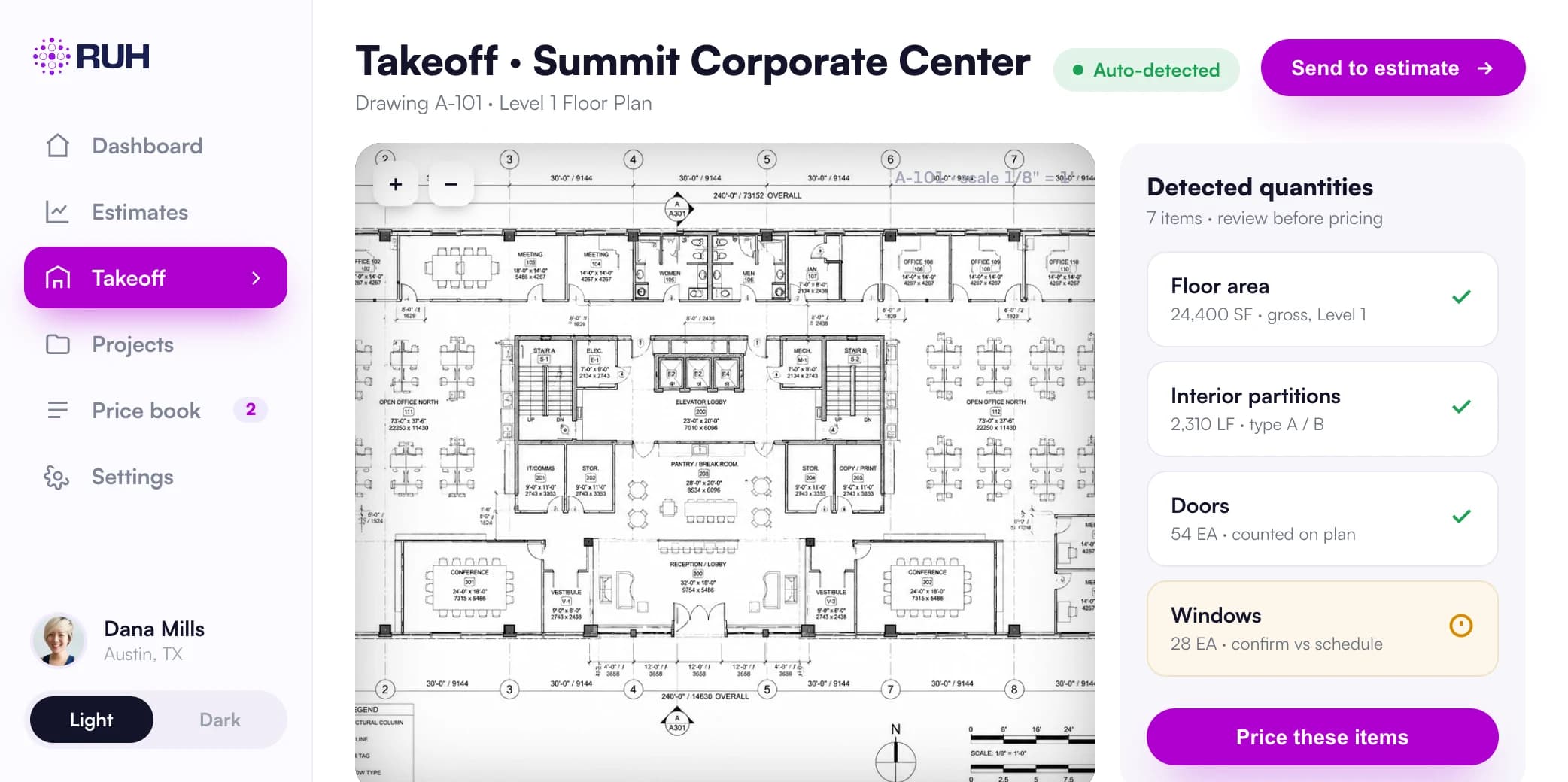
Ruh reads the roof framing plan and connector schedule, counts the rafter or truss bearing points, and multiplies by the ties per bearing the schedule specifies, including any heavier connectors at gable ends and corners. It tallies the matching connector nails per the tie model and prices the ties and fasteners on your own price book hardware line. The estimator checks the tie count and model against the schedule and signs off.
See framing estimating softwareHurricane tie: frequently asked questions
What does a hurricane tie do?+
It mechanically fastens each rafter or truss to the top plate so the roof resists wind uplift and lateral load. It maintains the continuous load path from roof to foundation that toe-nails alone cannot provide in high-wind areas.
How many hurricane ties do I need?+
Count one tie per rafter or truss bearing point as a baseline, then follow the connector schedule, which may call for two ties per seat or heavier connectors at gable ends and corners. For 40 rafters on one bearing wall, that is 40 ties.
Do hurricane ties need special nails?+
Yes. Each connector is rated only when filled with the specific connector nails or screws the manufacturer lists, often around 8 per tie. Substituting fasteners voids the rated capacity, so order the matching nails with the ties.
Still measuring by hand? Your next takeoff can run while you review this one.
See it on your plansRelated terms
Keep going: read the full guide or explore framing estimating software.
See Ruh price a bid from your own drawings.
AI takeoff and estimating on your price book, your estimator signs off.
Figures on this page are illustrative. Construction estimates depend on project-specific conditions, source documents, market pricing, and professional judgment. Ruh's AI assists the estimator and does not replace professional review: your team reviews, validates, and approves every estimate, bid, and pricing decision.