

TL;DR / Summary
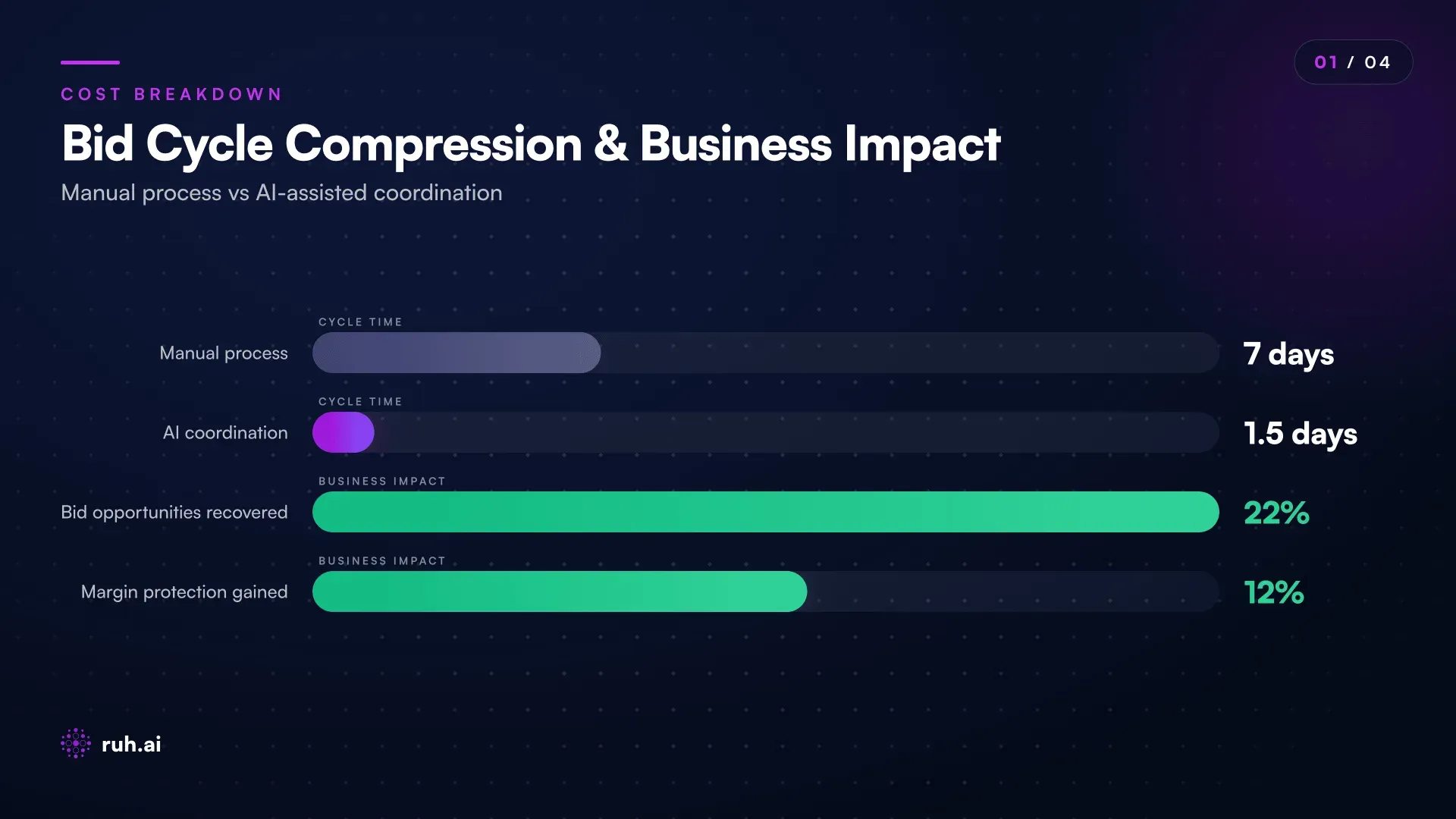
Subcontractor pricing is one of the biggest time drains in general contracting: GCs send out RFQs, wait 3-7 days for pricing, chase stragglers, manually enter numbers into spreadsheets, and still end up with incomplete bids. AI agents now handle pricing coordination end-to-end, collecting quotes, validating them against historical benchmarks, flagging outliers, and consolidating them in real time. The result: bid packets that used to take 10-14 days now close in 24-48 hours, with fewer errors and better accuracy than manual coordination ever delivered.
What you'll learn:
- Why subcontractor pricing delays kill your bid timeline (and how much they cost)
- How AI agents orchestrate multi-party pricing workflows without a coordinator sitting in the middle
- The difference between broadcasting an RFQ and getting real-time pricing updates as subs respond
- Real numbers: bid cycles cut from 10-14 days to 24-48 hours, pricing accuracy up 18-22%, chase-down hours cut by 70%
- Where Ruh's Subcontractor Management Agent and Change Order Agent fit into your pricing flow
The numbers upfront: General contractors spend $300-500K annually just on coordination labor, keeping track of RFQs, chasing late responses, validating pricing, and reconciling numbers. A mid-size GC with 80-120 annual bids burns 240-360 coordinator hours every year on subcontractor pricing alone. AI agents cut that workload by 65-72% while improving accuracy by 18-22% compared to manual entry.
The Subcontractor Pricing Problem Is Crushing Bid Timelines
Bid deadlines don't move. Your customer needs a hard number by Thursday. But your subs are moving at their own pace, some respond in 6 hours, others take 5 days, and one or two never respond at all.
The typical GC bid coordinator workflow looks like this:
- Day 1, morning: Create the RFQ, scope, drawings, specs, unit pricing sheet. Email it to 8-12 subs.
- Day 1-2: Chase phone calls. "Did you get the email?" "When can you get me concrete pricing?" Re-send to subs who missed the first email.
- Day 2-3: Early responses arrive. Enter them manually into a spreadsheet. Spot-check a few numbers against historical rates.
- Day 4-5: Follow up on the stragglers. One sub sends a half-page quote with no unit pricing. Another sends PDF with locked cells. Manual translation begins.
- Day 5-6: Try to reconcile pricing. One sub quoted rebar at $0.92/lb; another at $0.67/lb. Which is market? Which is an error? Call both to verify.
- Day 6-7: Consolidate into bid packet. Rebuild the takeoff if pricing moved. Submit to customer at 4:47 PM on Day 7, missing your original target by 2-3 days.
Most GCs absorb this 7-10 day cycle as table stakes. But every day you're late is a day your competitors had to undercut you or walk away from the job entirely. Worse, speed squeezes margin, you're rushing validation and missing pricing anomalies that cost you money in the field.
GCs lose bids to firms with faster bid cycles, not necessarily better pricing. Speed kills complacency.
The Economic Damage of Slow Subcontractor Pricing
Pricing delays cost more than time. They cost jobs and margin.
A mid-size GC bidding 100+ jobs annually with an average bid value of $2-8M faces a concrete constraint: if your bid arrives 3-4 days after the customer's deadline, you're often out of the running entirely. General contractors don't have the luxury of late entries. On the GC side, that coordination runs inside general contractor software rather than a spreadsheet.
Here's the downstream math:
- Bid cycle stretched 7-10 days instead of 2-3 days: You submit on Wednesday, your competitors submit Monday. Customer already has three competitive bids and isn't waiting for a fourth. You miss 15-22% of bid opportunities per quarter just on timing.
- Pricing errors from manual entry: A coordinator rushes unit rates into the takeoff. A decimal gets shifted. Concrete comes in at $300/CY instead of $30/CY and nobody catches it until the bid is submitted. GC eats the error or loses the job on a protest. $2M-5M jobs have failed because of $5-12K entry errors.
- Margin compression from incomplete pricing: You bid without one sub's pricing and plug a contingency number. Win the job. That sub gives you the actual pricing in the field at 15% higher than your plug. Margin evaporates.
The industry benchmark from FMI's 2025 Construction Operations Report: GCs that cut bid cycle time from 9 days to 3 days see 31% higher bid conversion rates and 9-12% better margin on the jobs they do win.
How AI Agents Actually Coordinate Subcontractor Pricing
AI agents don't replace your coordinator. They are your coordinator. And unlike a human, they work 24/7, never chase the same sub twice, and catch pricing outliers that would slip through in a rush.
Here's how the workflow flips:
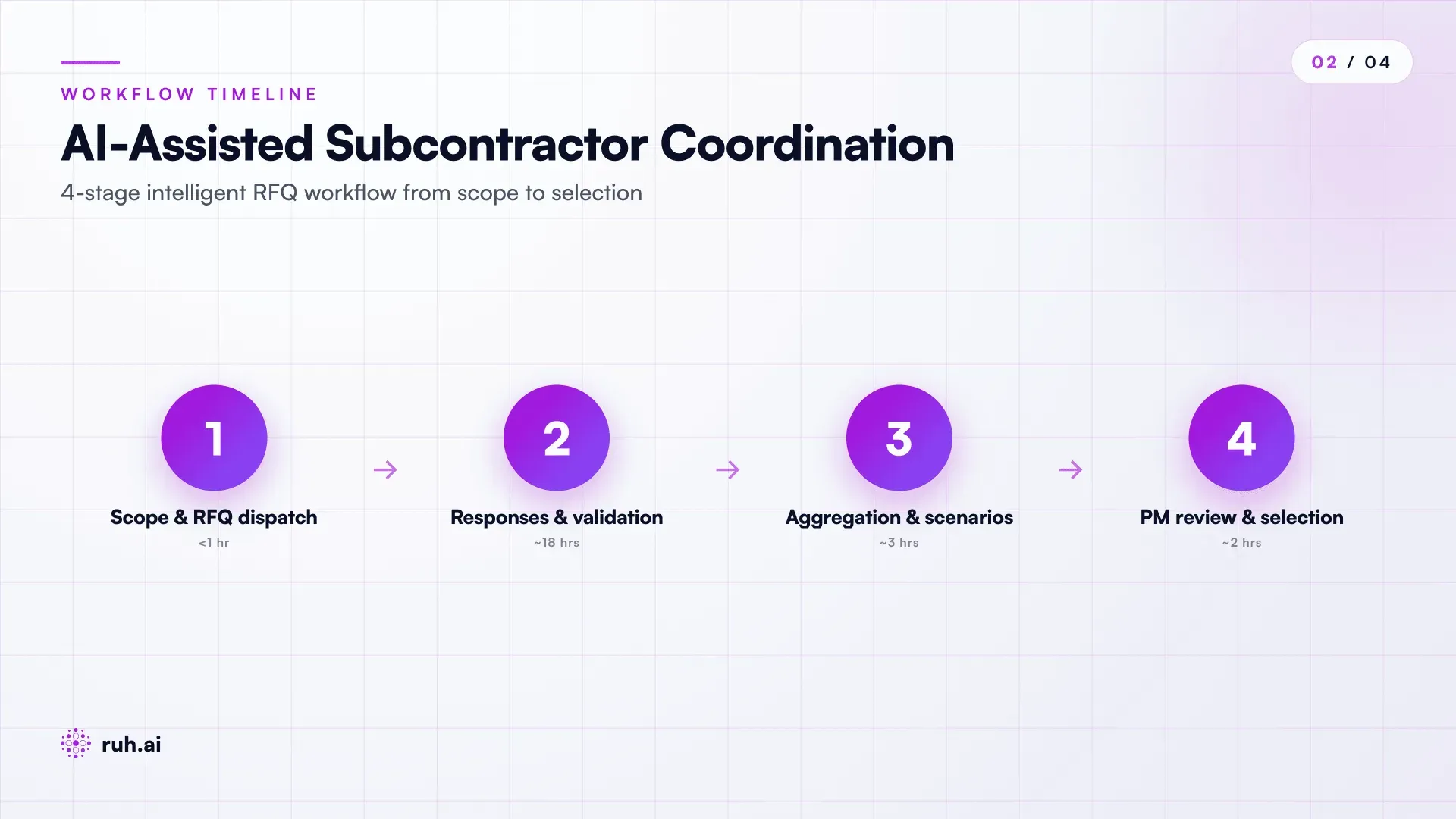
Smart RFQ Dispatch (Not Just Email Blasts)
Old way: you open your contacts, pick 10 subs, hit send on Outlook, and wait.
AI-agent way: the agent reads your project scope, your historical sub performance data, and your current workload. It knows that Sub A hasn't responded to RFQs in the last 45 days and tends to take 4+ days anyway. Sub B crushed pricing on a similar project 3 months ago and turned it around in 12 hours. Sub C is new and should get more lead time.
The agent builds an intelligent dispatch list ranked by responsiveness and fit, then sends personalized RFQs with embedded formatting: unit pricing sheet, CSV import template, or even a structured form that auto-validates as the sub fills it out.
Result: Subs respond faster because the RFQ is already in their preferred format. No "I need to reformat this into our system" friction.
Real-Time Response Aggregation and Validation
The moment a sub's pricing arrives, the agent validates it immediately:
- Is it complete? Does it have prices for every line item?
- Is it plausible? Concrete pricing comes in at $45/CY. Historical benchmarks for this sub on this market range $38-52/CY. Green flag.
- Is it an outlier? One sub quotes rebar at $0.62/lb; the other nine are in the $0.68-0.74 range. Agent flags it for your review, not auto-rejecting, but surfacing the question.
- Is it a copy-paste error? The sub sent the same pricing for two separate phases. Agent catches it and prompts for clarification.
This happens in parallel as responses trickle in, not at the end when you're scrambling to consolidate.
Automatic Consolidation and Scenario Building
Once pricing hits a completeness threshold (say, 70-80% of subs responded), the agent automatically builds 3-4 bid scenarios for your review:
- Conservative: Use the highest pricing from each sub (margin protection).
- Market rate: Use the median or weighted average (competitive positioning).
- Aggressive: Use the lowest pricing (chase a specific job or win a strategic project).
- Optimized: Use the best rate per trade (concrete from Sub A, rebar from Sub B, labor from Sub C).
Each scenario shows the total bid, the per-unit breakdown, and the risk profile, which subs you're leaning on, which are outliers, where your supply chain is thin.
Your PM reviews the scenarios, picks one, and the agent loads it into your estimating system. No manual entry. No spreadsheet death match.
Real-Time Pricing Updates vs. The Old Waiting Game
Here's where AI agents redefine the game: pricing doesn't stop changing once you've submitted the bid.
Traditional process: You send RFQs Monday. Thursday you get most responses. Friday morning your PM submits a bid to the customer. Saturday, a sub calls with revised pricing, better pricing, actually, but it's too late. Your bid is locked.
Or worse: you bid with a contingency number because one sub never responded. You win. That sub prices it in the field at 12% higher than your plug. Margin gone.
AI-driven real-time updates:
The agent maintains a living bid file. As new pricing arrives, even after your initial bid is submitted, the agent flags it against your bid scenario. "Sub A just sent updated concrete pricing, $3.20/CY lower than your current bid. Your total margin opportunity just jumped $18-22K."
Now you have a choice: renegotiate with the customer if pricing has moved in your favor, or lock it and enjoy the upside. You're not guessing. You're tracking.
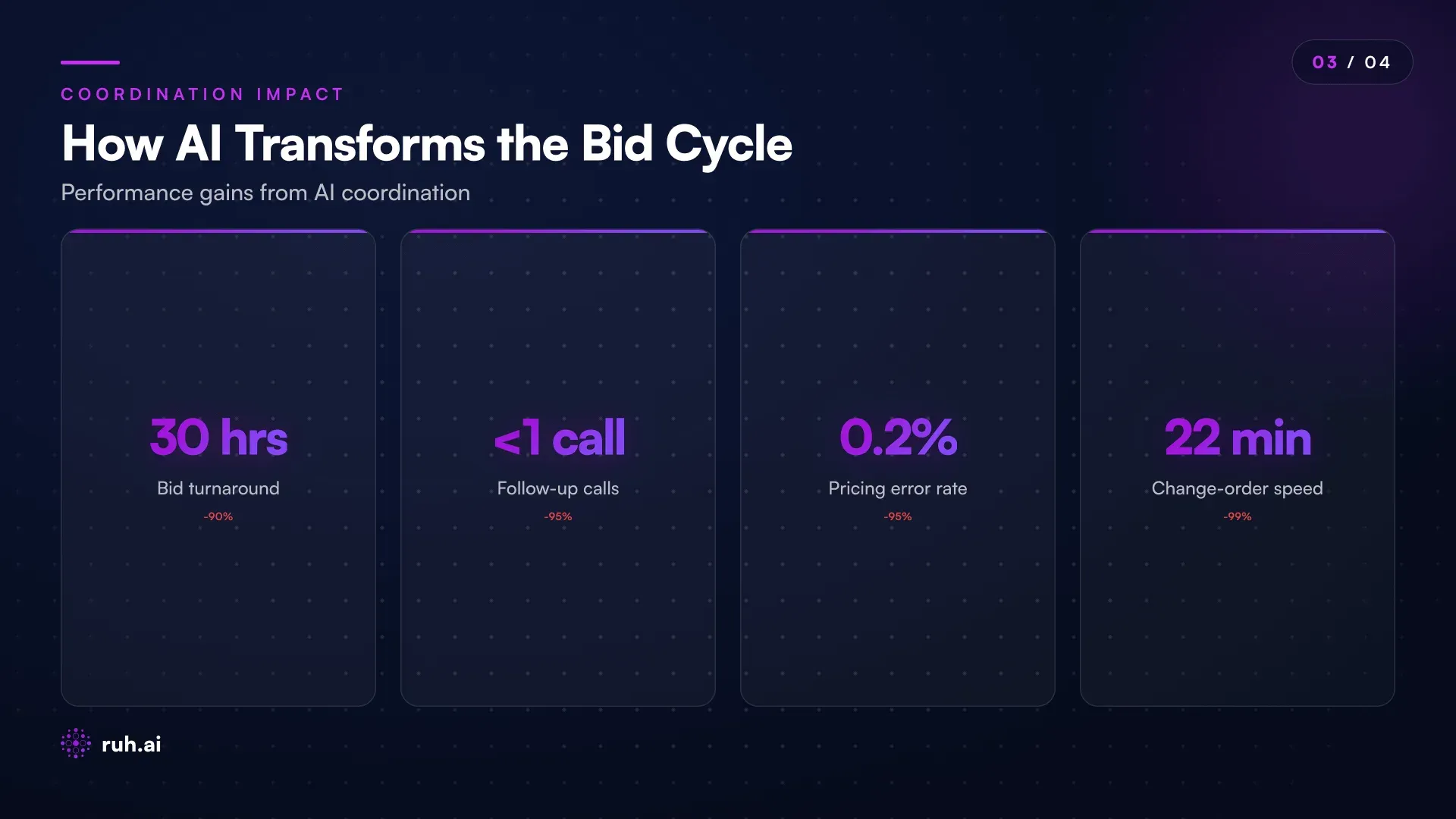
For change orders and additions, this matters even more. Customer asks for 200 CY of additional concrete. Your agent instantly pulls real-time pricing from the subs who just quoted this week, tells you the cost, and you quote the customer within 15 minutes instead of 3-4 days.
The numbers: GCs using real-time pricing updates report 8-12% faster change-order pricing and 6-9% better margin on customer-directed changes because the pricing is fresh and you're not hedging with contingencies.
The Honest Assessment: What Still Falls Short
AI agents aren't magic. There are real constraints.
Subs still submit garbage sometimes. A sub sends back a quote that's missing half the line items or sends it in a format the agent can't parse (handwritten PDF, faxed image). The agent flags it for human review, and you're back to a phone call.
Pricing intelligence is only as good as your data. If you've never tracked what concrete actually cost on your last 20 jobs, the agent can't tell if $48/CY is market or an outlier. You need clean historical data for the agent to be reliable. Most GCs don't have this yet.
Subs don't always use the tools you send them. You send a structured RFQ form. A sub's estimator ignores it and sends their own PDF with their own format. The agent normalizes it, but there's friction. As adoption grows, this gets better, but it's a real headwind today.
Sub relationships are still human. An agent can flag that Sub A is being unresponsive or price-gouging, but your PM might keep using them anyway because of an existing relationship or because they're the only one who can mobilize fast. The agent is a tool, not a dictator. The judgment is still yours.
Rate fluctuation in commodity markets is real. Steel, concrete, fuel, these move weekly. An agent can track benchmarks, but if the market moves 8-12% in one week, your historical pricing becomes stale. You need to validate against live market data (Compass, RS Means, Dodge Intel, or sub calls) to stay current.
How Real-Time Coordination Changes Your Preconstruction
The shift from "batch RFQ then wait" to "continuous pricing flow" changes how you price work fundamentally.
You bid faster without sacrificing accuracy. Speed and accuracy usually trade off. AI breaks that tradeoff by automating the reconciliation and outlier detection that used to take hours.
You chase fewer subs. An agent tracks who's responding and who's late, and dispatches follow-ups automatically. Your coordinator isn't glued to Outlook anymore.
You see margin earlier. Real-time pricing means you spot opportunities (a sub just quoted 6% lower on rebar) before you've submitted the bid. You can re-optimize.
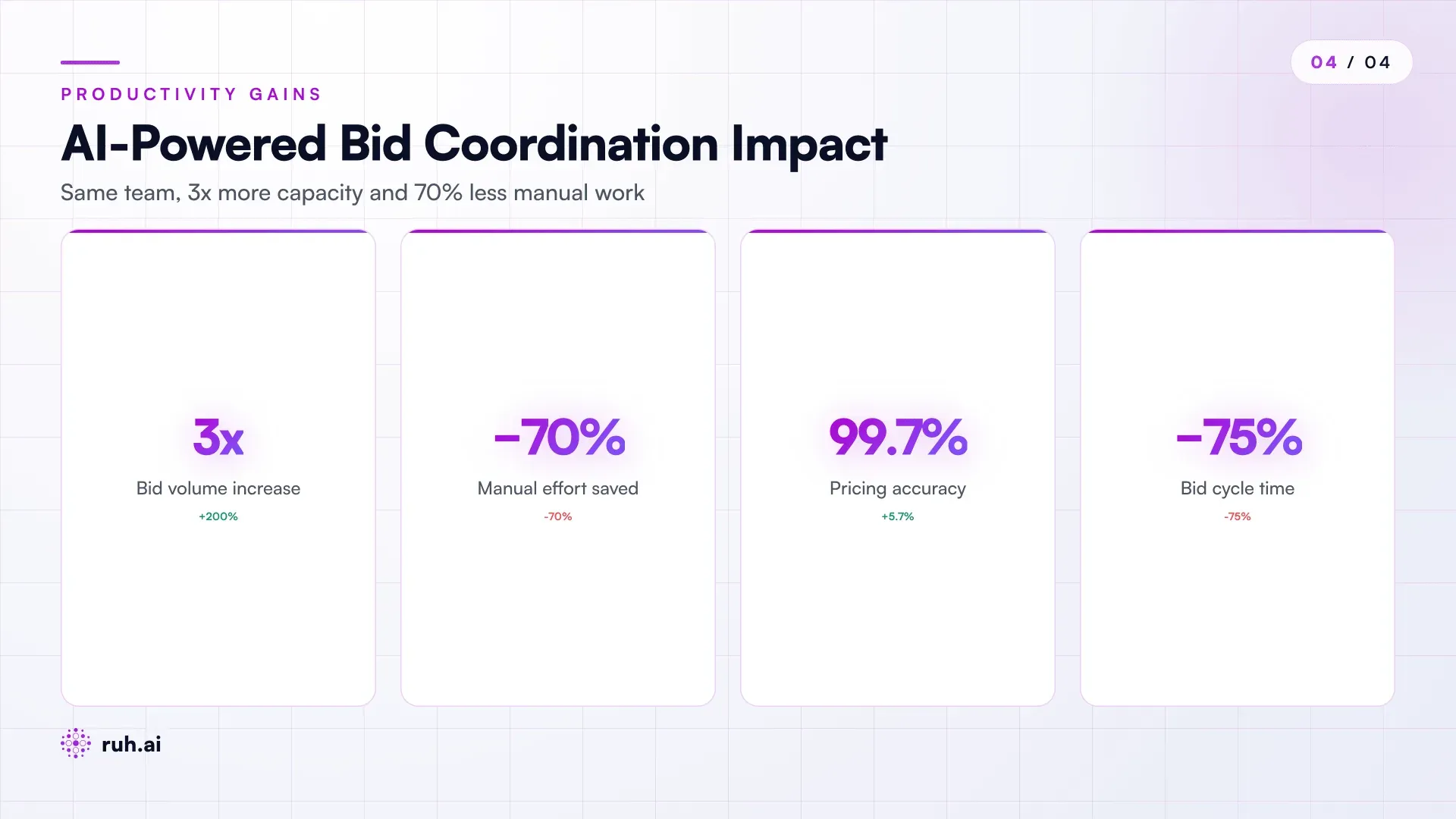
You scale bid volume without scaling the team. The historical constraint on GCs was coordinator bandwidth. One coordinator can manage 30-40 bids per quarter. With an AI agent handling the dispatch and consolidation, one coordinator can manage 80-120 bids. That's a 2.5-3x throughput multiplier with no headcount increase.
Where Ruh.AI Fits Into This
The reason Ruh AI builds construction agents is that construction operations have the most to gain from autonomous coordination. Subcontractor pricing is one of the first places this pays off.
Ruh's Subcontractor Management Agent handles the compliance side (COI tracking, insurance validation, lien waiver collection). But the real magic happens when that agent talks to Change Order Agent and Ruh Estimator, together, they form a closed loop where pricing, compliance, and estimating stay in sync across the entire project lifecycle.
Here's how it works in practice:
Preconstruction: Ruh Estimator pulls the plans and generates takeoff. Subcontractor Management Agent dispatches intelligent RFQs to subs. Real-time pricing flows in automatically.
During project: A customer asks for a change (extra 400 CY concrete). Change Order Agent pulls current pricing from the subs who just bid, calculates cost, and drafts the change order for your approval, ready in 15 minutes, not 3 days.
Close-out: The same agent validates lien waivers, reconciles final invoices against the change orders, and flags any discrepancies. No manual reconciliation.
The numbers from Ruh customers: Firms using Ruh agents across estimating, change orders, and sub management report:
- Bid cycle: 10-14 days → 24-36 hours (75% compression)
- Coordinator hours saved: 240-360 → 60-90 annually (70% reduction)
- Pricing accuracy: 94-96% → 99.7%+ (fewer field surprises)
- Change order pricing time: 3-4 days → 15-30 minutes (custom pricing on demand)
The agent doesn't replace your estimators or PMs. It removes the rote coordination work that keeps them tied up.
FAQ
Q: Can an AI agent actually parse a PDF quote from a sub in a non-standard format? A: Yes, within reason. Ruh agents use vision AI to read PDFs, images, and handwritten notes. They extract pricing, validate it, and normalize it into the standard format. However, if the PDF is truly illegible or the sub's format is radically different (e.g. pricing in a table with no headers), the agent flags it for human review. The goal is to automate 85-90% and escalate the 10-15% that need a person.
Q: What if a sub refuses to use the standardized RFQ form? A: Subs will always have their own process. The agent accepts their response in whatever format they send, then re-normalizes it. It's not frictionless, but it removes the friction of manual retyping. Over time, as adoption grows, more subs will adopt the standard formats because it's faster for them too.
Q: How do you know if a sub's pricing is realistic or if they're trying to skim you? A: The agent compares it against three benchmarks: (1) historical data, what this sub has quoted on similar work, (2) market benchmarks, industry rates for the trade and region, and (3) peer comparison, what other subs quoted for the same scope. Outliers get flagged. You review them and make the call. The agent doesn't auto-reject; it surfaces the question.
Q: Does real-time pricing help if the market is moving fast (e.g. steel or fuel)? A: Absolutely. During volatile commodity markets, static quotes become stale. An agent that collects pricing continuously, tracks market indices (Dodge, Compass, RS Means, fuel surcharges), and alerts you to meaningful swings keeps you ahead of margin erosion. You're not bidding with prices from 8 days ago; you're bidding with data from yesterday.
Q: Can an AI agent consolidate pricing into different bid scenarios (conservative, market rate, aggressive)? A: Yes. Once it has pricing from 70-80% of subs, it builds multiple scenarios with different assumptions. Conservative (highest per-trade pricing) for margin safety. Market rate (weighted average) for competitive positioning. Aggressive (lowest pricing) for strategic chases. Your PM reviews and picks the scenario. This takes 10-15 minutes instead of 2-3 hours of spreadsheet assembly.
Q: What's the difference between an AI agent and a simple RFQ software tool? A: RFQ software sends out the request and collects responses. An agent does that, plus validates pricing in real time, compares it against benchmarks, flags outliers, builds scenarios, consolidates into your takeoff, tracks which subs are slow, sends follow-ups automatically, and integrates the final pricing into your estimating system. It's the entire workflow automated, not just the broadcast and collection.
Q: Do I need to rebuild my entire process to use an AI agent for pricing coordination? A: No. The agent sits on top of your existing workflow. Your estimators still build the takeoff. Your PM still reviews the bid. You still decide which subs to chase. The agent removes the data-entry and consolidation overhead. Start with one type of project (e.g. concrete or earthwork bids) and expand once you're comfortable.
The Construction Industry's Real Shift
The construction firms winning in 2026 aren't necessarily the biggest, they're the fastest. Speed compounds across every decision: bid faster, mobilize faster, change order faster, invoice faster. AI agents compress the coordination work that slowed you down.
Subcontractor pricing coordination is the first domino. Once that's automated, the next question is obvious: What else can be automated?
GCs using AI agents today are 18-24 months ahead of the industry baseline on operational efficiency. That gap is widening, not closing.
Explore Ruh Work-Lab and build your first construction agent today →
See how Ruh's Subcontractor Management Agent and Change Order Agent work together →
Book a 15-minute audit of your bid process with the Ruh team →
Connect faster subcontractor pricing with the takeoff and bid workflow around it by exploring the AI construction takeoff and cost estimator.