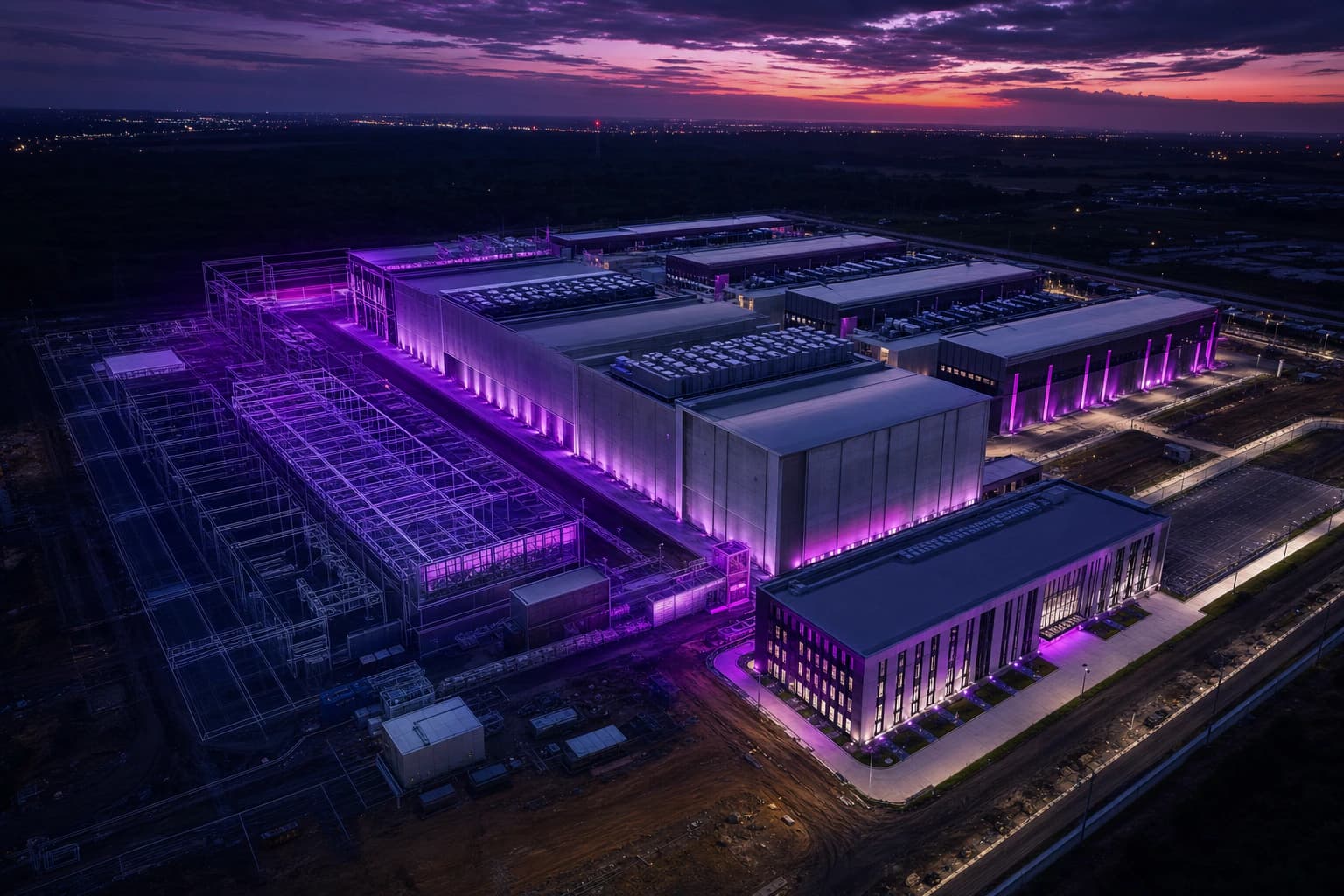
Part 01 argued that a campus is one module repeated, and that every number in the estimate needs provenance. Both claims assume something: that a drawing set already exists to measure and to price. It does not, yet. Before the takeoff, before the bid, someone has to turn a parcel into data halls, electrical galleries, and admin blocks. That is the design phase, and it is where the schedule is won or lost first.
Scheme the Campus on the Real Parcel
A data center is not an abstract program. It is data halls, electrical galleries, and admin blocks laid out on ground that has real setbacks, a real point where power ties in, and a real order in which the phases have to come online. Fit the module to that ground wrong and the whole schedule inherits the mistake.
In preview, Ruh generates site schemes on the actual parcel and iterates them against setbacks, power, and phasing constraints in hours rather than weeks. Take a hypothetical 200 MW campus: the question is not whether one layout works, it is how several layouts compare before land money is committed. This is design at demand speed, and it runs in preview, not in production.
The generative site scheme and the drawing set generation are in preview for data center teams. They are not shipped. The bid-side products they feed, measured takeoffs and priced estimates, are the parts running today.
The Set Generates From the Approved Model
A scheme is a decision, not a document. Once the design partners approve one, the documentation still has to follow, and that is usually where weeks disappear. In preview, the drawing set generates from the approved model and stands as the contractual spec, with revisions carried on one record instead of scattered.
A dimension you cannot trace is a dimension you cannot defend.
Every Dimension Knows Where It Came From
Downstream, this is already how the shipped work behaves. AI Takeoff works from your real drawing set, PDF or CAD, classifies the foundation plans, sections, and structural sheets, calibrates scale, and reconciles schedules that live on different sheets against the whole set instead of reading them in isolation. Quantities are measured off the drawing set. That runs today.
The preview extends the same discipline one step upstream. When the set generates from the approved model rather than being drafted by hand against it, a dimension does not just appear on a sheet. It traces back to the scheme decision that produced it. Measured, derived, or assumed stays true from the first line, not reconstructed after the fact.
The Second Campus Starts Ahead
A data hall is a repeatable building type, which is exactly what makes design reuse pay. In preview, the second campus does not start from a blank sheet. It starts from everything the first one learned: the module that fit, the galleries that coordinated, the phasing that held. The repetition that made errors tile in Part 01 works the other direction here, compounding what is already proven.
This Augments Your AE Firm, It Does Not Replace It
The obvious question is whether this replaces the AE firm. It does not. It compresses the production and coordination burden around them: feasibility data up front, schemes iterated in hours, and drawing sets generated from the approved model, all in preview, with your design partners steering intent. The judgment stays with the people who own it. The keystrokes and the re-keying are what get automated.
The set is the handoff. Once it generates in preview, it lands in AI Takeoff, the quantities come off it, and the estimate becomes the record. That is the next part of this series: from a drawing set to a bid you can defend, line by line, on the same project graph.