

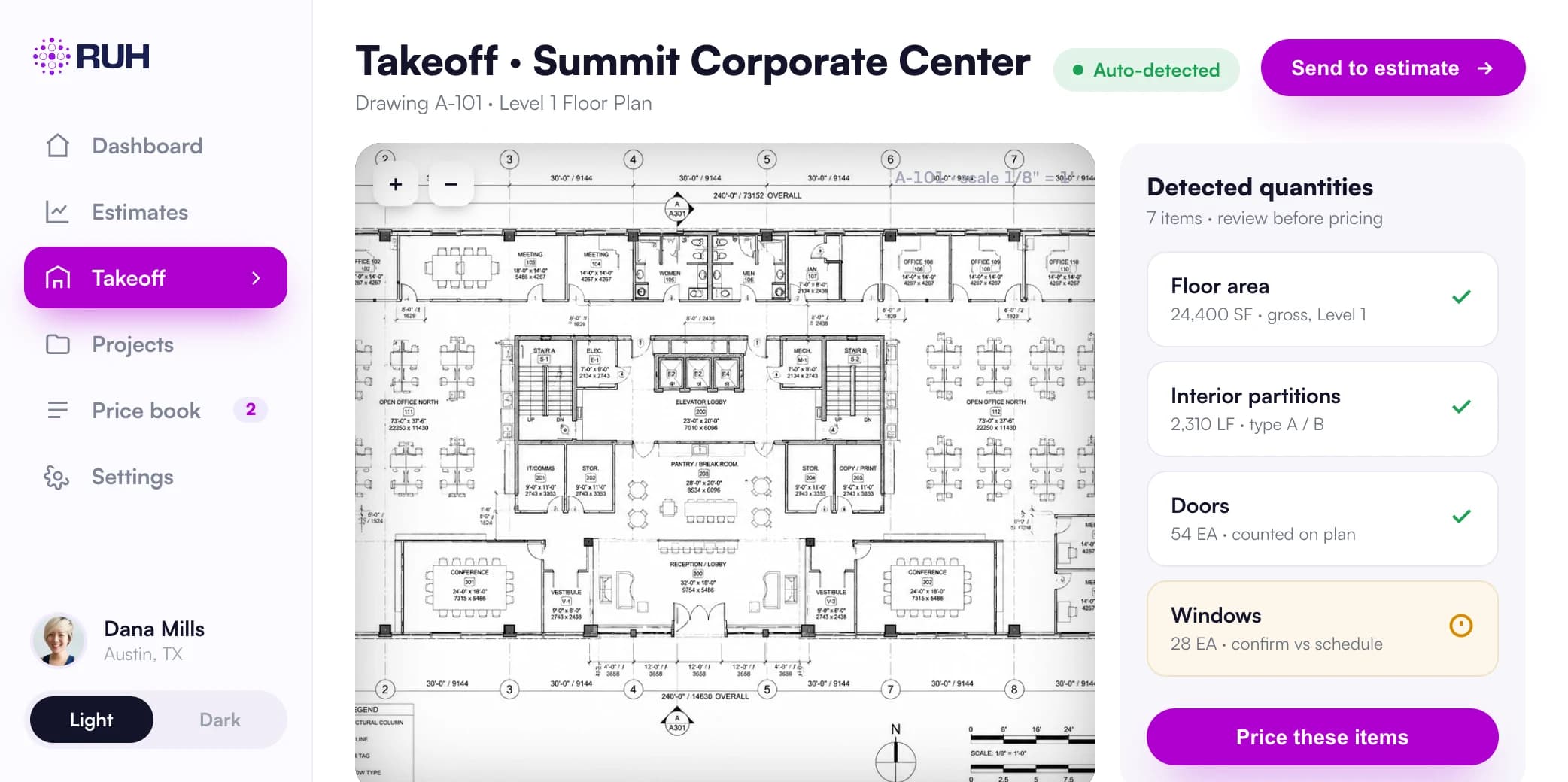
Construction glossary · Estimating concepts
What is material takeoff in construction?
A material takeoff (MTO) is the process of measuring construction drawings and listing every material a project needs, with a quantity and unit for each item, so the estimate and the buyout rest on counted quantities instead of guesses. Estimators perform the takeoff before pricing, then extend each quantity against unit costs to build the bid. The term is often used interchangeably with quantity takeoff (QTO), though a material takeoff strictly refers to the buy list of materials itself.
Updated June 2026 · Reviewed by the Ruh construction team
How a material takeoff is built
Estimating estimating concepts scope this week? Watch Ruh take off a real plan in 30 minutes.
Book a walkthroughA material takeoff is the quantity survey an estimator performs against the drawings before anything gets priced. You work sheet by sheet, pulling out every material the scope requires: concrete in cubic yards, rebar in tons, studs in each, sheathing in square feet. The takeoff feeds the estimate, the purchase orders, and later the schedule of values on pay applications, so an error here compounds downstream. General contractors use takeoffs to check subcontractor bids, subs use them to buy out material, and suppliers use them to quote packages. On most US jobsites MTO and QTO get used interchangeably; strictly, a quantity takeoff counts every measured quantity including the ones that drive labor, while a material takeoff is the subset that becomes a buy list. New estimators make two common mistakes: scaling dimensions off the sheet instead of reading the printed dimensions (drawings say "do not scale" for a reason), and forgetting waste, laps, and drops, so the field runs short. Note your assumptions on the takeoff so a reviewer can trace the math.
Takeoff quantities always carry units, and the unit follows how the material is bought: each (EA) for studs, doors, and fixtures; linear feet (LF) for plates, trim, and pipe; square feet (SF) for sheathing, drywall, and roofing; cubic yards (CY) for concrete; tons or pounds for rebar and structural steel. Estimators measure from the dimensioned architectural and structural sheets and record quantity, unit, and location for each line. Most add a waste factor by material type, with lumber and sheet goods typically carrying a higher allowance than equipment. The finished takeoff shows up in the bid as line items, then again in purchase orders and the schedule of values, so the units need to match the supplier's units or the buyout team ends up converting under deadline.
Worked example
Take one wall section: 40 ft long, 9 ft plate height, 2x6 studs at 16 in on center, double top plate, single bottom plate, 7/16 in OSB sheathing. Studs: 40 ft x 12 = 480 in of wall, and 480 / 16 = 30 stud spaces, plus 1 stud to close the run = 31. Add 4 for corners and opening framing, so carry 35 studs. Plates: 3 plate runs x 40 ft = 120 LF. Buying 16 ft sticks, 120 / 16 = 7.5, round up to 8 pieces. Sheathing: 40 ft x 9 ft = 360 SF. One 4x8 sheet covers 32 SF, so 360 / 32 = 11.25, round up to 12 sheets. Illustrative pricing: 35 studs at $9 each = $315, 8 plate sticks at $14 each = $112, 12 sheets at $18 each = $216. Material for this wall section totals $643 before tax and delivery.
Try Ruh on a real bid. 100% money-back guarantee if you are not satisfied.*
*Scoped delivery, terms apply. Read the guarantee terms
How Ruh handles material takeoff
Ruh performs the material takeoff directly from the contractor's drawings, reading the sheets and producing counted quantities with units for every material in scope. It then prices those quantities against the contractor's own price book, their real unit costs, and hands the estimator a line-item draft. The estimator reviews the quantities, adjusts waste factors and assumptions, and signs off, so the takeoff stays under professional judgment.
See construction estimating softwareMaterial takeoff: frequently asked questions
What is the difference between a material takeoff (MTO) and a quantity takeoff (QTO)?+
In day to day US practice the terms overlap heavily. Strictly, a quantity takeoff counts all measured quantities in a scope, including ones that mainly drive labor (square feet of wall to paint, for example), while a material takeoff is the subset that becomes a purchase list in buyable units. On most commercial bids the same spreadsheet serves both purposes, and the label depends on the trade and the company.
Who prepares the material takeoff on a commercial project?+
On hard bid work, each subcontractor's estimator takes off their own trade, and the general contractor's estimating team takes off self-performed scopes and spot checks sub bids. Suppliers often run their own takeoff to quote a package; lumber yards and rebar fabricators do this routinely. Whoever signs the bid owns the quantities, so most estimators verify any takeoff they did not produce themselves.
How do you account for waste in a material takeoff?+
Apply a waste factor by material type after you count the net quantity, then round up to the purchase unit. Sheet goods and lumber typically carry a higher allowance than fixtures or equipment because of cuts and drops, and anything cut from stock lengths should be checked against the lengths the supplier actually carries. Document the factor on each line so a reviewer can separate counted quantity from allowance.
Still measuring by hand? Your next takeoff can run while you review this one.
See it on your plansRelated terms
Keep going: read the full guide or explore construction estimating software.
See Ruh price a bid from your own drawings.
AI takeoff and estimating on your price book, your estimator signs off.
Figures on this page are illustrative. Construction estimates depend on project-specific conditions, source documents, market pricing, and professional judgment. Ruh's AI assists the estimator and does not replace professional review: your team reviews, validates, and approves every estimate, bid, and pricing decision.