Construction glossary · Estimating concepts
What is allowance in construction?
An allowance in construction is a fixed dollar amount written into the contract to cover a specific scope item that cannot be accurately priced at bid time, usually because the owner has not made a final selection (flooring, hardware, light fixtures). The contractor carries that amount in the contract sum, and once the actual cost is known, the contract is adjusted up or down by change order to match what was really spent.
Updated June 2026 · Reviewed by the Ruh construction team
An allowance is a placeholder dollar
Estimating estimating concepts scope this week? Watch Ruh take off a real plan in 30 minutes.
Book a walkthroughAn allowance is a placeholder dollar amount the contract carries for work that is real but not yet priceable, usually because the owner has not made a final selection. You will see allowances called out in Division 01 of the specifications (typically Section 01 21 00), on the bid form, and in the owner-contractor agreement. Architects write them in, estimators carry them as discrete line items, and project managers reconcile them during construction through change orders, with the adjustments flowing into the schedule of values and pay applications. The most common rookie mistakes: pricing the allowance scope twice (once as a takeoff line, once as the allowance), failing to read what the allowance actually covers (material only versus furnished and installed), and ignoring the markup language. Under AIA A201, the default is that the allowance covers the cost of materials and equipment delivered to the site plus taxes, while the contractor's labor, overhead, and profit on that work sit in the base contract sum. A low allowance also masks real project cost, so flag any allowance that looks thin against your own unit costs.
Allowances are stated as lump-sum dollar amounts, not measured quantities. They appear in Section 01 21 00 of the specifications, on the bid form, and as named line items in the agreement and the schedule of values. As an estimator, you do not quantify the allowance itself; you carry the stated figure as its own line and keep the surrounding work priced normally. What you do measure is the scope behind it. For a flooring allowance, take off the square footage anyway so you can test whether the dollar amount is realistic, for example 5,000 square feet against a $25,000 material allowance implies $5.00 per square foot. During construction the allowance is reconciled in dollars: actual invoiced cost versus the allowance amount, with the difference handled by change order.
Worked example
Take an illustrative tenant improvement: the contract carries a $25,000 material allowance for flooring and gives the contractor 10 percent overhead and profit on allowance adjustments. The owner picks a luxury vinyl tile and the actual material invoice, with tax and delivery, comes to $31,500. Reconciliation: $31,500 minus $25,000 equals $6,500 over the allowance. Apply the 10 percent markup: $6,500 times 0.10 equals $650. The additive change order is $6,500 plus $650, or $7,150, and a $2,000,000 contract becomes $2,007,150. Now run it the other way. The owner picks a cheaper carpet tile and the invoice totals $21,000. The allowance is underrun by $25,000 minus $21,000, or $4,000, which goes back to the owner as a deductive change order (often with no markup credit on the deduct, but read your contract). Either way, the labor to install the flooring was already in your base bid; only the material dollars move.
Try Ruh on a real bid. 100% money-back guarantee if you are not satisfied.*
*Scoped delivery, terms apply. Read the guarantee terms
How Ruh handles allowance
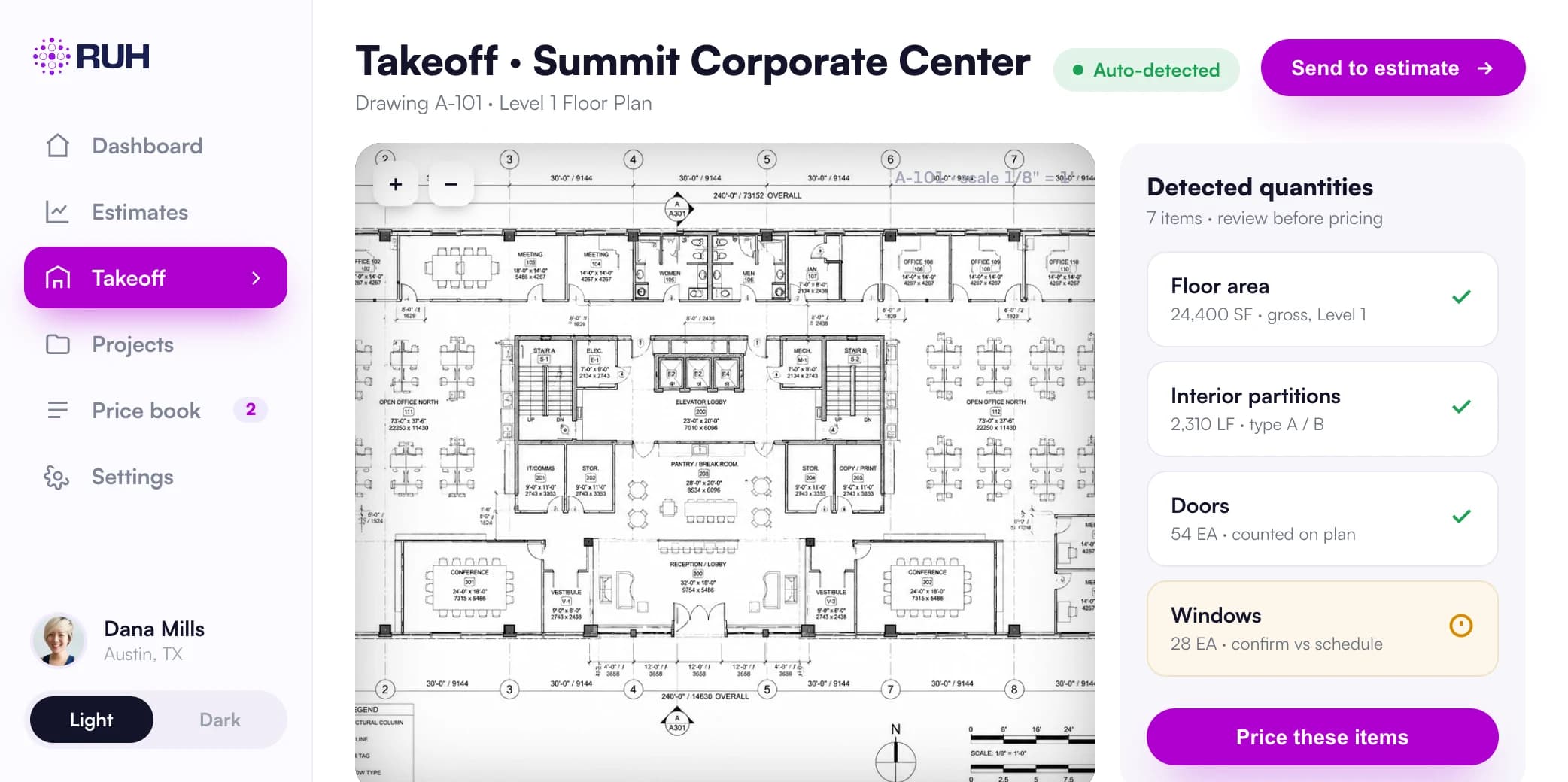
Ruh performs the takeoff from the drawings either way, so even when a spec item is carried as an allowance, the estimator still gets the measured quantity (the actual square footage behind a flooring allowance, for example) priced against their own price book. That gives the estimator a fast gut check on whether the stated allowance is realistic before bid day, and a ready line item to swap in once the owner makes a selection. The estimator still decides how to carry the allowance in the bid and signs off on the final number.
See construction estimating softwareAllowance: frequently asked questions
Who keeps the money if a construction allowance is not fully spent?+
Under most US commercial contracts the unspent portion goes back to the owner through a deductive change order; the contractor does not pocket the savings. The flip side is also true: a legitimate overrun entitles the contractor to an additive change order. Either direction, document actual costs with invoices, because that paper trail is what the reconciliation rides on.
What is the difference between an allowance and a contingency?+
An allowance is tied to a specific, known scope item whose price is not yet settled, like flooring the owner has not selected. A contingency is a general reserve for unknowns, with no scope attached until something changes or goes wrong. Allowances are reconciled item by item against actual invoices, while a contingency is drawn down (or returned) as a pool.
Does a construction allowance include labor and markup?+
It depends entirely on the contract language, so read the allowance clause before you price around it. The AIA A201 default is that the allowance covers materials and equipment delivered to the site plus taxes, while the contractor's labor, overhead, and profit for that work are carried in the base contract sum. Owner-drafted contracts often flip this to furnished and installed, which changes what you leave out of your base bid.
Still measuring by hand? Your next takeoff can run while you review this one.
See it on your plansRelated terms
Keep going: read the full guide or explore construction estimating software.
See Ruh price a bid from your own drawings.
AI takeoff and estimating on your price book, your estimator signs off.
Figures on this page are illustrative. Construction estimates depend on project-specific conditions, source documents, market pricing, and professional judgment. Ruh's AI assists the estimator and does not replace professional review: your team reviews, validates, and approves every estimate, bid, and pricing decision.