
TL;DR / Summary
RFI delays are one of construction's biggest hidden budget killers. The average commercial project bleeds $859,680 just managing RFIs, and 37% of project overruns trace back to slow RFI cycles. AI automation cuts response time from 10 days to 48 hours while saving $200K–$600K per project.
What you'll learn:
- Why RFI management costs 1–3% of total project value on every commercial build
- How manual workflows create a cascade of delays that 22% of RFIs never recover from
- The specific mechanics of AI RFI automation and why 60% of drafts need zero revision
- A 4-step implementation path with measurable ROI benchmarks
- Which teams are seeing 4.5 days of schedule recovery per RFI
The Hidden Cost of RFI Delays in Construction
You're a project manager on a $40 million commercial build. Your team generates 600 RFIs across 18 months. Each one takes 9.7 days to answer, compared to the AIA benchmark of 5.2 days. That gap, 4.5 days per RFI, is your margin walking out the door.
The math is brutal: 600 RFIs × 4.5 days of delay × $1,000–$5,000 per day in lost crew productivity and schedule recovery. That's $2.7 million to $13.5 million at risk on a single project. Even cutting that estimate in half, you're looking at $400,000 to $1.2 million in preventable overruns tied directly to RFI bottlenecks.
This isn't theoretical. According to the Construction Industry Institute, the average commercial project spends $859,680 processing RFIs, not answering them perfectly, just getting them reviewed, drafted, and logged. The American Institute of Architects benchmarks a proper RFI response at 5.2 days. Most teams clock in at 9.7 days in the field, and Western US projects pull 6.4-day averages while the Southeast struggles toward 9.7. Even when teams beat the benchmark, they're fighting the system: an RFI sits in someone's inbox, then waits for the right subcontractor, then loops back for clarification, then hits the PM's desk for final approval. By then, the crew is already idle.
And 22% of RFIs never get answered at all. They float in limbo, creating legal exposure, forcing rework, and chewing through schedule recovery budgets that cost $1,000–$5,000 per day.
RFI delays compound to cost 1–3% of total project value, on a $40 million build, that is $400K–$1.2M in preventable overruns. More than one-third of all project overruns trace back to RFI backlogs and the rework they trigger.
Why Manual RFI Management Fails at Scale
The problem isn't effort. Your team works hard. The problem is that manual RFI workflows don't scale.
Here's what happens in a typical shop: An RFI arrives. Someone (usually the coordinator or a junior PM) reads it, then hunts through 500+ prior RFIs to see if this question was already answered. They dig into the spec, cross-check the drawings, maybe ping a subcontractor. Then they draft a response. All told: 45 to 90 minutes of skilled labor.
That's $30–$75 in labor cost per RFI, but the real cost is what it blocks. Your experienced PMs can't focus on design decisions and schedule management because they're trapped drafting responses to questions the contracts already answer.
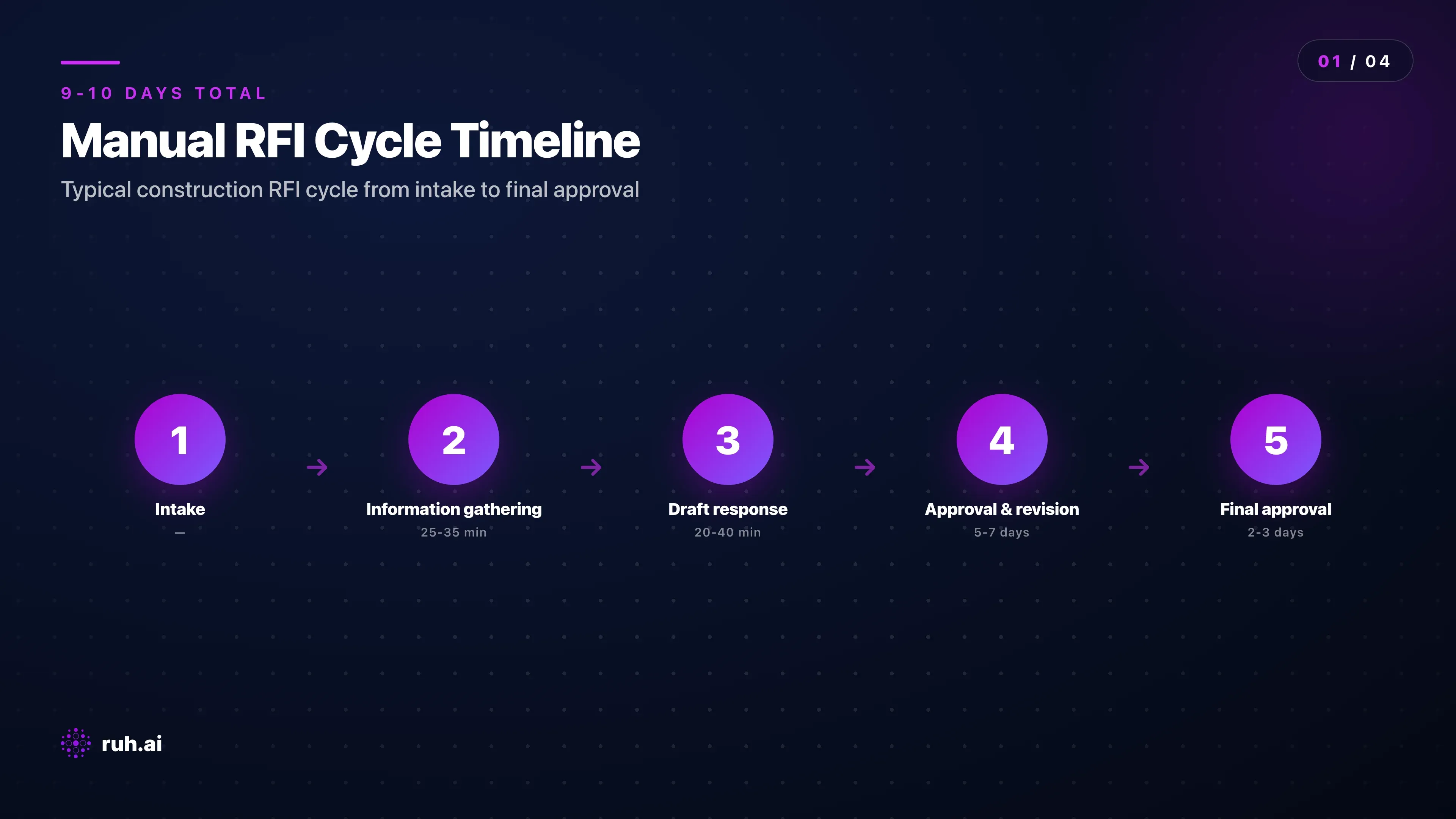
Then approval cycles kick in. A single RFI bounces between the GC, the subs, the architect, and sometimes the owner. Back-and-forth iterations add 2 to 4 days per cycle. Most teams never hit the 5.2-day benchmark because they're stuck in approval queues, not drafting slowness.
And at scale, 500 to 800 RFIs per commercial project, or 9.9 RFIs for every $1 million of construction value, this breaks. A 200-person team cannot manually draft 800 RFI responses and keep the schedule. Something has to slip. Usually it's the 22% that go unanswered because the team gave up chasing them, creating schedule risk and legal liability that pile on top of the margin already lost to delay.
Manual RFI workflows create cascading delays because the team hits capacity at 60% utilization and stops treating unanswered RFIs as a risk. The coordinator is drowning. The PM is in meetings. Answers slow from days to weeks.
How AI RFI Automation Cuts Response Times
RFI analysis automation uses an AI agent to read each RFI and draft a complete response from contract documents, prior RFI precedent, and project constraints. A PM or engineer spot-checks the logic, and your team approves everything before it goes out.
An AI RFI agent works differently. It ingests your project's complete context in a single setup phase: every prior RFI you've answered (with your actual reasoning), every change order and addendum, the full spec, the drawing index, your submittal log, and your historical change-order data.
Then when a new RFI lands, the agent reads it and immediately drafts a complete response, sourcing the answer from your contract documents, prior RFI precedent, and specific project constraints. The entire draft happens in roughly 90 minutes of equivalent skilled labor.
But here's the key: the agent surfaces 100% of its reasoning. Every fact, every prior RFI it references, every spec section it cites. Your team doesn't have to rebuild the answer from scratch. Instead, they audit the reasoning for 10 to 15 minutes, a PM or engineer spot-checking logic, not drafting, and either approve or flag gaps.
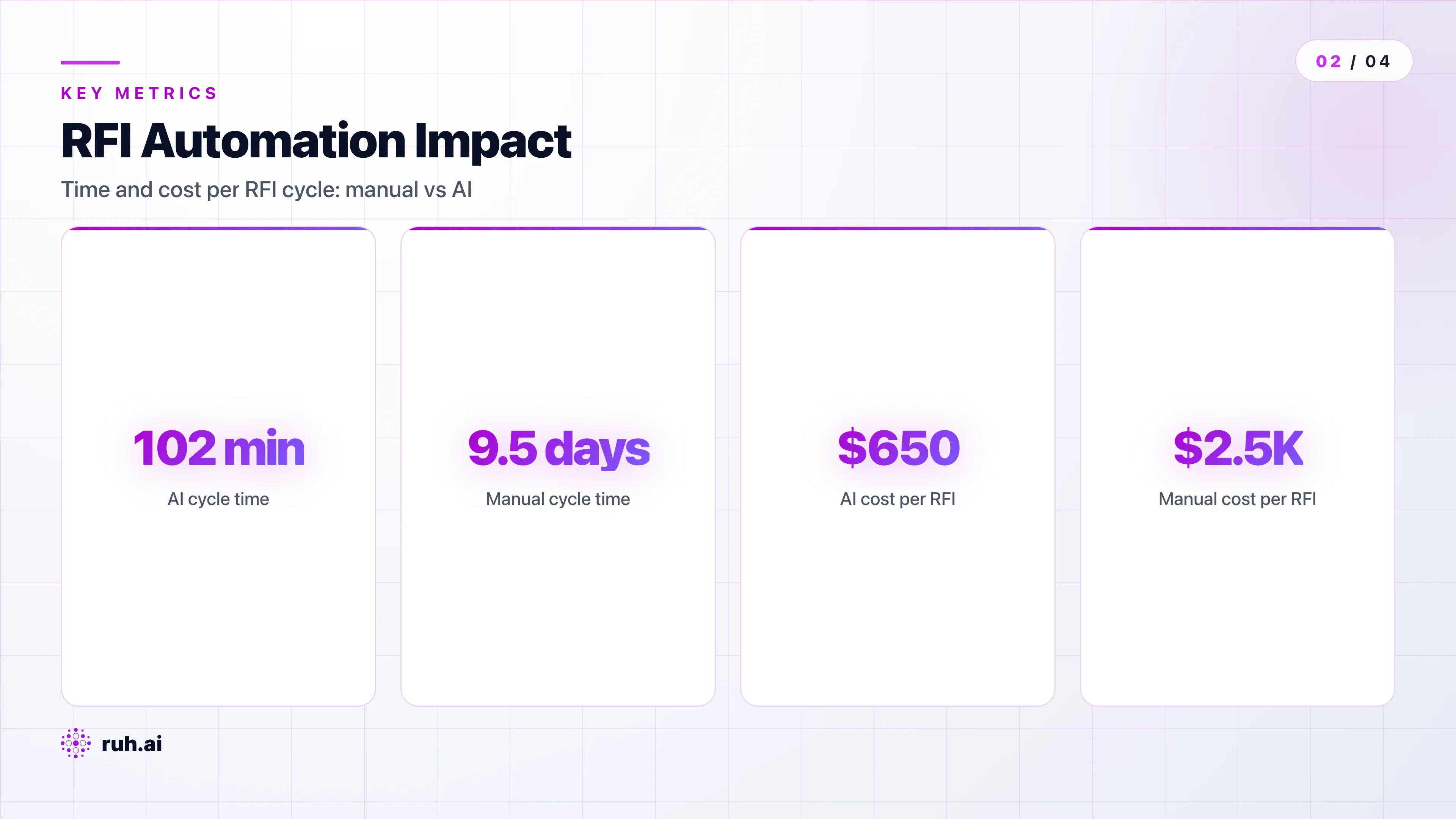
A typical team reports response times collapsing from 10 days to 48 hours, and approval loops becoming a 15-minute spot-check instead of a 5-7 day back-and-forth. The agent doesn't replace your PM's judgment, it replaces the mechanical work of hunting, cross-referencing, and drafting. Your team approves everything before it goes out. The only difference is the time it takes to do that approval.
And because the agent learns your decision patterns and constraints, your voice, your risk tolerance, your approach to ambiguous specs, the first draft right-answers the question 60% of the time. No back-and-forth. No second round. The answer ships clean.
For the speed side of this story, how teams get RFI turnaround down to hours instead of days, see our companion breakdown: RFI response in minutes, not days.
What AI RFI Automation Delivers: Concrete Savings
The math flips entirely. If a single RFI takes 10 days to answer and your project has 600 RFIs, that's 6,000 days of pipeline delay. AI cuts that to 48 hours per RFI, 288 days of delay. Recovery: 5,712 days, or roughly 4.5 days per RFI.
On a $40 million project with a daily burn rate of $40,000–$100,000 (crew, equipment, overhead), 4.5 days of recovered schedule per RFI across 600 RFIs is $200,000–$600,000 in avoided rework and crew idle time.
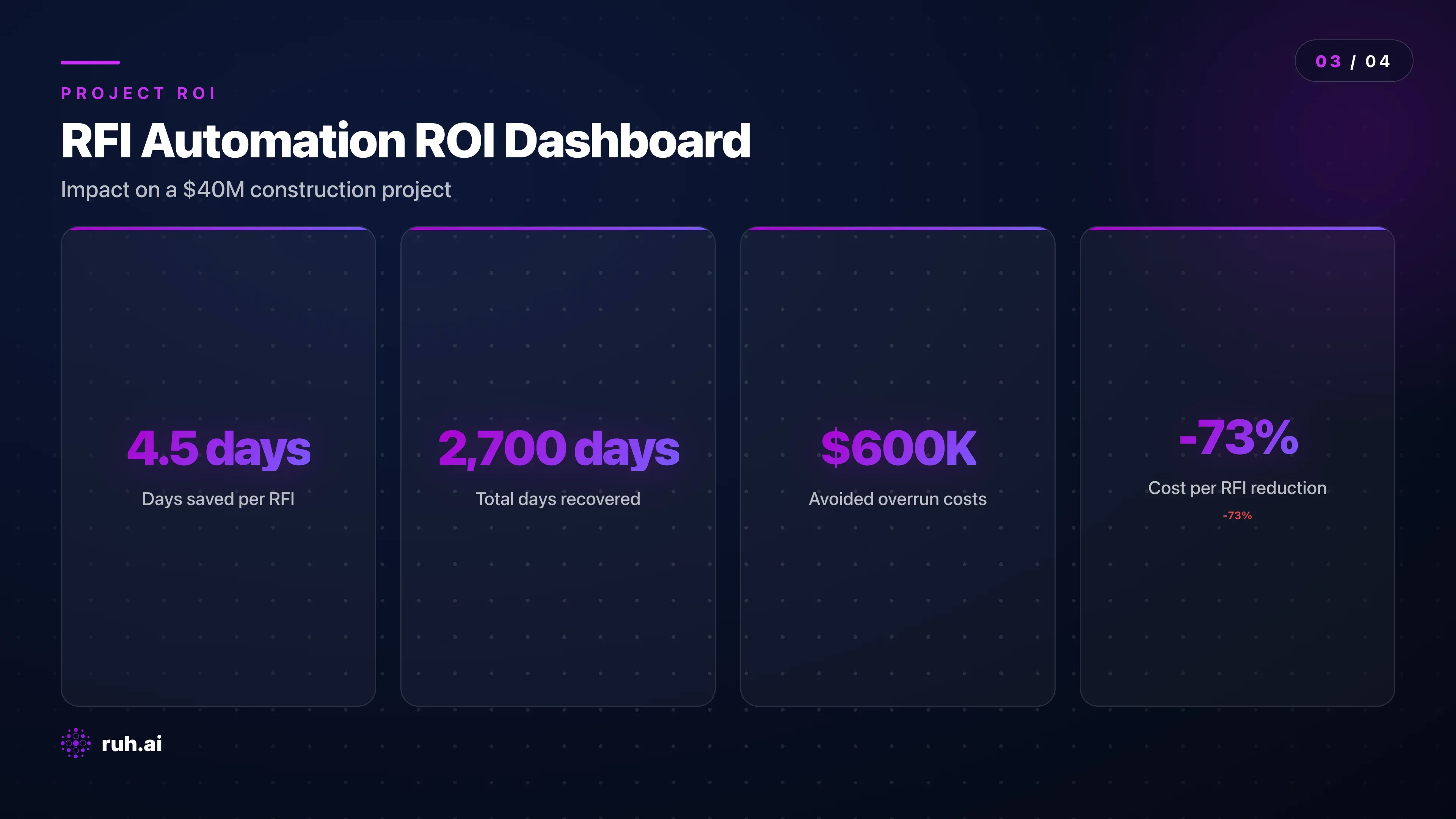
The cost-per-RFI tells another story. Manual review and draft: $2,000–$3,000 in labor and overhead. AI draft plus 15-minute review: $500–$800. That's a 60–75% cost reduction on the mechanical work. On a 600-RFI project, that's $900,000–$1.4 million in RFI processing cost recovered.
And that assumes you're not touching the legal exposure or the 22% of RFIs that currently go unanswered. An AI agent that drafts and routes every RFI, backed by your approval, closes that gap. Every RFI gets logged. Every answer is documented. No orphaned questions creating liability or rework down the road.
What the Data Reveals About RFI Productivity
The Navigant Construction Forum studied 1,362 projects containing over a million RFIs and found an average of 9.9 RFIs per $1 million of construction value. A $400 million mega-project faces 3,960 RFIs. No manual workflow scales there. You have to choose: hire more people, or automate the drafting layer.
Most teams pick hiring. And then watch the new person spend six months learning your decision patterns and your spec before they're useful. By then, they're already burned out from the RFI triage pile.
AI agents hit the ground running because they're trained on your historical RFIs and your spec set. They know, on day one, how your team answers ambiguity. They know which subs you trust and which ones you always verify. They know your risk profile.
The second-order effect: your licensed PMs and engineers stop doing paperwork. A PM's job is schedule management and design decisions. A coordinator's job is tracking and routing. Right now, both are buried in RFI drafting because that's where the bottleneck is. AI moves the drafting work out of the critical path. Your team's time suddenly has capacity for the decisions that actually move projects.
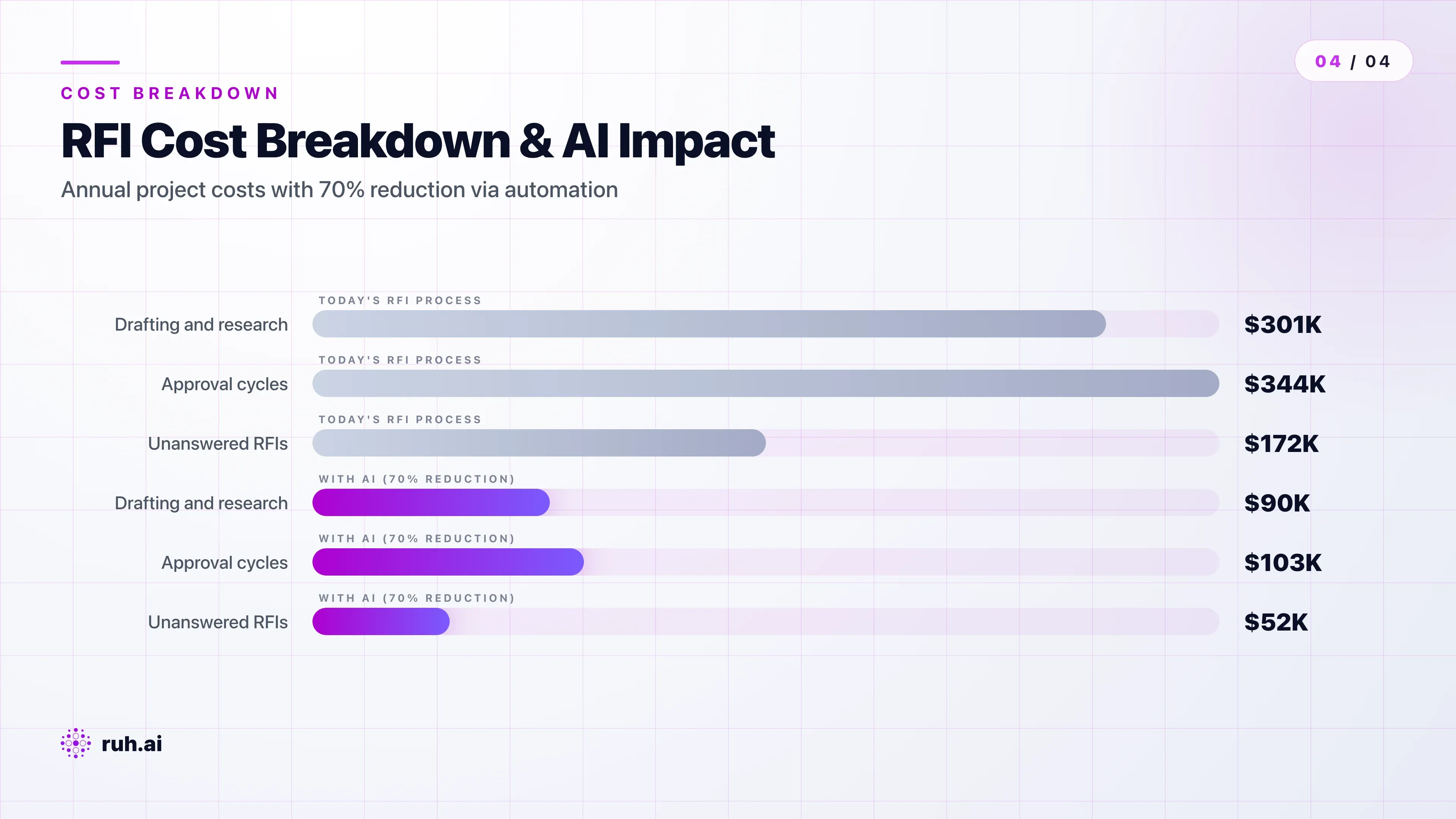
The average project spends $859K on RFI management, that is real money lost to process friction, not value creation. Automation recovers 40–50% of that waste, freeing skilled labor to focus on design and schedule strategy.
Getting Started: Implementing RFI Automation
Start with a baseline. Pull your last 50–100 closed RFIs. Time how long each one took from intake to final approval. Measure the cost-per-RFI based on who touched it and how many iterations it took. Count how many are still "open" or "unanswered." This is your current state.
Then load your project's context into the AI agent: the full spec, every prior RFI with your actual responses, change orders, submittals, and your project schedule. The agent learns your constraints and decision patterns in a 2–4 week setup phase.
Pilot on a cohort. Deploy the agent on your next 50–100 incoming RFIs, keeping your manual review process intact. Measure response time, cost per RFI, and team feedback on draft quality. If the agent cuts response time by 40% and your team approves the quality, expand to all incoming RFIs.
Measure the ROI. Compare your pilot metrics (response time, cost, rework rate) against your baseline. If the numbers hold, roll out full automation and capture the $200K–$600K project savings.
The Honest Assessment: What Still Falls Short
AI RFI agents are not mind readers. A spec that's ambiguous to humans is ambiguous to the agent. If your contract set has conflicting details (Plan Sheet 3 says one thing, Detail A says another), the agent will flag it, but a licensed professional still has to decide which takes precedence. That's the right call, it keeps liability on your team, where it belongs.
Also, RFI automation only works if your historical RFI archive and spec set are reasonably organized. If you have 500 RFIs scattered across email threads and folders, the setup phase takes longer because someone has to digitize and structure them first. That's not an AI limitation, it's a data quality limitation.
And adoption still depends on your team trusting the first draft enough to do a 15-minute review instead of a full rebuild. Some teams struggle with that mental shift. They see a perfectly good AI draft and instinctively want to rewrite it from scratch. That kills the time savings. Teams that see the agent as a research assistant (surfaces the facts, the PM makes the call) get the full benefit. Teams that treat it as a threat to their judgment tend to slow down.
How Ruh AI Fits Into RFI Automation
Ruh AI builds the RFI Responder, a custom AI agent that owns the entire RFI loop. It reads your spec and prior RFIs, drafts a response with full citation, routes it to the right reviewer, tracks approvals, and logs the answer back to Procore or your RFI management system. No per-seat SaaS tax. No platform migration.
Most point tools speed up one step. Procore has an RFI module and shipping AI agents, but they're surface-level, they don't own your approval workflow or integrate your full spec. Trunk Tools validates the RFI category as a market opportunity, but they're a specialized point tool for a single workflow.
The RFI Responder is different because it plugs into the tools you already use, Procore, your drawing system, email, your schedule. It's an AI employee that clears the backlog and stops the 1–3% margin bleed. A PM stops chasing answers. The schedule stops slipping.
Explore Ruh Work-Lab and deploy your first AI agent today →
You can build and deploy the RFI Responder without code through Ruh's Work-Lab, or integrate it into a larger automation suite through the Ruh Developer platform. Either way, the agent learns your project constraints, your voice, and your decision patterns, because it's trained on your historical RFIs and your specs. Not some generic RFI bot.
Frequently Asked Questions
Q: How does the AI know our project-specific context? A: The agent is trained on your historical RFI archive, approved responses, specs, submittals, change orders, and schedule. It learns your decision patterns, your risk tolerance, and your voice, so its drafts sound like your team wrote them. The setup phase (2–4 weeks) is mostly just loading and organizing this context.
Q: What if the AI draft is wrong? A: Every response passes through your standard approval workflow. Your PM or licensed professional reviews and approves (or revises) before it ships. The agent is the draft layer, not the decision layer. Your team retains full responsibility and control.
Q: How long does implementation take? A: Typically 2–4 weeks: load and structure your historical RFI archive, specs, and change logs; configure the agent's routing and approval rules; pilot on 50–100 responses; measure baseline metrics. Go-live happens after the pilot passes your quality gates.
Q: Does this replace our RFI coordinator? A: No. It frees them from drafting and research so they can handle exception cases, coordinate across trades, and manage escalations. A coordinator's real value is stakeholder management and problem-solving, not hunting through filing cabinets.
Q: Can we integrate with Procore or other RFI management systems? A: Yes. Most RFI platforms, Procore, Autodesk Build, Touchplan, support API export or CSV feeds. The agent can ingest RFI data from these systems and log responses back, so context flows seamlessly without manual data entry.
Q: What about liability and approvals? A: Every response passes through your standard approval chain. Your PE or licensed professional signs off, and Ruh AI keeps full audit trails of what the agent drafted and what your team approved or changed. Liability stays with your team, the agent is a tool, not a decision-maker.
Q: How much does it cost compared to hiring another coordinator? A: A junior coordinator costs $45K–$65K per year in salary and overhead. The RFI Responder agent costs a fraction of that and scales across multiple projects simultaneously. A $5M project generates 50 RFIs; a $50M project generates 500. Manual scaling means hiring. AI scales at cost.
Q: What happens if the spec or prior RFIs are contradictory? A: The agent flags the contradiction and drafts a response that surfaces the conflict for the PM or architect to resolve. This is actually valuable, it forces the team to close spec gaps before the clash hits the field.
Getting Started: The 4-Step Path
1. Establish your baseline. Measure current RFI response time, cost per RFI, and rework cycles on your last 50–100 RFIs. This gives you a clear ROI metric to compare post-deployment.
2. Load your project context. Export your historical RFIs, responses, change orders, and specs into the AI system. This takes 1–2 weeks and is the heavy lift, but it's one-time setup.
3. Pilot on a small cohort. Deploy the agent on your next 50–100 incoming RFIs while keeping manual review in place. Measure response time, cost-per-RFI, and team feedback. If you hit 40%+ improvement in speed and your team approves the quality, move to step 4.
4. Scale and measure ROI. Roll out to all incoming RFIs and track the total recovery: days saved per RFI, cost reduction, and reduction in unanswered RFIs. On a $40M project, you're looking at $200K–$600K in avoided overruns if the metrics hold.
The Bottom Line
RFI delays are eating millions from your projects. $1,000–$5,000 per day in lost productivity, 37% of project overruns, and $859,680 in average processing costs per build. AI RFI automation cuts that waste by 40–50%, delivering 48-hour turnaround and freeing your team to focus on strategy and design decisions.
The pilots are proving the ROI. The data is clear. The question isn't whether to automate RFIs, it's how quickly you can start.
Explore Ruh Work-Lab and build your RFI Responder today →