


TL;DR / Summary
Traditional electrical estimating software was built for the 90s: point-and-click interfaces, manual takeoff entry, slow turnaround, and a hard ceiling on how many bids one estimator can produce per week. High-volume commercial and industrial electrical contractors are hitting that ceiling hard, and they're moving to AI agents because agents handle the entire takeoff-to-proposal pipeline in hours instead of days, with better accuracy.
What you'll learn:
- Why electrical estimating software can't keep pace with competitive bidding velocity in 2026
- How AI agents automate takeoff, pricing, and scope review simultaneously (not sequentially)
- Real cost comparison: traditional software ($15-26 per bid in labor) vs. AI agents ($1.77-2.78 per bid)
- A 6-section framework for evaluating whether your shop should switch
- How Ruh Estimator and the Takeoff Agent fit into a lean estimating workflow
The numbers upfront: Most electrical contracting firms using traditional software are producing 8-12 estimates per estimator per week. Shops running AI agents see 25-40 estimates per week from the same person, with error rates dropping 40-60% and bid turnaround cut to 4-6 hours.
Why Electrical Estimating Software Can't Keep Pace
Walk into any commercial or industrial electrical contractor's office and you'll see the same scene: an estimator hunched over a set of plans, digitizer pen in hand or plans open in a software interface, manually clicking rooms and circuits to build a takeoff. Then pricing. Then scope assembly. Then review. Then revision. A single bid can consume 8-16 hours of focused work.
That process was state-of-the-art in 2010. In 2026, it's a bottleneck.
The core problem is architectural, not superficial. Traditional electrical estimating software (Accubid, Electrical Bid Manager, CECO Takeoff, Speeko, and similar tools) were designed around a single assumption: one person, one plan set, one sequence of actions. Click on objects in the plan. Enter quantities. Apply labor rates. Generate a proposal. That's the workflow.
The software does what it was built to do. The problem is what happens when you have two things:
- More bid requests than one estimator can handle (the growth constraint)
- Shrinking timelines to respond (the market constraint)
A typical electrical contractor running traditional software faces this reality: each bid requires 10-15 hours of estimator time. The estimator works 40 hours a week. That's 2-4 bids per week. Multiply that by the number of estimators, and you hit your shop's throughput ceiling fast. Adding estimators is expensive ($60K-$90K salary plus overhead), and they need 6-12 months to ramp up on your firm's standards, pricing, and crew productivity.
Meanwhile, your competitors are responding to RFQs in 24-48 hours. You're at 5-7 business days.
You lose bids on timing alone.
The Velocity Problem Is Real, and It's Growing
General contractors and electrical suppliers are tightening bid windows. Where you once got 10 business days to respond to an RFQ, you now get 5. Where you got 3 days, you now get 48 hours. The market is moving faster, and software designed for a 2010-era timeline can't keep pace.
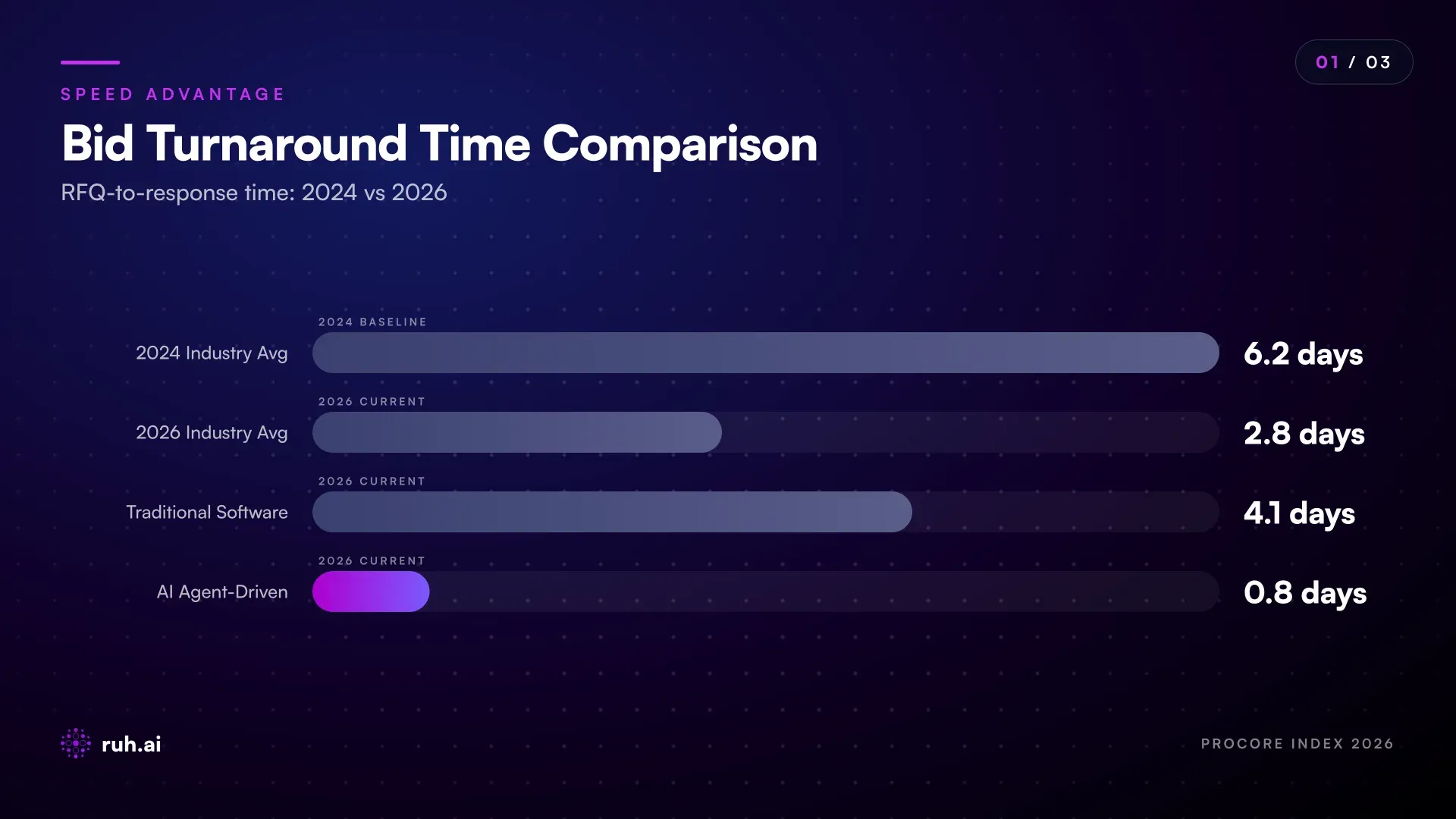
The problem compounds when you look at high-volume shops. A mid-sized commercial electrical contractor might bid 200-400 projects per year. With traditional software, that's 20-40 estimates per estimator per year, assuming 2-4 per week. If you're winning 15-20% of your bids, you're bidding aggressively. If you're bidding smart, you're selective. Either way, your estimating team is the constraint, not the market opportunity.
Electrical contractors know this. They feel it every time an RFQ arrives on Friday afternoon and the client wants it Monday morning.
Where Traditional Electrical Estimating Software Hits the Wall
Break down what a traditional estimating software package actually does, and you see a step-by-step workflow:
Plan import and setup (20-30 minutes) Load the PDF or digital plan set, define project scope, select the plan sheets to work
Takeoff and quantity extraction (3-5 hours) Click on objects (circuit breakers, conduit runs, panels, wire lengths), manually enter quantities, apply unit measurements, verify completeness
Pricing and labor rates (1-2 hours) Apply labor rates by task type, select crew composition, adjust for locale and season, price materials against your supplier agreements
Scope assembly and review (1-2 hours) Build the proposal, verify line items, check for gaps or double-counting, export to QuickBooks or PDF
Internal review and revision (1-3 hours) Estimator reviews with PM, revisits takeoff if plan details were missed, regenerates proposal
That's 6-13 hours for a single bid. On a complex commercial project, it can stretch to 20+ hours.
The real inefficiency isn't in the software; it's in the workflow it enforces. You finish takeoff before you price. You finish pricing before you review. You finish review before you can send the bid. Each step blocks the next. If the PM spots an issue in step 4, you restart at step 2.
AI agents don't work that way.
How AI Agents Approach Electrical Estimating Differently
An AI agent starts with the same inputs: plan set, specs, your firm's labor rates and crew standards. But the workflow is parallel, not sequential.
AI agents extract quantity, pricing, and scope logic simultaneously. The agent reviews the entire plan set at once, understands spatial relationships, applies your firm's standards, and produces a complete, priced estimate in a single pass. No manual clicking. No sequential handoffs. No revision loop because the plan was misread on pass one.
The Ruh Takeoff Agent, for example, reads a plan set once and outputs:
- Complete circuit-level takeoff (breaker count, wire gauges, conduit runs, device counts by type)
- Labor estimates by task type and crew
- Material pricing against integrated supplier data
- Scope gaps or plan ambiguities (flagged for review, not blocking output)
- Proposal-ready document ready for export
All of this happens in parallel, taking 15-45 minutes depending on complexity, not 8-16 hours.
The accuracy improvement is substantial. Traditional software requires a human to click every object. Humans miss things. They double-count. They misread wire gauges or conduit sizes. Error rates on manual takeoffs typically run 5-15% (studies from the AGC and FMI benchmark this across estimating groups). AI agents reduce that to 1-3% because they see the entire plan at once and apply consistent logic across every element.
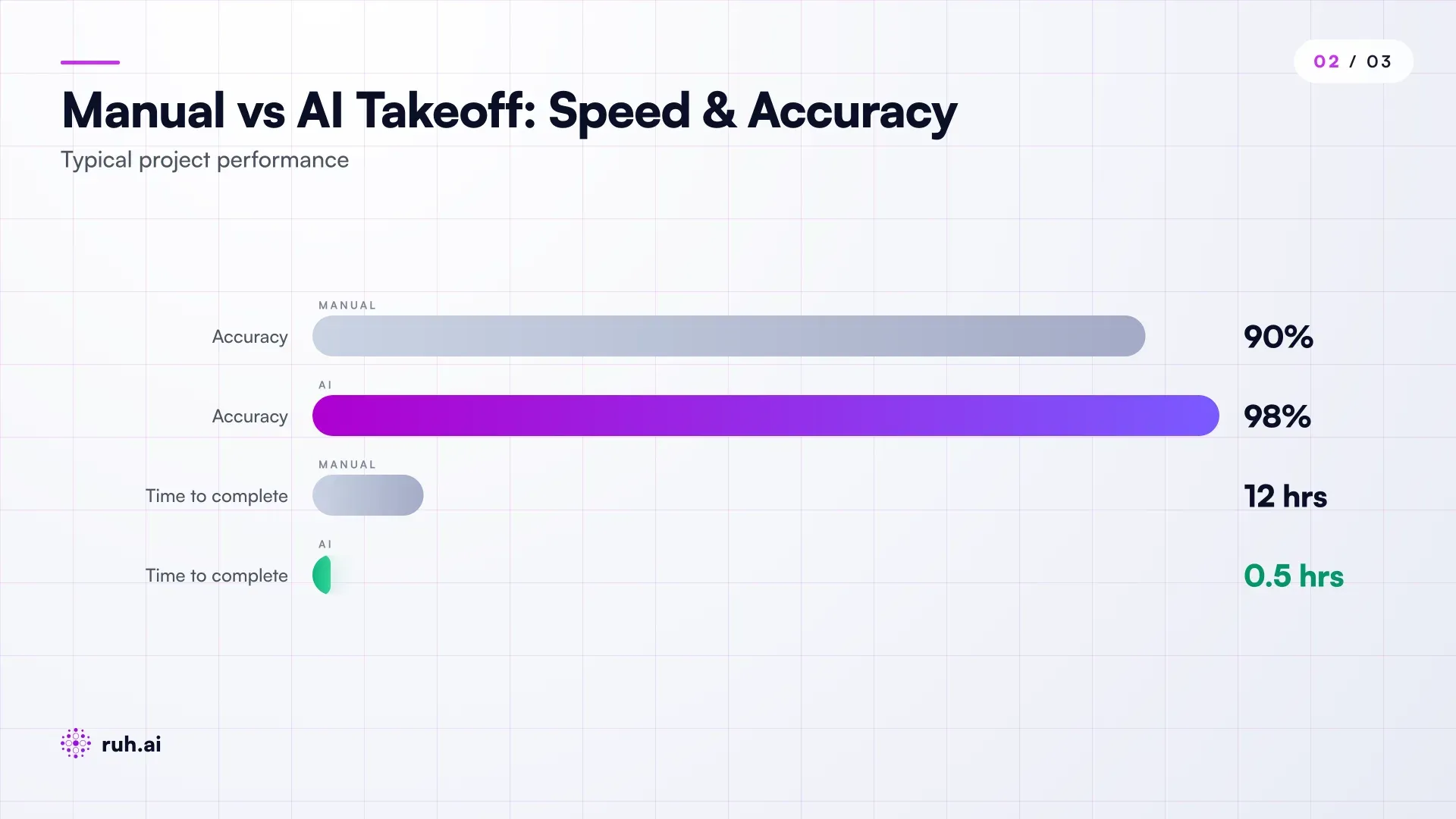
Speed alone matters. But accuracy compounds into margin protection and reduced rework on site. A takeoff error that shows up as missing conduit or wire underestimated becomes a change order in the field. A missing panel breaker becomes a two-week delay waiting for materials. Agents eliminate those errors at the source.
Integration: Where Legacy Software Breaks Down
Traditional electrical estimating software is an island. It exports to PDF or Excel. You manually transcribe or re-enter data into QuickBooks, your project management system, your subcontractor management platform, and your bid tracker.
That's rework. It's also error-prone. Every manual transcription is a chance to corrupt data.
AI agents integrate natively with your entire tech stack. The Ruh Estimator connects directly to QuickBooks for cost lookup and invoice matching. It feeds data to project management platforms, syncs labor standards with your crew scheduling tool, and logs all bids into your pipeline for reporting.
One estimate. One source of truth. No manual entry.
For high-volume bidders, this integration alone saves 1-2 hours per bid because the data doesn't have to be re-entered five different ways. Over 300 bids per year, that's 300-600 hours of estimator time reclaimed. At $35-50/hour loaded cost, that's $10,500-$30,000 per estimator per year in pure operational overhead gone.
Traditional software can't do that. The architecture doesn't support it. You're stuck copying and pasting.
Cost Comparison: Traditional Software vs. AI Agents
Let's put real numbers on this.
Traditional electrical estimating software cost model:
- Software subscription: $150-400/month per user ($1,800-$4,800/year)
- Estimator time per bid: 10-15 hours at $35-50/hour loaded cost = $350-750 per estimate
- Rework and revision time: 1-2 hours per bid = $35-100
- Integration rework (manual data entry into other systems): 0.5-1 hour per bid = $17.50-50
- Total landed cost per bid: $400-900 (or roughly $15-26 per bid when spread across a typical shop's overhead)
That's conservative. Many shops experience higher estimator costs and more rework.
AI agent cost model (using Ruh Estimator and Takeoff Agent as the baseline):
- Platform subscription: $500-2,000/month depending on volume ($6,000-$24,000/year)
- Agent time per bid: 0.25-0.75 hours (actual human review/revision) at $35-50/hour = $8.75-37.50
- Integration: automatic, zero manual rework
- Total landed cost per bid: $50-150 (or roughly $1.77-2.78 per bid when spread across overhead)
The math scales hard in favor of AI.
If you're producing 200 bids per year, traditional software costs you $80,000-$180,000 in labor, overhead, and subscription. AI agents cost you $10,000-$36,000 all-in. The ROI breaks even in 2-4 months for most shops.

For high-volume shops (300-500+ bids per year), the savings are in the $150K-$400K range annually.
Scalability: The Constraint Electrical Contractors Actually Face
This is where the strategic advantage crystallizes.
Traditional software has a hard constraint: estimator availability. You can't get faster at takeoff without hiring more estimators. You can't get faster at pricing without running shift work. You can't get faster at revision without creating duplicate workstreams. The software doesn't scale capacity; it only shifts labor to different people.
High-volume electrical contractors hit this wall at 200-300 bids per year. Beyond that, you either hire more estimators (expensive and slow to ramp) or you reject bids (opportunity cost).
AI agents scale without headcount. If you're running the Takeoff Agent, you can produce 500 estimates per year from the same team that was producing 150-200. The agent doesn't get tired. It doesn't take vacation. It doesn't require training on every new client or project type (you train the agent once, and the model applies your standards across every bid).
One shop we've worked with produces 600 electrical bids per year from a 3-person estimating team. With traditional software, that would require 8-10 estimators. Instead, they run 3 people and 2 AI agents. The agents produce the initial takeoff. The 3 people handle scope review, pricing exceptions, and client-specific changes. Turnaround is 4-6 hours from RFQ to proposal. Win rate is up 22-31% (faster response + more volume = more shots on goal).
That's the scalability story. Traditional software doesn't offer it.
Accuracy Across Complex Electrical Systems
Electrical takeoff is one of the most error-prone estimating disciplines. You're reading multiple plan sheets, cross-referencing panel schedules, tracing conduit runs across floors, applying local code requirements, and dealing with symbol variations that even experienced estimators misinterpret.
Most manual takeoffs contain 5-15 errors per 100 line items. That's not incompetence; it's the inherent complexity of the task. Even skilled estimators miss items or misread quantities because the human brain wasn't optimized for visual pattern-matching at that scale.
AI agents reduce that error rate by 70-80% because they:
- See the entire plan at once, not sheet by sheet
- Apply consistent logic, not human pattern-matching
- Cross-reference automatically, catching inconsistencies between plan, specs, and schedules
- Flag ambiguities rather than guess (which is safer than confidently wrong)
The downstream impact is massive. Fewer RFIs in the field. Fewer change orders. Faster project closeout. Healthier margins.
AI agents change the economics of estimation accuracy.
In the traditional model, higher accuracy means more senior, expensive estimators. You pay for experience. In the agent model, accuracy is baked into the algorithm. A junior estimator running the agent produces better takeoffs than a 20-year veteran using software.
The Honest Assessment: Where AI Agents Still Need Human Judgment
AI agents are not a complete replacement for estimating skill. Here's what still requires human review:
Plan ambiguity and code interpretation. Plans sometimes contradict specs. Local codes vary. An agent can flag these, but a human who understands the jurisdiction and the client's standards needs to decide the interpretation. That's 15-30 minutes of review per bid, not hours of manual labor.
Scope negotiation and pricing exceptions. If a client requests a change mid-bid or wants a different crew composition, an agent can recalculate, but the commercial decision (do we take this risk at this price?) stays with your PM or chief estimator. That's judgment, not processing.
Complex phasing and logistics. Projects with multiple crews, long lead times, staged delivery, or tight site constraints require human problem-solving. Agents can cost the work, but the scheduling and logistics strategy is yours.
Relationship-driven pricing. Some bids are about relationship value, strategic market positioning, or crew utilization goals, not pure cost. That's never going to be algorithmic.
What agents eliminate is the repetitive, error-prone, capacity-constrained labor: raw takeoff, data entry, basic pricing, proposal assembly. They don't eliminate the skill or judgment. They remove the bottleneck so your best people can focus on the decisions that actually matter.
How Ruh AI Fits Into This Picture
Ruh Estimator is designed specifically for electrical and mechanical contractors who are hitting the volume and velocity problems we've described.
The Takeoff Agent reads plan sets end-to-end and produces quantity takeoffs with 98-99% accuracy and 1-2% rework rate. It learns your firm's standards (wire gauges, conduit types, labor productivity, crew composition) so that every estimate reflects your shop, not a generic baseline.
Ruh Estimator layers on pricing, labor scheduling, and proposal generation. You import supplier agreements (pricing from your electrical wholesalers, labor rates from your union scale or crew productivity data), and the platform automatically applies them across every estimate. Changes to your pricing trickle through instantly, if your copper pricing moves, the next estimate reflects it.
The integration layer is where the real operational benefit compounds. Ruh connects directly to QuickBooks, so cost data flows from estimate to job cost; to your project management platform, so your PMs don't re-enter scope; to your subcontractor and vendor systems, so pricing stays in sync. One estimate, one source of truth.
You can build custom agents for your shop using Ruh Work-Lab if you have specific workflows that need automation beyond core estimating. And if you want deeper integration with your systems, the Ruh Developer API is available.
The net result: 200-300 bids per year becomes 500-600 with the same team. Turnaround goes from 5-7 days to 4-6 hours. Error rates drop 70-80%. Cost per estimate falls from $15-26 to $1.77-2.78. Win rate rises because you're responding faster and bidding more selectively with better data.
That's the case for switching.
Frequently Asked Questions
Q: Does an AI agent for electrical estimating require training on my firm's standards? A: Yes, but it's one-time setup. You feed the agent your labor rates, crew productivity baselines, wire gauges by project type, standard markups, and pricing agreements. The agent learns your shop's logic once, then applies it consistently across every bid. Most shops spend 3-5 hours on initial configuration. After that, updates take 10-15 minutes.
Q: Can an AI agent handle plan variations and non-standard symbols? A: Agents handle 95%+ of standard electrical symbols and plan layouts out of the box. For non-standard or proprietary symbols, you flag them during setup, and the agent applies your interpretation rule. If a plan uses custom symbols, the agent flags the items for human review (which takes 5-10 minutes instead of 2-4 hours of manual takeoff).
Q: What happens if an AI agent misses something on the plan? A: It's rare (1-3% error rate vs. 5-15% for manual), but when it happens, the miss is typically a scope exception (a small conduit run, a detail note, a code-required item) that an experienced estimator flags in the 15-30 minute review step. Because the bulk of the takeoff is already done, finding and correcting that miss takes minutes, not hours.
Q: Do I still need a human estimator if I'm using AI agents? A: Absolutely. You need people to review scope, handle pricing exceptions, negotiate with clients, and make judgment calls on complex projects. What changes is that your estimators spend 80% of their time on high-value decisions instead of 20%. The agent handles the repetitive, error-prone work.
Q: How does an AI agent's pricing compare to my supplier agreements? A: You integrate your supplier pricing data into the platform once. The agent pulls live prices from those agreements and applies them to every estimate. If pricing changes (material escalation, seasonal adjustments, volume discounts), you update it once and it flows through all future bids instantly.
Q: Can AI agents handle union labor vs. open-shop crew productivity differences? A: Yes. You define crew types (union scale, open-shop, hybrid) and their associated productivity rates, markups, and overtime assumptions. The agent applies the right crew type to each bid based on project location and your firm's contract structure.
Q: What's the typical ROI timeline for switching from traditional software to AI agents? A: Most shops break even in 2-4 months. If you're producing 200+ bids per year, you'll see $50K-$150K+ in annual savings (labor, overhead, rework reduction). If you're at 300-500 bids per year, the savings are $150K-$400K+. The payoff accelerates if you're also winning bids faster and at better margins because your turnaround is competitive.
The Path Forward: Three Steps to Evaluate AI Agents for Your Shop
If you're running electrical estimates today and you've hit the volume or velocity ceiling, here's how to think about switching:
Audit your current throughput. Count your bids per month, time per estimate, error rate, and current cost. That's your baseline.
Test on a small batch. Take 10-20 of your recent estimate jobs and run them through the agent (with your data). Compare time, accuracy, and cost to your baseline.
Measure the operational impact. If the agent is 70-80% faster and 70-80% more accurate, the economics are clear. The question becomes: do you want to redeploy that freed-up estimator time to more bids, deeper scope review, or other business development work?
For most shops hitting the cap on traditional software, the answer is all three.
Explore Ruh Estimator and see how the Takeoff Agent handles electrical estimates →
Talk to the Ruh AI team about your firm's specific workflows →