
TL;DR / Summary
Construction's AP crisis is hidden but real: your subs wait 82% longer for payment than two years ago, and they've raised bids by 25% to absorb the delay. Meanwhile, your AP team processes each invoice for $15–$26, 10x higher than industry leaders. AI AP automation cuts that to $1.77–$2.78 per invoice, faster closes, and on-time payments that make your company the preferred vendor on every sub's speed dial.
What you'll learn:
- Why 82% of contractors now wait 30+ days for payment and the hidden bid-padding cost this creates
- The construction-specific complexity that drives manual AP costs to $15–$26 per invoice
- How an AI AP agent automates job coding, 3-way matching, and retainage rules without replacing your accounting system
- Real ROI: 500 monthly invoices → $85k–$156k annual savings, plus faster cash flow
- Why on-time payment is a contractor-selection advantage worth more than competitive pricing
The Construction AP Crisis: Slow Pay Drives Cost Across Every Project
Your best subcontractors just bid 25% higher. They didn't tell you that's the surcharge for waiting 30+ days to get paid.
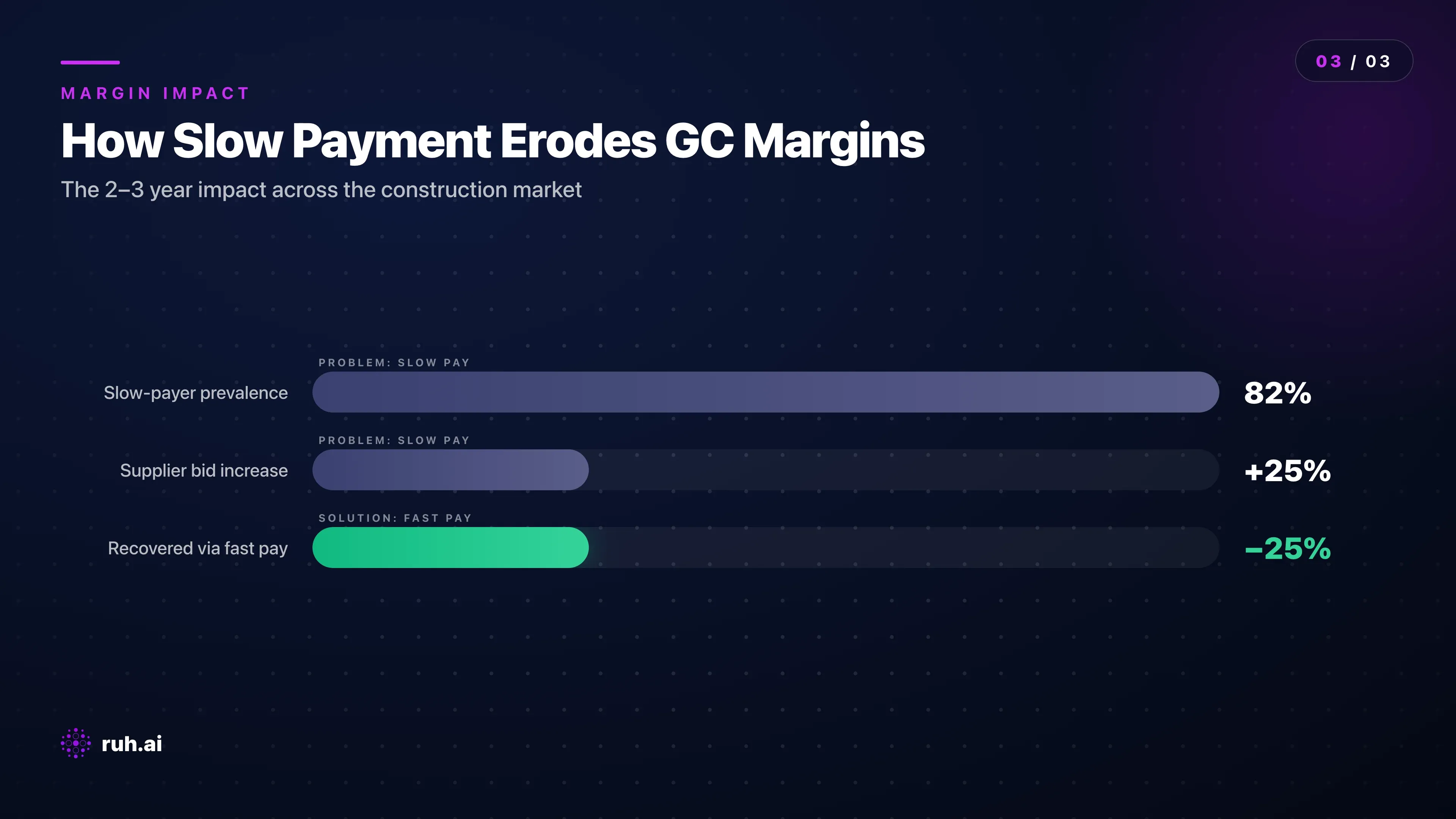
The numbers are stark. 82% of contractors now wait more than 30 days for payment, up from 49% just two years ago. In response, 75% of subcontractors have explicitly raised their bids to absorb expected payment delays. That's not a complaint; it's a survival strategy. A sub waiting 45 days instead of 15 days loses 30 days of cash flow on every project. They offset that by raising the bid, which means every future project your GC bids costs 3–5% more just to move money slower.
This pattern compounds. Slow payers lose vendor optionality. The best trades, the ones with full schedules and lowest pricing, choose clients with fast pay records. A GC paying on time gets the A-list subs and keen numbers. A slow payer gets the B-list trades who have availability because their other clients rejected them. That's not just inefficiency; it's a margin drain on every project you bid.
The real cost of slow AP isn't just in payment delays. It's in lost project margins, higher turnover among field teams (when subs struggle with cash flow, quality drops), and the operational risk of subcontractors walking mid-project because they can't fund their own work.
Construction payment delays now cost GCs 3–5% in inflated subcontractor bids, a hidden tax on every project margin.
Why Manual Accounts Payable Processing Costs So Much in Construction
Most back-office industries can process an invoice in minutes. Construction takes days, and it costs far more than it should.
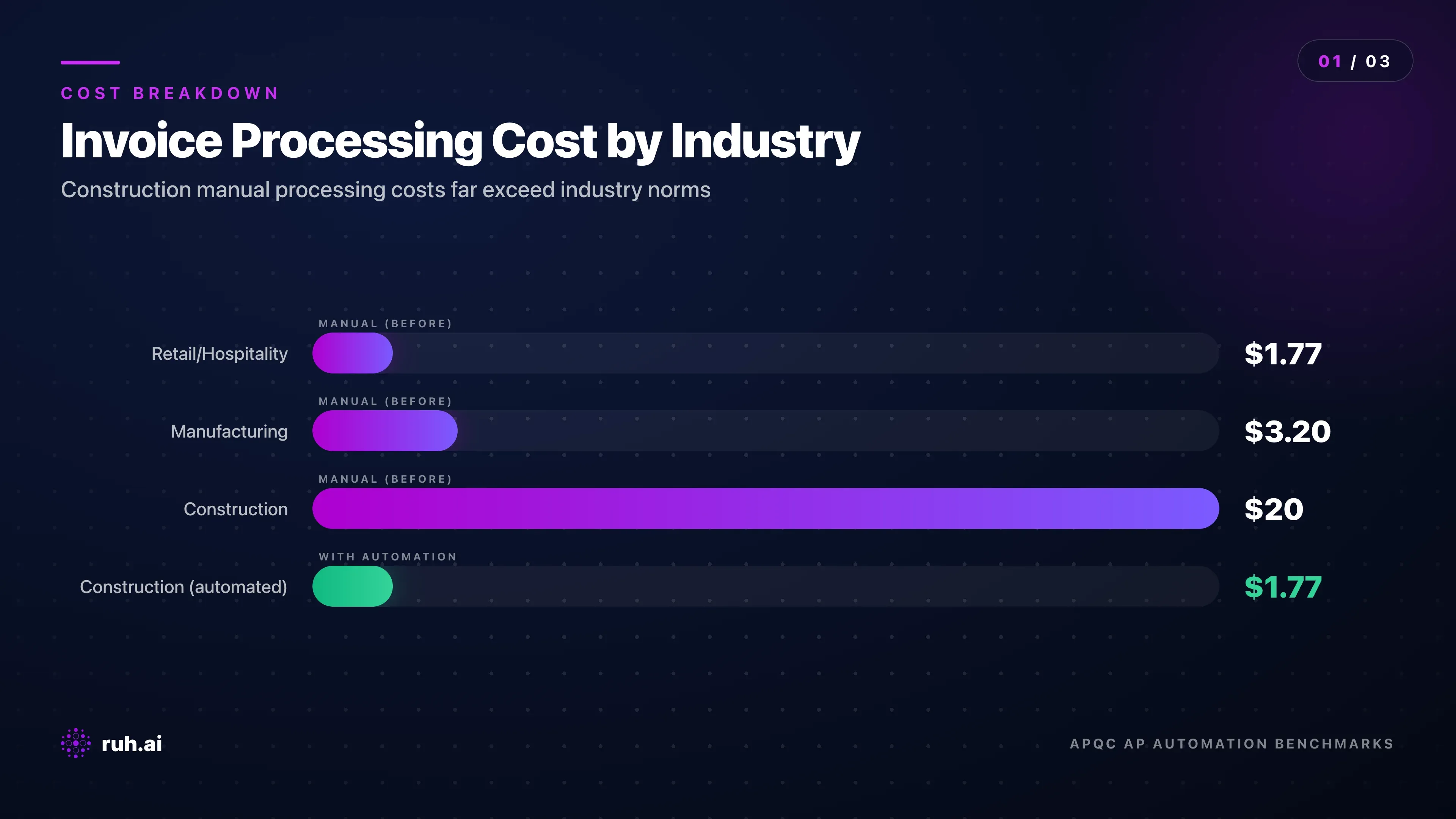
Manual invoice processing across all industries averages $1.77 to $26 per invoice. Top performers, large firms with centralized, highly structured AP systems, hit the $1.77 mark. Most construction companies operate somewhere in the $10–$20 range. Some, with complex multi-entity, multi-job structures, push toward $26 per invoice. For a GC processing 500 invoices per month, that's a $7,500–$13,000 monthly invoice-processing cost alone.
Construction invoicing adds layers other industries don't touch:
Job coding: Every line item on a vendor invoice must be coded to a specific project, cost code (labor, materials, equipment, subcontract), and phase (excavation, framing, MEP). A single invoice may hit 5–15 different cost codes across 2–4 jobs.
3-way matching: Before approving payment, AP must verify that the invoice matches both the purchase order (quantity, unit price) and the goods receipt (what actually arrived on site). Construction adds complexity here: partial deliveries, backorders, and substitutions are normal.
Retainage holds: Construction contracts typically hold 5–10% of payment as retainage until project completion. This retainage must be tracked separately, released per contract terms, and accounted for in lien-waiver workflows.
Compliance requirements: Lien waivers, joint-check agreements, and contractor compliance docs must be attached and verified before payment. Missing docs can trigger payment holds or compliance issues.
Multiple approvers: Each invoice often touches 3–6 people, the AP clerk (data entry and initial screening), the project accountant (job-code verification), a supervisor or PM (code approval), finance (threshold approval), and sometimes the controller (exceptions). Each handoff adds cycle time and introduces manual-entry errors.
Only 41% of construction companies use automated approval workflows. The rest route invoices by email, Slack, or PDF, a process that turns a straightforward approval into a 5-day bottleneck.
The cost gap is real: construction's unique coding and compliance requirements push per-invoice processing costs 5–10x higher than industries without job-cost complexity.
How AI Accounts Payable Automation Works in Construction
The AI AP agent doesn't replace your accountant or your approval process. It eliminates the clerical work that stalls it.
Here's the workflow:
Invoice intake and extraction: The agent receives an invoice (PDF, email, or direct upload) and extracts structured data, vendor name, invoice number, amount, line items, tax, and dates. No manual data entry.
Intelligent job coding: Using your historical invoicing patterns and your unique cost-code structure, the agent automatically assigns each line item to the correct job, cost code, and phase. A single invoice might be split across multiple codes; the agent handles that. If it's uncertain (e.g. a new vendor or unusual charge), it flags that one line for human review and approves the rest.
Automated 3-way matching: The agent compares the invoice line items against the PO and goods receipt. It flags true discrepancies, overages, missing items, pricing mismatches, and clears compliant invoices automatically. Minor variances (1–2% pricing differences) are configurable based on your tolerance.
Retainage and compliance logic: Retainage percentages, hold dates, and release triggers are applied automatically. Lien-waiver and joint-check requirements are verified and flagged if missing. Construction-specific compliance rules are baked into the approval logic, not added as an afterthought.
Routing and approval: Cleaned, coded, and matched invoices route to a single approval screen instead of bouncing through six inboxes. One click and the invoice syncs to your accounting system, QB, Foundation, Viewpoint, or Sage. Exceptions and overrides are logged with full audit trails.
Learning and adaptation: Over time, the agent learns your patterns. It gets better at coding edge cases, catches exceptions you care about, and requires less human intervention per invoice.
The result: your AP team stops data entry and exception hunting, and starts with a clean, coded, matched invoice ready for approval. That's the efficiency gain that cuts per-invoice cost from $15–$20 to $1.77–$2.78.
AI Accounts Payable Automation: 5–10x Cost Reduction Per Invoice
The math is simple and compelling.
Manual processing: $15–$26 per invoice. AI-automated processing: $1.77–$2.78 per invoice.
For a typical general contractor processing 500 invoices per month:
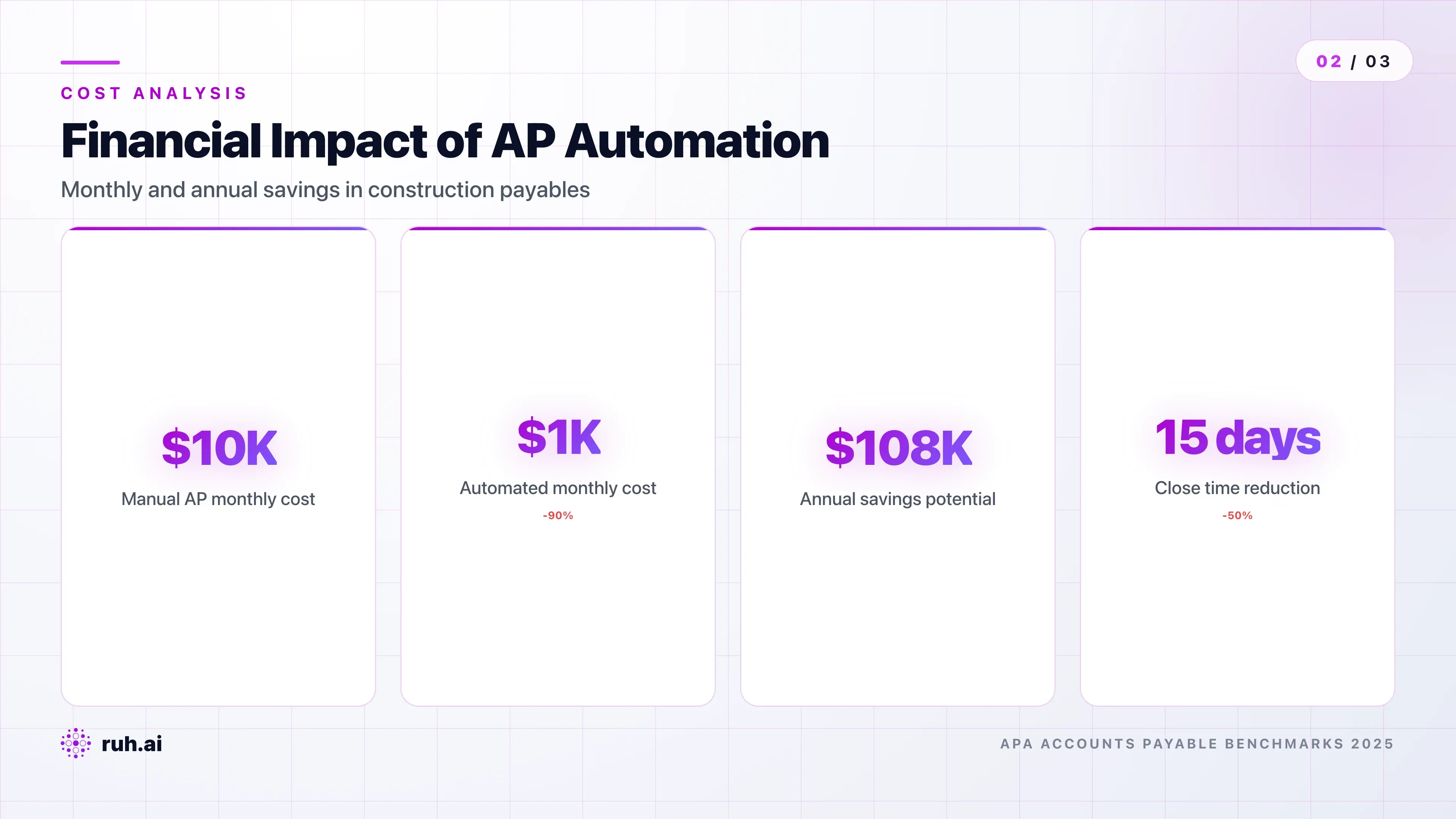
- Manual cost: $7,500–$13,000/month ($90k–$156k annually)
- AI-automated cost: $885–$1,390/month ($10,620–$16,680 annually)
- Annual savings: $73,380–$145,380
That's not accounting for the secondary benefits. Cleaner invoices also reduce disputes with vendors, aged-payables cleanup (less money stuck in exception queue), and invoice-correction cycles. For a GC with a $2–5M annual sub spend, those secondary benefits often match the primary cost savings.
The payback is fast. A $20k annual SaaS fee for AP automation pays back in 2–4 months on invoice cost alone, before touching cash-flow or vendor-relationship improvements.
But there's more: faster processing means closer pay runs. Where manual AP closes in 20–30 days post-invoice-receipt, automated AP can close in 10–15 days. That 15-day swing is transformational for contractor relationships. Subs who know they'll get paid within 15 days bid keener and schedule your jobs before competitors'. GCs who reduce days-payable-outstanding (DPO) from 45 to 30 days improve their own cash cycle and improve their standing with lenders and bonding companies, both of which care about payment velocity.
On-Time Payments: The Hidden Competitive Advantage in Contractor Selection
Most GCs think of payment speed as a nice-to-have. Subcontractors think of it as a dealbreaker.
When 82% of contractors pay late, the 18% who pay on time gain an outsize edge. Subs with a choice pick fast payers. They give their best crews, their keenest pricing, and their first availability to companies with a reputation for clean, fast pay. Slow payers get the crews with schedule gaps, the subs who need cash flow assistance, and the padded bids.
This creates a virtuous or vicious cycle. Fast payers attract better subs, deliver better projects, win more bids, grow faster. Slow payers lose vendor optionality, deliver less competitive bids, and struggle to compete on price and quality. Over 2–3 years, the gap compounds.
Reversing this pattern, moving from the 82% (slow) to the top decile (fast), directly improves future project margins. A sub who knows they'll get paid on time from your GC will drop their bid by 2–3% on the next job. Across a year of projects, that's a material margin gain.
There's also a staff-retention angle. AP teams hate being the bad guy when subs call asking about payment. A cleaner, faster AP process reduces staff burnout and turnover in a role that's notoriously high-churn.
Construction's competitive advantage increasingly flows to GCs who pay subs on time, a fact that automation, not just discipline, can deliver.
Implementation: Integrating AI AP Into Your Construction Workflow
You're not replacing your accounting system. You're adding an intelligent layer between the invoice inbox and the GL.
The AP agent integrates with your existing stack. Whether you run QuickBooks, Foundation Software, Viewpoint, Sage 300, or another construction accounting platform, the agent maps to your cost-code structure and syncs coded, approved invoices directly. No parallel entry. No manual mapping.
Integration points:
- Invoices come in via email, PDF portal, or direct upload, no scan-to-desk
- Agent codes to your job structure, respects your cost-code hierarchy, cost centers, and phase structure
- Matched invoices route to approval, your approval chain, your thresholds, your rules
- Approved invoices sync to GL, with full audit trail for lender or bonding audits
Audit and compliance: Every decision is logged. The system records what was coded, why, who approved it, when it was paid, and any exceptions or overrides. Construction lenders and bonding companies expect this level of detail; the agent provides it automatically. No spreadsheets. No detective work.
Customization: The system is tuned to your rules, not the other way around. Retainage percentages, approval thresholds, cost-code hierarchies, lien-waiver requirements, job-specific compliance rules, all configurable to match your process, not force you into a new one.
Phased deployment: You don't need to switch the entire AP process overnight. Start with invoice coding and 3-way matching (the two biggest cost drivers). Once that's running clean, add approval routing. Then add forecasting and cash-flow modeling. Each phase has ROI; each builds on the last.
The Honest Assessment: What Still Requires a Human
AI AP automation is powerful, but construction's complexity means some exceptions land on a desk, and they should.
Change orders and amendments: If a sub submits a change order invoice that doesn't match the original PO (which is the point of a change order), the agent flags it for review. This is correct behavior. A human should approve a $50k change before it hits the GL.
Unusual or new vendors: First invoices from new subs, unusual charges, or invoices outside the normal pattern get flagged. This protects against fraud and coding errors. Flagging isn't failure; it's the agent being honest about its confidence.
Multi-project or split-billing invoices: Some subs invoice across multiple jobs or bill on unusual terms (unit rates, T&M with limits, retainage percentages by job). The agent can handle these if the rules are clear; if they're ambiguous, it escalates. Again, this is correct.
Retainage disputes or release timing: If a job is wrapping and retainage is due for release but the sub hasn't submitted a final waiver, the agent flags it for you to coordinate with the sub and your legal/compliance team. This is a human decision, not a system failure.
The goal isn't to eliminate human judgment, it's to eliminate busywork. The goal is to process 85–90% of invoices without human touch and flag the 10–15% that require oversight, not the other way around.
How Ruh.AI Fits Into This
Ruh.AI builds the AP Invoice agent, a purpose-built construction AP automation tool that owns the full loop from invoice intake to GL sync, tailored to your unique cost-code structure and approval chain.
Unlike point tools that digitize the inbox (AvidXchange, Medius) or generic accounting connectors, the AP Invoice agent understands construction complexity. It codes to your job structure, runs construction-specific matching logic (retainage, COI, lien waivers), and learns your approval patterns over time.
More importantly: it's built on Ruh.AI's Work-Lab platform, meaning you can extend it or build adjacent agents without waiting for vendor roadmaps. You need to audit invoice coding against your profit plan? Build an agent that does that. You need to flag invoices that miss a retention schedule? Build an agent. You're not locked into a rigid SaaS feature set.
The AP Invoice agent also integrates with Ruh.AI's broader agent ecosystem, your SDR agent, your recruiting agents, your operations agents. Your construction workflows live in one platform, not fragmented across six SaaS tools.
FAQ: Construction AP Automation Questions Answered
Q: Can the AI handle construction invoices with retainage, change orders, and partial deliveries? A: Yes. Construction-specific rules, retainage percentages, hold dates, change-order logic, partial-delivery matching, are built into the agent's matching rules. You configure them once; the agent applies them on every invoice.
Q: What if one invoice is coded to multiple jobs or cost codes? A: The agent splits it automatically. Each line item routes to the correct job, cost code, and phase. No manual line-by-line allocation.
Q: How does the system handle invoices that don't match the PO, overages, missing items, or pricing mismatches? A: Flagged for human review. The agent shows the discrepancy (X variance on line 3, missing item Y) so the approver sees exactly what needs resolution. No blind approval.
Q: Is there a full audit trail for compliance and lender audits? A: Complete. Every invoice decision (coded, matched, approved, or flagged) is timestamped with the rationale and user. Construction lenders and bonding companies expect this level of detail.
Q: How long does implementation take? A: Typically 4–6 weeks. The first two weeks are data integration and system mapping (your cost codes, approval chains, and compliance rules get loaded into the agent). Weeks 3–4 are testing with a sample of real invoices. Weeks 5–6 are staff training and go-live. You can start seeing cost savings in month two.
Q: Can it integrate with our existing accounting system (QB, Foundation, Viewpoint, etc.)? A: Yes. The agent integrates with QuickBooks, Foundation Software, Viewpoint, Sage, and most major construction accounting platforms. No rip-and-replace.
Q: What about invoices in PDF or image format, or handwritten notes? A: The agent handles PDFs and images via OCR. Handwritten notes on invoices get extracted where legible; illegible sections are flagged for human clarification.
Closing: The ROI You Can Measure, and the Vendor Relationships You Can't
The immediate ROI is clear. A GC processing 500 invoices per month saves $7,500–$13,000 per month, north of $100k annually, in AP processing costs alone. That's a faster payback than most back-office investments.
But the second-order return is larger. Fast, reliable payment turns your GC into a preferred vendor. Subs bid keener, schedule your jobs first, and send their best crews. Over 2–3 years, that compounds into project margins that beat competitors still stuck in manual AP workflows.
The third-order return is operational: your AP team stops fighting exceptions and starts owning cash management and vendor relationships.
Construction's competitive edge in 2026 increasingly flows to operators who can move fast and pay reliably. AI AP automation is how you do both.
Explore the Ruh.AI Work-Lab and build your first AI agent today →