Every project gets estimated more than once. An owner needs a number before there are drawings, a design team needs budget checks as documents develop, and a contractor needs a bid price built from real quantities. Those are different jobs, and the industry uses four estimate types to do them.
What are the 4 types of construction estimates?
The four types, in the order a project meets them:
- Rough order of magnitude (ROM), from experience and history, before meaningful design exists.
- Square foot (parametric) estimate, from early concept drawings and a cost per sf.
- Assembly (systems) estimate, from design development documents, priced by building systems.
- Detailed unit cost estimate, from complete documents and a full quantity takeoff.
The classes trade speed for certainty. A ROM takes an afternoon and can miss by half; a detailed estimate takes days and is expected to land within single digits. Accuracy ranges below are the commonly used industry framings, not guarantees; every firm calibrates to its own history.
1. ROM estimate: the feasibility number
A ROM estimate answers one question: is this project worth pursuing at all? It is built from history (what similar buildings cost per sf), adjusted roughly for location and market, and is commonly framed at plus or minus 25 to 50 percent.
Worked illustration: an owner asks about a 40,000 sf tilt-up warehouse. Your last three comparable warehouses landed near an illustrative $115 per sf for shell. 40,000 sf x $115 = $4,600,000, carried as "$4.1M to $5.5M depending on site and finish level." That range is honest at this stage; a single number would be theater.
Who uses it: owners and developers for go or no go decisions, lenders for early screening, GCs deciding whether to chase the work.
2. Square foot estimate: the concept budget
With a concept plan (floor areas, building type, structure type), the estimate moves to cost per sf by building component or by use type, adjusted for size, height, and region. Commonly framed at plus or minus 15 to 25 percent.
The improvement over ROM is that the areas are now real: actual gross sf by floor, actual exterior wall area, a real site footprint. The unit cost applied to them is still historical, which is where the remaining error lives.
Worked illustration: concept drawings show 40,000 sf of warehouse plus 4,000 sf of office fit-out. Warehouse shell at $112 per sf = $4,480,000. Office build-out at an illustrative $148 per sf = $592,000. Sitework allowance at 12 percent of building cost = $608,640. Concept budget: $4,480,000 + $592,000 + $608,640 = $5,680,640, carried as $5.7M plus or minus 20 percent.
3. Assembly estimate: pricing by systems
At design development, the estimate is rebuilt from assembly costs: a foundation system per lf, a wall assembly per sf that rolls up studs, sheathing, insulation, and finish, a roof system per square. Commonly framed at plus or minus 10 to 15 percent.
Assemblies are the bridge between parametric speed and unit cost detail. The estimator is no longer pricing "a building per sf" but "this wall type, this roof system, this foundation," each with quantities measured from the developing drawings.
Who uses it: design-build teams steering decisions (does the budget survive a switch from tilt-up to steel?), CM teams running budget checks at each design milestone, and owners protecting their pro formas before documents are complete.
4. Detailed unit cost estimate: the bid
With complete construction documents, the estimator performs a full takeoff and prices every line: quantities times unit costs for material, labor, and equipment, then markup, overhead and profit, bonds, and contingency. Commonly framed at plus or minus 5 to 10 percent, and this is the number a contractor signs.
Worked illustration, one line of hundreds: a 1,500 sf slab at 6 in thick is 750 cf / 27 = 27.8 cy, carried at 30 cy with waste. At an illustrative $172 per cy of mix, $2.10 per sf place and finish, and 1.05 tons of rebar at $2,400 per ton installed, the slab package prices at (30 x $172) + (1,500 x $2.10) + (1.05 x $2,400) = $5,160 + $3,150 + $2,520 = $10,830. Multiply that discipline across every system in the documents and the bid earns its single-digit accuracy class.
This is also the estimate type where the labor lives: the takeoff is most of the work, which is exactly the step AI now compresses.
How the four types fit together
The same project flows through all four. The owner ROMs it to decide to buy the land. The architect's concept gets a square foot budget. Design development gets assembly checks so scope decisions stay inside the budget. Construction documents get the detailed estimate that becomes the bid, the buyout targets, and the schedule of values.
Two practical rules follow. First, never present a tighter accuracy class than the design information supports: a detailed-looking estimate built on concept drawings is a ROM in a suit. Second, keep the earlier estimates alive: when the detailed estimate exceeds the square foot budget, the variance report between them is how the team finds what grew.
Where AI changes this picture
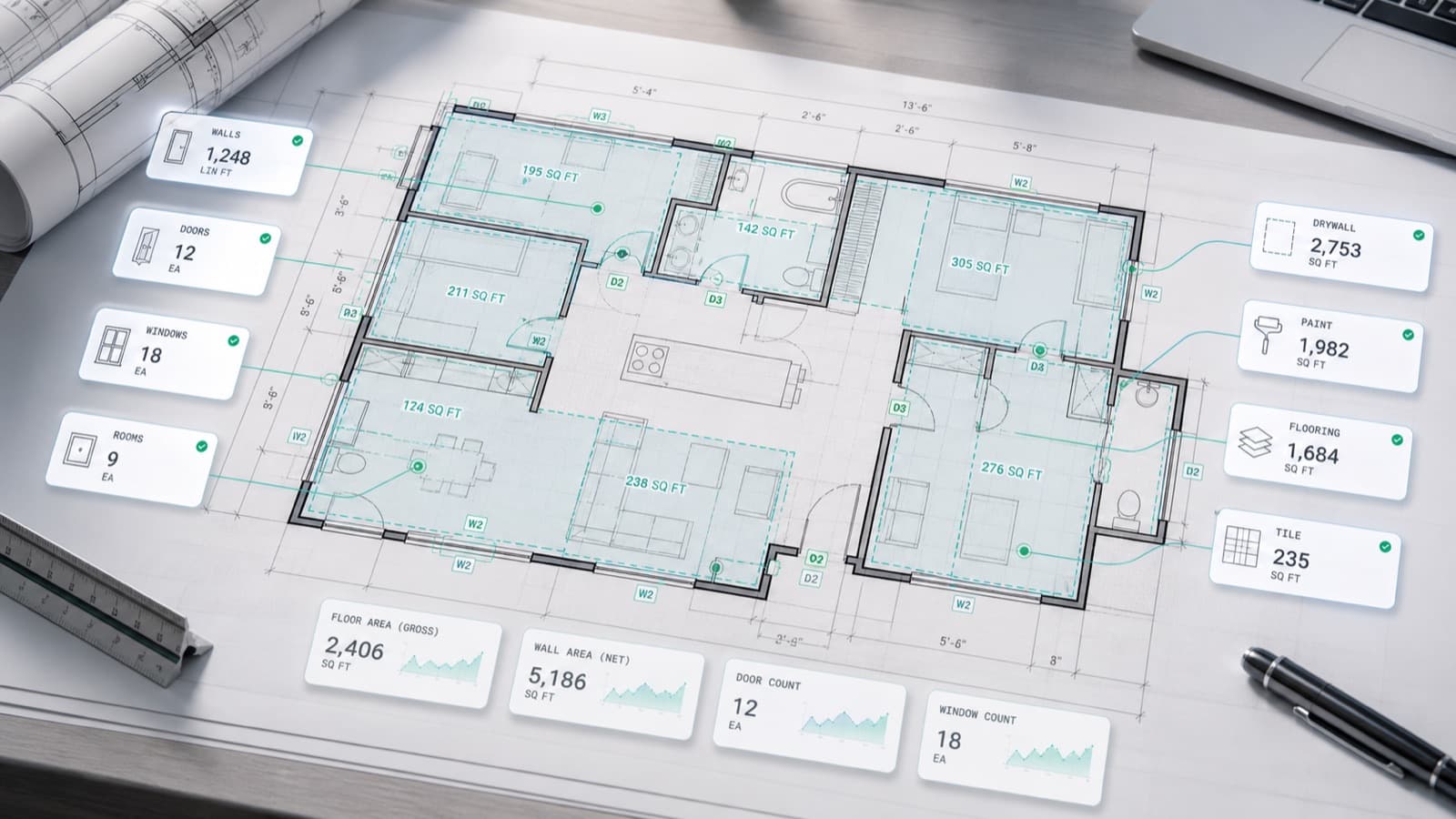
AI compresses the expensive end. The ROM and square foot classes were already fast; the detailed estimate was the multi-day grind. Software that reads the drawings, performs the takeoff, and prices it against the contractor's own price book collapses that grind into a review task: the estimator checks flagged assumptions, adjusts means and methods, and signs off. The accuracy class still belongs to the human judgment on top, but the hours underneath it shrink. That is precisely how Ruh approaches it, and why teams start with the detailed estimate when they evaluate construction estimating software.
Cloud takeoff and estimating platforms include stack construction takeoff software as one example.
The four types are not competing methods; they are the same project seen at four moments of certainty. Match the class to the information you actually have, state the range honestly, and spend your saved hours where accuracy is bought: the takeoff and the pricing behind the bid.
Try Ruh on a real bid. 100% money-back guarantee if you are not satisfied.*
*Scoped delivery, terms apply. Read the guarantee terms
Frequently asked questions
What are the 4 types of construction estimates?+
Rough order of magnitude (ROM), square foot (parametric), assembly (systems), and detailed unit cost estimates. They map to design maturity: ROM before design, square foot at concept, assembly at design development, and detailed unit cost from complete construction documents.
How accurate is each type of estimate?+
Common industry framings run plus or minus 25 to 50 percent for ROM, 15 to 25 percent for square foot, 10 to 15 percent for assembly, and 5 to 10 percent for detailed unit cost estimates. The ranges are conventions, not guarantees; firms calibrate against their own bid history.
What is the difference between an assembly estimate and a unit cost estimate?+
An assembly estimate prices whole systems (a wall type per sf, a foundation per lf) with the components rolled up, which is fast and fits incomplete drawings. A unit cost estimate prices every component line separately from a full quantity takeoff, which is slower and needs complete documents, but it is the accuracy class bids are signed on.
Which estimate type should a contractor use for bidding?+
Hard bids deserve a detailed unit cost estimate built from a full takeoff of the construction documents. Square foot and assembly numbers are for screening and budget steering; signing a lump sum against them is how margin disappears. If bid time is short, compressing the takeoff with software beats skipping accuracy classes.
Who prepares each type of estimate?+
Owners and developers (often with a CM or cost consultant) run ROM and square foot numbers. Design phase assembly estimates come from CMs, design-builders, or independent estimators. The detailed bid estimate is the contractor's, built by their estimators from their own production rates and pricing.
Still pricing in a spreadsheet? Your price book, automated end to end. Your estimator signs off.
See it runTerms used in this guide
Figures on this page are illustrative. Construction estimates depend on project-specific conditions, source documents, market pricing, and professional judgment. Ruh's AI assists the estimator and does not replace professional review: your team reviews, validates, and approves every estimate, bid, and pricing decision.