Construction glossary · Concrete and masonry
What is stucco in construction?
Stucco is a portland cement plaster applied in coats over masonry, concrete, or lath on framed walls to form a hard, weather-resistant exterior wall finish. In US commercial work the standard system is three-coat stucco: a scratch coat, a brown coat, and a finish coat, about 7/8 in total thickness over metal lath. Estimators take it off in square feet (sf) of net wall area with openings deducted, then price the lath, accessories, and plaster as one system.
Updated June 2026 · Reviewed by the Ruh construction team
Three-coat stucco assembly
Estimating concrete and masonry scope this week? Watch Ruh take off a real plan in 30 minutes.
Book a walkthroughOn commercial drawings, stucco shows up on exterior elevations and wall sections, usually tagged as portland cement plaster, and the spec lives in Division 09 (cement plastering, often 09 24 00). Over framed walls the system is metal lath with a water-resistive barrier behind it, then scratch, brown, and finish coats; over concrete or CMU it can be direct-applied without lath. The lath and plaster subcontractor owns the scope, but the estimator has to assemble it: plaster area in sf, plus lineal accessories such as weep screed, casing bead, corner aid, and control joints, plus scaffolding or lift time. New estimators make three common mistakes. They confuse hard-coat stucco with EIFS, which is a Division 07 synthetic system with very different costs. They take off the field area and forget the lineal trim items, which carry real money. And they ignore access, because second-story and parapet work needs scaffold that never appears on the finish schedule. Read the wall sections before you price anything; the substrate determines the system.
Stucco is taken off in square feet (sf) of net wall area, though plastering subs often convert to square yards (sy, 9 sf per sy) for their own pricing. Work from the exterior elevations: measure gross wall area, deduct openings, and add back jamb, head, and sill returns where the plaster wraps into them. Soffits and ceilings get their own line because overhead application runs slower. Accessories are lineal feet (lf): weep screed at the base, casing bead at terminations, corner aid at outside corners, and control joints laid out to the spacing in the spec (ASTM C1063 commonly limits panels to 144 sf). Carry scaffold, lifts, and pump setup separately. The unit price should state what it includes: lath, paper, three coats, and finish texture, or plaster only.
Worked example
Take a two-story retail shell with three-coat stucco over lath. Gross wall area from the elevations: two walls at 120 ft x 24 ft (2,880 sf each) and two at 80 ft x 24 ft (1,920 sf each), 9,600 sf gross. Deduct openings: 28 windows at 4 ft x 5 ft (560 sf) and two storefronts at 8 ft x 10 ft (160 sf), 720 sf total. Net area: 9,600 sf minus 720 sf = 8,880 sf. At an illustrative installed rate of $12.50 per sf covering lath, paper, and all three coats, the field is 8,880 sf x $12.50 per sf = $111,000. Add the lineal items: about 600 lf of control joints at $4.50 per lf ($2,700) and 400 lf of weep screed at $5.00 per lf ($2,000). The stucco package totals roughly $115,700 before scaffold and markups.
Try Ruh on a real bid. 100% money-back guarantee if you are not satisfied.*
*Scoped delivery, terms apply. Read the guarantee terms
How Ruh handles stucco
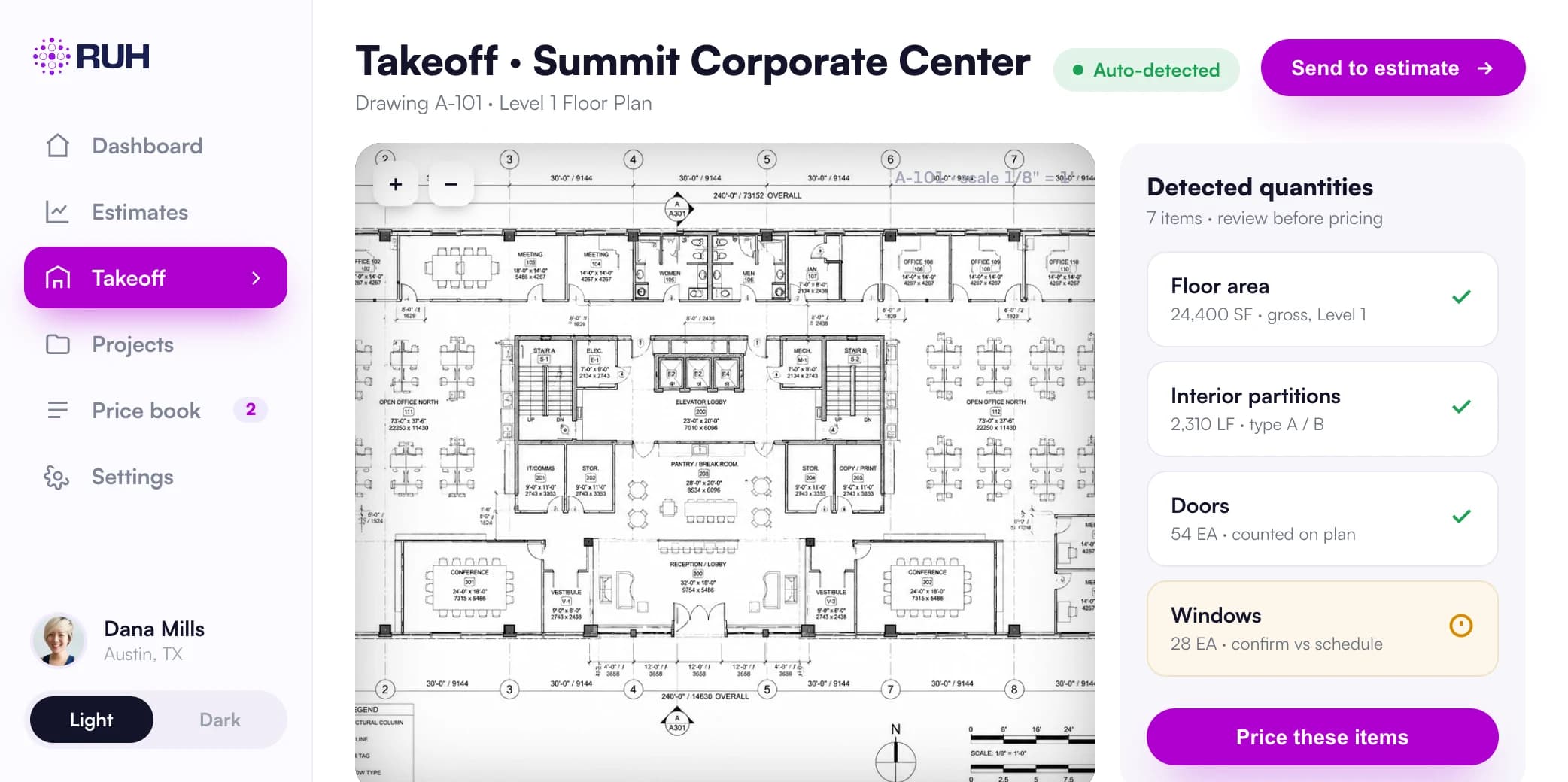
Ruh reads the elevations and wall sections, takes off net stucco area with openings deducted, and picks up the lineal accessories (control joints, weep screed, casing bead) that manual counts tend to miss. It prices those quantities against the contractor's own price book, so the three-coat rate is the contractor's real cost rather than a national average, and hands the estimator a line-item draft. The estimator confirms the system, substrate, and returns, adjusts where the job warrants it, and signs off.
See concrete estimating softwareStucco: frequently asked questions
What is the difference between stucco and EIFS?+
Stucco is a cementitious plaster installed wet over lath or masonry, while EIFS is a synthetic cladding built from foam insulation board, a thin fiberglass-reinforced base coat, and an acrylic finish. On the documents, stucco is specified in Division 09 (cement plastering) and EIFS in Division 07, and different subcontractors install them at different unit costs. They look alike from the street, so confirm which system the wall sections actually show before you price anything.
How much does commercial stucco cost per square foot?+
As an illustrative 2024 to 2026 US range, installed three-coat stucco over lath often runs about $10 to $18 per sf, including lath, paper, and finish. Wall height, access, trim density, and job size move the number, and small or cut-up elevations price high per sf. Use sub quotes or your own cost history for bid day; published ranges are only a sanity check.
What is the difference between one-coat and three-coat stucco?+
One-coat systems are proprietary fiber-reinforced base coats applied at roughly 3/8 in to 1/2 in, usually over rigid foam or sheathing, and they are governed by the manufacturer's code evaluation report. They save labor and cure time compared with the traditional system, but fastening, panel limits, and approved finishes must follow that report rather than the general spec. If the documents call for three-coat, treat a one-coat price as a substitution and flag it to the GC instead of burying it in the number.
Still measuring by hand? Your next takeoff can run while you review this one.
See it on your plansRelated terms
Keep going: read the full guide or explore concrete estimating software.
See Ruh price a bid from your own drawings.
AI takeoff and estimating on your price book, your estimator signs off.
Figures on this page are illustrative. Construction estimates depend on project-specific conditions, source documents, market pricing, and professional judgment. Ruh's AI assists the estimator and does not replace professional review: your team reviews, validates, and approves every estimate, bid, and pricing decision.