100% money-backBook a walkthrough

Construction glossary · Concrete and masonry

What is CMU (concrete masonry unit) in construction?

A CMU (concrete masonry unit) is a precast concrete block, hollow or solid, that masons lay in mortar to build structural and non-structural walls. The standard US unit is nominally 8 in wide x 8 in high x 16 in long, and it takes 1.125 blocks to cover 1 sf of wall, which is how estimators convert wall area into block counts.

Updated June 2026 · Reviewed by the Ruh construction team

Nominal block 8 x 8 x 16 in~1.125 block per sf of wallCounted by the each / sf

How CMU is counted in a wall

~1.125 per sfwall face arearunning bond

Estimating concrete and masonry scope this week? Watch Ruh take off a real plan in 30 minutes.

Book a walkthrough
Definition

CMU is the precast concrete block masons lay in mortar to build foundation walls, elevator and stair shafts, demising walls, exterior backup walls, and site walls. On commercial projects it shows up in the architectural wall type schedule, on structural drawings as reinforced shear walls and lintels, and in Division 4 specs, typically Section 04 22 00, which calls out ASTM C90 units, weight class (normal, medium, or lightweight), and face finish (smooth gray, split face, ground face, glazed). Units come in nominal widths of 4 in, 6 in, 8 in, 10 in, and 12 in, almost always 8 in high and 16 in long. New estimators get burned in predictable ways: counting only standard stretchers and missing special shapes (bond beam, half, corner, sash, and bullnose units), skipping the grout and vertical rebar in reinforced cells, pricing lightweight block when the spec says normal weight, and reading nominal dimensions as actual. Remember the block itself is often the cheapest part of the wall; grout, reinforcing, scaffolding, and mason labor carry the cost.

How it is measured

Take off CMU walls in square feet: wall length times height, pulled from the floor plans, elevations, and wall sections, with openings deducted (many estimators ignore openings under about 10 sf because cut block and extra labor eat up the credit). Convert area to units at 1.125 blocks per sf for standard 8 in x 8 in x 16 in block, then add a typical 3 to 5 percent waste for cuts and breakage. Count related items separately: grouted cells and vertical rebar at the spacing shown (16 in, 24 in, 32 in, or 48 in on center), bond beams and lintels by the linear foot, horizontal joint reinforcement by the linear foot at every other course, and mortar by the bag. Pricing is usually per block or per square foot of wall, with labor built up from crew production rates.

Worked example

Worked example

Say the plans show 1,800 sf of 8 in CMU wall after deducting openings. A standard 8 in x 8 in x 16 in block covers 16 in x 8 in = 128 sq in of wall face, and since 1 sf is 144 sq in, you need 144 / 128 = 1.125 blocks per sf. Net count: 1,800 sf x 1.125 = 2,025 blocks. Add 5 percent waste for cuts, breakage, and rejects: 2,025 x 1.05 = 2,126.25, call it 2,130 blocks. At an illustrative $3.00 per block for standard gray units, material runs 2,130 x $3.00 = $6,390 for block alone. That is not the wall price: mortar, grout, rebar, bond beam units, joint reinforcement, scaffolding, and mason labor typically run several times the block material, so carry each as its own line in the estimate.

100%

Try Ruh on a real bid. 100% money-back guarantee if you are not satisfied.*

*Scoped delivery, terms apply. Read the guarantee terms

Start with a walkthrough
How Ruh handles it

How Ruh handles CMU (concrete masonry unit)

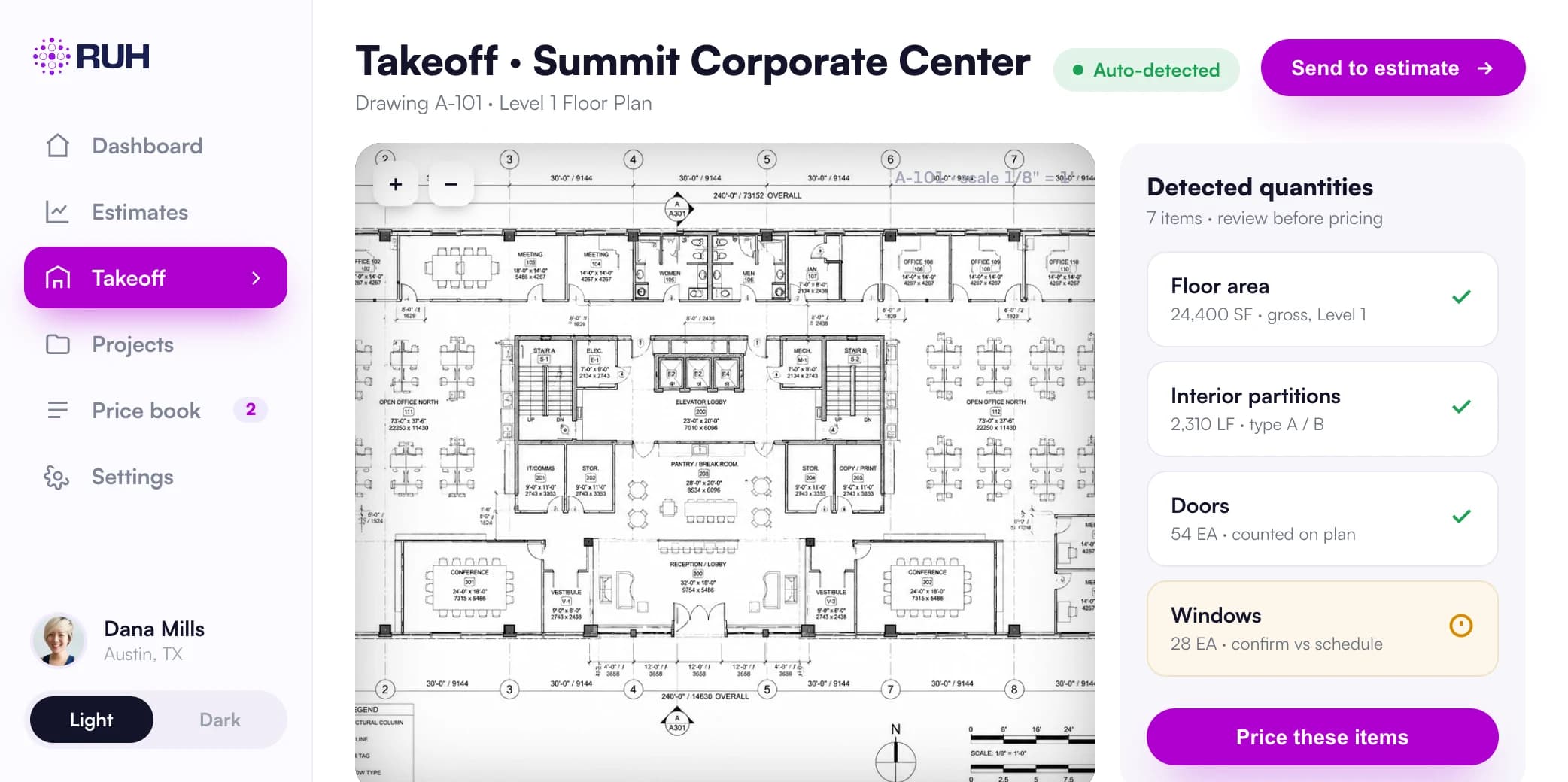
Ruh reads the wall types and dimensions off the contractor's drawings, measures each CMU wall area with openings deducted, and converts it to block counts with waste applied, breaking out grout, rebar, and special shapes as separate lines. It prices those quantities against the contractor's own price book, so block, grout, and mason labor carry the contractor's real unit costs rather than published averages. The estimator reviews the line-item draft, adjusts waste or production where the job warrants it, and signs off, keeping judgment with the person who owns the bid.

See concrete estimating software

CMU (concrete masonry unit): frequently asked questions

What sizes do CMU blocks come in?+

Nominal widths run 4 in, 6 in, 8 in, 10 in, and 12 in, with nearly all standard units 8 in high by 16 in long nominal. Actual dimensions are 3/8 in less in each direction (a nominal 8 in unit measures 7 5/8 in) so that block plus mortar joint lays out on a clean 8 in module. Producers also cast half blocks, half-high units, 4 in high veneer units, and special shapes like bond beam, corner, sash, and bullnose.

How much does a CMU block cost?+

As an illustrative 2024 to 2026 US figure, a standard gray 8 in x 8 in x 16 in unit runs roughly $2.00 to $4.50 in material, with architectural faces like split face, ground face, and glazed costing noticeably more. Installed cost is a different number entirely: with mortar, grout, reinforcing, scaffolding, and mason labor, a reinforced 8 in wall commonly lands somewhere around $20 to $40 per sf depending on height, reinforcing density, and market. Price from current supplier quotes and your own labor history, not published averages.

Is a CMU the same as a cinder block?+

In the field the terms get used interchangeably, but cinder block is a holdover from units made with coal cinder aggregate decades ago. Modern units are concrete, governed by ASTM C90 for loadbearing block, and specs will say concrete masonry unit, never cinder block. For estimating, treat them as the same product and price exactly what the spec calls out for weight class, strength, and finish.

Still measuring by hand? Your next takeoff can run while you review this one.

See it on your plans

Related terms

Keep going: read the full guide or explore concrete estimating software.

The Concrete and masonry estimating cheat sheet
Every unit, waste factor, and conversion on one page. Free PDF.

See Ruh price a bid from your own drawings.

AI takeoff and estimating on your price book, your estimator signs off.

Figures on this page are illustrative. Construction estimates depend on project-specific conditions, source documents, market pricing, and professional judgment. Ruh's AI assists the estimator and does not replace professional review: your team reviews, validates, and approves every estimate, bid, and pricing decision.