
Construction glossary · Concrete and masonry
What is grout in construction?
Grout in construction is a flowable mix of cement, aggregate, and water poured into the cells of concrete masonry units (CMU) to encase vertical rebar and bond the steel, block, and bond beams into one structural wall. It is a different material from mortar, which is the stiffer mix that beds the units. Estimators quantify masonry grout in cubic yards, driven by block size and the spacing of grouted cells.
Updated June 2026 · Reviewed by the Ruh construction team
Which CMU cells get grouted
Estimating concrete and masonry scope this week? Watch Ruh take off a real plan in 30 minutes.
Book a walkthroughOn commercial drawings, masonry grout lives in two places: the structural sheets (typical wall sections, masonry general notes, and the grouting schedule) and Division 04 of the specs, usually Section 04 05 16 Masonry Grouting or inside 04 22 00 Concrete Unit Masonry. The governing standard is ASTM C476, which covers fine grout (cement and sand) and coarse grout (the same mix plus 3/8 in pea gravel), both with a minimum compressive strength of 2,000 psi at 28 days. The mason places it at an 8 to 11 in slump so it flows around vertical rebar and consolidates inside the CMU cells. The mason subcontractor carries grout in the wall price; the GC estimator's job is checking that the sub's volume matches the drawings. New estimators make three predictable mistakes: confusing grout with mortar (different material, different spec section, different line item), picking up only the vertical cells and missing bond beams and lintels, and assuming partial grout when the notes call for solid grouting below grade or in seismic zones. Read the structural general notes before you quantify anything.
Masonry grout is measured in cubic yards (cy), with cubic feet (cf) used for small pours. The quantity comes off the structural drawings: wall area by block size, then grouted cell spacing from the typical details, where 8 in on center means solid grout and 16 in, 24 in, 32 in, or 48 in on center means partial grout. Estimators convert with a volume factor, roughly 0.2 cf per vertical foot of grouted cell in 8 in CMU, or pull cf per 100 sf of wall from published tables. Bond beams and lintels are taken off in linear feet and converted to volume separately. Add 5 to 15 percent for waste and spillage, watch ready-mix minimum load charges, and note whether placement is low lift or high lift, because pump and labor cost ride on that.
Worked example
Take an 1,800 sf wall of 8 in CMU with vertical bars grouted at 24 in on center (2.0 ft spacing). Step 1, grouted cell length: 1,800 sf / 2.0 ft spacing = 900 vertical feet (vf) of cell to fill. Step 2, volume factor: a typical two-core 8 in block takes about 0.21 cf of grout per vertical foot of cell. Step 3, volume: 900 vf x 0.21 cf per vf = 189 cf, and 189 cf / 27 cf per cy = 7.0 cy. Step 4, waste: grout placement is sloppy, so carry 10 percent: 7.0 cy x 1.10 = 7.7 cy, so order 8 cy. At an illustrative $250 per cy delivered, material runs 8 cy x $250 = $2,000 before pump time and the mason's placement labor. Bond beams at the top of the wall would add volume on top of this, so take them off separately.
Try Ruh on a real bid. 100% money-back guarantee if you are not satisfied.*
*Scoped delivery, terms apply. Read the guarantee terms
How Ruh handles grout
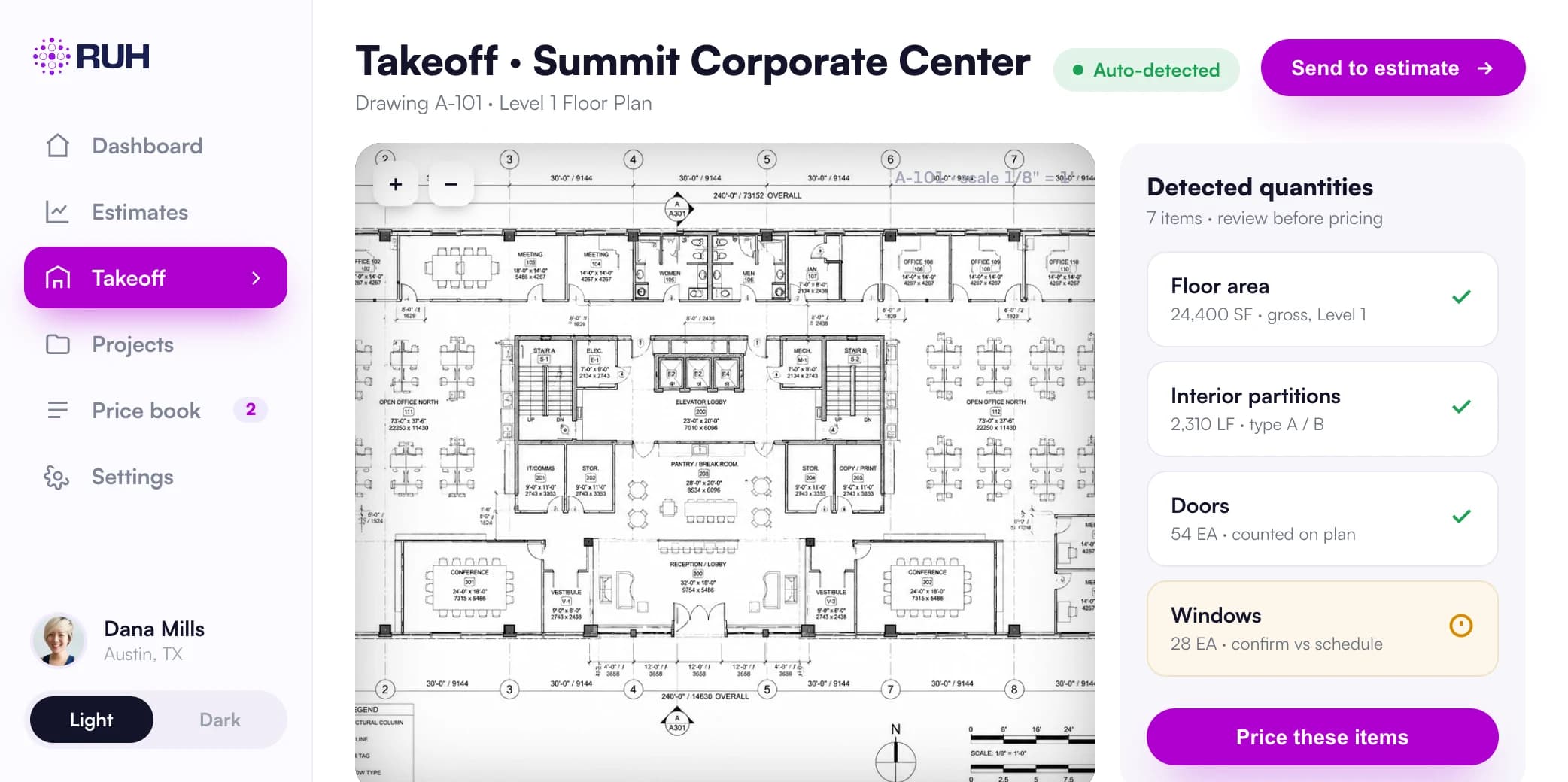
Ruh reads the structural sheets, pulls grouted cell spacing, bond beam courses, and solid grout zones from the wall types and general notes, and converts wall areas into cubic yards of grout as separate takeoff line items. It then prices those quantities against the contractor's own price book, their real unit costs for grout supplied, pumped, and placed, and hands the estimator a line-item draft. The estimator reviews the spacing assumptions and waste factor, adjusts for the placement method, and signs off; the AI speeds up the takeoff, the judgment stays with the estimator.
See concrete estimating softwareGrout: frequently asked questions
Do all the cells in a CMU wall need to be grouted?+
No. On most commercial jobs you grout only the cells containing vertical reinforcing, anchor bolts, or embedded items, at spacings like 24 in, 32 in, or 48 in on center, plus bond beams and lintels. Solid grouting of every cell shows up below grade, in retaining walls, in high seismic zones, and wherever the structural notes require it. The grouting schedule and general notes govern, so read them before you quantify.
What is the difference between fine grout and coarse grout?+
Both are covered by ASTM C476. Fine grout is cement, sand, and water, while coarse grout adds pea gravel up to 3/8 in. Code tables tie the choice to the size of the grout space and the pour height, since coarse grout needs more room to flow around rebar. Coarse grout typically costs a bit less per cubic yard, so use it where the cells allow.
What is the difference between low lift and high lift grouting?+
Low lift grouting fills the wall in pours of roughly 5 ft or less as the courses go up, with no cleanouts required. High lift grouting builds the wall to full height first, then grouts through cleanout openings at the base of each grouted cell. The grout volume is identical either way, but labor, pump time, and cleanout work differ, so the placement method belongs in your unit cost, not just the material price.
Still measuring by hand? Your next takeoff can run while you review this one.
See it on your plansRelated terms
Keep going: read the full guide or explore concrete estimating software.
See Ruh price a bid from your own drawings.
AI takeoff and estimating on your price book, your estimator signs off.
Figures on this page are illustrative. Construction estimates depend on project-specific conditions, source documents, market pricing, and professional judgment. Ruh's AI assists the estimator and does not replace professional review: your team reviews, validates, and approves every estimate, bid, and pricing decision.