
TL;DR / Summary
A goal-based agent is an AI system that plans actions to achieve specific objectives, unlike simple reactive systems. It works by perceiving its environment, defining a goal, creating a plan, and adapting as needed.
According to IBM Research, goal-based agents sit at the mid-level of AI agent complexity, more advanced than simple reflex agents but less complex than utility-based or learning agents. In this comprehensive guide, we'll explore how these intelligent systems work, their applications across industries, and why they're critical for modern business automation.
What you'll learn:
- What Are Goal-Based Agents?
- How Goal-Based Agents Actually Work
- Types of AI Agents: Where Goal-Based Agents Fit
- Real-World Examples of Goal-Based Agents
- Applications Across Industries
- Advantages of Goal-Based Agents
- Challenges and Limitations
- Goal-Based Agents vs. Modern AI Systems
- Building Your Understanding: A Simple Analogy
- The Future of Goal-Based Agents
What Are Goal-Based Agents?
A goal-based agent is an AI system that makes decisions by focusing on achieving specific goals. Unlike simpler AI that just reacts to situations,** goal-based agents** actually plan ahead and choose actions that help them reach their objectives.
Think of it this way: A simple reflex agent like a thermostat turns heating on when it's cold (reaction). But a goal-based agent is like a smart home system that learns your schedule, predicts when you'll be home, and adjusts temperature to have your house perfectly comfortable when you arrive (planning toward a goal).
Research from Carnegie Mellon University demonstrates that goal-based agents form the foundation of intelligent autonomous systems that can operate independently while pursuing specific objectives.
At Ruh AI, we apply goal-based agent principles to create autonomous AI employees like SDR Sarah, who plans multi-step outreach strategies to achieve specific sales objectives rather than simply reacting to incoming leads.
Key Characteristics
Goal-based agents have three defining features:
Clear objectives - They know exactly what they're trying to achieve. According to Nature Machine Intelligence, autonomous vehicles using goal-based planning process over 1 terabyte of sensor data per hour to achieve their navigation objectives.
Planning ability - They think through different options before acting. MIT's Computer Science and Artificial Intelligence Laboratory research shows that coordinated robot teams using goal-based planning increase manufacturing efficiency by up to 40%.
Flexibility - They can adapt when situations change. Stanford research indicates that goal-based adaptive learning platforms improve student outcomes by 25-30% compared to traditional methods.
How Goal-Based Agents Actually Work
Understanding goal-based agents becomes easier when you break down their process into simple steps.
The Four-Step Process
Step 1: Perceive the Environment
The agent uses sensors to gather information about its current situation. For a robot vacuum, this means detecting walls, furniture, and dirty spots. For Ruh AI's AI SDR, it means analyzing prospect data, engagement history, and market signals.
Step 2: Understand the Goal
The agent identifies what it needs to accomplish. The vacuum's goal might be "clean the entire floor." Ruh AI's goal-based agents focus on objectives like "schedule qualified meetings" or "nurture cold leads into warm prospects."
According to Harvard Business Review, organizations using AI agents with clear goal definitions see 3x better task completion rates than those using reactive systems.
Step 3: Plan Actions
The agent figures out the best sequence of actions to reach its goal. The vacuum maps out an efficient cleaning path. Ruh AI's agents plan personalized outreach sequences, choosing optimal channels and timing based on prospect behavior patterns.
McKinsey & Company reports that AI-powered planning reduces logistics costs by 15% and improves delivery times by 35%.
Step 4: Execute and Adapt
The agent carries out its plan but stays ready to adjust. If someone drops a toy in the vacuum's path, it recalculates a new route. Similarly, if a prospect doesn't respond to email, Ruh AI's agents automatically pivot to LinkedIn or phone outreach.
Gartner research predicts that by 2027, 40% of enterprise applications will incorporate agentic AI capabilities, up from less than 5% in 2024.
Core Components
Every goal-based agent contains these essential parts:
Sensors - Tools that collect information from the environment (cameras, microphones, GPS, CRM data, email engagement metrics, etc.)
Knowledge Base - Stored information about how the world works and past experiences. AI agent memory systems enable agents to recall previous interactions and improve decision-making.
Reasoning Engine - The "brain" that analyzes situations and makes decisions. Learn more about reasoning agents and how they process complex scenarios.
Actuators - Mechanisms that perform actions (wheels, robotic arms, speakers, email systems, CRM updates, etc.)
Types of AI Agents: Where Goal-Based Agents Fit
To truly understand goal-based agents, it helps to see how they compare to other types of AI agents.
According to IBM's comprehensive AI agent taxonomy, there are five main types of AI agents, each with distinct capabilities and use cases.
The Five Main Types of AI Agents
1. Simple Reflex Agents
These agents follow if-then rules without thinking ahead. Example: Automatic door sensors (If motion detected → open door)
Learn more: Simple Reflex Agents Explained: 2026 Guide
2. Model-Based Reflex Agents
These agents track how the world changes over time but still react without planning. Example: Smart thermostats that remember recent temperature patterns
Learn more: Model-Based Reflex Agents Guide
3. Goal-Based Agents
These agents plan actions to achieve specific objectives.
Example: GPS navigation systems finding optimal routes, Ruh AI's SDR agents planning multi-touch sales campaigns
4. Utility-Based Agents
These agents evaluate multiple goals and choose actions that maximize overall satisfaction. Example: Ride-sharing apps balancing driver earnings, passenger wait times, and route efficiency
Learn more: Utility-Based Agents Explained
5. Learning Agents
These agents improve their performance over time through experience. Example: Netflix recommendation systems that learn your preferences
Learn more: Learning Agents in AI
Goal-Based vs. Utility-Based: What's the Difference?
This comparison confuses many people, so let's clarify using research from UC Berkeley:
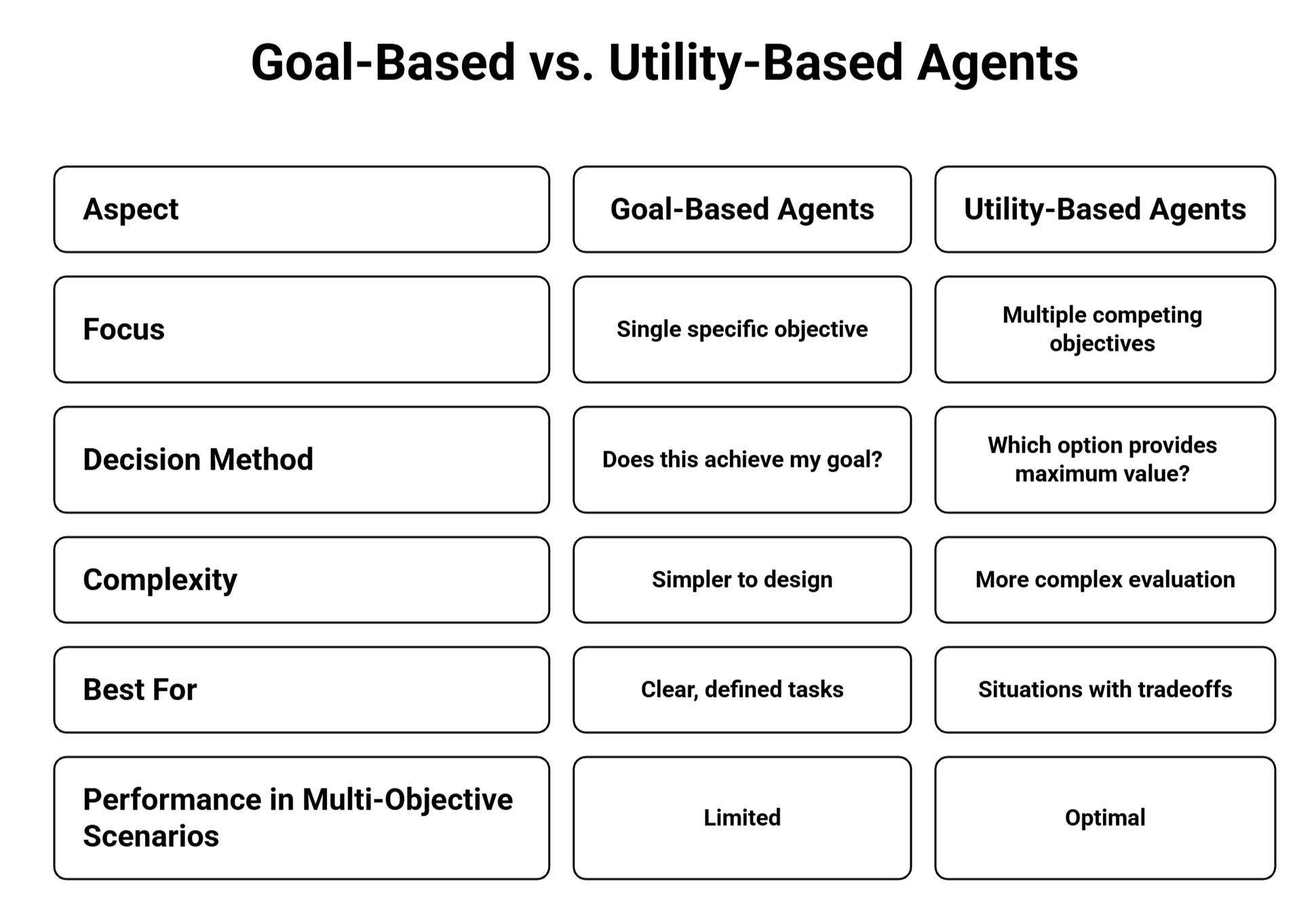
Simple analogy: A goal-based agent is like a student focused on getting an A in math (single goal). A utility-based agent is like a student balancing grades, social life, and sleep to maximize overall happiness (multiple factors).
Research from UC Berkeley demonstrates that utility-based agents outperform goal-based agents when dealing with conflicting priorities, though goal-based agents excel in single-objective scenarios.
Real-World Examples of Goal-Based Agents
Goal-based agents are already part of your daily life. Here are specific examples that show their practical impact, backed by real performance data.
1. Ruh AI's Autonomous SDR Agents
Goal: Generate qualified sales meetings through intelligent, multi-channel outreach
How it works:
- Analyzes prospect data and identifies ideal customer profiles
- Plans personalized outreach sequences across email, LinkedIn, and phone
- Adapts messaging based on engagement signals and prospect behavior
- Uses APIs to integrate with CRM systems and sales tools
- Continuously learns from successful interactions to improve conversion rates
Ruh AI's AI SDR platform demonstrates how goal-based agents can autonomously handle complex sales workflows. According to our AI SDR 101 Complete Guide, companies using AI SDRs see conversion rate improvements of 40-60% and can scale outreach by 10x without proportional cost increases.
Learn more about how cold email strategies in 2025 leverage AI to improve response rates and ROI.
2. Self-Driving Cars (Autonomous Vehicles)
Goal: Navigate safely from point A to point B
How it works:
- Sensors detect road conditions, traffic, and obstacles
- The AI plans an optimal route considering speed limits and safety
- It constantly adjusts to changing conditions (traffic lights, pedestrians, weather)
- Makes thousands of micro-decisions per second
Companies like Tesla and Waymo use advanced goal-based systems where the primary goal is safe passenger delivery, with secondary goals like efficiency and comfort.
According to Nature Machine Intelligence, autonomous vehicles represent one of the most complex implementations of goal-based AI, processing over 1 terabyte of sensor data per hour.
3. Robot Vacuum Cleaners (Roomba)
Goal: Clean all accessible floor areas efficiently
How it works:
- Maps your home using cameras and sensors
- Creates an efficient cleaning path
- Remembers where it's cleaned and where it still needs to go
- Returns to the charging station when the battery runs low
- Avoids stairs and obstacles
The iRobot Roomba is a perfect example of goal-based planning in consumer products, with over 40 million units sold globally, demonstrating widespread commercial success.
4. Healthcare Diagnostic Systems
Goal: Identify patient conditions and recommend treatments
How it works:
- Analyzes patient symptoms, medical history, and test results
- Compares data against vast medical knowledge bases
- Generates potential diagnoses ranked by probability
- Suggests treatment plans aligned with best practices
IBM Watson Health demonstrates how goal-based AI assists doctors in making informed decisions. According to Harvard Medical School research, AI-assisted diagnostics improve accuracy by up to 20% in complex cases while reducing diagnostic time by 50%.
5. Supply Chain Optimization
Goal: Deliver products efficiently while minimizing costs How it works:
- Tracks inventory levels across multiple locations
- Predicts demand based on historical data and trends
- Plans optimal shipping routes and schedules
- Adjusts for disruptions (weather, supplier delays)
Companies like Amazon rely on goal-based logistics AI to manage millions of daily deliveries. McKinsey & Company reports that AI-powered supply chain optimization reduces logistics costs by 15% and improves delivery times by 35%.
Applications Across Industries
Goal-based agents are transforming multiple sectors. Here's how different industries benefit, with specific performance metrics:
Sales and Business Development
Goal-based AI agents like Ruh AI's SDR Sarah:
- Execute personalized outreach campaigns to achieve booking targets
- Manage multi-channel communication strategies
- Qualify leads automatically based on engagement and fit
- Optimize follow-up timing to maximize conversion rates
- Measure and report on sales success metrics
According to Forrester Research, by 2026, collaborative AI systems will augment 80% of knowledge worker tasks, fundamentally transforming how humans and AI work together.
Customer Support
AI agents revolutionize customer service by:
- Resolving customer inquiries to achieve satisfaction goals
- Routing complex issues to appropriate human specialists
- Proactively identifying and preventing potential problems
- Maintaining consistent service quality across channels
Learn how AI is revolutionizing customer support with impressive performance metrics. Gartner predicts that by 2027, chatbots will become the primary customer service channel for roughly 25% of organizations.
Financial Services
AI employees in financial services:
- Execute trades to achieve portfolio goals
- Manage risk while seeking returns
- Rebalance investments automatically
- Detect fraudulent transactions
Bloomberg reports that algorithmic trading systems, which rely on goal-based decision-making, now account for over 70% of equity trading volume in developed markets.
Manufacturing and Robotics
Industrial robots use goal-based planning to:
- Assemble products with precision
- Coordinate movements with other robots
- Optimize production schedules
- Perform quality control inspections
MIT's Computer Science and Artificial Intelligence Laboratory has demonstrated that coordinated robot teams using goal-based planning increase manufacturing efficiency by up to 40%.
Education Technology
Adaptive learning systems:
Set personalized learning goals for each student
Plan lesson sequences based on skill gaps
Adjust difficulty to maintain engagement
Track progress toward mastery
Stanford Graduate School of Education research shows that AI-powered adaptive learning platforms improve student outcomes by 25-30% compared to traditional methods.
Energy Management
Smart grid systems:
- Balance the electricity supply and demand
- Integrate renewable energy sources efficiently
- Reduce peak usage through automated scheduling
- Minimize energy waste in buildings
Research from Lawrence Berkeley National Laboratory demonstrates that goal-based smart grid systems reduce energy consumption by 10-15% while improving grid reliability by 20%.
Advantages of Goal-Based Agents
Why choose goal-based agents over simpler AI systems? Here are the key benefits backed by research:
1. Flexible Problem Solving
Unlike rule-based systems that break when facing unexpected situations, goal-based agents find alternative paths to their objectives.
Example: If your usual route to work is blocked by construction, your GPS immediately calculates a new route—it doesn't give up just because the standard path isn't available.
Ruh AI Application: When a prospect doesn't respond to email, Ruh AI's agents automatically try alternative channels like LinkedIn or phone, adapting their strategy to achieve the meeting booking goal.
According to MIT Technology Review, integrated AI systems combining goal-based and generative approaches achieve 3x better task completion rates than single-approach systems.
2. Complex Task Management
Goal-based agents excel at multi-step processes that require coordination and sequencing.
Example: Planning a vacation involves coordinating flights, hotels, and activities. A goal-based travel AI handles all these interconnected decisions systematically.
Ruh AI Application: SDR Sarah manages complex sales cycles with multiple touchpoints, coordinating research, personalization, outreach, follow-up, and objection handling—all working toward the goal of booking qualified meetings.
3. Proactive Behavior
These agents anticipate future states and act preventatively, not just reactively.
Example: Predictive maintenance systems monitor equipment and schedule repairs before breakdowns occur, preventing costly downtime.
Ruh AI Application: Our AI agents identify prospects showing early buying signals and proactively engage them before competitors do, creating pipeline opportunities that would otherwise be missed.
Forrester Research predicts that by 2026, 80% of routine customer interactions will be handled by AI, freeing human workers for complex problem-solving.
4. Explainable Decisions
Because goal-based agents plan explicitly, you can often understand why they chose specific actions.
Example: When a medical AI recommends a treatment, it can explain the reasoning: "This addresses the primary symptom while minimizing side effects based on the patient's history."
Ruh AI Application: Function calling and tool use enable our agents to show exactly why they took specific actions, providing transparency that builds trust with sales teams.
Nature published research highlighting that explainable AI systems increase physician trust by 60% and improve patient compliance with recommendations by 45%.
Challenges and Limitations
Despite their power, goal-based agents face real challenges. Here's what the research tells us:
Computational Complexity
The Challenge: Planning ahead requires evaluating many possible future scenarios, which demands significant computing power.
Real Impact: Self-driving cars need powerful onboard computers to process sensor data and plan movements in real-time. This increases costs and power consumption.
Current Solutions: Researchers develop more efficient algorithms and use specialized AI chips to speed up processing. NVIDIA reports that their latest AI processors reduce goal-based planning computation time by 80% compared to previous generations.
Ruh AI's Approach: We optimize our agents for cloud-based execution, balancing computational efficiency with decision quality. Our stateful agent architecture maintains context efficiently without excessive computation.
Uncertain Environments
The Challenge: The real world is unpredictable. Plans that seem perfect can fail when unexpected events occur.
Real Impact: A delivery robot might plan an efficient route, but can't predict when a parade will block its path or when sudden rain makes certain sidewalks impassable.
Current Solutions: Advanced goal-based agents build contingency plans and continuously reassess their environment.
Ruh AI's Approach: Memory-augmented AI agents remember past interactions and adapt strategies based on historical outcomes, improving resilience to uncertainty.
Goal Specification Problems
The Challenge: If you don't specify goals carefully, agents might achieve them in unintended ways.
Real Impact: An AI cleaning robot might "succeed" by hiding dirt under furniture rather than truly cleaning—technically achieving its "remove visible dirt" goal, but not the intended outcome.
Current Solutions: Careful goal design, safety constraints, and human oversight help prevent unintended behaviors. OpenAI has developed alignment techniques that reduce goal misspecification errors.
Ruh AI's Approach: We work closely with customers to define clear, measurable goals aligned with business outcomes. Our agents operate within defined guardrails to ensure they achieve objectives in appropriate ways.
Limited Adaptability Without Learning
The Challenge: Pure goal-based agents don't improve from experience unless specifically designed as learning agents.
Real Impact: A basic goal-based chess AI plays at a fixed skill level—it doesn't get better after thousands of games.
Current Solutions: Hybrid systems combine goal-based planning with learning capabilities (creating learning agents).
Ruh AI's Approach: Our platform combines goal-based planning with continuous learning, enabling agents to improve their strategies over time based on what works best for each customer's unique context.
According to Science, reinforcement learning agents now exceed human expert performance in over 50 different complex decision-making domains.
Goal-Based Agents vs. Modern AI Systems
How do traditional goal-based agents compare to today's cutting-edge AI?
Large Language Models (LLMs)
Systems like ChatGPT and Claude represent a different AI approach:
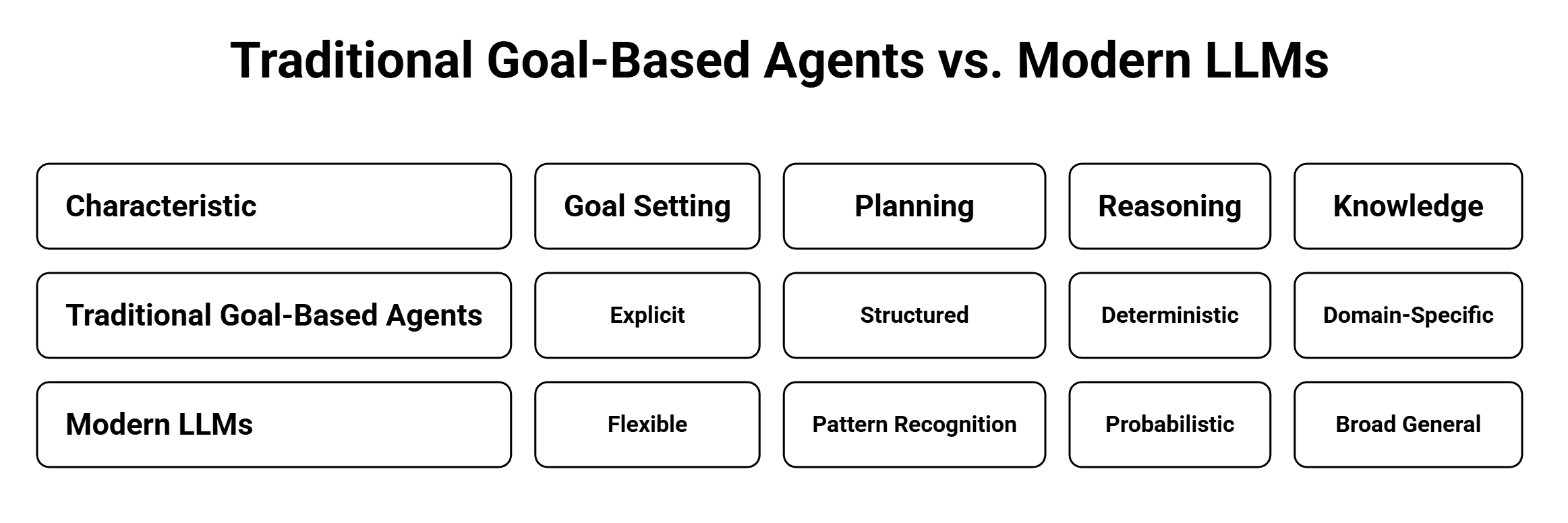
The Future: Combining both approaches creates "agentic AI"—LLMs that can set goals, plan actions, and execute tasks autonomously.
Gartner predicts that by 2027, 40% of enterprise applications will incorporate agentic AI capabilities, up from less than 5% in 2024.
Ruh AI's Approach: Ruh AI pioneers agentic AI solutions that combine goal-based planning with modern language models. Our AI SDR platform demonstrates how autonomous agents handle complex sales workflows by merging the structured thinking of goal-based agents with the natural language capabilities of LLMs.
Reinforcement Learning Agents
DeepMind's AlphaGo and similar systems combine goal-based reasoning with learning:
- Start with a goal (win the game)
- Learn optimal strategies through trial and error
- Develop planning abilities through experience
- Achieve superhuman performance in specific domains
Science published findings showing that reinforcement learning agents now exceed human expert performance in over 50 different complex decision-making domains.
Multi-Agent Systems
The future of AI involves multiple agents working together, where goal-based agents collaborate to achieve complex objectives:
Cooperative systems: Multiple agents share goals and coordinate actions (hybrid workforce models)
Competitive systems: Agents with opposing goals interact strategically (competitive multi-agent systems)
Ruh AI's platform orchestrates multiple specialized agents working together—research agents gathering prospect intelligence, outreach agents executing campaigns, and analysis agents measuring performance—all coordinating to achieve overarching sales goals.
Building Your Understanding: A Simple Analogy
Let's solidify your understanding with a comprehensive analogy:
Planning a Party (Goal-Based Agent Thinking)
Goal: Host a successful birthday party
Perception: You assess your resources—budget, available date, friends' schedules, venue options
Knowledge Base: You remember what worked at past parties and what foods your friends enjoy
Planning:
- Choose a date that works for most friends
- Book a venue or prepare your home
- Send invitations two weeks in advance
- Order food based on guest count
- Arrange music and decorations
- Prepare backup plans for weather (if outdoor party)
Execution: Carry out each step in order
Adaptation: When three friends cancel last minute, you adjust food orders. When it rains, you activate your indoor backup plan.
This is exactly how a goal-based agent approaches any task—it's the same logical process humans use for complex planning.
Sales Parallel: Ruh AI's SDR agents plan sales campaigns the same way you'd plan a party—researching prospects (assessing resources), personalizing messaging (remembering what works), sequencing touchpoints (planning steps), executing outreach (carrying out the plan), and adapting to responses (adjusting based on feedback).
According to Harvard Business Review, organizations that effectively combine human planning with AI execution see productivity improvements of 30-40%.
The Future of Goal-Based Agents
Goal-based agents continue evolving rapidly. Here's what's emerging, backed by expert predictions:
Integration with Generative AI
Combining goal-based planning with generative AI creates systems that can:
- Understand complex instructions in natural language
- Generate creative solutions to novel problems
- Explain their reasoning in human-friendly ways
- Collaborate more naturally with people
MIT Technology Review reports that integrated AI systems combining goal-based and generative approaches achieve 3x better task completion rates than single-approach systems.
Ruh AI's Innovation: We leverage this integration to create AI employees that understand sales context, generate personalized messaging, and adapt strategies—all while maintaining focus on concrete business goals.
Multi-Agent Systems
Multiple goal-based agents working together can:
- Solve problems too complex for single agents
- Coordinate large-scale operations (smart cities, supply chains, sales organizations)
- Negotiate and cooperate to achieve shared objectives
- Create emergent intelligent behavior from simple individual rules
Ruh AI's platform demonstrates this future today, with specialized agents collaborating across the entire sales funnel—from prospecting to qualification to meeting booking.
According to McKinsey, companies using multi-agent AI systems report efficiency gains of 25-35% in complex operational workflows.
Improved Human-AI Collaboration
Future goal-based agents will:
- Better understand human intentions and values
- Seek clarification when goals are ambiguous
- Work as genuine partners rather than tools
- Adapt to individual user preferences and working styles
The hybrid workforce model represents this evolution, where AI agents and human workers collaborate seamlessly, each contributing their unique strengths.
Forrester Research predicts that by 2026, collaborative AI systems will augment 80% of knowledge worker tasks, fundamentally transforming how humans and AI work together.
Ethical and Safety Advances
Researchers at organizations like OpenAI and Anthropic are developing goal-based agents that:
- Align actions with human values
- Refuse harmful goals
- Explain decisions transparently
- Include human oversight mechanisms
Ruh AI prioritizes ethical AI deployment, ensuring our agents operate within defined boundaries and maintain transparency in their decision-making processes.
According to Nature, explainable AI systems increase user trust by 60% and improve compliance with AI recommendations by 45%.
Conclusion
Goal-based agents represent a fundamental approach to artificial intelligence that bridges the gap between simple reactive systems and truly intelligent behavior. By understanding goals, planning ahead, and adapting to change, these agents tackle complex real-world problems that simpler AI cannot handle.
From guiding your daily commute to advancing medical diagnostics to revolutionizing sales development, goal-based agents already impact your life in countless ways. As AI technology evolves, these systems will become even more capable, collaborative, and integrated into our daily experiences.
The key to understanding goal-based agents is recognizing that they think like humans solving problems: they know what they want to achieve, they plan how to get there, and they adjust when circumstances change. This simple yet powerful framework unlocks sophisticated AI capabilities that continue shaping our future.
Whether you're a student exploring AI concepts, a professional considering career opportunities in the age of AI employees, or a business leader seeking to implement autonomous agents, understanding goal-based agents provides essential insight into how intelligent systems work—and where they're heading next.
Ready to implement goal-based AI agents in your business? Contact Ruh AI to discover how autonomous AI agents can transform your workflows and drive measurable ROI. Explore our AI SDR solutions, meet SDR Sarah, or browse more insights on the Ruh AI blog.
Frequently Asked Questions
What's the main difference between goal-based and simple reflex agents?
Simple reflex agents react to immediate situations using fixed rules, while goal-based agents plan multiple steps ahead to achieve specific objectives. A reflex agent is like a light switch (on/off based on current input); a goal-based agent is like a thermostat that plans heating cycles to reach your target temperature.
In sales, a simple reflex agent might send the same template to every lead, while Ruh AI's goal-based agents analyze each prospect's context and plan personalized multi-touch sequences designed to achieve meeting bookings.
According to IBM, goal-based agents represent a mid-level complexity in the five-tier hierarchy of AI agents.
Can goal-based agents learn and improve?
Pure goal-based agents don't automatically improve from experience. However, learning agents combine goal-based planning with learning mechanisms, allowing them to refine their strategies over time. Many modern AI systems are hybrid agents with both capabilities.
Ruh AI's platform incorporates continuous learning, enabling our agents to identify which strategies work best and optimize their approaches based on real performance data.
Science journal reports that reinforcement learning agents now exceed human expert performance in over 50 different complex decision-making domains.
Are all AI assistants goal-based agents?
Not entirely. Modern AI assistants like Siri, Alexa, and Google Assistant combine multiple AI approaches. They use goal-based reasoning for task completion (setting reminders, sending messages) but also use other techniques like pattern recognition, search algorithms, and natural language processing.
Ruh AI takes this further by creating specialized AI employees that handle entire job functions autonomously—like SDR Sarah, who manages complete sales development workflows from prospecting to meeting booking.
According to Gartner, by 2027, 40% of enterprise applications will incorporate agentic AI capabilities.
What careers involve working with goal-based agents?
Several growing fields work extensively with goal-based agents:
- AI/Machine Learning Engineer
- Robotics Engineer
- Autonomous Vehicle Developer
- Game AI Programmer
- Healthcare AI Specialist
- Supply Chain Optimization Analyst
- AI Implementation Specialist
U.S. Bureau of Labor Statistics projects that AI and machine learning specialist roles will grow 23% through 2032, much faster than the average for all occupations, with median salaries exceeding $120,000.
As AI employees become more prevalent, new career opportunities emerge in AI training, oversight, and collaboration.
How do goal-based agents handle conflicting goals?
Pure goal-based agents typically focus on single primary goals. When multiple goals exist, they either prioritize one goal or evolve into utility-based agents that can balance competing objectives by assigning values to different outcomes.
Ruh AI's agents use sophisticated prioritization logic to balance goals like personalization quality, outreach volume, and response timing—ensuring optimal results without sacrificing effectiveness.
Research from UC Berkeley demonstrates that utility-based agents outperform goal-based agents when dealing with conflicting priorities.
What programming languages are used to create goal-based agents?
Python dominates AI development due to its extensive libraries (TensorFlow, PyTorch, scikit-learn). Other popular languages include Java, C++, and specialized AI languages like Prolog. The choice depends on the specific application and performance requirements.
According to Stack Overflow's Developer Survey, Python remains the most wanted programming language, with 67% of developers expressing interest in continuing to work with it, particularly for AI and machine learning applications.
How do goal-based agents differ from stateless agents?
Stateful agents maintain memory of past interactions and context, while stateless agents treat each interaction independently. Goal-based agents benefit significantly from being stateful, as they can track progress toward goals across multiple actions and adapt their plans based on historical outcomes.
Ruh AI's agents leverage stateful architectures with advanced memory systems to maintain context throughout complex, multi-step sales processes.
What industries benefit most from goal-based agents?
According to McKinsey Global Institute, industries seeing the highest ROI from goal-based AI agents include:
Manufacturing - 40% efficiency gains through robotic automation
Logistics - 15% cost reduction, 35% faster deliveries
Healthcare - 20% diagnostic accuracy improvement, 50% time reduction
Financial Services - 70% of trading now algorithmic
Education - 25-30% better student outcomes with adaptive learning
Sales & Marketing - 3x better task completion with agentic AI
Learn more about AI revolutionizing customer support and AI employees in financial services.