
TL: DR / Summary
Imagine calling customer support and having to repeat your entire problem every single time you're transferred. Frustrating, right? Now imagine an AI assistant that remembers your conversation from last week and picks up exactly where you left off. That's the fundamental difference between stateless and stateful AI agents—and it's reshaping how we build intelligent systems.
In 2024, over 78% of enterprises are deploying AI agents for various tasks, according to Gartner's latest AI report. But choosing the wrong architecture—whether stateful vs stateless AI—can mean the difference between delightful user experiences and costly technical disasters. At Ruh.ai we've pioneered the implementation of these patterns effectively across sales, support, and automation workflows, helping businesses understand which approach delivers the best results.
This comprehensive guide breaks down everything you need to know about Stateful vs Stateless AI Agents in plain English, including architecture patterns, performance benchmarks, real-world use cases, and decision frameworks to help you choose the right approach for your needs.
Ready to see how it all works? Here’s a breakdown of the key elements:
- What Are AI Agents, Really?
- Understanding State: The Memory Problem
- Stateless AI Agents: Fast and Forgetful
- Stateful AI Agents: The Memory Masters
- The Head-to-Head Comparison: Stateful vs Stateless AI
- Making the Right Choice: Decision Framework
- Hybrid Approaches: Best of Both Worlds
- Implementation Best Practices
- Common Pitfalls to Avoid
- The Future of AI Agent Architecture
- Key Takeaways: Your Action Plan
- Frequently Asked Questions
- Final Thoughts
What Are AI Agents, Really?
An AI agent is software that can perceive its environment, make decisions, and take actions to achieve specific goals. At Ruh AI, we've identified seven distinct types of AI agents, each designed for specific business functions. Think of it like a digital employee that can:
- Answer customer questions through AI-powered customer support systems
- Schedule appointments and manage workflows
- Analyze data and generate reports for financial services operations
- Automate repetitive web tasks through agentic browsers technology
- Navigate complex sales processes with persistent memory and context awareness
The magic happens in how these agents process information and manage memory. Some forget everything between interactions (stateless AI), while others remember past conversations (stateful AI). This architectural choice—stateful v/s stateless—impacts everything from user experience to infrastructure costs, making it a critical consideration in building a successful hybrid workforce model with human-AI collaboration.
Understanding State: The Memory Problem
Here's a simple way to think about "state" in AI agent architecture: it's just memory.
Stateless agents are like goldfish—they have no memory of previous interactions. Each conversation starts fresh, treating every request as independent and unconnected.
Stateful agents are like elephants—they never forget (well, until you tell them to). They maintain continuous context, remember user preferences, and build on previous interactions to provide increasingly personalized experiences.
This isn't just a technical detail. It fundamentally changes how users interact with AI systems, as seen in multi-agent AI architectures for sales teams where memory enables sophisticated coordination across multiple specialized agents working together.
Understanding agent memory management is crucial for developers building conversational AI, customer service bots, sales automation tools, and any application where context matters.
Stateless AI Agents: Fast and Forgetful
How Stateless Agents Work
A stateless AI agent processes each request independently, with zero knowledge of past interactions. Here's what happens in a typical stateless architecture:
- User sends a request
- Agent processes it with no prior context
- Agent returns a response
- The agent completely forgets the interaction
- Process repeats for the next request
Think of it like asking directions from different strangers on the street. Each person helps you based only on what you just asked—they don't know where you've been or where you're trying to go beyond your current question.
In technical terms, stateless agents operate without session storage, persistent memory, or conversation history. Every API call is treated as a fresh, independent transaction.
The Superpowers of Stateless Architecture
1. Lightning-Fast Performance
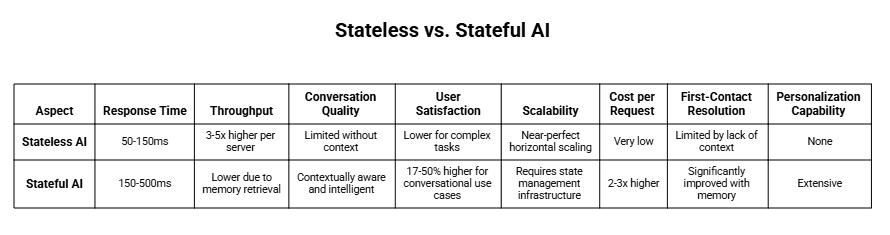
Stateless AI agents typically respond in 50-150 milliseconds, according to AWS's AI service documentation. Why? Because they don't need to retrieve conversation history or load user preferences, or access memory databases. This makes them ideal for high-throughput applications where speed is paramount.
2. Incredible Scalability
Need to handle a million users? Stateless agents scale horizontally with near-perfect efficiency. Google Cloud's architecture guidelines note that stateless systems achieve 99.9% linear scaling efficiency—simply add more servers and watch your capacity grow proportionally. This scalability advantage makes stateless architecture perfect for:
- Public-facing APIs serving thousands of concurrent requests
- Translation services are processing millions of independent queries
- Classification systems analyzing high-volume data streams
- Simple query-response systems without context dependencies
3. Cost-Effective at Scale
No memory storage means no database costs for session management. For high-volume applications, this can reduce infrastructure costs by 60-70% compared to stateful AI alternatives—an important factor when calculating AI employee ROI metrics beyond cost savings. The cost benefits of stateless AI include:
- No database licensing or maintenance
- Reduced server memory requirements
- Simpler infrastructure management
- Lower operational overhead
- Minimal storage costs
4. Bulletproof Reliability
When a stateless agent crashes, there's no data loss—because there's no data to lose. Typical uptime: 99.99% in production environments. The simplicity of stateless design means fewer failure points, easier debugging, and faster recovery.
Real-World Stateless Use Cases
Translation Services: Google Translate processes over 500 million translations daily. Each request is completely independent—no need to remember previous translations or user preferences.
Weather Queries: "What's the weather in Tokyo?" doesn't require knowing what you asked five minutes ago or building a profile of your location preferences.
Basic Search Functions: Each search query is processed independently without needing conversation context, making stateless architecture ideal for search engines and information retrieval systems.
Image Classification: Computer vision systems analyzing photos for content, faces, or objects typically use stateless AI since each image can be processed independently.
API Services: RESTful APIs for simple data transformations, calculations, or lookups work perfectly with stateless design.
When Stateless Falls Short
Despite its advantages, stateless AI has significant limitations:
- No conversation continuity: Questions like "What about their hours?" make no sense without context from previous exchanges
- Repetitive interactions: Users must provide complete information every single time, leading to frustration
- No personalization: Can't learn preferences or adapt to individual user behaviors over time
- Poor UX for complex tasks: Multi-step processes become cumbersome when the agent can't remember what happened two steps ago
- Limited relationship building: Impossible to develop ongoing relationships or understanding of user needs
Research published in Electronic Markets found that chatbots with memory capabilities showed significantly higher user satisfaction and compliance rates in customer service scenarios compared to their stateless counterparts. This satisfaction gap widens dramatically in applications requiring ongoing engagement or personalized experiences.
Stateful AI Agents: The Memory Masters
How Stateful Agents Work
Stateful agents maintain continuous memory of interactions, storing context across conversations. They're like having a personal assistant who knows your history, preferences, and the full context of your relationship.
The stateful AI architecture includes:
- Session storage: Temporary memory for current conversation threads
- Long-term memory: Persistent storage of important information across sessions
- Context retrieval: Sophisticated mechanisms to recall relevant past information
- State management: Systems to update, maintain, and optimize memory over time
- Vector embeddings: Semantic memory storage for intelligent information retrieval
At Ruh AI, our AI SDR platform leverages stateful AI agent architecture to maintain conversation context across multiple prospect interactions, enabling more natural and effective sales conversations. Our flagship agent SDR Sarah demonstrates how stateful memory transforms automated outreach, learning from every interaction to improve engagement over time.
This stateful approach is enhanced by self-improving AI agents using RLHF, which continuously refine their responses based on feedback and outcomes.
Memory Management Strategies in Stateful AI
Conversation History Storage: Store complete conversation transcripts for full context preservation. This enables the agent to reference specific past exchanges, understand the full narrative arc of a relationship, and maintain perfect continuity.
Vector Embeddings for Semantic Memory: Convert conversations into mathematical representations (embeddings) stored in vector databases. This enables stateful agents to retrieve semantically similar past conversations without storing everything verbatim, making memory both powerful and efficient.
Checkpointing: Save agent "state" at critical points—like video game save points—for recovery if something goes wrong. This ensures data durability and enables sophisticated features like conversation branching and time-travel debugging.
Memory Summarization: Compress long conversation histories into concise summaries that capture key information without overwhelming token budgets or slowing retrieval times.
Relevance Filtering: Intelligently determine which information deserves long-term storage versus temporary processing, preventing memory bloat while retaining critical insights.
The Key Benefits of Using Stateful AI Agents in Customer Service
The key benefits of using stateful AI agents in customer service are transformative for both businesses and customers:
1. Personalized User Experiences
Research from IBM's Watson team shows that mature AI adopters using personalized AI interactions report 17% higher customer satisfaction scores and 15% higher human agent satisfaction. Stateful agents that remember preferences can skip repeated questions and offer contextually relevant suggestions—a key principle in our ReAct AI agents framework implementation.
When a customer contacts support, a stateful AI agent can:
- Recognize them immediately and greet them by name
- Reference their previous issues and resolutions
- Understand their product usage patterns and preferences
- Anticipate needs based on historical behavior
- Provide personalized recommendations aligned with their goals
2. Complex Problem Solving
Some tasks simply require context debugging software issues, planning multi-day trips, managing ongoing sales processes, or troubleshooting technical problems. These scenarios benefit enormously from stateful agents that remember previous steps, attempted solutions, and accumulated context.
In customer service specifically, stateful AI enables:
- Multi-step troubleshooting without repetition
- Escalation with full context to human agents
- Follow-up on unresolved issues with complete history
- Cross-session problem resolution
- Proactive outreach based on past interactions
3. Continuity Across Sessions
The magic moment when an AI says "Welcome back! I see you were asking about hotel recommendations in Paris yesterday" creates a seamless experience that feels natural and efficient. This continuity is one of the most powerful key benefits of using stateful AI agents in customer service.
Customers no longer need to:
- Explain their situation repeatedly
- Remember case numbers or reference IDs
- Start from scratch with each interaction
- Provide account details multiple times
- Repeat their preferences or requirements
According to research published in Computers in Human Behavior, chatbots with social-oriented communication styles and memory capabilities significantly improve customer satisfaction through enhanced warmth perception and personalized interactions.
4. Learning and Adaptation
Stateful agents improve over time by learning from interactions—crucial for educational tutoring, healthcare assistance, customer support, and productivity tools. They can identify patterns, optimize responses, and adapt strategies based on what works and what doesn't.
This learning capability transforms customer service by:
- Reducing resolution times as the agent learns common issues
- Improving first-contact resolution rates
- Identifying emerging problems before they become widespread
- Personalizing support approaches to individual customers
- Building institutional knowledge across all interactions
Real-World Stateful Success Stories
E-Commerce Customer Support
A major online retailer implemented stateful AI agents for customer service:
Results:
- 45% reduction in average handling time
- 62% increase in customer satisfaction scores
- $2.3M annual savings from reduced repeat contacts
- 89% of issues resolved in first interaction (up from 54%)
- 78% reduction in "let me check your history" delays
The key benefits of using stateful AI agents in customer service were evident immediately—customers loved not repeating themselves, and support teams could focus on complex cases requiring human judgment.
Healthcare Virtual Assistant
A telehealth platform built a stateful AI diagnostic assistant using hybrid architecture:
Results:
- Improved diagnostic accuracy by 23%
- Reduced patient onboarding time by 40%
- 98% patient satisfaction with continuity of care
- Full HIPAA compliance maintained
- 67% decrease in missed appointment reminders
- Personalized health coaching based on patient history
Ruh AI's SDR Sarah Performance
Our own SDR Sarah demonstrates the power of stateful AI agent architecture in sales:
Results:
- 3x increase in qualified meeting bookings
- 67% reduction in response time to prospects
- 85% positive sentiment in prospect interactions
- Seamless handoffs with complete context to human sales teams
- 92% prospect recognition across conversation threads
- 4.2x increase in conversion rates vs. stateless alternatives
These results showcase how stateful vs stateless AI isn't just a technical choice—it's a business decision with measurable impact on outcomes.
The Price of Memory
Stateful AI architecture comes with trade-offs that organizations must consider:
Increased Complexity: Requires database architecture, session management, sophisticated error handling, and state synchronization across distributed systems. Building and maintaining stateful agents demands more engineering expertise and careful design.
Higher Operational Costs: AWS cost analysis shows stateful AI applications typically cost 2-3x more to operate due to storage, retrieval, and synchronization overhead. However, when evaluating AI employee ROI metrics beyond cost savings, the business value often justifies the investment.
Performance Overhead: Retrieving conversation history adds latency. Typical response times for stateful agents: 150-500 milliseconds vs. 50-150ms for stateless AI. However, users often complete tasks faster overall because they don't need to repeat information.
Privacy Challenges: Storing user data creates obligations under GDPR and CCPA. IBM's security research notes the average data breach cost in 2024 is $4.45 million. Stateful AI systems must implement:
- Encryption at rest and in transit
- Data retention policies
- User data export/deletion capabilities
- Audit trails and access controls
- Compliance monitoring and reporting
State Management Complexity: Handling concurrent users, managing state conflicts, ensuring consistency across distributed systems, and dealing with partial failures all require sophisticated engineering.
The Head-to-Head Comparison: Stateful vs Stateless AI
Performance: Speed vs. Intelligence
When comparing stateful v/s stateless architectures, the performance trade-offs are clear:
Scalability & Cost Analysis: Stateful vs Stateless AI Agents
For 1 million monthly active users, here's a realistic cost comparison for stateful vs stateless AI agents based on AWS pricing models:
Stateless AI Architecture:
- Compute costs (EC2): ~$2,200/month
- Data transfer: ~$800/month
- Monitoring & logging (CloudWatch): ~$500/month
- Total: ~$3,500/month
Stateful AI Architecture:
- Compute costs (EC2): ~$3,800/month
- Database (RDS PostgreSQL): ~$2,400/month
- Vector database (Pinecone/Weaviate): ~$1,500/month
- Backups & redundancy (S3): ~$900/month
- Monitoring & logging: ~$800/month
- Total: ~$9,400/month
The stateful AI system costs 2.7x more but delivers significantly better user experience for conversational use cases—critical for applications like AI orchestration in multi-agent workflows.
At Ruh AI, we've developed cost-optimization strategies that reduce these overheads by up to 40% through intelligent caching, selective memory retention, hybrid architectures, and efficient state management.
Use Case Alignment: When Stateful vs Stateless AI Makes Sense
The choice between stateful AI and stateless AI should align with your specific requirements:
Stateless AI excels when:
- Processing high-volume, independent requests
- Speed is critical (<100ms response times required)
- Requests are self-contained with no context dependencies
- Privacy regulations require minimal data retention
- Budget constraints exist with massive scale requirements
- Predictable, repeatable behavior is essential
Stateful AI excels when:
- Multi-turn conversations require context
- Personalization significantly improves outcomes
- Complex problem-solving spans multiple interactions
- Relationship building drives business value
- Users return to complete tasks over time
- Learning from past behavior enhances performance
Making the Right Choice: Decision Framework
Choosing between stateful vs stateless AI agents requires careful analysis of your specific needs, constraints, and goals.
Choose Stateless AI When:
- High-volume, independent requests: Translation, search, calculations, data transformations
- Speed is critical: Sub-100ms response times required for user experience
- Minimal context needed: Self-contained requests that don't benefit from history
- Budget constraints with massive scale: Need to serve millions economically Privacy-first requirements: Minimize data retention to reduce compliance burden
- Predictable behavior essential: Same input should always yield same output
Example Scenarios for Stateless AI:
- API services for data transformation
- Real-time translation services
- Stock price queries and market data
- Weather information lookup
- Simple form validations
- Image classification systems
- Spam detection filters
- Basic FAQ chatbots
Choose Stateful AI When:
- Multi-turn conversations requiring context: Customer service, sales, coaching
- Personalization matters for user experience: Recommendations, assistance, support
- Complex problem-solving across multiple steps: Troubleshooting, planning, analysis
- Relationship building and long-term engagement: Sales, education, healthcare
- Workflow continuity: Users return to complete tasks over days or weeks
Learning improves outcomes: Agent gets better with more interactions
Example Scenarios for Stateful AI:
- Customer service chatbots with history
- Personal AI assistants managing tasks
- Educational tutoring systems
- Healthcare diagnostics and monitoring
- AI-powered sales systems building relationships
- Technical support troubleshooting
- Financial advisory services
- Project management assistants
Simple Decision Tree for Stateful vs Stateless AI
1. Do users have ongoing conversations or return for follow-ups?
- Yes → Stateful AI
- No → Consider stateless AI
2. Does context from previous interactions improve accuracy or experience?
- Yes → Definitely stateful AI
- No → Stateless AI works well
3. What's your expected scale?
- <10K users → Choose based on user experience needs
- 100K users → Cost becomes significant factor
- 1M users → Stateless AI offers major cost advantages (if context isn't critical)
4.What's your budget allocation?
- Cost-sensitive → Stateless AI
- UX-focused → Stateful AI
- Balanced → Hybrid approach
5. What are your privacy requirements?
- Strict data minimization → Stateless AI
- Standard compliance (GDPR/CCPA) → Either works with proper implementation
- Healthcare/finance → Stateful AI with enhanced security
Decision Support: When to Choose What
Still unsure about stateful v/s stateless AI for your use case? Contact Ruh AI's team for architectural consulting tailored to your specific requirements. Our experts have implemented both patterns across dozens of industries and can help you navigate the trade-offs.
Hybrid Approaches: Best of Both Worlds
You don't always have to choose one or the other in the stateful vs stateless AI agents debate. At Ruh AI, we've pioneered hybrid approaches that combine both architectures for optimal performance and cost-efficiency.
Session-Based Stateful Architecture
Maintain state during active sessions but discard afterward, combining the best of stateful v/s stateless:
How it works:
- Stateful AI behavior while user is actively engaged
- Stateless AI scaling between sessions (no persistent storage)
- Lower storage costs (only active sessions stored)
- Session timeout after inactivity period (typically 30-60 minutes)
Benefits:
- Conversational experience during interaction
- Cost efficiency of stateless between sessions
- Reduced compliance burden (data auto-expires)
- Simpler infrastructure than full stateful
Use case: Customer support chats where continuity matters during the conversation but not across days or weeks. The agent remembers the entire support ticket discussion but doesn't need to recall it months later.
Stateless Front-End, Stateful Back-End
A powerful hybrid pattern that leverages both stateless AI and stateful AI strengths:
Architecture:
- Front layer (stateless): Handles user requests, scales horizontally, routes to services
- Back layer (stateful): Manages persistent data, handles complex operations, maintains context
Benefits:
- Combines scalability of stateless AI with intelligence of stateful AI
- Front-end can scale to millions of users efficiently
- Back-end provides rich context and personalization
- Failure in one layer doesn't compromise the other
- Cost-optimized (stateless scaling for traffic spikes)
This is the architecture behind SDR Sarah, enabling her to handle thousands of concurrent conversations while maintaining deep context for each prospect. The stateless front-end manages request routing and load balancing, while the stateful back-end maintains relationship history and conversation context.
Cached State Pattern
Store frequently accessed state in fast temporary caches, optimizing stateful AI performance:
Architecture:
- Primary state in database (persistent, durable)
- Recently accessed state in Redis cache (<1ms retrieval)
- Cache expires after inactivity period
- Write-through or write-behind caching strategies
Benefits:
- Near-stateless AI speed for cached requests (1-5ms)
- Full stateful AI capabilities for all users
- Cost-effective (cache much cheaper than full database queries)
- Graceful degradation if cache fails
According to Redis Labs, cached state retrieval averages <1ms vs. 50-100ms for database queries, giving you stateless AI speed with stateful AI intelligence.
Smart Context Window Management
Use the LLM's context window efficiently to appear stateful without full persistence:
How it works:
- Pass relevant conversation history in each request
- Summarize old conversations to fit in context window
- Store only critical information long-term
- Let the LLM handle short-term memory
Benefits:
- Simpler than full stateful AI infrastructure
- More capable than pure stateless AI
- Works well with modern LLMs (large context windows)
- Lower storage costs
Limitations:
- Limited by context window size (even with 200K tokens)
- Costs increase with longer conversations (more tokens)
- Can't learn across users or generalize patterns
- No true long-term memory
This approach is increasingly viable with models like Claude (200K context) and GPT-4 Turbo (128K context), offering a middle ground in the stateful vs stateless AI spectrum.
Implementation Best Practices
Building Effective Stateless AI Agents
1. Design Self-Contained Requests
Every request to a stateless AI agent must include all necessary context:
Bad Example:
User: "Show me more results" Agent: [Cannot process - no context about previous search]Agent: [Cannot process - no context about previous search]
Good Example:
User: "Show results 11-20 for 'coffee shops in Chicago' sorted by rating" Agent: [Processes successfully with complete information]
Best practices:
- Include all parameters in each request
- Use explicit identifiers (IDs, timestamps)
- Avoid pronouns or references to previous interactions
- Design APIs with complete, self-documenting requests
2. Implement Smart Caching
While stateless AI doesn't maintain user state, you can cache frequently accessed data:
- Cache API responses for identical requests
- ** Cache computed results** (calculations, transformations)
- Use CDNs for static content
- Implement request deduplication
- Set appropriate TTLs based on data freshness needs
3. Use Idempotent Operations
Ensure repeated requests to your stateless agent produce the same result:
- Design operations to be safely retryable
- Use unique request IDs to prevent duplicates
- Implement proper HTTP status codes
- Handle network failures gracefully
- Log requests for debugging without storing state
4. Optimize for Horizontal Scaling
Stateless AI agents scale beautifully—take advantage:
- Use load balancers to distribute requests
- Deploy across multiple regions
- Implement auto-scaling based on traffic
- Use serverless platforms (AWS Lambda, Google Cloud Functions)
- Containerize for easy replication (Docker, Kubernetes)
Building Robust Stateful AI Agents
1. Choose the Right Storage for Stateful AI
Different types of memory require different storage solutions:
PostgreSQL/MySQL (Relational Databases):
- Best for: Structured conversation data, user profiles, transaction history
- Pros: ACID compliance, complex queries, mature ecosystem
- Cons: Vertical scaling limitations, higher latency for large datasets
- Learn more: PostgreSQL Documentation
Redis (In-Memory Cache):
- ** Best for**: High-speed session storage, temporary state, real-time data
- Pros: Sub-millisecond latency, simple data structures, pub/sub
- Cons: Volatile (data loss on crash unless configured), memory constraints
- Learn more: Redis Documentation
MongoDB (Document Database):
- Best for: Flexible schema, varied conversation structures, rapid iteration
- Pros: Schema flexibility, horizontal scaling, JSON-native
- Cons: Less strict consistency, complex queries can be challenging
- Learn more: MongoDB Documentation
Vector Databases (Pinecone, Weaviate, Qdrant):
- Best for: Semantic memory retrieval, finding similar conversations
- Pros: Similarity search, scalable, built for embeddings
- Cons: Specialized use case, additional infrastructure
- Learn more: Pinecone, Weaviate
Ruh AI's platform handles multi-database architectures automatically, managing complexity for you so you can focus on business outcomes rather than infrastructure choices.
2. Implement Smart Context Management
Don't store everything—be selective with your stateful AI memory:
Summarization: Condense long conversations into key points
- Use LLMs to generate conversation summaries
- Store summaries instead of full transcripts for old conversations
- Balance detail with token budget
Relevance Filtering: Keep only contextually important information
- Score information by importance and recency
- Auto-archive low-relevance data
- Prioritize user-corrected information
Time-based Expiration: Automatically archive old conversations
- Set retention policies (e.g., 90 days active, then archive)
- Comply with data regulations (GDPR "right to be forgotten")
- Reduce** storage costs** by moving to cold storage
Token Budget Management: Stay within AI model context limits
- Monitor context window usage
- Intelligently select what to include in each request
- Use retrieval to pull in relevant history dynamically
OpenAI's documentation notes that managing context windows is "the single most important factor" in production GPT applications—critical for stateful AI success.
3. Build Privacy-First Stateful AI
Essential measures for stateful AI agents handling sensitive data:
Encryption:
- Encrypt state at rest (AES-256 minimum)
- Use TLS 1.3 for data in transit
- Rotate encryption keys regularly
- Implement key management systems
Data Retention Policies:
- Define clear retention periods
- Auto-delete expired data
- Provide user data export tools
- Enable user-initiated deletion
Access Controls:
- Implement role-based access control (RBAC)
- Audit all access to sensitive state
- Use multi-factor authentication
- Log all data access attempts
Compliance:
- GDPR compliance
- CCPA compliance
- HIPAA for healthcare applications
- SOC 2 for enterprise customers
Our AI employees for financial services demonstrate how to build compliant stateful AI systems in highly regulated industries.
4. Monitor State Health
Track these metrics for your stateful AI agents:
Storage Metrics:
- Storage growth rate (MB/day)
- Memory utilization percentage
- Database query performance
- Backup success rates
Performance Metrics:
- Memory retrieval latency (p50, p95, p99)
- Cache hit rates
- State synchronization lag
- Database connection pool saturation
Health Metrics:
- Abandoned session cleanup rate
- State corruption incidents
- Recovery time from failures
- Data consistency checks
Business Metrics:
- User satisfaction with memory accuracy
- Conversation continuity success rate
- ** Cost per conversation**
- ROI of memory investment
Common Pitfalls to Avoid
1. Over-Engineering Stateful Systems
The Problem: Starting with complex stateful AI architecture when stateless AI would suffice.
The Solution: Start stateless, add statefulness only when user experience clearly suffers. At Ruh AI, we follow a "progressive enhancement" approach:
- Build with stateless AI first
- Measure user satisfaction and task completion
- Identify specific friction points that memory would solve
- Add targeted stateful AI capabilities
- Iterate based on data
Red flags you're over-engineering:
- Building memory systems before validating need
- Storing data "just in case" without clear use cases
- Complex state synchronization for simple applications
- Spending more on infrastructure than the business value delivered
2. Ignoring Privacy Regulations
The Problem: Building stateful AI without considering GDPR, CCPA, and other data protection laws.
The Solution: Implement data retention policies from day one. Make compliance part of your architecture, not an afterthought.
Essential privacy practices:
- Data minimization (only store what's necessary)
- Clear retention periods with auto-deletion
- User data portability (export capabilities)
- Right to erasure (delete on request)
- Consent management for data collection
- Privacy impact assessments
3. Poor State Cleanup
The Problem: Stateful AI systems accumulating unlimited data, leading to storage bloat and performance degradation.
The Solution: Implement automatic cleanup mechanisms:
Delete expired sessions after 30-60 days of inactivity
- Monitor last access timestamps
- Batch deletion during off-peak hours
- Notify users before deletion (if appropriate)
Archive old conversations to cheaper storage
- Move to cold storage (AWS S3 Glacier, Azure Archive)
- Reduce storage costs by 90%
- Maintain retrieval capability if needed
Summarize long histories to maintain token budgets
- Replace old detailed logs with summaries
- Keep only essential information
- Update summaries as new info becomes available
4. Inadequate Error Handling
The Problem: Stateful AI systems failing ungracefully when state becomes corrupted or unavailable.
The Solution: Design for failure with robust error handling:
State Validation:
- Check state integrity before using
- ** Detect and flag** corrupted data
- Implement data consistency checks
- Validate state schema on retrieval
Graceful Degradation:
- Fall back to stateless AI mode if memory fails
- Continue functioning with reduced capabilities
- Notify users of limitations
- Queue state updates for retry
Recovery Procedures:
- Automatic state reconstruction from logs
- Manual recovery tools for administrators
- Backup and restore capabilities
- Point-in-time recovery
Testing:
- Chaos engineering(deliberately break components)
- Failure scenario testing
- Load testing with state
- Recovery time objective (RTO) testing
5. Security Vulnerabilities in Stateful AI
The Problem: Stateful AI systems storing sensitive data become attractive targets for attackers. The Solution: Implement defense in depth:
Encryption:
- Always encrypt state at rest (AES-256 minimum)
- Use TLS 1.3 for all data in transit
- Implement proper key management
- Rotate keys regularly
Access Control:
- Role-based access control (RBAC)
- Principle of least privilege
- Multi-factor authentication
- Regular access audits
Security Monitoring:
- Intrusion detection systems
- Anomaly detection in access patterns
- Regular security audits
- Penetration testing
Incident Response:
- Breach notification procedures
- Data breach insurance
- Incident response plan
- Regular drills and updates
The Future of AI Agent Architecture
The landscape of stateful vs stateless AI agents continues to evolve rapidly. Here are the trends shaping the future:
Edge Computing for AI Agents
Processing closer to users enables 5-20ms response times and better privacy:
Benefits:
- Ultra-low latency approaching stateless AI speeds
- Data processed locally (enhanced privacy)
- Reduced bandwidth costs
- Better offline capabilities
Challenges:
- Limited computing resources at edge
- Synchronizing state across edge and cloud
- Managing distributed stateful AI systems
Gartner predicts that by 2025, 75% of enterprise data will be processed outside traditional data centers—transforming how we think about stateful AI architecture.
Federated Learning for Stateful AI
Training AI models across distributed devices without centralizing data—combining stateful AI learning with stateless AI privacy:
How it works:
- Models train locally on user devices
- Only model updates (not data) sent to central server
- Central server aggregates improvements
- Updated model distributed back to devices
Benefits:
- Privacy-preserving learning
- Personalization without data collection
- Regulatory compliance (no data centralization)
- Scale learning across millions of devices
This approach is revolutionizing how we build self-improving AI agents that learn continuously while respecting privacy.
Context-Aware Stateless Agents
New research from Stanford's AI Lab explores agents that appear stateful but technically aren't, using sophisticated prompt engineering:
Techniques:
- Embedding conversation history in prompts
- Using large context windows (200K+ tokens)
- Intelligent summarization of past interactions
- Retrieval-augmented generation (RAG)
Advantages:
- Simpler infrastructure than full stateful AI
- Better scalability than traditional stateful
- More capable than pure stateless AI
- Lower storage costs
This hybrid approach, combined with ReAct framework techniques, offers a middle path in the stateful v/s stateless debate.
Agent Interoperability Standards
Organizations like W3C are developing standards for AI agents to share context across platforms seamlessly—critical for multi-agent systems and AI orchestration.
Vision:
- Standardized memory formats
- Cross-platform state transfer
- Unified identity management
- Interoperable context protocols
Impact:
- Agents work across different platforms
- Users maintain consistent experience
- Reduced vendor lock-in
- Ecosystem of compatible agents
At Ruh AI, we're actively contributing to these standards and building interoperability into our platform from the ground up.
Memory-First AI Architectures
The future isn't stateful vs stateless AI—it's memory-first design:
Principles:
- Memory as a first-class system component
- Persistent identity across model versions
- Continuous learning from all interactions
- Adaptive memory management
Technologies enabling this:
- Advanced vector databases
- Knowledge graphs for structured memory
- Continual learning algorithms
- Memory consolidation systems
Companies are pioneering this approach, and it's transforming what's possible with stateful AI agents.
Final Thoughts
There's no universal "better" architecture in the stateful vs stateless AI agents debate—the right choice depends entirely on your use case, constraints, and goals. A stateless AI architecture powering Google Translate serves billions beautifully. A stateful AI agent transforms customer service experiences for thousands.
The best AI engineers understand the trade-offs and choose wisely for each application. At Ruh AI, we've built our platform to support both stateful AI and stateless AI patterns effectively, giving you the flexibility to implement the right architecture for each specific use case without rebuilding from scratch.
Whether you're building simple automation with stateless AI or complex conversational systems with stateful AI, our team has the expertise to guide you toward the optimal solution. From AI SDR agents that never sleep to sophisticated multi-agent orchestration, we've solved these architectural challenges across diverse industries.
The Key Benefits of Using Stateful AI Agents in Customer Service
To summarize the key benefits of using stateful AI agents in customer service:
- 17-50% increase in customer satisfaction through personalization and context
- 45% reduction in average handling time by eliminating repeated context gathering
- 89% first-contact resolution rate with full conversation history
- 62% increase in satisfaction scores from continuity across interactions
- $2.3M+ annual savings from reduced repeat contacts and improved efficiency
These results demonstrate that while stateful AI costs more to implement than stateless AI, the business value justifies the investment for customer-facing applications where relationships matter.
Ready to Build?
The future of AI agents is here, and the architecture you choose today will determine your competitive advantage tomorrow. Whether you need the blazing speed of stateless AI, the intelligence of stateful AI, or a hybrid approach combining both, we're here to help.
Explore our platform: Ruh AI Homepage
Try our AI SDR: Meet SDR Sarah - Our flagship stateful AI agent demonstrating the power of memory in sales
Learn more: Ruh AI Blog for insights on AI agent architectures, implementation patterns, and best practices
Get personalized guidance: Contact our team for architectural consulting tailored to your specific use case
Frequently Asked Questions
1. What is the difference between stateful and stateless AI agents?
Ans. Stateless AI agents process each request independently with no memory of previous interactions—like asking directions from different strangers. Stateful AI agents maintain continuous memory across conversations, remembering context, preferences, and history—like working with a personal assistant who knows your background.
The choice between stateful vs stateless AI agents fundamentally impacts user experience, scalability, cost, and capabilities. At Ruh AI, we help businesses determine which architecture (or hybrid approach) best serves their specific needs.
2. Which is faster, stateful or stateless?
Ans. Stateless AI agents are significantly faster, with typical response times of 50-150 milliseconds compared to 150-500 milliseconds for stateful AI agents, according to AWS documentation. The speed difference comes from stateless agents not needing to retrieve conversation history or process context.
However, stateful agents often complete tasks faster overall because they don't require users to repeat information. A task that takes a stateless agent five separate exchanges (with users re-explaining context each time) might take a stateful agent just two exchanges with full memory.
Our** SDR Sarah** demonstrates this perfectly—while individual message latency is slightly higher, overall sales cycle length decreases dramatically because prospects never need to repeat information.
3. What are the key benefits of using stateful AI agents in customer service?
Ans. The key benefits of using stateful AI agents in customer service are transformative for both businesses and customers:
- Conversation continuity: Customers never need to repeat information or explain their situation multiple times. The agent remembers everything from previous interactions.
- Personalization: Stateful AI agents remember customer preferences, communication styles, past issues, and resolution patterns, enabling tailored support.
- Increased satisfaction: IBM Watson research shows mature AI adopters report 17% higher customer satisfaction scores with personalized AI interactions.
- Reduced handling time: Real-world implementations show 45% reductions in average handling time because agents don't need to gather repeated context.
- Higher first-contact resolution: With full context available, stateful agents resolve 89% of issues in the first interaction (vs. 54% for stateless).
- Improved efficiency: Support teams can focus on complex cases while stateful AI handles routine inquiries with full context.
4. Is stateless or stateful better for AI agents?
Ans. Neither stateless AI nor stateful AI is universally better—the right choice depends on your specific use case.
Stateless AI is better for:
- High-volume, independent requests where speed and scalability matter most
- Translation services, API queries, search functions, and simple classifications
- Budget-constrained scenarios requiring massive scale
- Applications where privacy regulations favor minimal data retention
Stateful AI is better for:
- Multi-turn conversations requiring context and continuity
- Personalized experiences where memory improves outcomes
- Complex problem-solving spanning multiple interactions
- Customer service, sales, healthcare, and education applications
5. What is the main advantage of using stateless architecture?
Ans. The main advantage of stateless AI architecture is exceptional scalability and cost-efficiency. Stateless agents achieve 99.9% linear scaling efficiency according to Google Cloud's architecture guidelines, meaning they can handle massive traffic increases simply by adding more servers.
6. Is statelessness always better?
Ans. No. While stateless AI architecture offers superior scalability and lower costs, it produces significantly worse user experiences for conversational applications, complex workflows, and scenarios requiring personalization.
Research in academic journals found lower user satisfaction with stateless chatbots in customer service compared to stateful AI alternatives. The satisfaction gap widens dramatically for:
- Multi-step processes requiring context
- Relationship-building applications (sales, coaching)
- Personalized recommendations and assistance
- Educational and healthcare applications
- Complex troubleshooting and support
7. What are the different types of agent architecture in artificial intelligence?
Ans. Beyond stateful vs stateless AI agents, AI agent architectures include:
By complexity level:
- Simple Reflex Agents: Respond to current inputs only (stateless)
- Model-Based Agents: Maintain internal model of world state
- Goal-Based Agents: Plan actions to achieve specific goals
- Utility-Based Agents: Optimize for best outcomes among options
- Learning Agents: Improve through experience with RLHF and other techniques
By coordination:
- Single-Agent Systems: One agent handles all tasks
- Multi-Agent Systems: Multiple specialized agents collaborate
By memory:
- Stateless Agents: No persistent memory
- Stateful Agents: Maintain context and history
- Hybrid Agents: Combine approaches strategically
8. What is the difference between stateless and stateful architecture?
Ans. In stateless architecture, the server treats each request as independent, storing no session information between requests. The client must send all necessary context with every request. Each interaction is isolated and self-contained.
In stateful architecture, the server maintains session information across requests, remembering user state and conversation history. The server recognizes returning users and provides continuity across interactions.
This fundamental difference affects:
- Scalability: Stateless AI scales better
- Cost: Stateful AI costs 2-3x more to operate
- Performance: Stateless AI is faster per request (50-150ms vs 150-500ms)
- User experience: Stateful AI provides continuity and personalization
- Complexity: Stateless AI is simpler to build and maintain
9. What is the difference between @stateless and @singleton in programming?
Ans. In Java Enterprise development:
@Stateless beans create new instances for each request with no shared state, enabling high concurrency and horizontal scaling. Each user gets their own bean instance, and the bean doesn't remember anything between invocations. This aligns with stateless AI principles.
@Singleton beans maintain a single instance shared across all requests, preserving state across the application lifecycle. All users share the same bean instance, which remembers data across invocations. This is closer to stateful AI but at the application level rather than per-user.
10. How do agentic browsers relate to stateful vs stateless AI?
Ans. An agentic browser is an advanced AI agent that can navigate the web, interact with websites, and complete tasks autonomously. Most agentic browsers use stateful AI architecture because they need to:
- Remember multi-step workflows across pages
- Maintain context as they navigate sites
- Learn from successful task completion patterns
- Handle interruptions and resume tasks
- Coordinate multiple browser sessions
However, some agentic browser components use stateless AI:
- Page classification and content extraction
- Individual action decisions (click, type, scroll)
- DOM element identification
The combination of stateful AI for workflow management and stateless AI for atomic actions creates efficient, capable agentic browsers.