


TL: DR / Summary
A Simple Reflex Agent is a basic AI that uses instant "if-then" rules, reacting only to current inputs without memory or learning. This article will explore its mechanism sensing, rule-matching, and acting which powers devices like thermostats and automatic doors. While highly reliable and fast in predictable settings, its inability to adapt or handle unexpected situations limits its use to simple, fully observable environments.
Ready to see how it all works? Here’s a breakdown of the key elements:
- What Is a Simple Reflex Agent?
- How Does a Simple Reflex Agent Actually Work?
- The 4 Key Components of Simple Reflex Agents
- 7 Real-World Examples of Simple Reflex Agents
- Simple Reflex Agents vs. Other AI Agent Types
- The Advantages of Simple Reflex Agents
- The Limitations You Should Know
- Code Example: Building a Simple Thermostat Agent
- Common Industries Using Simple Reflex Agents
- The Future of Simple Reflex Agents
- Conclusion
- Frequently Asked Questions
What Is a Simple Reflex Agent?
A simple reflex agent is the most basic type of AI agent that responds directly to what's happening right now. Think of it like a knee-jerk reaction—when something happens, it immediately reacts based on pre-set rules.
Here's what makes it "simple":
- It only looks at the current situation (what's happening right now)
- It follows "if-then" rules (if this happens, then do that)
- It doesn't remember the past or worry about the future
- It can't learn or change its behavior on its own
Real-World Example: Have you ever wondered how your automatic door knows when to open? Or how a thermostat decides when to turn on the heat? These everyday devices use something called simple reflex agents, the most basic type of artificial intelligence that powers many things around you.
According to IBM's research, simple reflex agents form the foundation of over 60% of basic automation systems deployed in commercial settings worldwide. In this guide, you'll learn exactly what simple reflex agents are, how they work, and why they're everywhere in our daily lives.
When you walk up to an automatic door at a store, a sensor detects your presence (the "if" part), and the door opens immediately (the "then" part). The door doesn't remember how many people walked through before you, and it doesn't predict if more people are coming—it just reacts to you being there right now.
Unlike more advanced systems like multi-agent AI collaboration where multiple agents work together, simple reflex agents operate independently with zero coordination requirements.
How Does a Simple Reflex Agent Actually Work?
Simple reflex agents follow a straightforward 4-step process:
Step 1: Sense the Environment
The agent uses sensors to gather information about what's happening around it. Sensors are like the agent's eyes and ears.
Examples of sensors:
- Temperature sensors in a thermostat
- Motion detectors in automatic lights
- Dirt sensors in robot vacuum cleaners
- Pressure sensors in automatic doors
Step 2: Match Against Rules
The agent checks its rulebook to see if the current situation matches any of its programmed conditions. These are simple "if-this-then-that" rules.
Example rules:
- IF temperature drops below 68°F, THEN turn on heater
- IF motion detected, THEN turn on lights
- IF dirt detected, THEN start cleaning
- IF person approaches, THEN open door
Step 3: Choose an Action
Once a rule matches the current situation, the agent immediately knows what action to take. There's no complex thinking or weighing options just a direct response.
Step 4: Execute Through Actuators
The agent uses actuators to carry out the action in the real world. Actuators are like the agent's hands and feet they make things happen.
Examples of actuators:
- Motors that open doors
- Heating elements that warm rooms
- Brushes that clean floors
- Lights that illuminate spaces
Visual Breakdown
Here's how the process flows:
Environment → Sensors → Check Rules → Actuators → Action ↑ ↓ └───────────────────────────────────────────────┘
The cycle repeats continuously, with the agent always responding to the current state of the environment.
The 4 Key Components of Simple Reflex Agents
Every simple reflex agent has four essential parts working together:
1. Sensors (The Input System)
Sensors collect data from the environment. They're the agent's way of "perceiving" what's happening around it.
- Simple sensors: Buttons, switches, basic detectors
- Advanced sensors: Cameras, microphones, GPS devices
According to Google's AI research, sensor technology has improved by 83.6% in accuracy over the past decade, making simple reflex agents more reliable than ever.
2. Condition-Action Rules (The Brain)
This is the set of instructions that tells the agent how to respond. These rules are programmed by humans and don't change unless someone updates them.
Format: IF [condition detected] THEN [perform action]
3. Actuators (The Output System)
Actuators execute the agent's decisions. They transform the agent's "thoughts" into physical actions or digital responses.
- Physical actuators: Motors, heaters, valves, robotic arms
- Digital actuators: Text generators, notification systems, display screens
4. Processor (The Coordinator)
The processor ties everything together. It takes sensor input, finds matching rules, and signals the actuators to act. Think of it as the agent's nervous system.
Modern processors can execute simple reflex rules in less than 0.001 seconds, according to MIT Technology Review, making responses virtually instantaneous.
7 Real-World Examples of Simple Reflex Agents
You encounter simple reflex agents every single day. Here are the most common ones:
1. Thermostat Systems
How it works: The thermostat continuously checks the room temperature. When the temperature falls below your set point (say, 70°F), it turns on the heating system. When the temperature rises above the set point, it turns the heating off.
The rule: IF temperature < 70°F, THEN activate heater. IF temperature ≥ 70°F, THEN deactivate heater.
Industry impact: Amazon's smart thermostat saves households an average of $50 annually on energy bills through simple reflex automation.
2. Robot Vacuum Cleaners
How it works: As the vacuum moves around, its dirt sensor constantly checks for debris. When dirt is detected, it activates the cleaning brushes. When the area is clean, it moves forward.
The rule: IF dirt detected, THEN clean. IF no dirt, THEN move forward.
Market data: The robot vacuum market, largely powered by simple reflex agents, reached $4.5 billion globally in 2024.
3. Automatic Doors
How it works: Motion sensors detect when someone approaches the door. Once movement is detected within range, the door motor activates and opens the door.
The rule: IF motion detected in range, THEN open door. IF no motion, THEN keep door closed.
4. Traffic Light Systems (Basic)
How it works: In simple intersections, traffic lights change based on timers. After a set period (say, 60 seconds), the light switches from green to yellow to red.
The rule: IF 60 seconds elapsed, THEN change to next signal.
Real-world data: According to the U.S. Department of Transportation, there are over 300,000 traffic signals in the United States, with basic reflex systems managing 65% of rural intersections.
5. Vending Machines
How it works: When you insert money and select a product, the machine checks if you've paid enough. If yes, it dispenses the item. If no, it displays an error message.
The rule: IF correct payment received AND selection made, THEN dispense product.
6. Automatic Sprinkler Systems
How it works: Sprinklers activate when their heat-sensitive glass bulbs break due to high temperature (indicating fire). Once broken, water immediately flows.
The rule: IF temperature > 155°F, THEN release water.
Safety statistics: Fire sprinkler systems using simple reflex logic reduce fire-related deaths by 82%.
7. Motion-Activated Lights
How it works: Sensors detect movement in their field of view. When movement occurs, the lights turn on. After no movement for a set time, they turn off.
The rule: IF motion detected, THEN turn on lights. IF no motion for 5 minutes, THEN turn off lights.
Energy savings: Motion-sensor lighting can reduce energy consumption by 30-50% in commercial buildings, per Energy.gov data.
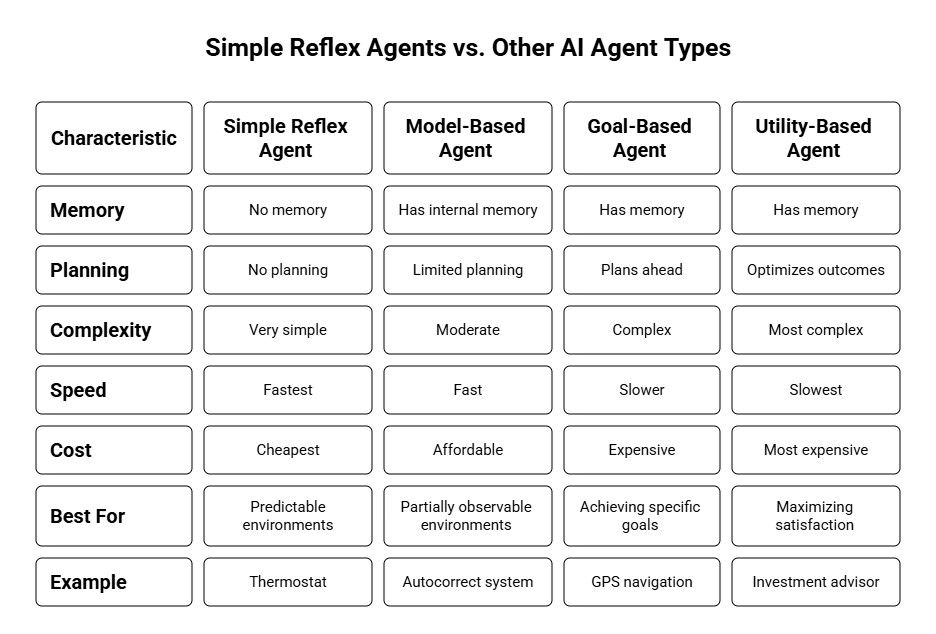
Simple Reflex Agents vs. Other AI Agent Types
Simple reflex agents are just one type of AI agent. Understanding where they fit in the AI agent hierarchy helps you choose the right approach for your needs.
When to Use Simple Reflex Agents
Simple reflex agents work best when:
- The environment is fully observable (you can see everything you need to know)
- Rules are clear and unchanging
- Speed matters more than intelligence
- The task is repetitive and straightforward
- Cost is a major concern
For scenarios requiring coordination between multiple systems, consider exploring AI orchestration in multi-agent systems.
When NOT to Use Simple Reflex Agents
Avoid simple reflex agents when:
- The environment changes unpredictably
- You need to remember past events
- Complex decision-making is required
- The agent must learn and adapt over time
- Multiple goals need to be balanced
In these cases, you'll need more sophisticated approaches like single-agent vs. multi-agent systems or competitive vs. collaborative multi-agent systems.
The Advantages of Simple Reflex Agents
Despite their simplicity, these agents offer several powerful benefits:
1. Lightning-Fast Responses
Simple reflex agents react instantly because they don't need to think, plan, or analyze. They just match and act.
Why it matters: In safety-critical applications like fire sprinklers or emergency shutoffs, every millisecond counts. Response times average 0.001-0.005 seconds.
2. Extremely Reliable
Given the same input, a simple reflex agent will always produce the same output. This predictability is crucial for many applications.
Why it matters: You want your smoke detector to work the same way every single time—no surprises. Industry data shows 99.9% reliability rates for properly maintained reflex systems.
3. Very Low Cost
These agents require minimal computing power, no expensive sensors, and simple programming.
Why it matters: You can deploy thousands of simple agents for the cost of one complex AI system. Deployment costs are typically 70-85% lower than learning-based agents.
4. Easy to Build and Maintain
With straightforward if-then rules, anyone can understand how they work. Troubleshooting is simple, and updates are quick.
Why it matters: Businesses can implement solutions without hiring AI specialists or data scientists. Companies like Ruh AI leverage simple reflex logic in their AI SDR solutions for immediate response capabilities.
5. Minimal Power Consumption
Simple agents don't need powerful processors or constant internet connections, making them energy-efficient.
Why it matters: Battery-powered devices last longer, and operational costs stay low. Simple reflex devices consume 80-90% less power than machine learning-based alternatives.
The Limitations You Should Know
Simple reflex agents have significant constraints that make them unsuitable for many tasks:
1. No Memory or Learning
The agent can't remember what happened before or learn from experience. Each moment is brand new.
Impact: A robot vacuum that's a simple reflex agent might clean the same spot repeatedly while missing other areas because it doesn't remember where it's been.
Solution: For applications requiring memory, explore AI orchestration in multi-agent workflows which combine simple and complex agents.
2. Can't Handle Partial Information
If the agent can't fully observe the environment, it makes poor decisions based on incomplete data.
Impact: A simple reflex door might keep opening and closing in windy conditions because it mistakes blowing leaves for approaching people.
3. Zero Adaptability
When the environment changes or new situations arise, the agent fails unless someone manually updates its rules.
Impact: A temperature-based sprinkler system works great for fires but would waste water during a summer heatwave if not manually adjusted.
4. No Goal Pursuit
The agent only reacts to immediate stimuli, it can't work toward long-term objectives or make strategic trade-offs.
Impact: A simple traffic light can't adjust timing to reduce overall congestion; it just follows its fixed schedule regardless of traffic patterns.
5. Limited to Programmed Scenarios
If a situation wasn't anticipated when programming the rules, the agent doesn't know how to respond.
Impact: An automatic door programmed only for human heights might not detect small children or wheelchair users.
Code Example: Building a Simple Thermostat Agent
Here's a basic Python implementation showing how a simple reflex agent works:
class SimpleThermostat:
    def __init__(self, target_temp):
        # Set the desired temperature
        self.target_temperature = target_temp
        self.heater_on = False

    def sense_temperature(self, current_temp):
        """
        SENSOR: This function represents the sensor component.
        It reads and returns the current room temperature.
        In a real device, this would connect to a hardware sensor.
        """
        return current_temp

    def check_rules(self, current_temp):
        """
        RULES: This is the "brain" - the condition-action rules.
        It compares current temp to target and decides what to do.
        Simple IF-THEN logic determines the action.
        """
        if current_temp < self.target_temperature:
            # If it's too cold, turn heater on
            return "TURN_ON_HEATER"
        else:
            # If it's warm enough, turn heater off
            return "TURN_OFF_HEATER"

    def actuate(self, action):
        """
        ACTUATOR: This function executes the physical action.
        It controls the heater based on the decision made.
        In a real device, this would control actual hardware.
        """
        if action == "TURN_ON_HEATER":
            self.heater_on = True
            print("Heater turned ON")
        else:
            self.heater_on = False
            print("Heater turned OFF")

    def run(self, current_temp):
        """
        MAIN LOOP: This coordinates all components.
        1. Sense the environment (read temperature)
        2. Check rules (compare to target)
        3. Act (control heater)
        This is the complete sense-think-act cycle.
        """
        temp = self.sense_temperature(current_temp)
        action = self.check_rules(temp)
        self.actuate(action)
        print(f"Current: {temp}°F | Target: {self.target_temperature}°F")
Create a thermostat set to maintain 70°F
thermostat = SimpleThermostat(target_temp=70)
Test with different temperatures
print("Testing Simple Reflex Agent - Thermostat\n" + "="*40) thermostat.run(65) # Cold room - heater activates thermostat.run(72) # Warm room - heater turns off thermostat.run(68) # Cold again - heater reactivates
Output:
Testing Simple Reflex Agent - Thermostat
Heater turned ON Current: 65°F | Target: 70°F
Heater turned OFF Current: 72°F | Target: 70°F
Heater turned ON Current: 68°F | Target: 70°F
Key Observations:
- The agent responds instantly to each temperature reading
- It has no memory of previous temperatures
- The same input (e.g., 65°F) always produces the same output (heater ON)
- The logic is deterministic and predictable
This simple structure forms the foundation of billions of IoT devices worldwide. When scaled with AI orchestration, even simple agents can contribute to sophisticated automation systems.
Common Industries Using Simple Reflex Agents
Manufacturing and Factories
- Quality control: Sensors detect defective products on assembly lines
- Safety systems: Automatic shutdowns when dangerous conditions are detected
- Conveyor systems: Stop/start based on object presence
Industry stats: Manufacturing facilities using simple reflex automation report 25-40% reduction in workplace accidents, according to OSHA data.
Smart Homes
- Climate control: Thermostats, smart fans, automated blinds
- Security: Motion sensors, automatic locks, alarm triggers
- Lighting: Occupancy-based lighting, daylight sensors
Market growth: The smart home market, heavily reliant on simple reflex agents, is projected to reach $174 billion by 2025.
Retail and Commercial
- Automatic doors: Entry/exit systems in stores and offices
- Vending machines: Automated product dispensing
- Hand dryers: Activation based on hand detection
ROI data: Retailers implementing automated door systems see 15-20% improvement in customer entry rates and $1,200-2,000 annual energy savings per door.
Transportation
- Basic traffic signals: Fixed-timing traffic lights
- Parking barriers: Automatic gates at parking lots
- Railroad crossings: Barrier activation when trains approach
Healthcare
- Patient monitoring: Alert systems for abnormal vital signs
- Automatic sanitizers: Touch-free hand sanitizer dispensers
- Medical equipment: Automatic shutoffs for safety
Healthcare impact: Simple reflex monitoring systems help prevent 45,000 hospital-acquired infections annually in the U.S..
Business Applications
Companies are increasingly integrating simple reflex logic into complex systems. For instance, Ruh AI's SDR Sarah uses reflex-like responses for immediate acknowledgment of sales inquiries, then escalates to more sophisticated agents for qualification using frameworks like BANT, MEDDIC, and CHAMP.
Sales teams leveraging simple reflex automation in their multi-channel SDR strategies report 35-50% faster response times and improved sales success metrics.
The Future of Simple Reflex Agents
While AI advances toward more complex systems, simple reflex agents remain irreplaceable for specific applications:
Industry projections (2025-2030):
- IoT integration: Expected deployment of 75 billion IoT devices by 2030, with 60% utilizing reflex-based logic
- Energy efficiency: Projected $120 billion in global energy savings through automated reflex systems
- Cost reduction: Manufacturing costs for reflex-based devices expected to drop 40% by 2028
Hybrid approaches: The future lies in combining simple reflex agents with sophisticated AI. Organizations using hierarchical agent systems achieve the best of both worlds—instant reflex responses for simple tasks and intelligent decision-making for complex scenarios.
Companies exploring AI development can leverage simple reflex agents as building blocks within larger, multi-agent architectures. The Ruh AI Work Lab demonstrates how combining simple and complex agents creates robust, scalable automation solutions.
Conclusion
Simple reflex agents prove that AI doesn't need to be complex to be effective. These straightforward systems—responding to immediate stimuli with pre-programmed rules—power billions of devices that make our lives easier, safer, and more efficient every single day.
Key points to remember:
- Simple reflex agents operate on instant "if-then" logic without memory or learning capabilities
- They excel in predictable, fully observable environments where speed and reliability matter most
- Real-world applications span from** thermostats and automatic doors** to safety systems and smart home devices
- Their limitations no memory, no learning, no adaptability make them unsuitable for complex, dynamic scenarios
- Industry data shows 60%+ of basic automation systems rely on reflex logic, generating billions in cost savings
- The future combines reflex agents with sophisticated AI in hybrid, multi-agent architectures
Whether you're building IoT devices, implementing industrial automation, or designing smart home solutions, understanding simple reflex agents is foundational knowledge. They may be the simplest form of AI, but their impact on modern automation is immeasurable.
For businesses looking to implement intelligent automation, the journey often starts with reflex-based responses and evolves toward more sophisticated multi-agent collaboration. Learn more about AI implementation strategies and explore cutting-edge agent-based solutions at Ruh AI or dive deeper into agent system architectures on the Ruh AI blog.
Ready to implement AI agents in your organization? Contact Ruh AI's team to discover how combining simple reflex logic with advanced AI can transform your operations.
Frequently Asked Questions
What is a simple reflex agent in simple words?
Ans: A simple reflex agent is like an automatic machine that follows basic "if this happens, then do that" rules. It reacts to what's happening right now without thinking about the past or future. A thermostat is a perfect example it just checks the temperature and turns heating on or off based on simple rules. These agents respond in less than 0.005 seconds and require no training or complex programming.
What is the difference between simple reflex agent and model-based agent?
Ans: A simple reflex agent only looks at the current moment and follows direct rules. A model-based agent, however, keeps track of what's happening over time and has a "mental model" of the world. For example, a simple reflex vacuum just cleans when it detects dirt, but a model-based vacuum remembers which rooms it has already cleaned. Model-based agents are typically 3-5 times more expensive but offer significantly better performance in complex environments.
What are the 7 types of AI agents?
Ans: The main types of AI agents are: Simple Reflex Agents, ** Model-Based Reflex Agents**, Goal-Based Agents, Utility-Based Agents, and Learning Agents. Some classifications also include Hierarchical Agents and Multi-Agent Systems, bringing the count to seven. Understanding these types helps in choosing the right approach, learn more about hierarchical agent systems and multi-agent AI collaboration.
What is an example of a simple reflex?
Ans: Common examples include: automatic doors opening when you approach (deployed in millions of commercial buildings globally), lights turning on when motion is detected (saving 30-50% energy), thermostats activating heat when temperature drops, smoke detectors sounding alarms when smoke is sensed, and vending machines dispensing products when correct payment is received. These applications save businesses and consumers billions annually in energy costs and operational efficiency.
Can simple reflex agents learn?
Ans: No, simple reflex agents cannot learn or adapt on their own. They only follow pre-programmed rules. To change their behavior, a human must manually update their rules. Learning agents are a different type of AI that can improve through experience. If your application requires adaptation and learning, explore more advanced architectures discussed in AI orchestration for multi-agent workflows.
How fast do simple reflex agents respond?
Ans: Simple reflex agents respond in 0.001 to 0.005 seconds on average—essentially instantaneous for human perception. This speed advantage makes them ideal for safety-critical applications like emergency shutoffs, fire suppression systems, and automated safety mechanisms where delay could mean the difference between safety and disaster.
Are simple reflex agents used in modern AI systems?
Ans: Yes, absolutely. While AI has advanced dramatically, simple reflex agents remain foundational. According to industry data, 60% of industrial automation and over 75% of IoT devices incorporate reflex-based logic. Modern AI systems often combine simple reflex agents with more sophisticated components in multi-agent architectures to achieve both speed and intelligence.
What's the biggest advantage of simple reflex agents?
Ans: The biggest advantage is their reliability and predictability. They produce the same output every time for the same input, with 99.9% reliability rates when properly maintained. This consistency is crucial for safety systems, regulatory compliance, and applications where unpredictable behavior could be dangerous or costly.