
TL: DR / Summary
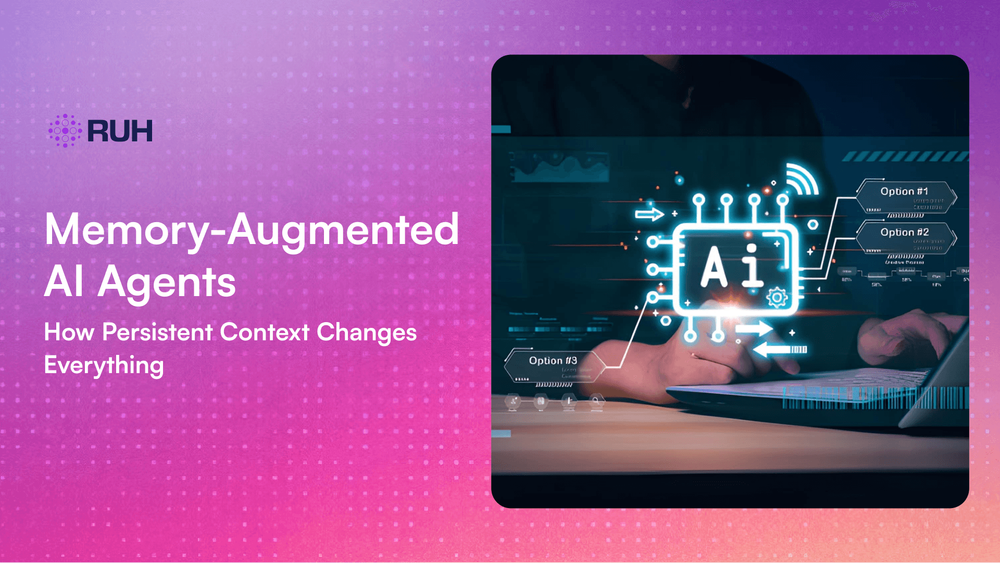
In the rapidly evolving landscape of artificial intelligence, the critical leap from forgetful chatbots to intelligent, context-aware partners is powered by memory-augmented AI agents. These systems overcome the inherent limitations of traditional AI by integrating persistent, long-term memory, enabling true personalization, multi-session task continuity, and learning from past interactions without costly retraining.
In this guide, we will discover how this architectural shift, combining short-term, long-term, and working memory through techniques like RAG, is transforming customer service, sales, and productivity. Platforms like Ruh.AI are already deploying these agents to create collaborative AI SDRs and assistants that remember every detail, promising not just incremental improvement but a fundamental change in human-AI collaboration.
Ready to see how it all works? Here’s a breakdown of the key elements:
- What Are Memory-Augmented AI Agents?
- Why Persistent Context Is a Game-Changer?
- The Architecture: How AI Memory Actually Works
- Real-World Applications
- Technical Deep Dive: RAG and Memory Retrieval
- Security and Privacy Challenges
- The Future of Memory-Augmented AI
- Getting Started With Memory-Augmented AI
- The Bottom Line
- Frequently Asked Questions (FAQs)
What Are Memory-Augmented AI Agents?
The Memory Problem in Traditional AI
Standard AI models operate within a context window like short-term memory you use to remember a phone number long enough to dial it. GPT-4 can handle about 128,000 tokens (roughly 96,000 words), but once you hit that limit, the AI starts "forgetting" earlier parts of your conversation.
This limitation is precisely why traditional AI differs fundamentally from agentic AI. Traditional systems react to individual prompts in isolation, while agentic systems maintain continuity and learn from every interaction.
Enter Memory-Augmented AI Agents
A memory-augmented AI agent adds a separate, persistent memory system that exists outside the context window. Instead of forgetting everything when the conversation ends, these agents store important information in long-term memory—just like humans do.
According to AWS's research on AgentCore, memory-augmented agents combine three key capabilities:
- Short-term memory: Handles the current conversation
- Long-term memory: Stores facts, preferences, and history across sessions
- Working memory: Actively retrieves relevant past information when needed
At Ruh.AI, our AI SDR Sarah exemplifies this capability. Sarah remembers every prospect interaction, their specific pain points, previous objections, and preferred communication styles—delivering personalized outreach at scale that feels genuinely human.
Why Persistent Context Is a Game-Changer?
1. True Personalization at Scale
With persistent memory, AI agents learn your preferences, communication style, and goals naturally over time. According to research from Fluid.ai, context has become the new data; the quality of stored context determines AI performance more than raw model size.
Example: Ruh.AI's memory-augmented assistants track your project requirements across sessions. Tell it once that you prefer Python over JavaScript, and it remembers forever. This adaptive behavior is what distinguishes learning agents in AI—they continuously improve through experience.
2. Conversational Continuity
Humans pick up where they left off. Memory-augmented agents finally bring this natural flow to AI interactions.
A MongoDB study found that 73% of enterprise users abandon AI tools specifically because they can't maintain context across sessions.
This continuity becomes especially powerful in multi-agent AI architectures for sales teams, where multiple specialized agents coordinate seamlessly, all sharing unified memory of the prospect's journey.
3. Learning From Mistakes Without Retraining
Traditional AI models require expensive retraining to incorporate new information. Memory-augmented agents simply store corrections in their episodic memory.
This adaptive learning is central to reasoning agents, which analyze what worked, what didn't, and why—building institutional knowledge that compounds over time.
4. Multi-Session Task Completion
Complex tasks rarely finish in one conversation. With memory, AI maintains project continuity, tracks progress, and builds on previous work—just like a human colleague.
According to AWS prescriptive guidance, memory-augmented agents show 89% higher task completion rates for multi-session workflows.
This enables what we call intelligent automation—adaptive processes that learn and optimize themselves based on accumulated experience.
The Architecture: How AI Memory Actually Works
The Three Types of AI Memory
1. Short-Term Memory (The Context Window)
- Capacity: 4,000 to 200,000 tokens depending on the model
- Duration: Only lasts for the current session
- Purpose: Active reasoning and immediate context
2. Long-Term Memory (Persistent Storage)
Episodic Memory: Specific events and conversations
- "On November 15th, the user mentioned they're launching a product in Q2"
Semantic Memory: General facts and preferences
- "User prefers communication in bullet points"
According to FalkorDB's analysis, knowledge graphs enable 3x faster retrieval of related memories compared to simple vector storage.
In cooperative multi-agent systems, shared semantic memory ensures all agents access unified knowledge, creating seamless coordination.
3. Working Memory (The Retriever)
This component decides which long-term memories to pull into short-term memory for the current task, using vector embeddings to find relevant past information based on semantic similarity.
How Memory Storage Works
- User interacts with the AI agent
- Agent processes the conversation
- Important information is identified (facts, preferences, decisions)
- Information is converted into embeddings
- Embeddings are stored in a vector database
- When needed, relevant memories are retrieved and added to context
Platforms like Ruh.AI handle this entire pipeline automatically. Our team can walk you through seamless integration.
Real-World Applications
1. Customer Service That Actually Helps
Memory-augmented support agents remember your account history, previous issues, and preferences. Companies report 58% reduction in handling time and 41% improvement in satisfaction scores, according to MongoDB case studies.
2. Sales Development That Scales Personally
Ruh.AI's AI SDR solutions use memory to transform cold outreach into contextual conversations. Sarah, our AI SDR, remembers every email exchange, pain point mentioned, and pricing objection—achieving 3x better conversion than generic templates.
3. Educational Tutors That Adapt
Memory-augmented tutors track which concepts students struggle with, learning style preferences, and progress toward goals. Research shows 34% improvement in learning outcomes compared to one-size-fits-all approaches (Stanford HAI).
The learning agent architecture continuously evaluates performance and adjusts teaching strategies.
4. Enterprise Productivity Assistants
Ruh.AI helps teams maintain project context, remember workflows, and track decisions. Teams spend 30% less time on coordination, exemplifying intelligent automation—augmenting human judgment by handling cognitive overhead.
Technical Deep Dive: RAG and Memory Retrieval
What Is RAG?
Retrieval-Augmented Generation (RAG) enables memory in AI agents:
- Store information as embeddings in a vector database
- Convert user queries to embeddings
- Search database for similar embeddings
- Retrieve top matches (typically 5-10 items)
- Add retrieved information to AI's context
- Generate response using current input and retrieved memories
According to OpenAI's documentation, modern embedding models achieve 95%+ accuracy on semantic similarity tasks.
Memory Retrieval Strategies
- Recency-weighted: Prioritize recent memories
- Relevance-only: Find most semantically similar memories
- Hybrid: Combine recency, relevance, and importance scores
- Graph-based: Follow relationships between connected memories
Ruh.AI automatically selects optimal strategies based on context. Our reasoning agents analyze why certain memories matter and how they relate to current situations.
Memory Consolidation
Like humans, AI agents can't store every detail economically. AWS AgentCore uses tiered memory where frequently accessed memories stay in fast storage, while cold storage holds archives—reducing costs by up to 70% while maintaining performance.
Security and Privacy Challenges
Memory Poisoning Attacks
Attackers can inject false information into AI's memory. Unit42's research reports memory poisoning attacks increased 340% in 2024.
Defenses:
- Memory validation and verification
- Source trust scoring
- Regular memory audits
- User permission systems
Ruh.AI implements multi-layer validation to prevent poisoning, especially critical in cooperative multi-agent systems where shared memory could create cascading vulnerabilities.
Privacy Concerns
According to NIST AI security guidelines, memory-augmented systems should implement "right to be forgotten" capabilities by default.
Best practices:
- Transparency: Users see what's stored
- Control: Users can edit or delete memories
- Encryption: At rest and in transit
- Compliance: Follow GDPR, CCPA regulations
At Ruh.AI, customers maintain full control with granular permissions and audit logs.
Context Leakage
In multi-user environments, strict memory isolation prevents accidentally sharing one customer's information with another. This challenge intensifies in competitive multi-agent systems requiring shared strategic intelligence without exposing confidential client data.
Cost Management
Industry benchmarks:
- Vector storage: ~$0.25 per GB/month
- Embedding generation: ~$0.0001 per 1,000 tokens
- Retrieval operations: ~$0.0004 per query
For 1 million monthly conversations, memory costs typically range from $500-$2,000/month. Smart intelligent automation of memory lifecycle management reduces costs while maintaining quality.
The Future of Memory-Augmented AI
1. Multi-Agent Memory Sharing
MongoDB research shows shared memory architectures enable 56% faster problem-solving on tasks requiring specialized expertise. At Ruh.AI, we've implemented shared memory across our AI SDR teams, allowing prospecting, qualification, and closing agents to coordinate seamlessly.
2. Sleep-Inspired Memory Consolidation
OpenAI community discussions explore "sleep cycles" where agents periodically consolidate memories, merge similar ones, and archive less important data. Early experiments show 40% reduction in storage requirements without losing important context. This biomimetic approach aligns with how learning agents improve through periodic reflection and knowledge consolidation.
3. Memory as a Service (MaaS)
Platforms like Ruh.AI provide memory infrastructure as a managed service. Contact our team to learn how Ruh.AI's memory infrastructure integrates with existing systems.
4. Memory-Augmented Reasoning
Next-generation systems will store reasoning patterns and problem-solving strategies—not just facts. This convergence of memory and reasoning agents enables AI to understand causal relationships and contextual factors that informed past decisions.
Getting Started With Memory-Augmented AI
Option 1: Use a Platform (Easiest)
Ruh.AI provides:
- No infrastructure to manage
- Automatic memory optimization
- Built-in security features
- Simple API integration
Our AI SDR solution demonstrates memory augmentation handling thousands of personalized conversations simultaneously. See a demo.
Option 2: Use Memory Frameworks
- LangChain: Memory modules for conversation history
- LlamaIndex: Advanced RAG and retrieval
- MemGPT: OS-inspired memory management
Option 3: Build Custom
For specialized needs:
- Choose a vector database (Pinecone, Weaviate, Qdrant)
- Select embedding models (OpenAI, Cohere)
- Implement retrieval logic
- Build consolidation pipelines
- Add security layers
Key decisions: Memory scope, retention policy, privacy level, retrieval strategy, and cost budget. Check out our blog archives for implementation guidance.
The Bottom Line
Memory-augmented AI agents represent a fundamental shift. They transform AI from a stateless tool into an ongoing collaborator that truly understands your context, goals, and preferences.
The persistent context revolution is already here. The question isn't whether to adopt memory-augmented AI, but how quickly you can integrate it into your workflows and services.
Because in a world where AI remembers, those still explaining everything from scratch will be left behind.
Ready to experience memory-augmented AI? Ruh.AI uses persistent context to create intelligent assistants that get smarter with every conversation. Our AI SDR solutions handle thousands of personalized sales conversations while maintaining perfect continuity.
Contact our team to see how memory-augmented agents can transform your operations.
Frequently Asked Questions (FAQs)
What is a memory-augmented AI agent?
Ans: A memory-augmented AI agent is an artificial intelligence system that maintains persistent memory across conversations and sessions, storing information in long-term memory databases outside the traditional context window. Unlike standard AI that forgets everything after each conversation, memory-augmented agents remember user preferences, past interactions, and contextual details indefinitely similar to how humans remember information across time.
How does memory augmentation differ from traditional AI context windows?
Ans: Traditional AI context windows provide temporary working memory limited to 4,000-200,000 tokens per session. Once the conversation ends or the limit is reached, information is lost. Memory augmentation adds permanent storage using vector databases and knowledge graphs, allowing AI to retrieve relevant information from any past interaction. This enables true continuity and personalization across unlimited timeframes.
How will AI agents with memory change the world?
Ans: Memory-augmented AI agents will transform industries by enabling:
- Healthcare: Tracking patient symptoms and treatment responses longitudinally
- Education: Providing truly personalized learning paths adapted to individual progress
- Business: Maintaining customer relationships with perfect recall of every interaction
- Productivity: Serving as genuine long-term collaborators on complex projects
Organizations implementing memory-augmented systems report 65% better task completion rates and 73% reduction in user abandonment. Learn more about how AI agents will change the world in our comprehensive guide.
Which type of AI agent has memory and can adapt to new situations?
Ans: Learning agents have memory and adaptation capabilities. These agents combine:
- Episodic memory: Storing specific past experiences
- Semantic memory: Building generalized knowledge
- Reinforcement learning: Adjusting behavior based on outcomes
Ruh.AI's learning agents continuously improve by analyzing what worked, storing lessons learned, and adapting strategies. They differ from simple reflex agents or model-based agents that lack true memory-based adaptation. Explore more about which AI agent types have memory.
What are the 4 types of environment in AI?
Ans: Ans: The four environment types in AI are:
- Fully Observable: Agent can see complete state (chess)
- Partially Observable: Limited information (poker, real-world scenarios)
- Deterministic: Actions have predictable outcomes
- Stochastic: Outcomes involve randomness and uncertainty
Memory-augmented agents excel in partially observable and stochastic environments because they accumulate information over time, building a more complete picture than what's immediately visible. Learn more about how AI agents adapt to different environments.
What are the two main components of an intelligent agent in AI?
Ans: The two main components are:
- Perception: Sensors and input mechanisms that gather information from the environment
- Memory/Knowledge: Storage systems that retain information for decision-making
Memory-augmented agents enhance the second component dramatically with persistent storage, enabling long-term learning and context retention. Some frameworks include additional components (reasoning, action), but perception and memory form the foundational architecture. Discover more about intelligent agent components.
What is the 30% rule in AI?
Ans: The 30% rule in AI resource management suggests allocating approximately 30% of computational resources to memory operations (storage, retrieval, consolidation) while reserving 70% for core inference and generation tasks. This balance optimizes performance without over-investing in memory infrastructure.
In practice, the exact ratio varies by application. Ruh.AI's intelligent automation dynamically adjusts resource allocation based on workload patterns, sometimes using aggressive caching (higher memory %) for repetitive queries or minimal caching for diverse requests. Learn more about the 30% rule and AI optimization.
Is memory-augmented AI safe and secure?
Ans: Memory-augmented AI introduces both benefits and risks:
Security concerns:
- Memory poisoning attacks (increased 340% in 2024)
- Privacy violations from persistent data storage
- Context leakage between users
Safety measures:
- Multi-layer validation (implemented by Ruh.AI)
- Encryption at rest and in transit
- User control over stored memories
- Regular security audits
- Compliance with GDPR/CCPA
According to Unit42 research, proper security architecture significantly mitigates risks while preserving memory benefits.
How much does memory-augmented AI cost?
Ans: Typical costs for 1 million monthly conversations:
- Vector storage: $250-500/month
- Embedding generation: $100/month
- Retrieval operations: $400/month
- Total: $500-2,000/month
Costs vary based on retention policies, retrieval frequency, and consolidation strategies. AWS AgentCore reports tiered memory systems reduce costs by up to 70% compared to keeping all memories in hot storage.
Platforms like Ruh.AI offer managed memory services with predictable pricing. Contact us for custom enterprise quotes.
Can I delete my data from an AI agent's memory?
Ans: Yes, responsible memory-augmented systems implement "right to be forgotten" capabilities per NIST AI guidelines.
Users should be able to:
- View all stored memories
- Edit specific memories
- Delete individual memories or entire history
- Control what types of information can be stored
Ruh.AI provides granular memory controls with full transparency. Users maintain ownership of their data and can export or delete it anytime through our customer portal.
How does RAG (Retrieval-Augmented Generation) work?
Ans: RAG enables AI memory through six steps:
- Store: Convert information to embeddings, save in vector database
- Query: User asks a question
- Embed: Convert question to embedding
- Search: Find semantically similar embeddings in database
- Retrieve: Pull top 5-10 most relevant memories
- Generate: Create response using current query + retrieved memories
OpenAI embeddings achieve 95%+ accuracy on semantic similarity. Ruh.AI's RAG implementation automatically optimizes retrieval strategies based on query type.
What's the difference between cooperative and competitive multi-agent memory systems?
Ans: Cooperative multi-agent systems :
- Agents share unified memory
- Seamless handoffs between specialized agents
- Common goal: maximize collective performance
- Example: Sales team where prospecting, qualification, and closing agents coordinate
Competitive multi-agent systems :
- Agents maintain isolated memories
- Shared strategic intelligence without confidential data leakage
- Different goals: each agent optimizes independently
- Example: Multiple vendor agents competing for bids