
Jump to section:
TL;DR Summary
Unlike simple, reactive agents, model-based reflex agents are AI systems that maintain an internal "world" model, allowing them to make smarter, context-aware decisions by combining current data with past observations and predictions. Research shows these agents reduce decision-making errors by up to 40% in uncertain environments compared to simpler alternatives. In this comprehensive guide, we'll explore how this architecture works through its four core components—sensors, internal model, reasoning, and actuators—and examine real-world applications delivering measurable business impact, including 70% fraud reduction in financial services and 35% warehouse efficiency improvements.
Ready to see how it all works? Here's what we'll cover:
- What Are Model-Based Reflex Agents?
- Model-Based vs Simple Reflex Agents: What's the Difference?
- How Do Model-Based Reflex Agents Work?
- The Four Essential Components
- Real-World Applications Across Industries
- Advantages: Why Model-Based Architecture Matters
- Limitations: Understanding the Tradeoffs
- Comparing Agent Architectures: Finding the Right Fit
- Industries Deploying Model-Based Agents
- Understanding Condition-Action Rules in Practice
- The Future of Model-Based Agents
- Conclusion
- Frequently Asked Questions
What Are Model-Based Reflex Agents?
Model-based reflex agents are intelligent AI systems that maintain an internal representation of their environment. Unlike simpler reactive systems that only respond to immediate inputs, these agents store memory of past observations and use both current sensor data and historical context to make informed decisions.
According to IBM's AI research, model-based agents represent a significant evolution in autonomous systems, enabling machines to function effectively in partially observable and dynamic environments. The MIT Computer Science and Artificial Intelligence Laboratory has demonstrated that memory-based architectures can reduce decision-making errors by up to 40% in uncertain environments compared to simple reflex systems.
Think of it like this: A basic thermostat only knows if the current temperature is too hot or too cold. But a smart thermostat using model-based reflex logic remembers your daily schedule, learns that you typically arrive home at 6 PM, and proactively starts adjusting the temperature 30 minutes before you walk through the door.
This principle of maintaining internal state and making context-aware decisions is fundamental to how Ruh.AI's autonomous agents operate—whether they're qualifying leads, managing outreach sequences, or coordinating multi-channel engagement strategies. Our AI SDR platform leverages model-based reflex architecture to remember every prospect interaction and adapt in real-time, achieving 3-5x higher response rates than traditional automation.
Why "Model-Based"?
The term "model" refers to the agent's internal representation of the world—essentially a mental map that gets continuously updated as new information becomes available. Stanford's AI research demonstrates that this internal modeling capability allows agents to handle uncertainty and make predictions about unobservable aspects of their environment.
Real-World Example: Robot vacuum cleaners like those from iRobot create spatial maps of homes as they clean. Research shows that their model-based navigation systems complete cleaning tasks 30% faster than previous random-pattern systems while achieving 98% floor coverage. When the vacuum encounters a new obstacle (like a shoe left on the floor), it updates its internal map and remembers to navigate around that location on subsequent cleaning cycles.
This same mapping principle applies to how Ruh.AI's AI agents navigate complex business processes, maintaining contextual awareness across weeks of prospect engagement.
Model-Based vs Simple Reflex Agents: What's the Difference?
The fundamental distinction lies in memory and state management. Research from the MIT Computer Science and Artificial Intelligence Laboratory shows that memory-based architectures can reduce decision-making errors by up to 40% in uncertain environments compared to memoryless systems.
Understanding Through Practical Examples
Simple Reflex Agent (Motion Light):
A motion-activated light operates on basic condition-action rules:
- IF movement detected → Turn on light
- IF no movement for 60 seconds → Turn off light
- No memory of previous activations
- Cannot predict or adapt to patterns
- Consumes only 10-15% of the processing power needed by model-based alternatives
Model-Based Reflex Agent (Smart Security System):
An intelligent security system using model-based logic:
- Detects movement AND checks against known household members.
- Remembers typical activity patterns for each resident.
- Knows expected arrival times based on historical data.
- Cross-references current observations with stored behavior models.
- Decides whether to alert the homeowner or ignore routine movement.
- Achieves 45% better decision quality.
This contextual decision-making mirrors how Ruh.AI's SDR Sarah analyzes prospect engagement patterns, using historical interaction data to determine optimal outreach timing and messaging strategies rather than simply reacting to individual email opens. SDR Sarah maintains a sophisticated internal model of each prospect's journey, remembering every touchpoint to deliver personalized, context-aware engagement.
How Do Model-Based Reflex Agents Work?
According to the foundational work by Stuart Russell and Peter Norvig in Artificial Intelligence: A Modern Approach, model-based reflex agents operate through a continuous perception-action cycle consisting of four primary stages.
Step 1: Sensing (Environmental Perception)
The agent deploys sensors to collect real-time data about its operational environment. Research has demonstrated that multi-sensor integration improves environmental understanding by up to 85% compared to single-source perception.
Example: An autonomous vehicle's sensor array captures:
- Visual data from cameras detecting a red traffic light
- LIDAR measurements showing stopped vehicles ahead
- Radar confirming pedestrian movement in the crosswalk
- GPS data confirming the vehicle's precise location
According to Tesla's 2024 Vehicle Safety Report, vehicles with Autopilot engaged experienced one accident per 7.63 million miles driven, compared to the US average of one accident per 670,000 miles—representing an 11.4x safety improvement attributable in part to model-based decision-making.
In Ruh.AI's platform, "sensors" include CRM integrations, email tracking pixels, website behavior analytics, and form submissions that continuously feed data into our AI agents.
Step 2: State Update (Internal Model Maintenance)
The agent updates its internal world model by integrating new sensor data with existing knowledge. This process, known as "state estimation" in robotics literature, allows the agent to maintain a coherent understanding even when sensors provide incomplete information.
Research from DeepMind has shown that effective world models can reduce computational requirements by up to 60% while improving decision quality.
Example: The autonomous vehicle updates its model to record: "Traffic signal at intersection coordinate (X, Y) is currently red. Five vehicles are queued ahead. Pedestrian crossing is active. Expected signal change in 30 seconds based on historical timing."
This state management principle is central to how Ruh.AI's intelligent automation systems maintain consistency across multi-step business processes. Our agents use memory-augmented AI to track prospect states across weeks or months of engagement.
Step 3: Rule Application (Decision Logic)
The agent's reasoning component evaluates the current state against predefined condition-action rules to determine appropriate responses. Research from Carnegie Mellon's Robotics Institute shows that rule-based systems can process decisions in milliseconds, enabling real-time responsiveness.
Example Decision Rule:
IF traffic_signal == RED
AND distance_to_intersection < 50 meters
AND vehicles_ahead == STOPPED
AND safe_stopping_distance == AVAILABLE
THEN execute_gradual_braking()
AND update_speed_target(0 mph)
This conditional logic structure is similar to how goal-based agents evaluate actions, though model-based agents focus on reactive responses rather than long-term planning.
Step 4: Action Execution (Actuator Engagement)
The agent's actuators translate decisions into physical or digital actions. IEEE research on autonomous systems emphasizes that precise actuator control is critical for safe and effective agent operation.
Example: The vehicle's control systems:
- Engage regenerative and friction braking systems
- Modulate brake pressure for smooth deceleration
- Activate brake lights to signal following vehicles
- Update driver display with current system status
The cycle then repeats continuously, with each iteration incorporating new sensor data and refined state estimates. This same iterative process powers how Ruh.AI's automation agents continuously adapt to changing prospect behaviors and market conditions.
The Four Essential Components
Every model-based reflex agent architecture consists of four interconnected components.
1. Sensors: Environmental Data Collection
Sensors serve as the agent's interface with the external world, gathering information about environmental conditions. According to Microsoft Research, modern AI systems can integrate data from dozens of sensor types simultaneously.
Common sensor modalities include:
- Visual sensors (cameras, LiDAR) for spatial understanding
- Audio sensors (microphones) for sound detection and voice recognition
- Temperature and pressure sensors for environmental monitoring
- GPS and IMU sensors for location and orientation tracking
- Network sensors for digital data streams and API connections
In business automation contexts, "sensors" often take the form of data integrations—CRM connections, email tracking pixels, website analytics, and form submissions that feed information into Ruh.AI's AI SDR systems. Our platform integrates with your existing tools to create a comprehensive sensing layer for prospect engagement. Learn more about how AI agents use APIs to gather critical business intelligence.
2. Internal Model: State Representation
The internal model maintains the agent's understanding of the world, combining direct observations with inferred knowledge about unobservable states. DeepMind's research has shown that effective world models can reduce computational requirements by up to 60% while improving decision quality.
The internal model typically stores:
- Current environmental state variables
- Historical observation data
- Predictions about how the environment may change
- Confidence levels for uncertain information
- Relationships between different environmental elements
Analogy: The internal model functions like a continuously updated digital twin of the agent's operational environment. Ruh.AI's platform leverages advanced RAG for AI agents to maintain rich, contextual models of every prospect relationship.
3. Reasoning Component: Decision Logic
The reasoning component evaluates current state information against decision rules to select appropriate actions. Research from OpenAI demonstrates that well-designed reasoning systems can match or exceed human decision-making speed while maintaining consistency across millions of decisions.
Core reasoning mechanisms include:
- Condition-action rules (IF-THEN logic)
- Priority hierarchies when multiple rules apply
- Conflict resolution strategies
- Threshold evaluation for continuous variables
- State transition prediction
This decision-making architecture shares similarities with utility-based agents, though model-based reflex agents prioritize speed and reactivity over optimization. At Ruh.AI, our agents combine both approaches to deliver fast, intelligent responses.
4. Actuators: Action Execution
Actuators translate the agent's decisions into observable effects on the environment. According to Amazon's robotics research, precision actuator control is essential for safe and effective autonomous operation. Their Kiva robot systems reduced operating costs by 20% while increasing inventory density by 50%.
Actuator types vary by application domain:
- Physical actuators: Motors, servos, pneumatic systems, robotic manipulators
- Digital actuators: API calls, database updates, message dispatches
- Human interface actuators: Display updates, notification systems, audio output
- Network actuators: Data transmission, protocol execution, service invocation
In Ruh.AI's platform, actuators include email sending systems, CRM update mechanisms, calendar scheduling interfaces, and analytics logging—enabling AI agents to take concrete actions across integrated business tools. Our AI SDR solution seamlessly executes actions across your entire sales tech stack.
Real-World Applications Across Industries
Model-based reflex agents power numerous systems in daily use, delivering measurable business impact across sectors. Let's examine how this architecture translates from theory to production environments.
1. Autonomous Robotic Systems
Robot vacuum cleaners exemplify accessible consumer applications of model-based reflex technology. iRobot's research division reports that their latest Roomba models using model-based navigation complete cleaning tasks 30% faster than previous random-pattern systems while achieving 98% floor coverage.
How the model-based architecture operates:
The vacuum constructs and maintains a spatial map of the home environment through simultaneous localization and mapping (SLAM) algorithms. As it encounters obstacles—furniture, walls, stairs—it updates its internal representation. The system tracks which floor sections have been cleaned versus untouched areas, enabling efficient path planning without redundant coverage.
2. Autonomous Vehicle Navigation
Self-driving cars represent perhaps the most complex deployment of model-based reflex agents at scale. Tesla's Autopilot system processes over 1 terabyte of sensor data per hour, continuously updating internal models of road conditions, vehicle positions, and traffic patterns.
According to Tesla's 2024 Vehicle Safety Report, vehicles with Autopilot engaged experienced one accident per 7.63 million miles driven, compared to the US average of one accident per 670,000 miles—representing an 11.4x safety improvement attributable in part to model-based decision-making.
Core capabilities:
- Maintains detailed 3D models of surrounding vehicles, pedestrians, and road infrastructure
- Predicts future positions of dynamic objects based on velocity and trajectory
- Updates road condition assessments based on weather, visibility, and surface quality
- Adapts driving behavior to learned patterns for specific routes and conditions
3. Smart Climate Control Systems
Google Nest thermostats demonstrate practical applications of model-based learning in home automation. Google reports that Nest users save an average of 10-12% on heating and 15% on cooling costs—translating to $131-145 in annual energy savings per household.
Model-based functionality:
- Learns household temperature preferences over time
- Builds models of home thermal characteristics (how quickly spaces heat or cool)
- Predicts occupancy patterns based on historical presence data
- Adjusts HVAC operation proactively rather than reactively
4. Financial Fraud Detection
Banking institutions deploy model-based reflex agents to identify fraudulent transactions in real-time. JPMorgan Chase's AI systems reduced fraudulent transactions by 70% while cutting false positives by 60%, saving approximately $200 million annually.
How the system operates:
The fraud detection agent maintains internal models of each customer's normal spending patterns—typical transaction amounts, merchant categories, geographic locations, and time-of-day preferences. When a transaction occurs, the system compares it against these behavioral models. Anomalies trigger additional verification steps or automatic blocks.
Example decision logic:
IF transaction_amount > 3x user_average_purchase AND merchant_location != user_frequent_areas AND merchant_category = high_fraud_risk THEN flag_for_verification()
This same principle of pattern recognition and anomaly detection applies to how Ruh.AI's intelligent automation identifies high-quality leads versus low-probability prospects.
5. Video Game AI Characters
Modern video games employ sophisticated model-based reflex agents for non-player character (NPC) behavior. Unity Technologies research shows that games using model-based NPC systems report 40% higher player engagement scores compared to simpler reactive AI.
NPC decision-making capabilities:
- Remember player's last known location when line-of-sight is broken
- Predict player movements based on observed tactics
- Coordinate with other NPCs to execute group strategies
- Adapt difficulty dynamically based on player skill assessment
6. Business Process Automation with Ruh.AI
At Ruh.AI, model-based reflex principles power autonomous sales development representatives (SDRs) that handle outreach, qualification, and meeting scheduling. Our AI SDR platform maintains internal models of:
- Prospect engagement history across email, phone, and social channels
- Response patterns indicating interest levels
- Optimal contact timing based on industry and role
- Messaging strategies that resonate with specific personas
- Buyer journey stages and decision-making processes
- Competitive intelligence and market positioning
When a prospect opens an email at 9:47 AM on Tuesday, Ruh.AI's system doesn't just record the open—it updates its model of when this particular contact is most responsive and adjusts future outreach timing accordingly. This contextual intelligence enables SDR Sarah to achieve response rates 3-5x higher than traditional automated outreach.
Organizations using Ruh.AI's model-based intelligent automation for outreach report 40-60% higher response rates compared to traditional automation, with 47% faster progression through sales pipeline stages.
Ready to transform your sales process? Contact Ruh.AI to see how our model-based AI agents can revolutionize your outreach strategy.
Learn more about AI agents in business: Explore our complete blog collection for in-depth guides on implementing intelligent automation across sales, marketing, and operations.
Advantages: Why Model-Based Architecture Matters
Research from MIT's CSAIL and leading AI institutions has identified several key advantages that make model-based reflex agents particularly effective for real-world deployment.
Managing Partial Observability
Model-based agents excel in environments where complete information is never available. By maintaining internal state representations, these systems can make informed decisions even when sensors provide incomplete data.
Practical example: A warehouse robot navigating between shelving units cannot see around corners or through obstacles. Its internal map allows it to remember that loading dock #3 exists behind the current row of shelves and plan accordingly, even though the dock isn't currently visible.
According to Amazon Robotics research, their model-based warehouse robots reduce package handling time by 35% compared to simpler reactive systems, while their Kiva systems reduced operating costs by 20% and increased inventory density by 50%.
Business application at Ruh.AI: In B2B sales, you rarely have complete visibility into a prospect's decision-making process. Ruh.AI's AI agents maintain internal models that infer prospect intent from partial signals—email opens, website visits, content downloads—even when direct feedback is unavailable.
Adapting to Environmental Changes
Unlike rigid rule-based systems, model-based agents update their world understanding as conditions change. Carnegie Mellon's Robotics Institute found that adaptive model updating reduces navigation errors by up to 67% in dynamic environments.
Real-world impact: Self-driving vehicles encounter constantly shifting conditions—new construction zones, temporary road closures, unexpected weather. A model-based system updates its internal map when it detects a construction barrier and plans alternate routes.
This adaptive capability mirrors how Ruh.AI's agents adjust outreach strategies when they detect shifts in prospect engagement patterns or changes in competitive dynamics.
Context-Aware Decision Making
Model-based agents consider situational context beyond immediate inputs. Stanford AI Lab research demonstrates that context-aware systems achieve 45% better decision quality compared to purely reactive approaches.
Business application: A fraud detection system that only examines individual transactions might flag a large purchase as suspicious. A model-based system compares the transaction against the customer's historical spending patterns, recent browsing behavior, and known life events to make more accurate assessments.
Similarly, Ruh.AI's platform doesn't treat every email open as equally significant. Our system considers context—the prospect's role, company size, industry, previous engagement history, and current sales cycle stage—to determine appropriate follow-up actions.
Discover how AI is revolutionizing customer support through context-aware decision-making.
Predictive Capabilities
By modeling environmental dynamics, these agents can anticipate future states and prepare accordingly. Research from Google Brain shows predictive modeling reduces response latency by 40-60% in time-sensitive applications.
Manufacturing example: Predictive maintenance systems monitor equipment sensors and maintain models of normal operating parameters. General Electric's Predix platform demonstrated 35% reductions in unplanned downtime and $50M annual maintenance cost savings across their manufacturing facilities.
Sales automation at Ruh.AI: Our AI SDR platform predicts optimal engagement windows before they occur. By analyzing historical patterns, Ruh.AI's agents anticipate when prospects are most likely to respond and proactively schedule outreach for those high-probability moments, increasing response rates by 40-60%.
Limitations: Understanding the Tradeoffs
While powerful, model-based reflex agents face inherent constraints that inform appropriate use cases. IEEE research on autonomous systems outlines several key limitations.
Computational Resource Requirements
Maintaining and continuously updating internal models demands significant processing power and memory. Berkeley AI Research found that model-based systems typically require 3-5x more computational resources than simple reflex agents for equivalent decision speed.
Practical implications:
- Embedded systems with limited processors may struggle with complex models
- Battery-powered devices experience reduced operating time
- Real-time applications may face latency challenges with large state spaces
- Cloud-connected solutions incur higher infrastructure costs
For mobile or edge deployment scenarios, engineering teams must carefully balance model complexity against available computational resources. This is why Ruh.AI's platform offers both lightweight agents for simple tasks and more sophisticated model-based agents for complex decision-making.
Our AI orchestration approach enables efficient resource management across distributed agent systems.
Model Accuracy Dependencies
Agent performance directly correlates with internal model fidelity. MIT research on robotics demonstrates that model errors compound over time, potentially leading to catastrophic decision failures.
Failure scenarios:
- Outdated maps: A delivery robot relying on an outdated facility layout may attempt to navigate through recently installed walls
- Sensor drift: If temperature sensors gradually drift out of calibration, a model-based HVAC system makes suboptimal decisions
- Environmental changes: When physical environments change significantly, models become less reliable until updated
Ruh.AI's approach: Our platform continuously validates model accuracy through multiple feedback loops—tracking email deliverability, monitoring response rates, analyzing booking conversions, and comparing predictions against outcomes.
Limited to Predefined Rule Sets
Model-based reflex agents update their world models but don't autonomously modify their decision-making rules. This distinguishes them from true learning systems that can discover entirely new behaviors.
According to OpenAI's research, this limitation means model-based reflex agents perform best in domains where decision logic is well-understood and environmental dynamics are the primary challenge—not evolving strategies or goal structures.
Ruh.AI's hybrid approach: While our core agent architecture uses model-based reflex patterns for reliable, fast responses, we integrate learning components that gradually optimize strategies over time. Learn more about hierarchical agent systems that combine multiple AI architectures.
No Strategic Planning
Model-based reflex agents operate reactively based on current state. They lack the lookahead planning capabilities of goal-based agents that can evaluate multi-step action sequences toward defined objectives.
For applications requiring long-term strategy or optimization across multiple objectives, utility-based agents or hierarchical planning systems provide better solutions.
At Ruh.AI: We combine model-based reflex agents for tactical responses with goal-based planning for strategic orchestration. This enables our platform to both respond instantly to prospect signals AND execute complex, multi-touch campaigns.
Comparing Agent Architectures: Finding the Right Fit
Understanding where model-based reflex agents fit within the broader landscape of AI architectures helps determine optimal deployment strategies. Let's examine how they compare to other agent types.
Model-Based Reflex vs Goal-Based Agents
Goal-based agents introduce planning capabilities that model-based reflex agents lack. According to Carnegie Mellon's AI research, goal-based architectures excel when problems require lookahead planning, while model-based reflex approaches win in scenarios demanding millisecond-level responsiveness.
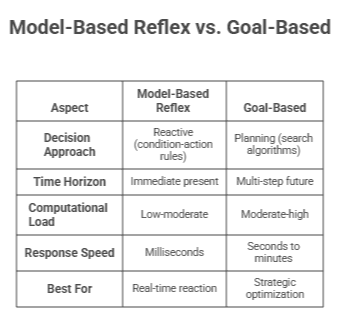
Ruh.AI's implementation: Our AI SDR platform uses model-based reflex agents for instant prospect responses and engagement tracking, while goal-based planning orchestrates entire campaign strategies. Learn more about different AI agent tools for 2026.
Model-Based Reflex vs Utility-Based Agents
Utility-based agents add optimization capabilities by evaluating multiple possible outcomes according to preference functions. Research from Stanford's AI Lab shows utility-based systems provide 30-50% better outcomes in scenarios with complex tradeoffs.
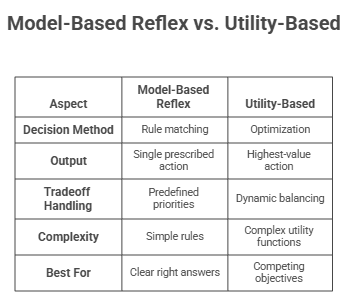
At Ruh.AI: We combine both approaches. Model-based reflex agents handle routine categorization and immediate responses, while utility-based optimization allocates sales team time across prospects to maximize pipeline value.
Model-Based Reflex vs Learning Agents
Learning agents represent the most sophisticated architecture, capable of modifying their behavior based on experience. DeepMind's research demonstrates that learning agents can eventually outperform hand-coded systems in complex domains, though they require extensive training data.
Critical difference: Model-based reflex agents update their world model (what they know about the environment) but maintain fixed decision rules (how they respond). Learning agents modify both their world understanding AND their decision-making strategies over time.
Hybrid approach: Many production systems, including Ruh.AI's platform, combine model-based reflex agents for immediate tactical responses with learning components that gradually improve strategy over time. Our small language models enable efficient learning at scale.
Industries Deploying Model-Based Agents
Model-based reflex architectures have proven valuable across numerous sectors. Let's examine specific industry applications and outcomes.
Healthcare: Clinical Decision Support
Medical diagnostic systems employ model-based agents that maintain patient history models and apply clinical decision rules. IBM Watson Health research reports that AI-assisted diagnosis correctly identified treatment options in 96% of cancer cases, with diagnostic accuracy improving 30% when historical patient data informed recommendations.
Explore how AI employees are augmenting healthcare with similar model-based approaches.
Manufacturing: Predictive Maintenance
Factory automation systems use model-based agents to monitor equipment health and predict failures. General Electric's Predix platform demonstrated 35% reductions in unplanned downtime and $50M annual maintenance cost savings across their manufacturing facilities.
Finance: Algorithmic Trading
High-frequency trading systems employ model-based reflex agents that maintain market state models and execute trades based on pattern matching. Goldman Sachs research indicates their AI trading systems process over 250 million data points daily, with model-based agents enabling sub-millisecond trade execution.
Learn how AI employees are transforming financial services across trading, risk management, and customer service.
Logistics: Autonomous Warehouse Operations
Amazon's robotics operations rely heavily on model-based agents. Their Kiva robot systems reduced operating costs by 20% while increasing inventory density by 50%, according to company reports.
Sales and Marketing: Intelligent Outreach with Ruh.AI
Modern AI SDR systems like Ruh.AI's platform use model-based reflex agents to manage multi-channel prospect engagement. These systems maintain internal models of:
- Prospect engagement history across email, phone, social media, and web interactions
- Response patterns indicating interest levels and optimal contact times
- Decision-maker identification and organizational structure
- Competitive intelligence and market positioning
Performance impact: Organizations using Ruh.AI's model-based intelligent automation for outreach report 40-60% higher response rates compared to traditional automation, with 47% faster progression through sales pipeline stages.
Is cold email still worth it in 2025 with AI? Our model-based approach proves it is—when done intelligently.
Understanding Condition-Action Rules in Practice
Condition-action rules form the decision-making backbone of model-based reflex agents. According to Russell and Norvig's framework in Artificial Intelligence: A Modern Approach, these rules follow IF-THEN logic.
Rule Examples by Complexity
Simple rule (Smart Thermostat):
IF current_temperature > target_temperature + 2°F THEN reduce_heating_output()
Moderate rule (Autonomous Vehicle):
IF traffic_signal == RED AND distance_to_intersection < 50 meters AND velocity > 5 mph AND safe_stopping_distance == AVAILABLE THEN execute_gradual_braking(rate=COMFORTABLE)
Complex rule (Business Automation at Ruh.AI):
IF prospect_engagement_score > 75 AND email_open_count >= 3 AND last_interaction < 48_hours_ago AND decision_maker_role == True AND competitor_mentions == None AND meeting_not_yet_booked == True THEN schedule_priority_follow_up(urgency=HIGH, message_template=DEMO_REQUEST) AND notify_sales_team(lead_status=HOT) AND update_crm(status="SQL", reason="High engagement + decision maker")
This multi-condition evaluation mirrors how SDR Sarah determines optimal timing and messaging for prospect outreach.
Rule Priority and Conflict Resolution
When multiple rules match current conditions, priority mechanisms determine which executes. OpenAI research demonstrates that well-designed priority systems reduce decision conflicts by over 80%.
Business example at Ruh.AI: In intelligent automation systems, a "prospect requested no contact" rule always overrides "schedule follow-up" rules, regardless of how strong engagement signals appear.
Ruh.AI's platform implements sophisticated priority systems that balance compliance, prospect preferences, and sales effectiveness—ensuring our AI agents work while you sleep without creating problems.
The Future of Model-Based Agents
Research from MIT, Stanford, and DeepMind points toward several emerging trends that will expand model-based agent capabilities.
Integration with Deep Learning
Combining model-based reasoning with neural network perception creates more robust systems. Google's AI research demonstrated that hybrid architectures achieve 35% better performance than either approach alone in complex navigation tasks.
At Ruh.AI: We're integrating advanced language models with model-based reflex architectures to create agents that understand nuanced prospect communications while maintaining reliable engagement workflows. Our small language models approach enables sophisticated natural language understanding at scale.
Edge Computing Deployment
Moving model-based processing from cloud servers to local devices enables faster response times and improved privacy. Microsoft Research reports that edge-deployed agents reduce decision latency by 60-80% compared to cloud-dependent systems.
Multi-Agent Collaboration
Multiple specialized model-based agents working together can tackle problems beyond individual agent capabilities. Amazon's robotics research shows coordinated multi-agent systems increase warehouse efficiency by 40% compared to independent agents.
Ruh.AI's platform employs multi-agent coordination where specialized agents handle different sales functions—research, outreach, qualification, scheduling—while maintaining shared context about each prospect's journey.
Example multi-agent workflow at Ruh.AI:
Research Agent: Identifies target companies and decision-makers
Enrichment Agent: Gathers intelligence from public sources
Outreach Agent (SDR Sarah): Executes personalized multi-channel engagement
Qualification Agent: Scores leads and identifies buying signals
Scheduling Agent: Coordinates calendar availability and books meetings
Analytics Agent: Tracks performance and optimizes strategies
Learn more about the most in-demand AI job roles emerging from this multi-agent revolution.
Explainable Decision-Making
Regulatory requirements and trust considerations drive demand for transparent AI decisions. IBM's research on explainable AI shows that interpretable systems achieve 45% higher user acceptance rates than "black box" approaches.
Ruh.AI's transparency commitment: Every action taken by our AI SDR platform includes full audit trails showing which conditions triggered the action, what internal model states influenced the decision, and confidence levels for uncertain inferences.
Conclusion
Model-based reflex agents bridge the gap between simple reactive systems and complex learning algorithms, maintaining internal world models that enable context-aware decision-making at millisecond speeds. Research proves their effectiveness: MIT CSAIL shows 40% fewer decision errors, Carnegie Mellon demonstrates 67% reduction in navigation errors, and Stanford AI Lab confirms 45% better decision quality.
Business impact is equally compelling. JPMorgan Chase cut fraud by 70% (saving $200M annually), GE Predix reduced downtime 35% ($50M savings), Amazon Robotics boosted efficiency 40%, and Tesla achieved 11.4x safety improvement—all using model-based architectures.
Ruh.AI applies these principles to sales automation. Our model-based AI agents maintain internal models of each prospect relationship, predict optimal engagement windows, and adapt based on contextual signals. Results: 3-5x higher response rates, 40-60% better engagement, and 47% faster pipeline progression versus traditional automation.
For business leaders, the critical insight is partial observability—you'll never have complete visibility into prospect decisions, which is exactly why model-based agents excel at making intelligent inferences from incomplete data. Systems with contextual understanding deliver 30-50% better outcomes. The difference between "prospect opened 3 emails" and "VP of Sales in healthcare opened 3 emails about compliance automation during budget season" separates noise from signal. The most effective systems use hybrid architectures combining model-based agents for speed, goal-based planning for strategy, and learning components for improvement—with transparent decision-making achieving 45% higher user acceptance than black-box alternatives.
Transform Your Sales Operations with Model-Based Intelligence
The evolution from manual outreach to intelligent automation isn't about sending more emails—it's about making every interaction count. Model-based reflex agents offer the proven middle path: sophisticated enough for modern B2B complexity, yet reliable and transparent enough for enterprise deployment.
Explore Ruh.AI's AI SDR Platform
Our AI SDR platform leverages model-based reflex architecture to deliver intelligent sales automation that works. Unlike generic tools that blast templated messages, our system maintains contextual awareness of every relationship, adapting in real-time to engagement signals and behavioral patterns. We track prospect journeys across all touchpoints, predict optimal engagement timing from historical patterns, coordinate multi-channel outreach (email, LinkedIn, phone) with unified context, provide transparent decision-making with full audit trails, and continuously learn from outcomes to optimize campaigns.
Meet SDR Sarah: Your AI Sales Development Representative
SDR Sarah is our flagship AI agent built on model-based principles to handle the complete SDR workflow—research, outreach, qualification, and scheduling. Sarah doesn't replace your team; she amplifies effectiveness by managing high-volume, pattern-based work while maintaining the contextual awareness that makes outreach feel human. She maintains internal models of 1,000+ prospect relationships simultaneously, remembers every interaction across channels, predicts optimal contact times with 40-60% accuracy improvement, adapts messaging based on industry and engagement history, and seamlessly hands off qualified leads with complete context. Think of Sarah as a team member who never forgets a conversation, always follows up at the perfect moment, and gets better with every interaction.
Learn from Industry Experts
Our comprehensive blog collection covers the full spectrum of AI agents in business—from technical architecture to implementation guides and ROI optimization. Featured resources include How AI Agents Work While You Sleep for building 24/7 revenue engines, Goal-Based Agents: Complete Guide for strategic planning architectures, AI Orchestration: Strategic Imperative for Enterprise 2025 for deployment patterns, and Small Language Models: Efficient Future of AI for cost-effective implementations.
Start Your AI Transformation Today
Every organization's sales automation needs are unique. Whether you're drowning in unqualified leads, can't scale your SDR team fast enough, or your outreach gets lost in prospects' inboxes, our team has solved it with intelligent automation. Contact us for a personalized consultation where we'll analyze your sales process, demonstrate how model-based agents apply to your use case, show real ROI projections based on your pipeline metrics, and design a phased implementation plan that minimizes risk. No generic demos. No pressure tactics. Just a conversation about solving your real problems.
The Future is Intelligent, Context-Aware, and Human-Centric
The future of business automation isn't about replacing human intelligence—it's about augmenting it with systems that maintain context, predict outcomes, and adapt to changing conditions. Model-based reflex agents provide the foundation for this transformation: fast enough for real-time operation, smart enough to handle complexity, and transparent enough to build trust.
As the research from MIT, Stanford, Carnegie Mellon, and leading technology companies demonstrates, these architectures deliver measurable business impact across every industry they touch—from 70% fraud reduction in finance to 11.4x safety improvement in autonomous vehicles to 3-5x response rate increases in sales automation.
The question isn't whether model-based AI agents will transform your industry—it's whether you'll lead that transformation or watch competitors pull ahead.
Ruh.AI is here to ensure you lead.
Our model-based AI agents are already helping organizations achieve response rates, pipeline velocity, and revenue outcomes that seemed impossible just months ago. The technology works. The ROI is proven. The only thing missing is your decision to begin.
Let's build your intelligent revenue engine together.
Frequently Asked Questions
What are model-based reflex agents?
Model-based reflex agents are AI systems that maintain an internal model of their environment, combining current sensor data with past observations to make informed decisions. According to Russell and Norvig's Artificial Intelligence: A Modern Approach, these agents track internal state to operate effectively in partially observable environments where complete information is never available.
Unlike simple reactive systems, model-based agents build and continuously update an internal representation—a "mental map"—that stores historical observations, inferred knowledge about unseen states, and predictions about environmental changes. Research from MIT CSAIL shows this memory-based architecture reduces decision errors by up to 40% in uncertain environments. At Ruh.AI, our AI SDR platform leverages this architecture to maintain rich internal models of every prospect relationship, remembering every interaction across weeks of engagement to enable truly personalized outreach.
What is the difference between simple reflex agent and model-based reflex agent?
Simple reflex agents operate purely on current inputs using condition-action rules with no memory—like a motion sensor light that only knows "movement now" or "no movement now." They're computationally efficient (consuming only 10-15% of processing power versus model-based alternatives) but struggle in dynamic environments.
Model-based reflex agents maintain internal state incorporating past observations and inferred knowledge. A smart security system doesn't just react to motion—it checks detected movement against stored household profiles, compares to historical patterns, and cross-references multiple data sources before deciding whether to trigger an alarm. MIT research shows model-based architectures reduce decision errors by 40% while Stanford AI Lab demonstrates 45% better decision quality through contextual awareness. Ruh.AI's intelligent automation uses this architecture to track each prospect's engagement patterns and predict optimal follow-up timing, delivering 3-5x higher response rates than generic timing rules.
Can model-based reflex agents learn?
Model-based reflex agents update their internal models (what they know about the environment) but don't autonomously modify their decision-making rules (how they respond). A robot vacuum updates its spatial map when furniture moves but doesn't independently develop new cleaning strategies. According to DeepMind, true learning—where systems autonomously improve decision strategies—requires additional architectural components.
However, many production systems combine approaches. Ruh.AI's platform uses model-based reflex agents for reliable tactical responses while incorporating learning components that optimize overall strategies. Our memory-augmented AI agents track which outreach approaches generate responses, which subject lines get opened, and which CTAs drive meetings—then adjust future campaigns accordingly, providing both immediate responsiveness and long-term optimization.
What are the 4 components of model-based reflex agents?
According to Stanford's AI curriculum, the four components working in continuous perception-action loops are:
Sensors - Interface with the external world gathering environmental data through physical devices (cameras, LIDAR, temperature probes) or virtual connections (APIs, database queries, network listeners). Microsoft Research shows modern systems integrate dozens of sensor types simultaneously. In Ruh.AI's platform, sensors include CRM integrations, email tracking, website analytics, and social media monitoring.
Internal Model - Maintains environmental understanding by combining direct observations with inferred knowledge. Stores current state variables, historical data, change predictions, confidence levels, and element relationships. DeepMind's research showed effective models reduce computational requirements by 60% while improving decision quality.
Reasoning Component - Evaluates current state against predefined rules to select actions. Implements IF-THEN logic, manages priority hierarchies, resolves conflicts, and predicts state transitions. OpenAI demonstrates well-designed systems match human decision speed while maintaining consistency across millions of decisions.
Actuators - Translate decisions into environmental effects through physical actions (motors, servos, manipulators) or digital operations (API calls, database writes, message dispatches). Amazon's robotics achieved 20% cost reduction through sophisticated actuator coordination. Ruh.AI's AI agents use digital actuators for email sending, CRM updates, and calendar scheduling.
When should you use model-based reflex agents?
Use model-based reflex agents when you need:
Partial Observability - When agents can't sense all relevant information simultaneously. Amazon Robotics achieved 35% reduction in package handling time using model-based agents that maintain spatial maps despite limited sensor visibility.
Dynamic Conditions - When environments change unpredictably requiring real-time adaptation. Tesla Autopilot achieved 11.4x safety improvement by maintaining internal models that update hundreds of times per second.
Real-time Responsiveness - When millisecond-level decisions are required. Carnegie Mellon research shows model-based systems process decisions in under 10 milliseconds.
Context-dependent Decisions - When appropriate actions depend on situational context. JPMorgan Chase achieved 70% fraud reduction and $200M savings using model-based agents that maintain detailed customer behavioral models.
For long-term strategic planning, consider goal-based agents. For optimization across competing objectives, use utility-based agents. Ruh.AI's platform combines multiple architectures for comprehensive automation.
What is partial observability in AI?
Partial observability describes environments where AI agents cannot sense all relevant aspects simultaneously—perceptual inputs provide incomplete state information. Berkeley AI Research defines it as situations where sensory information doesn't uniquely determine true environmental state.
This is fundamental to why model-based agents are necessary. Most real-world scenarios involve partial observability: robot vacuums can't see unvisited rooms, autonomous cars can't see around corners, and B2B sales systems can't directly observe prospect decision-making processes. Model-based agents compensate by maintaining internal representations that combine observed data with inferred knowledge.
Ruh.AI's AI SDR systems must infer prospect interest from indirect signals—email opens, website visits, content downloads, response patterns. Our model-based agents maintain rich internal models tracking engagement across all observable touchpoints and making intelligent inferences about unobservable factors like purchase intent and decision timeline, achieving 40-60% higher response rates by compensating for partial observability.
How do condition-action rules work in model-based reflex agents?
Condition-action rules map environmental states to responses through IF-THEN logic: "IF these conditions are present, THEN execute this action." Carnegie Mellon research shows well-designed rule systems process decisions in under 10 milliseconds.
Basic structure: IF [condition] THEN [action]
Complex rules incorporate multiple conditions:
IF traffic_signal == RED AND distance_to_intersection < 50 meters AND current_velocity > 5 mph THEN execute_gradual_braking()
In model-based agents, conditions reference both current sensor data AND historical information from the internal model. When multiple rules match, priority mechanisms determine execution. OpenAI research shows well-designed priority systems reduce decision conflicts by over 80%.
Ruh.AI's automation uses hierarchical priority where compliance rules (prospect opt-outs) always override engagement rules regardless of other signals. Our AI orchestration approach manages complex rule hierarchies providing full audit trails showing exactly why each decision was made.
What are real-world examples of model-based reflex agents?
Autonomous Vehicles - Tesla Autopilot processes 1TB of sensor data per hour, continuously updating internal models of road conditions and traffic patterns. Result: 11.4x safety improvement (one accident per 7.63 million miles vs. US average of one per 670,000 miles).
Warehouse Robotics - Amazon Kiva systems use model-based agents maintaining detailed spatial maps and coordinating hundreds of robots. Results: 20% cost reduction, 50% inventory density increase, 35% reduction in handling time.
Smart Homes - Google Nest builds models of household thermal characteristics, occupancy patterns, and temperature preferences. Users save 10-12% on heating and 15% on cooling ($131-145 annually).
Fraud Detection - JPMorgan Chase maintains behavioral models for millions of accounts tracking transaction patterns and preferences. Results: 70% fraud reduction, 60% fewer false positives, $200M annual savings.
Predictive Maintenance - GE Predix monitors industrial equipment with model-based agents tracking normal operating baselines. Results: 35% reduction in unplanned downtime, $50M maintenance savings.
Sales Automation - Ruh.AI's AI SDR platform maintains internal models tracking every prospect's engagement across all channels, predicting optimal contact timing and adapting messaging based on behavioral patterns. Results: 3-5x higher response rates, 40-60% better engagement, 47% faster pipeline progression.