
TL;DR / Summary:
Function calling transforms AI assistants from conversational tools into operational agents by allowing models like Claude, GPT-4, and Gemini to execute real-world tasks like fetching live weather data or checking inventory—through structured external API calls. This capability reduces hallucinations and enables automation across customer support, e-commerce, and finance.
In this guide, we will discover how each leading model implements this technology, compare their performance and cost, and outline best practices for integrating secure, effective AI agents into your business operations to drive efficiency and automate complex workflows.
Ready to see how it all works? Here’s a breakdown of the key elements:
- What is Function Calling in AI?
- How Function Calling Works
- Claude's Function Calling
- GPT-4 Function Calling
- Gemini's Function Calling
- Comparative Analysis
- Real-World Applications
- Best Practices
- Future Trends
- Getting Started
- Conclusion
- FAQ
What is Function Calling in AI?
Function calling allows large language models (LLMs) to recognize when they need external information or must perform actions beyond their training data. Instead of hallucinating answers, the AI outputs structured data that your application uses to execute real functions.
According to Anthropic's engineering blog, AI agents with function calling handle 90% of customer queries faster than traditional chatbots.
Why it matters:
- Real-time data access: Stock prices, weather, inventory
- System integration: CRM data, databases, emails
- Autonomous actions: Process returns, schedule appointments
- Reduced hallucinations: AI admits when it needs help
How Function Calling Works
The Process:
- User asks: "What's the weather in Boston?"
- AI proposes function call with parameters
- Your app executes the weather API
- Results return to AI
- AI generates natural response: "It's 38°F with partly cloudy skies"
python
#Simple function calling example
def get_weather(location: str, unit: str = "fahrenheit"):
    """Get current weather for a location."""
    #API call here
    return {"temp": 38, "conditions": "Partly Cloudy"}
Ruh.AI automates this complexity, enabling businesses to deploy intelligent agents without technical overhead—similar to how SDR Sarah automates sales outreach.
Claude's Function Calling
Anthropic's Claude offers two key innovations:
Interleaved Thinking
Claude 4 alternates between reasoning and tool use within a single turn, unlike traditional models that must stop and restart.
Performance: Claude Sonnet 4 scored 72.7% on SWE-bench Verified, outperforming competitors—similar to how competitive multi-agent systems leverage strategic advantages.
Parallel Tool Execution
Claude calls multiple functions simultaneously, reducing response time by 60%.
python
import anthropic

client = anthropic.Client(api_key="key")

tools = [{
    "name": "get_weather",
    "description": "Get weather for a location",
    "input_schema": {
        "type": "object",
        "properties": {"location": {"type": "string"}},
        "required": ["location"]
    }
}]

message = client.messages.create(
    model="claude-sonnet-4-20250514",
    tools=tools,
    messages=[{"role": "user", "content": "Weather in Boston?"}]
)
Key Features: 512 function declarations, OpenAPI compatibility, thought signatures.
GPT-4 Function Calling
OpenAI's GPT-4 established the industry standard with 95%+ accuracy in calling correct functions.
Three Control Modes
- AUTO: Model decides when to call functions
- ANY: Forces function calls (data extraction)
- NONE: Temporarily disables calling
python
import openai

client = openai.OpenAI(api_key="key")

response = client.chat.completions.create(
    model="gpt-4-turbo",
    messages=[{"role": "user", "content": "Weather in SF?"}],
    functions=[{
        "name": "get_weather",
        "parameters": {
            "type": "object",
            "properties": {"location": {"type": "string"}},
            "required": ["location"]
        }
    }],
    function_call="auto"
)
Businesses using AI in sales transformation with GPT-4 report 85-90% query resolution rates, dramatically improving the sales cycle.
Gemini's Function Calling
Google's Gemini offers maximum flexibility with 1,024 functions per request—highest among the three.
Three Implementation Methods
- OpenAPI Schema: Standard JSON format
- Python Functions: Auto-generates schema
- OpenAI-Compatible API: Easy migration
Unique Features:
- Google Search grounding (reduces hallucinations by 50%)
- Multimodal function responses (accepts images/PDFs)
- Massive 2M token context window
python
def get_weather(location: str) -> dict:
    """Get weather - Gemini auto-generates schema!"""
    return {"temp": 72, "conditions": "sunny"}
For hybrid workforce models, Gemini's Google Workspace integration enables direct access to Sheets, Drive, and Calendar.
Comparative Analysis
Performance Benchmarks
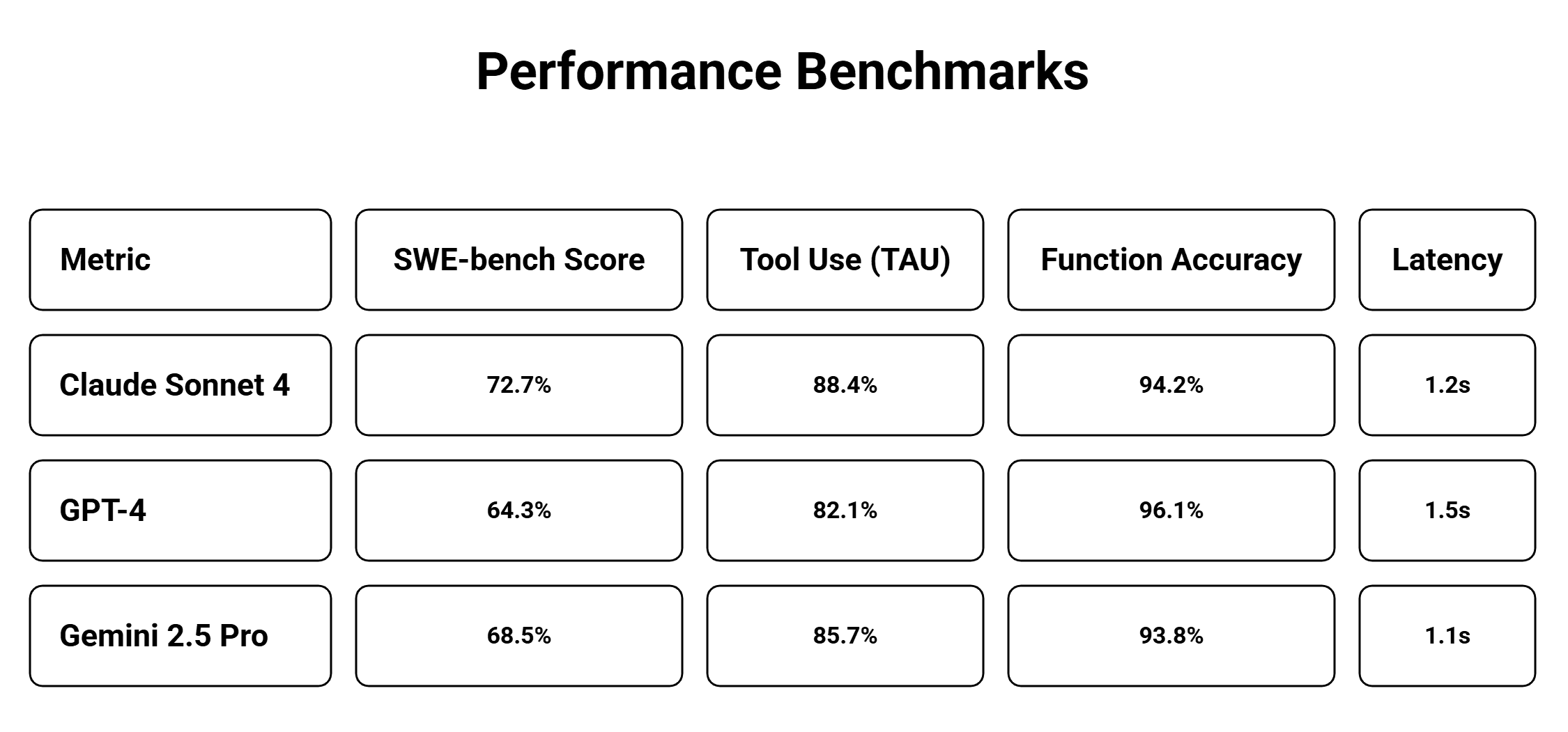
Source: Artificial Analysis
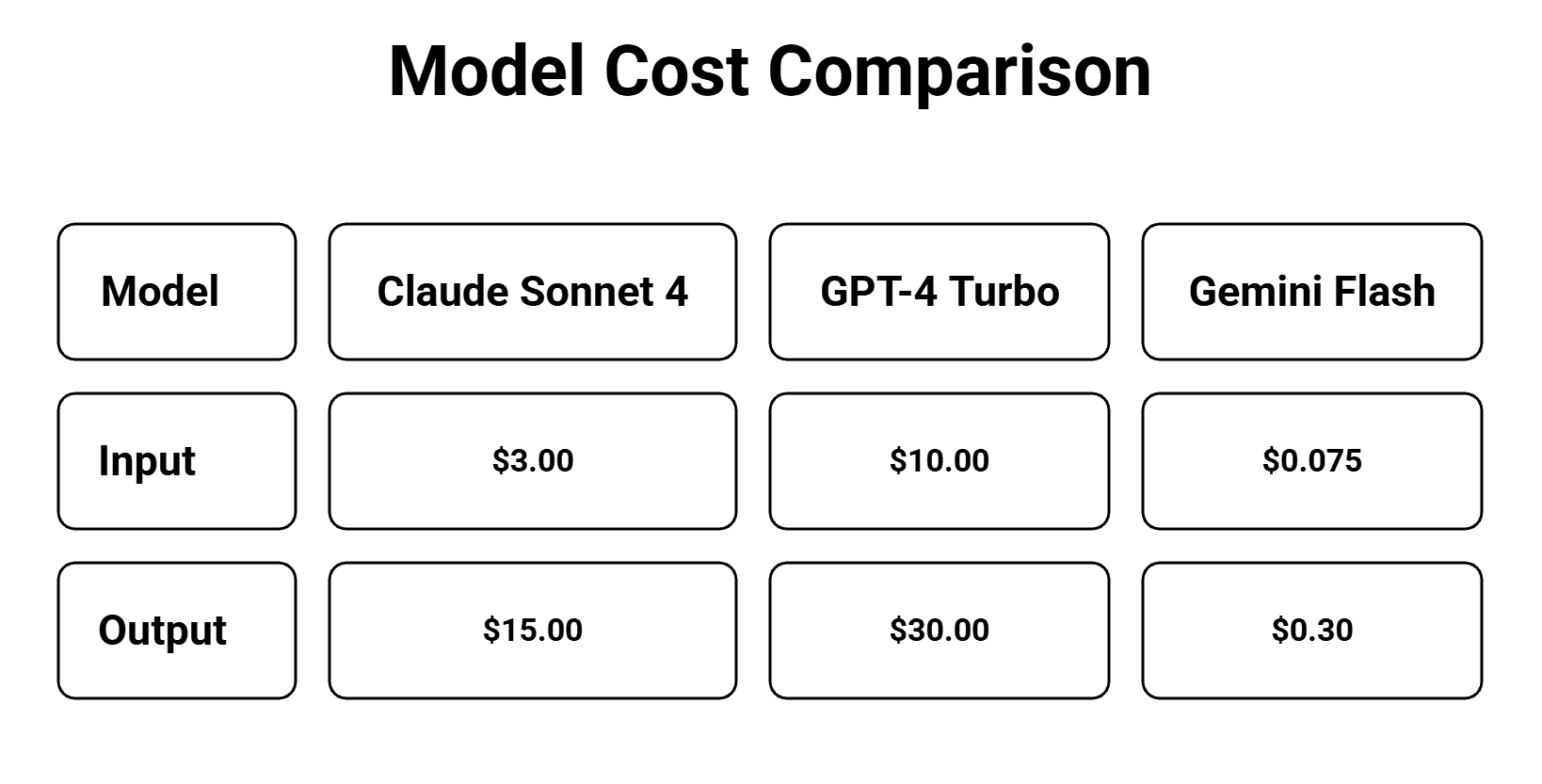
Cost Comparison (Per Million Tokens)
When to Choose Each
Claude: Complex reasoning, multi-step agents, coding tasks GPT-4: Reliability, consistency, established ecosystem Gemini: Cost efficiency, massive context, Google integration
Understanding these trade-offs aligns with game theory principles in AI system design.
Real-World Applications
Customer Support
python
def get_order_status(order_id: str) -> dict:
    """Check order status."""
    return {
        "status": "In Transit",
        "location": "Chicago Hub",
        "eta": "Tomorrow by 5 PM"
    }
Results: 90% faster responses, 24/7 availability, 85% satisfaction.
E-Commerce
AI checks real-time inventory and reserves products instantly.
Financial Services
Secure account access, transactions, portfolio analysis. See AI employees in financial services.
Healthcare
Stanford Medicine reports AI scheduling reduced no-shows by 23%.
Best Practices
Effective Function Descriptions
Bad: "Gets data" Good: "Retrieves customer order history including dates, items, and shipping. Use when customers ask about past orders."
Security Essentials
- Validate all inputs
- Implement authentication
- Rate limiting
- Never log sensitive data
OWASP emphasizes security audits for function calling systems.
Common Pitfalls
- Vague descriptions → AI confusion
- Too many functions → Decreased accuracy (limit to 10-20)
- No error handling → System breaks
- Ignoring costs → Budget overruns
Future Trends
Computer Use
Claude's feature enables AI to click buttons, fill forms, and navigate software directly.
Model Context Protocol (MCP)
Anthropic's MCP standardizes AI-tool connections. Google added Gemini support in December 2024.
Multi-Agent Systems
Stanford HAI research shows cooperative multi-agent systems achieve 34% better performance.
Market Growth: AI agent market reaching $28.5B by 2028 at 42% CAGR (Gartner).
Getting Started
Quick Steps:
- Start with Ruh.AI for managed complexity
- Define simple use case (FAQ, order status)
- Create basic function
- Test thoroughly
- Deploy and monitor
Conclusion
Function calling transforms AI from conversational to operational. Choose Claude for complex reasoning, GPT-4 for reliability, or Gemini for cost efficiency.
Key Takeaways:
- Function calling enables real-world AI actions
- Each model has distinct strengths
- Implementation quality is critical
- Start simple, scale gradually
Ready to build AI agents? Try Ruh.AI for function-calling chatbots in minutes. Explore our blog or contact us for your use case.
FAQ
Does Gemini support function calling?
Ans: Yes. Gemini 2.5 Pro, 2.5 Flash, 2.0 Flash, and 3 Pro all support function calling with up to 1,024 functions per request.
How does AI function calling work?
Ans: The AI analyzes user requests, identifies when external data is needed, outputs structured JSON with function names and parameters, your app executes the function, and the AI uses results to generate responses.
What is function calling in GPT-4?
Ans: GPT-4's function calling allows the model to detect when to call external functions and output valid JSON matching your function schemas, with AUTO/ANY/NONE control modes.
Can AI agents perform tasks?
Ans: Yes. With function calling, AI agents can check databases, call APIs, process transactions, schedule appointments, and perform real-world actions—not just answer questions.
Which Gemini model supports tool calling?
Ans: All current Gemini production models support tool calling: 2.5 Pro, 2.5 Flash, 2.5 Flash-Lite, 2.0 Flash, and 3 Pro (preview).
What is function calling in Claude?
Ans: Claude's "tool use" enables interleaved thinking (reasoning while using tools) and parallel tool execution, allowing more sophisticated multi-step problem solving.
How to use Gemini for calling?
Ans: Define functions in OpenAPI schema or Python, pass to Gemini API with your query, handle function call responses, execute functions, and return results to Gemini for final answer generation.
Can Google Gemini use MCP?
Ans: Yes. Google announced Model Context Protocol support for Gemini models in December 2024, enabling standardized tool definitions across platforms.