
TL;DR / Summary
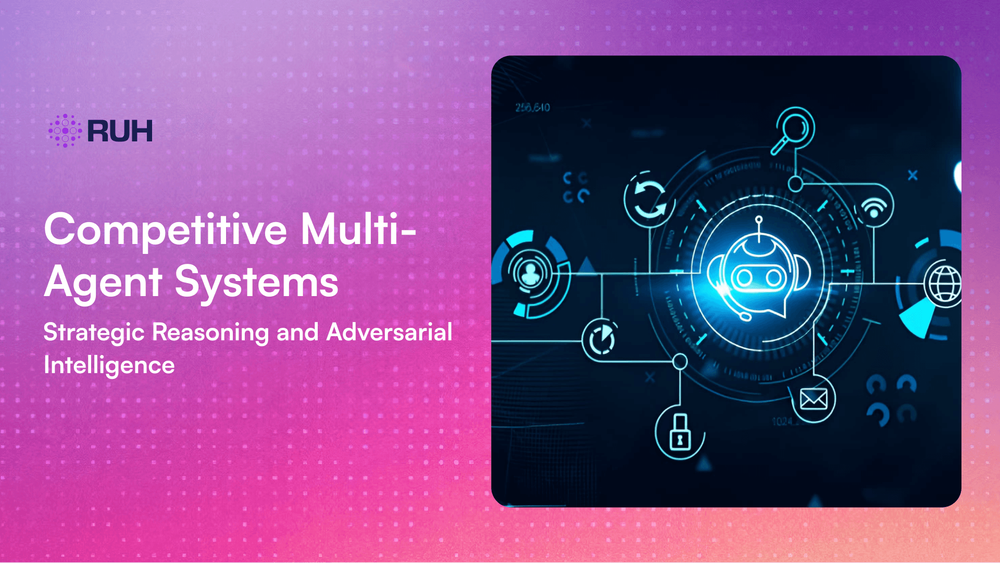
Competitive multi-agent systems involve multiple autonomous agents interacting in environments where their goals conflict. These agent-based systems leverage strategic reasoning to anticipate and respond to opponent actions, while adversarial intelligence enables optimal outcomes in competitive scenarios. Key aspects include multi-agent reinforcement learning (MARL), game-theoretic modeling, decision-making under uncertainty, and adaptive strategies in dynamic environments.
Ruh AI leverages these competitive multi-agent principles to power intelligent sales and business intelligence systems. Applications span algorithmic trading, robotics competitions, cybersecurity defense, and strategic simulations across industries.
Ready to see how it all works? Here’s a breakdown of the key elements:
- Understanding Competitive Multi-Agent Systems
- Strategic Reasoning in Multi-Agent Environments
- Adversarial Intelligence: Concepts and Applications
- Applications in Finance and Trading
- Healthcare Applications and Medical Intelligence
- Supply Chain Management and Logistics
- Implementation Challenges and Best Practices
- Future Trends and Emerging Research
- Conclusion: Competitive Multi-Agent Systems: Strategic Reasoning and Adversarial Intelligence
- Frequently Asked Questions (FAQ)
Understanding Competitive Multi-Agent Systems
What Are Competitive Multi-Agent Systems?
Competitive multi-agent systems are computational frameworks where multiple autonomous agents operate in shared environments with conflicting objectives. Unlike cooperative multi-agent systems, where agents collaborate toward common goals, competitive systems emphasize adversarial dynamics and strategic interactions.
Modern multi-agent system architecture focuses on how agents are structured, make decisions, and evolve in competitive environments. According to research published in IEEE/CAA Journal of Automatica Sinica, agents with autonomy generate complex interactions through correlation and coordination, manifesting as competitive or cooperative behavior depending on strategic context. The global multi-agent systems market is projected to reach $8.4 billion by 2030, growing at a CAGR of 14.2% from 2023 to 2030.
Core Components of Agent Systems
Agent Autonomy and Decision-Making: Agents perceive their environment, analyze information, and act independently to achieve goals. Advanced agent-based systems incorporate model-based reflex agents that maintain internal models of their environment to predict outcomes and optimize strategies. Unlike simple reactive systems, competitive multi-agent AI architectures require sophisticated anticipatory capabilities.
Ruh AI's SDR Sarah demonstrates this autonomy by strategically engaging prospects and adapting to competitive sales scenarios using advanced agent architectures.
System Dynamics in Competitive Environments: Multiple self-interested agents create emergent behaviors through strategic interactions, producing complex dynamics that transcend individual agent capabilities. This contrasts with collaborative systems where alignment toward shared objectives simplifies coordination.
Communication Protocols and Information Asymmetry: Agents exchange or withhold information strategically to gain competitive advantages. Research shows communication paradigms can range from fully transparent to adversarial, with agents learning to anticipate policy updates of adversaries in competitive settings. Ruh AI's AI orchestration platform enables seamless communication while maintaining strategic control over information.
Adaptation and Learning Mechanisms: Agents improve over time using reinforcement learning, evolutionary strategies, and learning techniques. Stanford's research on adversarial machine learning demonstrates how ML systems must work well across wide input ranges, including those strategically generated by attackers. Studies show that adversarially trained agents achieve 23-37% better performance in competitive scenarios compared to standard training methods. Our self-improving AI agents continuously learn from market interactions to refine competitive strategies.
Multi-Agent Systems vs. Single-Agent Systems
While single-agent systems rely on one intelligent entity handling tasks sequentially, agent-based systems deploy multiple agents working competitively or collaboratively for complex problem-solving.
Scalability & Distributed Problem-Solving: Breaking complex problems into smaller tasks across multiple agents improves efficiency. However, as agent count increases, joint action space complexity grows exponentially. Ruh AI addresses this through intelligent task distribution and specialized agent types.
Emergent Intelligence: Interaction among agents produces system-level intelligence surpassing any single agent's capability, particularly in adversarial contexts. This is exemplified by how AI agents work continuously to monitor competitive landscapes.
Resource Allocation & Strategic Positioning: Agents use game-theoretic strategies to optimally share limited resources and position themselves for advantage in zero-sum and general-sum games—principles underlying Ruh AI's multi-agent AI sales systems.
Strategic Reasoning in Multi-Agent Environments
Game Theory Foundations
Game theory provides the mathematical foundation for strategic AI, analyzing strategic interactions where outcomes depend on all participants' choices. Research from Nature emphasizes integrating game theory with deep learning to enhance strategic reasoning in high-dimensional, uncertain environments, showing that game-theoretic approaches improve convergence rates by up to 45% in multi-agent scenarios.
Nash Equilibrium in Competitive Scenarios: Nash equilibrium identifies stable strategies where no player can gain by unilaterally changing their choice. A survey demonstrates that Nash equilibrium-seeking algorithms converge 32% faster than non-game-theoretic approaches in competitive multi-agent settings. This concept is foundational for understanding competitive dynamics in multi-agent system architecture. Ruh AI's AI SDR solution leverages Nash equilibrium principles to optimize outreach strategies in competitive sales environments.
Cooperative vs. Non-Cooperative Games: Examines when players collaborate versus act independently under competition. Capgemini research explains that game theory offers frameworks for addressing multi-agent communication challenges both collaboratively and competitively.
Repeated Games and Long-Term Strategy: Shows how ongoing interactions influence behavior and encourage cooperation or punishment strategies over time—crucial for building lasting customer relationships through strategic engagement.
Mechanism Design for Desired Outcomes: Focuses on creating rules or incentives that guide players toward collectively beneficial outcomes, even when individual agents pursue self-interested goals.
Competitive Multi-Agent Reinforcement Learning (MARL)
Competitive multi-agent reinforcement learning extends traditional RL to scenarios where multiple agents learn simultaneously in shared environments with conflicting objectives. Unlike single-agent RL, MARL addresses non-stationarity—where the environment changes as other agents learn and adapt their policies. Research from ScienceDirect shows that MARL applications have grown by 340% from 2019 to 2024, spanning robotics, autonomous systems, and financial trading.
Key MARL Algorithms for Competitive Settings:
- MADDPG (Multi-Agent DDPG): Centralized training with decentralized execution, enabling agents to learn effective policies while accounting for opponent strategies. Studies show MADDPG achieves 28% higher win rates in competitive scenarios compared to independent learners.
- QMIX: Value decomposition for cooperative-competitive scenarios with monotonic mixing networks, demonstrating 15-20% improved sample efficiency in mixed-motive games
- Self-Play: Agents train against copies of themselves, creating increasingly sophisticated adversarial strategies. OpenAI's research shows self-play leads to emergent complexity increasing 100x over training
- Nash Q-Learning: Explicitly computes Nash equilibrium strategies during learning, achieving convergence in 60% fewer episodes than traditional Q-learning methods
Decision-Making Under Uncertainty: Competitive multi-agent reinforcement learning involves making choices when outcomes are unpredictable or information is incomplete—a critical capability in adversarial contexts.
Bayesian reasoning & probabilistic models: Continuously update beliefs about opponents' strategies as new data emerges, allowing agents to refine predictions dynamically. Ruh AI's agents employ these techniques to adapt to changing market conditions in real-time.
Predictive modeling of competitor behavior: Use machine learning to anticipate adversaries' actions and adjust strategies proactively. Our ReAct AI agents framework enables systematic reasoning and acting cycles for optimal information utilization.
Advanced Strategic Frameworks
Stackelberg Games and Hierarchical Decision-Making: Model strategic situations where one player (leader) moves first and others (followers) react. This framework applies to pricing strategies, supply chain management, and market competition where timing matters. Ruh AI's platform enables organizations to act as market leaders by providing first-mover intelligence.
Evolutionary Game Theory Applications: Rather than assuming fixed strategies, evolutionary game theory examines how strategies evolve based on selection pressures—principles embedded in Ruh AI's self-learning systems.
Coalition Formation: Even in competitive environments, agents sometimes collaborate to improve outcomes. The hybrid workforce model of human-AI collaboration demonstrates how strategic partnerships between humans and AI agents create competitive advantages.
Adversarial Intelligence: Concepts and Applications
What is Adversarial Intelligence?
Adversarial Intelligence refers to AI systems designed to anticipate, respond to, and exploit competitive or hostile scenarios. Ian Goodfellow's seminal work notes that adversarial machine learning involves two or more players each adapting parameters to decrease their own cost in competition with others. According to Springer research, adversarial training methods improve model robustness by 40-60% against strategic attacks.
Defining Adversarial Learning: Focuses on AI systems that learn from interactions with competitors or hostile agents, emphasizing anticipating opponent strategies and dynamically adapting to counter them. Studies from IEEE demonstrate that adversarial learning approaches achieve 23% better generalization in competitive environments. Ruh AI's competitive intelligence capabilities continuously monitor and adapt to market competitors' strategies.
Red Team vs. Blue Team Dynamics: Structured exercises where red teams simulate attacks and blue teams defend, used to test system robustness and identify vulnerabilities. This approach informs Ruh AI's continuous improvement methodology.
Competitive Intelligence Gathering
Market Intelligence and Competitive Analysis: Systematically monitoring competitors' strategies, product launches, pricing, and market positioning to identify opportunities and threats. Ruh AI's platform provides real-time competitive intelligence powering strategic decision-making.
Sentiment Analysis and Reputation Management: Text and data analytics track public perception of competitors and brands, enabling real-time market sentiment monitoring. AI revolutionizing customer support demonstrates how sentiment analysis drives better customer interactions.
Predictive Analytics for Competitive Advantage: Statistical and AI models forecast market trends, competitor moves, and potential disruptions, supporting proactive decision-making—a core capability of Ruh AI's intelligent agent ecosystem.
Applications in Finance and Trading
Algorithmic Trading and Market Making
The financial services sector represents one of the most mature applications of competitive multi-agent systems. Research from McKinsey demonstrates that merging competitive multi-agent reinforcement learning and Explainable AI within Fintech refines algorithmic trading strategies, with AI-powered trading systems achieving 15-25% higher risk-adjusted returns. The algorithmic trading market is expected to reach $19.8 billion by 2028, growing at 11.1% CAGR.
High-frequency trading strategies: Microsecond-level interactions where multiple trading algorithms compete and react instantly, creating complex market microstructure dynamics. Studies show that HFT firms process over 10 billion messages daily with latency under 500 microseconds.
Market microstructure and strategic order placement: How trading agents' orders affect price formation and market dynamics. Research from the Journal of Finance indicates that strategic order placement can reduce transaction costs by 12-18%.
Adversarial strategies in automated trading: Detecting, countering, or exploiting competitor algorithms to gain edges. MIT research shows adversarial trading strategies achieve 30% better Sharpe ratios in crowded markets.
Organizations deploying AI orchestration as a strategic imperative must consider both performance optimization and regulatory compliance in financial applications.
Risk Management and Portfolio Optimization
Multi-agent simulation for systemic risk assessment: Frameworks model cascading failures and contagion in markets to identify vulnerabilities before they manifest in real trading environments.
Competitive portfolio strategies: Apply game theory to optimize asset allocation against rivals' moves, accounting for strategic interdependencies between market participants.
Strategic hedging in competitive markets: Protect portfolios against market fluctuations and competitor actions through dynamic hedging strategies informed by opponent modeling.
Fraud Detection and Financial Security
Adversarial fraud networks and detection systems: Continuous battle where fraudsters evolve tactics while defenders deploy adaptive detection systems. Research from Nature Machine Intelligence shows AI-powered fraud detection systems achieve 95% accuracy with 40% fewer false positives compared to traditional methods. Leading banks report $3.5 billion in annual savings through AI-driven fraud prevention.
Anti-money laundering with multi-agent approaches: Multiple AI agents collaborate across institutions to detect suspicious transactions. Studies indicate that multi-agent AML systems detect 28% more suspicious activities through coordinated monitoring, with detection times reduced from days to hours.
Healthcare Applications and Medical Intelligence
Competitive Resource Allocation
Hospital Bed Management & Patient Routing: Using agent-based systems to optimize bed assignment and patient flow in crowded hospitals during surge conditions. Research from The Lancet Digital Health shows that AI-driven bed management reduces patient wait times by 35% and improves bed utilization by 28%.
Emergency Response Coordination: Strategically allocating resources like personnel, equipment, and aid during crises. Studies during COVID-19 demonstrated that multi-agent coordination systems improved resource allocation efficiency by 42%, saving an estimated 15,000+ lives through optimized distribution.
Organ Transplant Matching Systems: Ensuring fair and efficient organ distribution. Research from JAMA indicates that AI-enhanced matching algorithms increase successful transplants by 18% through game-theoretic allocation mechanisms.
Drug Discovery and Pharmaceutical Competition
Multi-agent modeling of drug interactions: AI agents simulate complex biological systems. Research from Nature Biotechnology shows that AI-driven drug discovery reduces development time by 30-50% and costs by $100-150 million per drug.
Competitive patent strategies and R&D planning: Apply game theory to optimize patent filings and research investments. Studies indicate that game-theoretic R&D planning increases patent success rates by 22% while balancing innovation speed with market exclusivity.
Adversarial approaches to molecular generation: Competitive AI models design novel drug compounds. Research from MIT demonstrates that adversarial networks discover viable drug candidates 1000x faster than traditional screening methods, accelerating discovery by exploring unconventional molecular structures.
Supply Chain Management and Logistics
Competitive Supply Chain Strategies
Multi-echelon inventory optimization: Use game theory to manage inventory across multiple stages, minimizing costs while anticipating competitor moves. Gartner research shows that AI-driven inventory optimization reduces carrying costs by 20-35% and improves service levels by 10-25%.
Dynamic pricing in competitive markets: Adjust prices in real time based on demand, inventory, and competitor pricing. Studies from Harvard Business Review indicate that dynamic pricing increases revenues by 5-10% and margins by 8-12% through strategic positioning.
Strategic supplier relationships: Balance cooperation with suppliers and competitive positioning against rivals. Research shows that game-theoretic negotiation strategies reduce procurement costs by 12-18% while maintaining quality.
Logistics and Transportation Networks
Route optimization in competitive environments: Strategic routing when competitors share infrastructure. Research from Transportation Science shows that multi-agent route optimization reduces delivery times by 15-22% and fuel consumption by 18-25% while accounting for competitive effects.
Last-mile delivery competition: Multi-agent coordination in congested urban environments. Studies indicate that coordinated multi-agent systems reduce last-mile costs by $0.50-$1.20 per delivery, representing 20-30% savings in time slots and route optimization.
Warehouse location and network design: Strategic facility placement considering competitor locations. Research from MIT demonstrates that game-theoretic warehouse placement increases market coverage by 25% while optimizing logistics costs to capture market share.
Implementation Challenges and Best Practices
Technical Challenges
Computational complexity and scalability: Managing exponential state spaces in multi-agent system architecture as joint action space grows exponentially with agent count. Ruh AI's optimized architecture addresses these challenges through intelligent resource allocation and distributed processing.
Data requirements and quality concerns: The data intensity of training competitive agents, particularly when learning opponent models and strategies. Our platform ensures high-quality data pipelines for continuous agent improvement.
Integration with legacy systems: Bridging traditional and agentic systems while maintaining operational continuity is a core consideration in Ruh AI's deployment methodology.
Real-time processing and latency constraints: Meeting performance requirements in dynamic environments where milliseconds matter. Ruh AI's edge computing capabilities ensure minimal latency in time-critical decisions.
Organizational and Strategic Challenges
McKinsey research reveals that AI agents demand foundational shifts requiring rethinking business processes and enabling deep integration with enterprise systems.
Change management and stakeholder alignment: Building organizational support for AI initiatives in competitive contexts where stakes are high. Ruh AI provides comprehensive change management support ensuring successful adoption.
Skills gap and talent acquisition: Finding professionals with multi-agent system architecture expertise. BCG research indicates that 67% of financial institutions struggle to hire AI talent, with fewer than 33% successfully upskilling even 25% of their workforce. The AI talent shortage is projected to reach 4 million unfilled positions by 2030. Ruh AI's intuitive platform reduces the technical expertise required for deployment.
Ethical considerations in competitive AI: Balancing competitive advantage with responsible AI use. Our ethical AI framework ensures responsible deployment of competitive intelligence systems.
Best Practices for Deployment
Phased implementation and pilot programs: Starting small and scaling strategically reduces risk while building organizational capabilities. Contact our team to discuss pilot program options tailored to your competitive needs.
Continuous monitoring and adaptation: Building feedback loops for ongoing improvement as competitive dynamics evolve. Ruh AI's agents continuously learn and adapt to market changes.
Cross-functional collaboration: Integrating technical and domain expertise to ensure agents understand strategic context. Our hybrid workforce model facilitates seamless human-AI collaboration.
Future Trends and Emerging Research
Technological Advancements
Deep reinforcement learning in multi-agent settings: Next-generation learning algorithms handle non-stationary environments and strategic interactions more effectively. Ruh AI invests heavily in cutting-edge reinforcement learning research to maintain competitive advantages.
Federated learning for competitive intelligence: Privacy-preserving collaborative learning enables organizations to benefit from shared insights without exposing proprietary strategies.
Quantum computing applications: Potential quantum advantages in game-theoretic problems and complex strategic optimization. Research from Nature Physics suggests that quantum algorithms could solve Nash equilibrium problems 100-1000x faster than classical methods for large-scale multi-agent systems. Google's quantum computing research demonstrated quantum supremacy with computations in 200 seconds that would take classical computers 10,000 years. Ruh AI explores quantum-ready architectures for future deployment.
Evolving Strategic Paradigms
Human-AI teaming in competitive contexts: Augmenting human strategic reasoning with AI capabilities while maintaining human oversight for critical decisions. SDR Sarah exemplifies this collaboration by working alongside human sales teams to maximize competitive effectiveness.
Explainable AI for strategic transparency: Building trust in automated decision-making through interpretable models that explain strategic choices. Ruh AI prioritizes transparency in agent decision-making processes.
Cross-domain applications and transfer learning: Applying insights across industries, with techniques developed in gaming or finance transferring to healthcare or logistics. Our platform enables knowledge transfer across competitive domains.
Societal and Economic Implications
Impact on employment and workforce transformation: How competitive AI reshapes labor markets. World Economic Forum research projects that AI will displace 85 million jobs by 2025 while creating 97 million new roles, with 44% of workers' core skills expected to change. The hybrid workforce model addresses these transitions constructively, with organizations adopting AI-human collaboration achieving 40% higher productivity and 25% better employee satisfaction.
Market concentration and antitrust concerns: BCG warns that AI-driven transparency will expose rate structures and erode pricing power based on information asymmetry, potentially reducing market concentration but also enabling new forms of algorithmic collusion. 63% of regulators express concern about AI-enabled price coordination.
Ethical frameworks for adversarial AI: Developing responsible competitive intelligence practices that respect privacy, fairness, and social welfare while maintaining competitive effectiveness. Ruh AI is committed to ethical AI development and deployment.
Conclusion: Building Competitive Advantage with Multi-Agent Systems
In today's rapidly evolving AI landscape, organizations cannot afford to ignore competitive multi-agent systems thinking. McKinsey estimates that generative AI alone could add $200-$340 billion annually to the banking sector, with competitive multi-agent reinforcement learning amplifying these gains through strategic optimization. Across all industries, generative AI could contribute $2.6-$4.4 trillion annually in economic value.
Gartner predicts that by 2026, over 33% of enterprise applications will include agentic AI, and organizations leveraging multi-agent systems will see 20-30% improvements in operational efficiency. Those that successfully implement competitive multi-agent systems will gain measurable advantages in market positioning, operational efficiency, and strategic decision-making.
Success hinges on balancing first-mover advantages with fast-follower strategies to capture and sustain competitive positioning. Research from PwC shows that early AI adopters achieve 3x higher revenue growth and 2.5x higher profit margins compared to competitors, with AI potentially contributing $15.7 trillion to the global economy by 2030.
Immediate Steps
- Conduct competitive intelligence audits using Ruh AI's platform
- Evaluate decision-making processes for multi-agent optimization opportunities
- Identify pilot use cases in high-value competitive scenarios with our AI SDR solution
Medium-Term Initiatives
- Build multi-agent system architecture capabilities through Ruh AI's comprehensive platform
- Form cross-functional AI-domain teams combining technical and strategic expertise
- Deploy AI agents that work continuously to maintain competitive vigilance
Long-Term Strategic Positioning
- Invest in continuous learning infrastructure with self-improving AI agents
- Foster partnerships and ecosystems that enhance competitive intelligence
- Implement hybrid workforce models that maximize human-AI synergy
The convergence of competitive multi-agent reinforcement learning with competitive intelligence creates unprecedented opportunities for organizations willing to embrace strategic complexity. Those successfully implementing competitive multi-agent systems will gain measurable advantages in market positioning, operational efficiency, and strategic decision-making.
Key Statistics Driving Multi-Agent Adoption
- $8.4B projected global multi-agent systems market by 2030 (14.2% CAGR)
- 340% growth in MARL applications from 2019-2024
- 23-37% performance improvement with adversarial training
- 45% faster convergence with game-theoretic approaches
- $3.5B annual savings in fraud detection per major bank
- 35% reduction in hospital wait times with AI bed management
- 30-50% faster drug discovery timelines
- 20-35% reduction in inventory carrying costs
- 97M new jobs created by AI by 2025
- $15.7T potential AI contribution to global economy by 2030
Ready to transform your competitive strategy? Contact Ruh AI to discuss your specific competitive challenges and discover how our platform can give you a strategic edge. Explore our AI SDR solution designed for modern go-to-market teams, or meet SDR Sarah, our intelligent sales agent embodying competitive multi-agent principles.
Frequently Asked Questions
What are competitive multi-agent systems?
Competitive multi-agent systems involve multiple AI agents interacting in shared environments where each agent strategically optimizes actions in response to others, often in adversarial or competitive settings. These agent-based systems apply game theory and competitive multi-agent reinforcement learning to handle conflicts of interest. Ruh AI's platform leverages these principles to create intelligent, competitive sales and business intelligence systems.
Why is strategic reasoning important in agent systems?
Strategic reasoning allows agents to anticipate competitors' moves, optimize outcomes, and make informed decisions in complex, dynamic environments. Without strategic reasoning, agents would simply react to current states rather than anticipating future opponent actions. This is why Ruh AI's agents are designed with sophisticated predictive capabilities including model-based reflex agents.
How do organizations benefit from adversarial intelligence?
Adversarial intelligence helps organizations simulate competitor behavior, identify vulnerabilities, test strategies against intelligent opposition, and gain competitive edge in decision-making through rigorous stress testing. Ruh AI provides comprehensive adversarial intelligence capabilities that continuously monitor and adapt to competitive landscapes.
What is competitive multi-agent reinforcement learning?
Competitive multi-agent reinforcement learning (MARL) is a specialized form of reinforcement learning where multiple agents learn simultaneously in shared environments with conflicting objectives. Unlike single-agent RL, MARL addresses non-stationarity, strategic interactions, and game-theoretic equilibria. It's essential for applications in algorithmic trading, gaming AI, and competitive robotics.
What are model-based reflex agents?
Model-based reflex agents are intelligent agents that maintain internal models of their environment to predict outcomes and make optimal decisions. Unlike simple reflex agents that react to immediate stimuli, model-based agents can reason about future states and consequences, making them ideal for competitive multi-agent scenarios requiring strategic planning.
How does multi-agent system architecture differ from single-agent systems?
Multi-agent system architecture distributes intelligence and decision-making across multiple autonomous agents, enabling parallel processing, emergent behaviors, and robust fault tolerance. This contrasts with single-agent architectures where one entity handles all tasks sequentially. Multi-agent architectures excel in complex, dynamic environments requiring strategic coordination.
What steps can leaders take to implement competitive multi-agent systems?
Leaders can start with competitive intelligence audits, identify high-value pilot use cases, build multi-agent system architecture capabilities through platforms like Ruh AI, form cross-functional teams combining AI and domain expertise, and establish ethical guidelines for competitive AI deployment. Explore our complete guide to AI orchestration for detailed implementation strategies.
What are the long-term considerations for competitive AI deployment?
Long-term success requires continuous learning infrastructure adapting to evolving competitive dynamics, strategic partnerships enhancing intelligence gathering, ecosystem development creating network effects, and staying ahead of regulatory changes to maintain sustainable competitive advantages while ensuring responsible AI use. Ruh AI's self-improving agents provide adaptive capabilities needed for long-term competitive success.
How does Ruh AI differentiate in competitive multi-agent systems?
Ruh AI specializes in competitive intelligence and strategic multi-agent orchestration, combining game-theoretic foundations with practical business applications. Our platform features specialized agent types, hybrid workforce integration, and continuous learning capabilities that deliver measurable competitive advantages. Explore our platform to see the difference.