
TL;DR
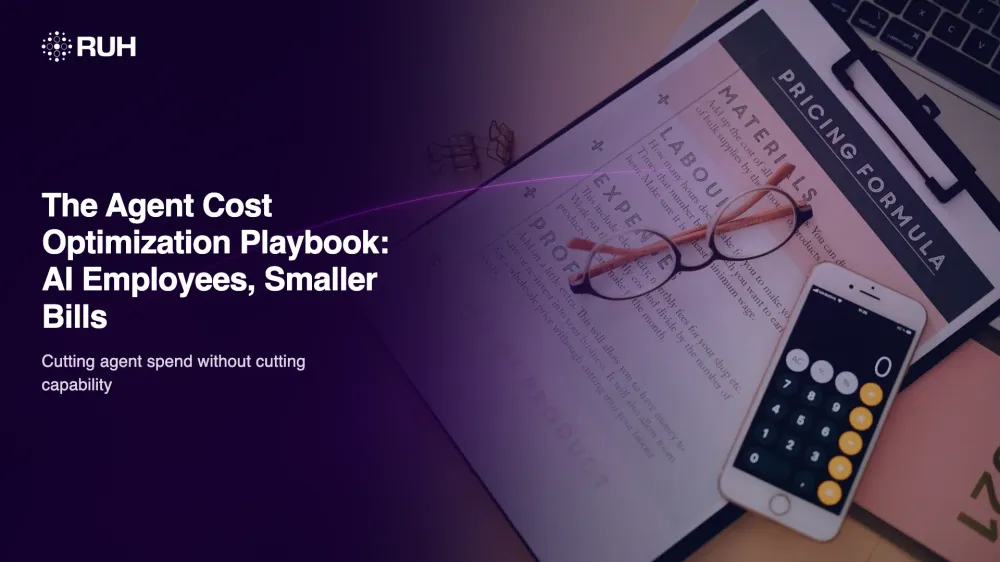
AI agents are getting cheaper per token and more expensive per outcome. Per-token inference prices have collapsed by roughly 80% in twelve months, yet enterprise AI bills are climbing because agentic workflows fire 10–20 LLM calls per user task, RAG pipelines inflate context windows 3–5×, and unsupervised agents quietly burn budget in tool-call loops. The fix is not "use a cheaper model." The fix is a stacked playbook — prompt caching, tiered model routing, batch APIs, semantic caching, small language models, and context compaction — wrapped in hard guardrails and AI FinOps observability. Teams that combine these levers report 47–85% reductions in spend without quality loss, while companies skipping them sit in the 77% of enterprises that haven't yet seen agent ROI. (For the broader business case on bringing AI employees into the org, see our companion piece on AI employee adoption cost.)
Ready to see how it works:
- Where the AI Employee Cost Crisis Came From
- Why Agent Bills Explode: The Hidden Token Math
- The Six Levers of Agent Cost Optimization
- Hard Guardrails Against Runaway Agents
- AI FinOps: Treating Agents Like Cloud Infrastructure
- The Real ROI of an Optimized Agent Workforce
- Honest Limitations and Trade-offs
- How Ruh AI Is Adapting Agent Cost Optimization for Smarter Results
- Your Next Move: Building a Lean Agent Stack
- Frequently Asked Questions About AI Agent Cost Optimization
Where the AI Employee Cost Crisis Came From
The phrase "AI employee" is barely three years old. It traces directly to a six-week sprint in March–April 2023, when game developer Toran Bruce Richards open-sourced AutoGPT, an experimental wrapper that let GPT-4 plan multi-step tasks, browse the web, and run code on a goal-seeking loop. According to BairesDev's history of autonomous agents, AutoGPT collected ~107,000 GitHub stars in its first six weeks, making it the fastest-growing open-source project in GitHub history at that time.
Days later, Yohei Nakajima released BabyAGI, a Python script demonstrating the now-canonical "task creation → execution → prioritization" loop using an LLM and a vector store. IBM's overview of BabyAGI notes that the framework popularized the agent-loop architecture that virtually every modern agent platform inherits.
From AutoGPT to Enterprise Agents: A 36-Month Sprint
The years after were a standardization marathon. ReAct, AutoGen, and AgentGPT demonstrated that LLMs could plan, act, and learn from feedback without human intervention. Then in late 2024, the ecosystem received its missing plumbing: Anthropic shipped the Model Context Protocol (MCP), an open framework that gave agents a uniform way to integrate tools and data; IBM released the Agent Communication Protocol (ACP), which later merged with Google's Agent2Agent (A2A) under the Linux Foundation.IBM's evolution-of-AI-agents brief tracks this lineage in detail.
By 2026, the AI agents market is projected to exceed $10.9 billion, growing at over 45% CAGR, with Gartner forecasting that 40% of enterprise applications will include task-specific AI agents by year-end (per Landbase's agentic AI statistics roundup). Adoption pulled ahead of optimization — and the gap shows up on every CFO's invoice.
Why Agent Bills Explode: The Hidden Token Math
A single LLM call is cheap. An agent is not a single LLM call. This is the part most teams underestimate when they pencil out their AI budget — and it's the same gap we explored in detail in our AI employee adoption cost analysis, where the headline price is rarely the price you actually pay.
The unit economics on the provider side are working in your favor. Featherless's 2026 pricing comparison documents that LLM API prices fell roughly 80% between early 2025 and early 2026: GPT-4o input pricing dropped from $5.00 to $2.50 per million tokens, while newer reasoning models like o4 Mini offer input as low as $0.55 per million tokens. Stevens Online's "Hidden Economics of AI Agents" goes further, citing per-token inference price drops between 9× and 900× per year for fixed performance benchmarks.
So why are bills going up? Three structural reasons.
First, output tokens dominate cost. Silicon Data's cost-per-token guide shows output tokens are typically 3–8× the price of input with a median ~4× ratio across major providers. Agents that generate verbose plans, tool calls, and reflections consume disproportionate output budget.
Second, agentic workflows multiply call volume. Stevens Online's analysis quantifies it cleanly: an agentic flow triggers 10–20 LLM calls per user task, RAG architectures inflate context windows 3–5×, and always-on monitoring agents consume compute 24/7. Multi-agent systems are worse — Codieshub's analysis of runaway agents reports agents consume ~4× more tokens than chat interactions, up to 15× in multi-agent systems.
Third, runaway loops. When a tool returns malformed data, an agent without termination logic will retry. Codieshub documents agents calling broken tools 400 times in five minutes, blowing through thousands of tokens before any rate limit kicks in.
The combined result, captured in Oplexa's AI inference cost crisis report: more than 90% of CIOs say managing cost limits their ability to get value from AI for their enterprise.
The Six Levers of Agent Cost Optimization
Treat the playbook as six levers you can stack. Most published reductions in the 47–85% range come from combining at least three. The math compounds — a 50% prompt-cache savings on top of a 40% routing savings on top of a 50% batch discount produces a much smaller bill than any single lever alone.
Level 1 — Prompt Caching (45–80% Savings)
Every major provider now ships prompt caching. The mechanic is the same: when the prefix of your prompt (system instructions, tool definitions, retrieved documents) is reused across calls, the provider charges a fraction of the input price for the cache hit instead of full input.
The pricing is striking. Anthropic's pricing docs and Finout's Anthropic API pricing breakdown spell out the math: 5-minute cache writes cost 1.25× the base input rate, 1-hour cache writes cost 2× the base rate, and cache reads cost just 0.1× the base rate. That means a single cache hit pays back the 5-minute write surcharge after one read; the 1-hour TTL pays back after two reads.
Redis's LLM token optimization guide reports prompt caching can reduce API costs by 45–80% while improving time-to-first-token by 13–31%. Practical advice from the cited sources:
- Stabilize prefixes. Move the volatile parts of your prompt (user input, timestamps) to the end. Caching only works on prefixes.
- Cache tool definitions and system prompts aggressively. These are the largest, most-reused fragments.
- Match TTL to traffic. Use 5-minute caches for bursty traffic and 1-hour for steady high-volume agents.
Level 2 — Model Routing & Tiered Selection (40–70% Savings)
Not every step of an agent task needs your most expensive model. Routing classifies each prompt by difficulty and dispatches it to the cheapest model that can handle it.
Mavik Labs's 2026 cost optimization analysis recommends a 70/20/10 distribution: about 70% of queries to a budget model, 20% to a mid-tier model, and 10% to a premium model for the hardest tasks. Premai's eight-strategy guide reports this tiered routing approach cuts average per-query cost by 60–80% versus routing all traffic through a flagship model.
Routing logic comes in three flavors:
- Heuristic routing — keyword and length rules. Cheap to build, brittle.
- Classifier routing — a small model judges difficulty before dispatch.
- Cascade routing — try the cheap model first; escalate only if confidence is low.
The catch: routing requires evals. Sending hard tasks to a small model produces silent quality regressions. Always pair routing with a regression suite that re-runs your top tasks weekly.
Lever 3 — Batch APIs for Async Workloads (50% Off, Flat)
Not every job is user-facing. Bulk classification, nightly summarization, dataset enrichment, embedding generation — all of these can wait minutes or hours. Anthropic's pricing and Morph's five-lever guide both confirm that Anthropic and OpenAI Batch APIs deliver a flat 50% discount on both input and output tokens, with results returned within 24 hours.
Even better, the discounts stack. Finout's analysis notes that a cached batch request can cost as little as 5% of a standard non-cached request — a 95% saving for asynchronous, repetitive workloads.
The simple rule: anything where a human is not blocked on the response should run in batch.
Lever 4 — Semantic Caching (Up to 73% in Repetitive Workloads)
Prompt caching reuses identical prefixes. Semantic caching reuses prompts that are similar in meaning — vector-embedded queries matched against a cache of recent answers.
Redis's LangCache documents up to ~73% cost reduction in high-repetition workloads, with cache hits returning in milliseconds versus seconds for fresh inference. Mavik Labs's writeup adds that pairing model routing with semantic caching reduces API call volume by 30–50% for typical enterprise deployments.
Semantic caching shines where users ask the same thing in different words — support FAQs, internal knowledge-base lookups, recurring research questions. It struggles where answers are sensitive to small wording changes (legal, medical, code-completion in active files).
Lever 5 — Small Language Models for Routine Steps (10–30× Cheaper)
The most consequential 2025–2026 architectural shift in agentic AI is the rise of Small Language Models (SLMs). The arXiv paper "Small Language Models are the Future of Agentic AI" argues — and NVIDIA's developer blog on SLM agents confirms — that a 7-billion-parameter SLM is 10–30× cheaper than a 70–175B-parameter LLM in latency, energy consumption, and FLOPs.
Why this matters for agents: most agentic substeps are repetitive and structurally simple. Parsing a tool result, extracting an entity, formatting JSON, deciding whether to re-plan — these don't need a 200B-parameter generalist. NVIDIA's research argues SLMs are "sufficiently powerful, inherently more suitable, and necessarily more economical" for many agent invocations.
The emerging pattern is heterogeneous: SLMs handle the operational majority of agent steps, with LLMs reserved for genuinely open-ended reasoning. Distillation lets teams build specialized SLMs for a few thousand dollars instead of training a foundation model from scratch.
Lever 6 — Context Engineering & Compaction
Every token you send is a token you pay for. Context compaction is the practice of removing redundant tokens from conversation history before sending it to the LLM — without summarizing, which can drop signal.
Morph's analysis notes that compaction works by verbatim deletion: it removes noise (stale tool outputs, repeated retrievals, exhausted reasoning chains) while preserving every surviving sentence character-for-character. Compared to summarization, compaction has lower hallucination risk and is reversible.
Other context-engineering moves that compound:
- Trim retrieved chunks to the minimum that supports the answer.
- Strip tool schemas that the agent doesn't need for the current step.
- Limit conversation memory to the last N relevant turns, not all turns.
A useful budgeting heuristic from Oplexa's enterprise budget guide: start with base token cost, add 25% for usage growth, 30% for infrastructure overhead, and 15% for experimentation — for a realistic budget of about 1.7× your base token calculation.
Hard Guardrails Against Runaway Agents
Optimization without guardrails is theater. The single biggest source of unplanned agent spend is the runaway loop — an agent that keeps calling tools, retrying, or re-planning long after it has stopped making progress.
Codieshub's runaway-agent guide catalogs the common causes: missing max_turns, termination functions that never return True, system prompts without a clear "done" signal, and tool failures (e.g., a website's HTML changes) that send the agent into infinite retry. The remedies are deterministic and external — the agent itself cannot be trusted to stop.
Five guardrails that belong in every production agent stack:
Maximum iteration limits on every loop.
Per-session token and cost budgets with hard kill switches.
No-progress detection — exit when N consecutive iterations produce no new information.
Repetitive-output detection — match recent action sequences and break on cycles.
Resource monitors that track tokens, tool calls, and wall-clock time, and trip a circuit breaker on anomalies.
Waxell's "$400M AI FinOps gap" report calls this gap precisely: the difference between knowing what your agents cost and stopping them from spending more. AnalyticsWeek's reporting cited in that piece estimates a $400 million collective cloud spend leak across the Fortune 500, driven by agent sessions running without per-session cost ceilings. Visibility is necessary; enforcement is what saves money.
AI FinOps: Treating Agents Like Cloud Infrastructure
Cloud infrastructure didn't get cheaper because providers slashed prices — it got cheaper because FinOps emerged as a discipline. The same shift is now happening for AI.
AI FinOps treats every agent invocation as a billable unit, attributes it to a feature/team/customer, sets budgets, alerts on overruns, and feeds the data back into engineering decisions. It is becoming a non-optional layer of the agent stack.
Augment Code's 2026 observability tooling roundup and AIMultiple's agentic monitoring overview compare the leading platforms. Two patterns dominate:
Proxy-based observability (Helicone): change one API URL, get cost dashboards immediately. Lowest implementation cost.
SDK-first tracing (LangSmith, Langfuse): instrument your code, get deep traces showing exactly which call in a chain costs the most.
What good AI FinOps actually delivers, per the cited tooling reviews:
Cost per request, per user, per model, per tenant — attribution down to the individual conversation.
Per-trace cost trends so you can see when an upgrade made an agent more expensive.
Smart routing to the cheapest available model based on live pricing and quota.
Alerts on anomaly windows — a 10× spike in cost-per-task usually means a regression.
Integration with your billing system so finance and engineering share one number.
The maturity rule of thumb: if AI is more than 50% of your cloud spend, you need LLM-specific observability with token-level attribution. If you're earlier, a proxy-based tool gets you 80% of the value with a one-line change.
The Real ROI of an Optimized Agent Workforce
Cost optimization isn't austerity — it's the math that lets you scale. Once your per-task cost is predictable, you can compare it against the alternative.
Per Netclues's agentic AI workforce cost analysis: a human employee at $35/hour handling four complex customer issues per hour costs about $8.75 per issue. An autonomous agent handling the same work has a real upfront development cost, but its operating cost can fall under $0.50 per issue. That's an ~17× per-task cost gap before quality and 24/7 availability are factored in. We unpack the support-side numbers in more detail in our breakdown of how AI is revolutionizing customer support — by the numbers.
The aggregate ROI numbers from Landbase's 2026 agentic AI statistics and AI Monk's enterprise case studies show:
Average enterprise ROI on agentic AI: ~171% (US enterprises ~192%) — about 3× the return of traditional automation including RPA and chatbots.
Break-even typically at 6–12 months; early adopters report measurable ROI in 4–6 weeks versus 6–12 months for in-house custom builds.
Documented gains include: a 42% reduction in documentation time for healthcare providers and a $77M boost in annual gross profit for one retailer.
Vertical patterns matter too. Sales orgs are an especially clean case study — pipeline coverage, lead qualification, and outbound cadence are tasks where an AI employee's per-task economics dominate the alternative; we walk through the data in AI in sales transformation 2026. Heavily regulated verticals are tougher but show similar economics once governance is in place — see our deep dive on AI employees in financial services for the compliance-aware version of the same playbook.
But the same data set surfaces the cautionary number: per Writer's 2026 enterprise adoption report, only ~23% of companies actually see ROI from their AI agents, while 97% of employees report personal productivity gains. The gap is almost entirely the optimization and governance layer described in this playbook.
Honest Limitations and Trade-offs
No optimization story is complete without the trade-offs. Five worth naming clearly:
Routing can degrade quality silently. A budget model that handles 70% of traffic well will fail on the long tail. Without continuous evals, regressions land in production unnoticed.
Cache hit rates are fragile. Personalization, timestamps, and rotating user IDs at the front of a prompt can drop your cache hit rate to near zero. Caching pays only when you architect prompts for it.
Batch APIs aren't real-time. The 50% discount is only available for asynchronous workloads. Anything user-facing pays the full sticker.
SLMs require fine-tuning investment. A general SLM won't match a flagship LLM out-of-the-box on most tasks. Distillation is cheaper than training, but it's not free — expect engineering time and a small evals investment.
FinOps is real engineering work. Wiring up per-session budgets, attribution, and observability is a multi-week effort. The reason most enterprises don't see ROI from agents isn't the model — it's that they skipped this layer entirely.
The optimization playbook isn't a free lunch. It's a smaller lunch with predictable pricing, which is exactly what production AI requires.
How Ruh AI Is Adapting Agent Cost Optimization for Smarter Results
At Ruh AI, we treat the six-lever playbook as the default architecture, not an afterthought. Every agent we build for our customers ships with optimization wired in from day one — because we've watched too many teams burn through pilots not because the model couldn't do the job, but because the bill showed up before the value did.
Three concrete ways we apply the playbook inside our platform:
Routing-by-default with evals built in. Every agent workflow on Ruh AI ships with a tiered routing layer. Easy parsing, formatting, and classification steps fall to small specialized models; planning and judgment steps escalate to flagship LLMs. The router is paired with a regression suite that re-runs the top tasks on every model upgrade so quality never silently drifts. You can see this approach in production with our purpose-built sales agent, SDR Sarah — part of our AI SDR lineup.
Caching, batching, and compaction at the platform layer. Customers don't have to think about prompt prefix stability or batch endpoints — Ruh AI's runtime stabilizes prefixes, batches asynchronous workloads automatically, and compacts conversation context as it grows. The result is a default 40–70% reduction in token spend versus a naive agent implementation, before any custom optimization.
Native AI FinOps with hard guardrails. Every agent invocation is traced, attributed, and budgeted. Per-session cost ceilings, max-turn limits, and no-progress detection are non-optional defaults — closing the "$400M FinOps gap" at the platform level so customers never deploy a runaway loop into production. Customers can browse the optimization, monitoring, and governance utilities that ship with the platform on our tools page.
The forward-thinking part is the philosophy: optimization is not a feature, it's a precondition for trusting agents in production. Ruh AI's bet is that the teams that win the agentic-AI era won't be the ones with the biggest models — they'll be the ones with the most disciplined cost-per-outcome math. For more on how we think about this — and the broader agent stack we're building — see the rest of our research and write-ups on the Ruh AI blog.
Your Next Move: Building a Lean Agent Stack
If you're running AI employees in production today, the gap between a 23%-of-companies-see-ROI deployment and an 80%-margin deployment isn't model choice — it's discipline. Pick three levers from this playbook this quarter:
Audit your largest workflow for prompt-cacheable prefixes and stabilize them.
Add a router in front of your most-called endpoint, even if it's a heuristic to start.
Stand up per-session cost ceilings and a basic observability dashboard before you ship one more agent.
You don't need all six levers in flight before you see results. You need the first three in production, the observability to measure them, and the honesty to keep evaluating.
If you want to skip the buildout and adopt a runtime where these defaults are wired in from day one, that's exactly what we built Ruh AI to do. Talk to our team about deploying agents that come pre-optimized — start with a ready-to-run AI employee like SDR Sarah, browse the platform tools, or read the rest of our research on the Ruh AI blog. Either way, the point is the same: in 2026, the cheapest agent isn't the one running the smallest model. It's the one running the right model, on the right call, with the right guardrails. The bill follows the discipline.
Frequently Asked Questions About AI Agent Cost Optimization
1. How much can I realistically reduce my AI agent costs?
Ans: Most teams that stack three or more levers (caching + routing + batching at minimum) report 47–85% reductions in total LLM spend without measurable quality loss, according to Premai and Morph. A realistic floor for a well-optimized production agent is 40–60% of the naive cost.
2. What is the difference between prompt caching and semantic caching?
Ans: Prompt caching reuses identical prefixes (system prompts, tool defs, retrieved docs) at the provider level, charging ~10% of base input price for hits. Semantic caching reuses similar-meaning queries by matching vector embeddings against a cache of prior answers — useful for FAQs and repeat lookups. They are complementary, not competitive.
3. When should I use batch APIs instead of real-time?
Ans: Whenever a human isn't waiting. Anthropic and OpenAI batch APIs deliver a flat 50% discount with results returned within 24 hours. Bulk classification, nightly summarization, dataset enrichment, embedding generation, and offline evaluation pipelines should all run in batch.
4. Are small language models good enough for production agents?
Ans: For specialized, repetitive substeps (parsing, formatting, classification, structured output) — yes. Recent research argues SLMs are "sufficiently powerful and necessarily more economical" for the operational majority of agent steps. Reserve flagship LLMs for open-ended reasoning and planning where their generalist capability is genuinely required.
5. How do I prevent runaway agent loops from blowing my budget?
Ans: Implement five deterministic guardrails: max iteration limits, per-session token/cost ceilings, no-progress detection, repetitive-output detection, and external resource monitors with circuit breakers. The agent itself cannot be trusted to terminate; the runtime around it must enforce stopping.
6. What's the typical break-even time for an agentic AI deployment?
Ans: 6–12 months is the most-cited range for production deployments. Documented early adopters report measurable ROI in 4–6 weeks when they buy a platform versus 6–12 months when they build custom in-house.
7. What is "AI FinOps" and do I need it?
Ans: AI FinOps is the practice of treating each agent invocation as a billable, attributable unit — with budgets, alerts, and dashboards. If AI is more than 50% of your cloud spend, you need a dedicated LLM observability tool with token-level attribution. Earlier-stage teams can start with a proxy-based tool that requires changing one API URL.
8. Why do agent costs explode if per-token prices are dropping?
Ans: Three reasons documented across the cited reports:
(1) agent workflows trigger 10–20 LLM calls per user task
(2) output tokens cost 3–8× input and agents generate verbose plans, and
(3) unsupervised loops can call broken tools 400× in five minutes.
Volume swamps the unit price drops.