100% money-backBook a walkthrough

Construction glossary · Concrete and masonry

What is concrete curing in construction?

Concrete curing is the controlled process of keeping fresh concrete moist and at a workable temperature so the cement can hydrate and reach its specified strength. Concrete does not dry to get strong, it cures: the reaction needs water, and losing that water too early permanently caps the strength. Estimators carry curing as a real line item, typically cure compound, wet cure with burlap, or cold weather protection.

Updated June 2026 · Reviewed by the Ruh construction team

Design strength at 28 days~70% strength by day 7Needs moisture & temp control

How concrete gains strength over time

Place & finishKeep moist 7 daysReaches ~70% by day 7Hits design psi at day 28Controlled hydration that develops strength

Estimating concrete and masonry scope this week? Watch Ruh take off a real plan in 30 minutes.

Book a walkthrough
Definition

Curing covers everything a crew does after the pour to protect hydration: spraying a membrane forming cure compound, keeping the surface wet with burlap and soaker hoses, covering with curing blankets, or tenting and heating in cold weather. Spec section 03 30 00 states the required method and duration, commonly seven days of moist curing for slabs, and the structural notes tie acceptance to 28 day cylinder strength, which sloppy curing will quietly sabotage. Estimators see curing go wrong in two ways. First, it gets left out of the bid because it feels like a means and methods detail, then the field buys compound, blankets, and labor out of margin. Second, seasonal reality gets ignored: a January pour in a northern market can need insulated blankets, ground thaw, and temporary heat that cost real money. Read the spec for the required method, then price the method the schedule actually demands.

How it is measured

Cure compound is measured by area covered, in sf, and converted to gallons using the manufacturer coverage rate, commonly 200 to 300 sf per gallon per coat. Wet curing is measured as sf of slab plus the labor to place, wet, and maintain coverage for the spec duration. Blankets are priced per sf owned or rented plus placement labor, and cold weather protection is priced as a package of heat, enclosure, and monitoring days. The takeoff quantity is usually the same sf already measured for the slab finish, so the estimating work is choosing the method and rate, not remeasuring.

Worked example

Worked example

A 9,600 sf warehouse slab specifies membrane cure compound at one coat. At a midpoint coverage of 250 sf per gallon, 9,600 sf / 250 sf per gallon = 38.4 gallons, carried as 40 gallons with handling waste. At an illustrative $32 per gallon, material is 40 x $32 = $1,280. Application runs with the finishing crew, figure 4 labor hours at an illustrative $65 per hour fully burdened = $260. Total curing line: $1,280 + $260 = $1,540, or $1,540 / 9,600 sf = $0.16 per sf. If the same slab poured in January and needed insulated blankets at an illustrative $0.45 per sf, the winter answer becomes 9,600 x $0.45 = $4,320, nearly three times the compound price, which is why the schedule date belongs in the estimate.

100%

Try Ruh on a real bid. 100% money-back guarantee if you are not satisfied.*

*Scoped delivery, terms apply. Read the guarantee terms

Start with a walkthrough
How Ruh handles it

How Ruh handles concrete curing

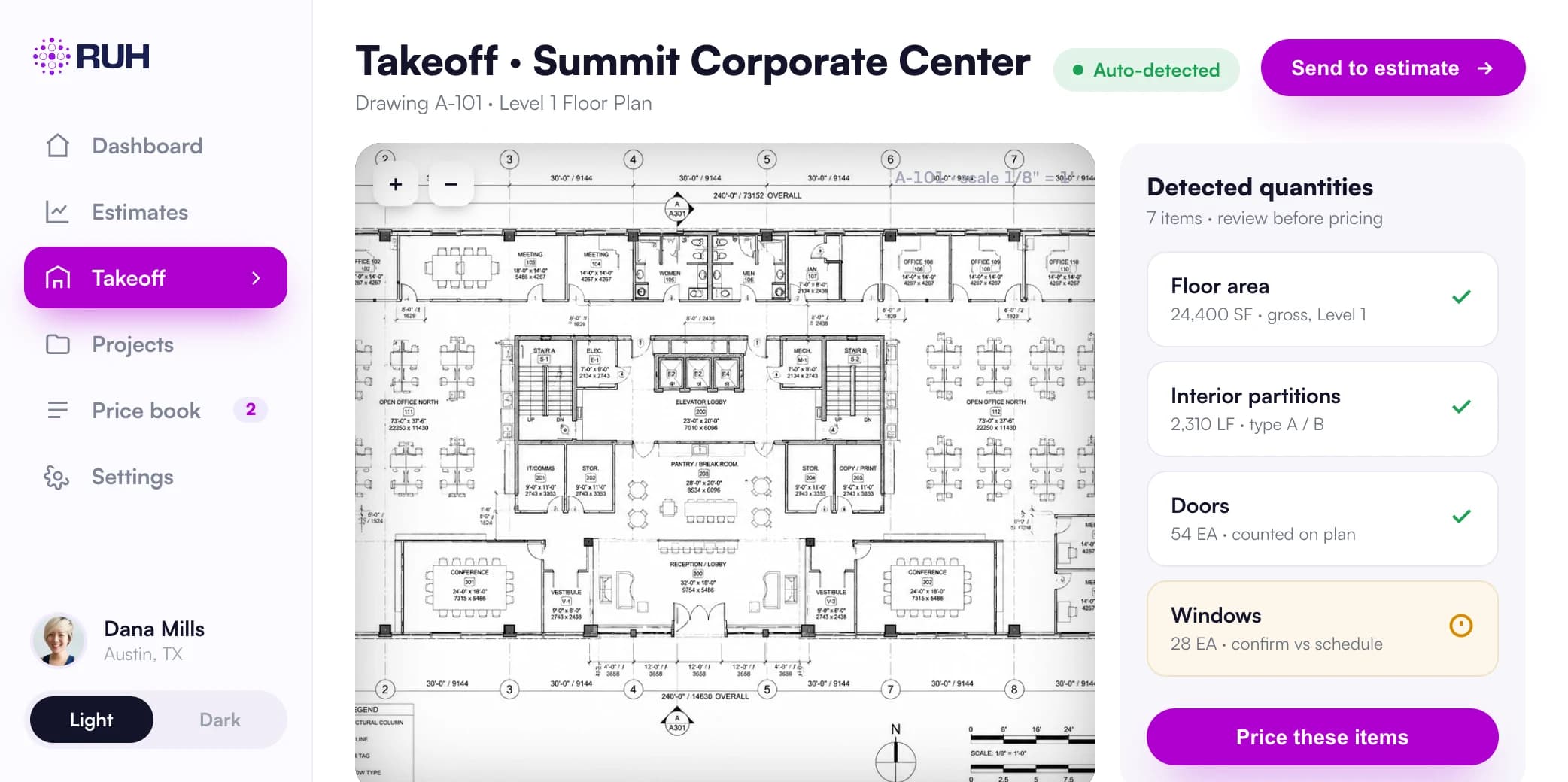
Ruh measures the slab and flatwork areas from the drawings, then prices curing from the contractor's own price book, whether that is cure compound per gallon, blankets per sf, or a winter protection assembly. Because the quantity ties to the same measured areas as the finish, the curing line lands in the draft estimate instead of being remembered late. The estimator reviews the method and seasonal assumptions and signs off.

See concrete estimating software

Concrete curing: frequently asked questions

How long does concrete take to cure?+

Design strength is verified at 28 days, but curing protection matters most in the first 3 to 7 days, when the spec typically requires continuous moisture. Concrete keeps gaining strength for months afterward. The schedule answer most teams use: foot traffic in 1 to 2 days, light loads near 7 days, and full design loading per the engineer, not the calendar.

What is the difference between curing and drying?+

Curing is hydration, the chemical reaction between cement and water that builds strength, and it needs water retained in the slab. Drying is water leaving the slab, which matters for flooring moisture limits. A slab can be fully cured and still too wet for glue down flooring, which is why moisture testing is a separate spec requirement.

Does cure compound replace wet curing?+

Only where the spec allows it. Membrane compounds seal moisture in and are the cheap default for most flatwork, but some specs demand wet curing for durability critical slabs, and some compounds conflict with flooring adhesives and must be removed. Check section 03 30 00 and the flooring spec before pricing the cheaper method.

Still measuring by hand? Your next takeoff can run while you review this one.

See it on your plans

Related terms

Keep going: read the full guide or explore concrete estimating software.

The Concrete and masonry estimating cheat sheet
Every unit, waste factor, and conversion on one page. Free PDF.

See Ruh price a bid from your own drawings.

AI takeoff and estimating on your price book, your estimator signs off.

Figures on this page are illustrative. Construction estimates depend on project-specific conditions, source documents, market pricing, and professional judgment. Ruh's AI assists the estimator and does not replace professional review: your team reviews, validates, and approves every estimate, bid, and pricing decision.