

TL;DR / Summary:
ReAct (Reasoning + Acting) is a transformative AI framework that dramatically improves accuracy by having AI agents think step-by-step, use external tools like search engines, and verify facts before answering, reducing errors by over 60%.
In this guide, we will discover how ReAct’s transparent, adaptable process is ideal for complex business tasks from customer support to sales automation and learn how to leverage platforms like Ruh AI to implement these intelligent agents. While it involves trade-offs in speed and cost, ReAct represents a fundamental shift toward reliable, trustworthy AI problem-solving that is already delivering competitive advantages.
Ready to see how it all works? Here’s a breakdown of the key elements:
- What is ReAct? Breaking Down the Framework
- ReAct vs Reactive Systems: Clearing the Confusion
- How ReAct Agents Work: The Three-Step Process
- Key Benefits: Why Organizations Choose ReAct
- ReAct vs Other AI Approaches
- Implementing ReAct: Getting Started
- Real Business Applications
- Understanding the Limitations
- Your Next Steps
- The Future of AI Agents
- Frequently Asked Questions
What is ReAct? Breaking Down the Framework
ReAct stands for Reasoning and Acting, an AI framework introduced by researchers from Princeton University and Google in 2022 that teaches large language models (LLMs) to think before they act.
Unlike traditional AI systems that separate decision-making from execution, ReAct agents combine both. They pause to reason through problems step-by-step, take actions to gather information from external sources, and observe results before moving forward. It's like watching a human think out loud while solving a puzzle.
According to the original research paper, ReAct agents achieve over 49% success rates on complex question-answering tasks a 3.5x improvement over traditional approaches that scored just 14%.
Why ReAct Matters for Business
If you've experienced AI confidently giving wrong answers (called "hallucinations"), ReAct provides the solution. By forcing AI to verify information with external sources and show its reasoning, it dramatically reduces errors. This makes ReAct perfect for business applications where accuracy isn't optionalit's essential.
Companies using ReAct-based systems for customer service, sales automation, and data analysis report significant improvements in both accuracy and user trust.
ReAct vs Reactive Systems: Clearing the Confusion
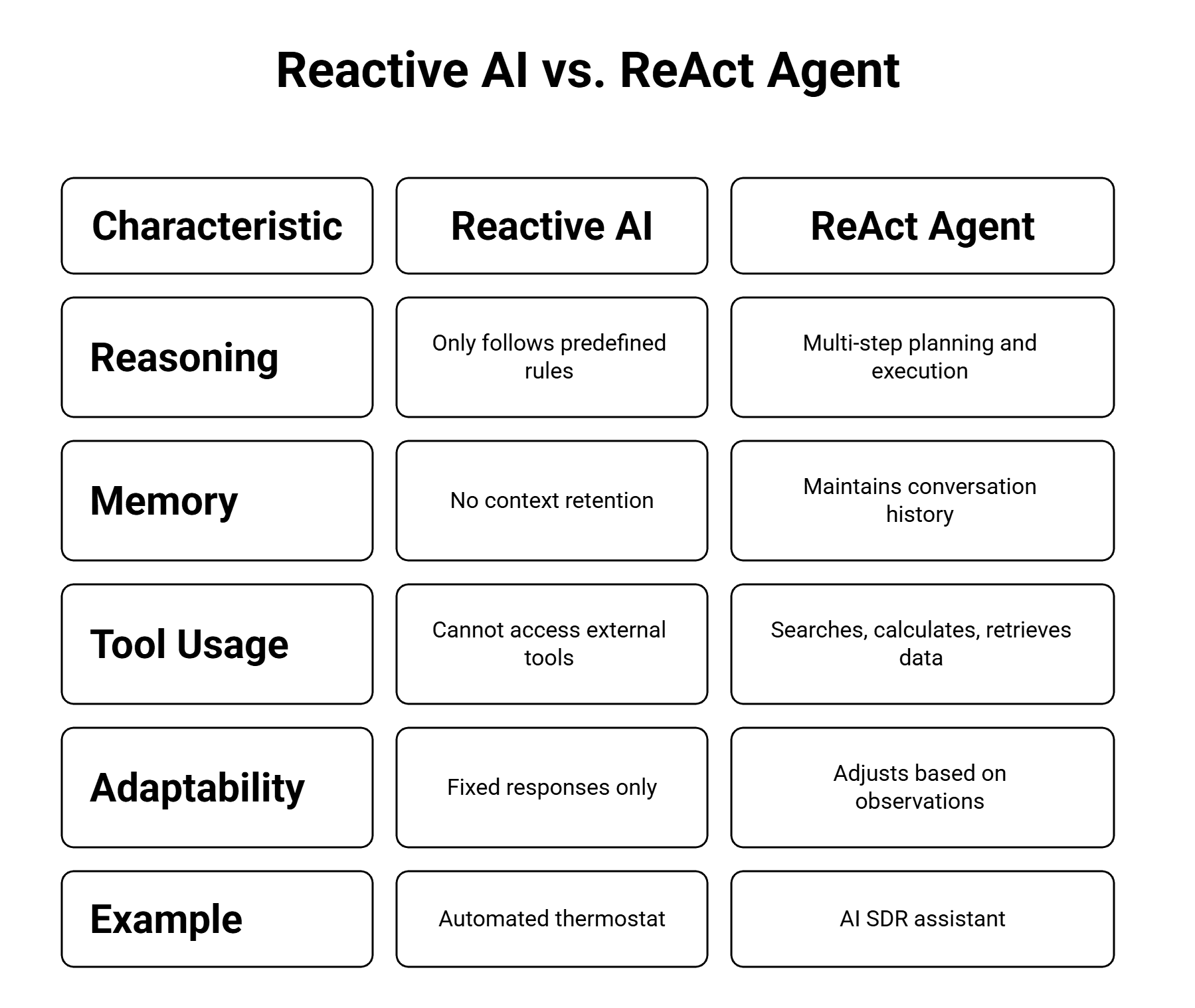
Many people confuse ReAct with "reactive" systems. Let's clear this up immediately—they're completely different technologies.
Reactive AI systems are simple stimulus-response machines. Think of a thermostat: temperature drops, heater turns on. No thinking, no memory, just automatic reactions to inputs. A reactive agent follows pre-programmed rules without reasoning.
ReAct agents think through problems dynamically, use external tools, maintain context, and adapt their approach based on what they learn. They're more like a strategic chess player than a knee-jerk reflex.
For businesses looking to implement intelligent automation, understanding this distinction is critical. Platforms like Ruh.AI build on ReAct principles to create adaptive AI agents for sales, marketing, and developer workflows.
How ReAct Agents Work: The Three-Step Process
ReAct operates like a detective solving a case—think through evidence (Thought), investigate leads (Action), examine findings (Observation), then repeat until solved.
The Core Loop: Thought → Action → Observation
1. Thought (Planning)
The AI analyzes the problem and plans its next move. For example: "I need the iPhone launch date. I should search Wikipedia for this information."
This verbalized chain of thought reasoning breaks complex tasks into manageable subtasks.
2. Action (Execution)
Based on its plan, the AI executes an action:
- Searches databases or APIs
- Performs calculations
- Retrieves documents
- Queries knowledge bases
The agent might execute: Search[iPhone release date]
3. Observation (Learning)
The AI receives and analyzes feedback: "The iPhone was released on June 29, 2007."
Here's what makes ReAct powerful: the agent evaluates whether this information is sufficient or if it needs to continue investigating.
Real-World Example
Watch how a ReAct agent handles this tricky question: "What year did the film featuring 'Shallow' win Best Picture?"
Thought 1: I need to identify which film featured "Shallow" Action 1: Search[Shallow song film] Observation 1: "Shallow" is from "A Star Is Born" (2018) Thought 2: Did "A Star Is Born" win Best Picture? Action 2: Search[A Star Is Born 2018 Best Picture winner] Observation 2: "A Star Is Born" was nominated but didn't win. "Green Book" won Best Picture in 2019. Thought 3: The question contains a false premise Action 3: Finish[A Star Is Born (2018) featured "Shallow" but did not win Best Picture, though nominated]
Notice how the agent didn't hallucinate an answer—it verified facts and caught the trick in the question. This level of accuracy is why businesses trust ReAct agents for critical decisions.
Key Benefits: Why Organizations Choose ReAct
1. Complete Transparency
Every reasoning step is visible. When AI agents make decisions, you see the entire thought process. This matters for:
- Compliance: Audit trails for regulated industries
- Debugging: Identify exactly where processes break
- Trust: Stakeholders can verify AI logic
IBM research shows interpretability is a top reason enterprises adopt ReAct frameworks.
2. Dramatically Fewer Errors
ReAct reduces AI hallucinations by over 60% compared to standard prompting, according to HotPotQA benchmark testing. By grounding responses in verified external data, ReAct agents deliver accuracy that builds user confidence.
3. Handles Multi-Step Complexity
Need to compare prices across multiple websites, calculate shipping, and recommend the best deal? Traditional AI struggles. ReAct agents excel:
- Search vendor A pricing
- Search vendor B pricing
- Search vendor C pricing
- Calculate total costs with shipping
- Compare and provide recommendation
Each step builds on the last, adapting if unexpected issues arise.
4. Seamless Tool Integration
ReAct agents connect with existing business systems:
- Search engines (Google, Bing)
- CRM platforms (Salesforce, HubSpot)
- APIs for real-time data
- Internal databases and knowledge bases
- Custom enterprise tools
This makes them practical for production environments. Ruh.AI's platform leverages this capability to deploy ReAct agents across sales, marketing, and operational workflows.
ReAct vs Other AI Approaches
ReAct vs Chain of Thought (CoT)
Both use step-by-step reasoning, but there's a crucial difference:
- Chain of Thought: AI reasons internally without accessing external information
- ReAct: AI reasons and interacts with external tools and data sources
When to use CoT: Math problems, logic puzzles, internal planning When to use ReAct: Research, fact-checking, real-time data retrieval
Think of CoT as thinking with your eyes closed, while ReAct thinks with access to Google, Wikipedia, and your company database.
ReAct vs Function Calling
Function calling (used by GPT-4, Claude, and others) is faster and more efficient for predictable tasks with clear tool requirements. The model outputs structured commands to execute specific functions.
Function Calling is better for: Straightforward tasks with known tool sequences ReAct is better for: Complex scenarios requiring adaptive reasoning and unpredictable tool usage
For dynamic business environments where conditions change, ReAct's flexibility often outweighs function calling's speed advantage.
Implementing ReAct: Getting Started
Modern frameworks make building ReAct agents accessible, even for teams new to AI development.
What You Need
- An LLM: OpenAI's GPT-4, Anthropic's Claude, IBM Granite, or Google Gemini
- A Framework: LangChain or LlamaIndex (open-source)
- Tools/APIs: Wikipedia, Google Search, or custom business APIs
- Basic Python: If-else logic and API calls are sufficient
Quick Implementation Overview
python
# Pseudo-code structure
- Define available tools (search, calculate, retrieve)
- Give AI a task
- Loop:
- AI generates reasoning (thought)
- AI selects appropriate action
- Execute action, return results
- AI observes outcome
- Decision: continue or provide final answer?
- Return completed response
Platforms like LangGraph provide pre-built ReAct templates. You define tools; the framework handles the reasoning loop.
For businesses seeking turnkey solutions, Ruh.AI offers ready-to-deploy ReAct agents with pre-configured integrations for common enterprise tools—no coding required.
Real Business Applications
Customer Support Excellence
ReAct agents transform support by:
- Searching knowledge bases for relevant solutions
- Checking customer account status in real-time
- Calculating refunds or delivery dates accurately
- Providing personalized, context-aware responses
Companies report 40% faster resolution times compared to scripted chatbots (IBM, 2024).
Intelligent Sales Automation
AI SDR agents powered by ReAct can:
- Research prospect companies and pain points
- Retrieve relevant case studies from CRM
- Personalize outreach based on multiple data points
- Schedule meetings and update pipelines
Discover how Ruh.AI's SDR Sarah uses ReAct principles to qualify leads and automate sales workflows.
Data Analysis & Research
ReAct agents handle complex analytical tasks:
- Query databases with natural language
- Cross-reference multiple data sources
- Identify patterns and anomalies
- Generate executive summaries with full transparency
Perfect for marketing analytics, financial modeling, and competitive intelligence.
Developer Assistance
ReAct agents excel at debugging because they can:
- Interpret error messages contextually
- Search documentation and Stack Overflow
- Test potential fixes iteratively
- Verify solutions work before suggesting
Explore developer-focused AI tools that leverage ReAct for code assistance.
Understanding the Limitations
ReAct isn't perfect. Here are honest challenges you'll face:
1. Latency Trade-offs
Each thought-action-observation cycle takes time. Simple queries answered in 2 seconds might take 10-15 seconds with ReAct reasoning.
The trade-off: Speed vs accuracy. For critical business decisions, the extra validation time is worth it.
2. Higher Token Costs
ReAct agents use 3-5x more tokens due to reasoning traces. At OpenAI's pricing, this means $0.01 per query vs $0.003 for direct answers.
Solution: Reserve ReAct for high-value tasks; use simpler methods for routine queries.
3. Dependent on Tool Reliability
Your agent is only as good as its tools. API downtime or incorrect data affects agent performance.
Solution: Implement error handling, fallback tools, and monitoring.
Your Next Steps
For Business Leaders
- Identify use cases: Where do teams spend time searching for information?
- Start with Ruh.AI's platform: Deploy ReAct agents without coding
- Pilot with one team: Test sales, marketing, or support workflows
- Measure impact: Track time saved and accuracy improvements
- Schedule a demo to see ReAct agents in action
For Developers
- Explore open-source tools: LangChain ReAct documentation
- Build with IBM Granite: Enterprise-ready LLMs optimized for agents
- Join developer communities for ReAct implementation guidance
- Read the original paper: Understand the research foundation
For Everyone
- Try ReAct agents: ChatGPT's web browsing uses ReAct-style reasoning
- Take free courses: IBM's ReAct tutorials
- Explore Ruh.AI's blog for implementation case studies
The Future of AI Agents
ReAct represents a fundamental shift from AI as a text generator to AI as an intelligent problem-solver. As multi-agent systems and agentic workflows become standard, ReAct's combination of transparency, accuracy, and adaptability positions it as a cornerstone technology.
Organizations implementing ReAct agents today are building competitive advantages that will compound over time. The question isn't whether to adopt ReAct—it's how quickly you can integrate it into your workflows.
Ready to transform your business with ReAct AI agents? Connect with Ruh.AI to explore custom solutions for your industry.
Frequently Asked Questions
What is a ReAct agent?
Ans: A ReAct agent is an AI agent that combines reasoning (step-by-step thinking) with acting (using external tools and data). Unlike traditional AI that just generates text, ReAct agents search databases, call APIs, verify information, and show their complete thought process.
Is ChatGPT a reactive AI?
Ans: No. Reactive AI systems have no memory and only respond to immediate inputs with fixed rules (like a thermostat). ChatGPT is a large language model that maintains conversation context and can use ReAct-style reasoning when connected to tools like web browsing.
What's the difference between React and ReAct?
Ans:
- React (lowercase 'a'): JavaScript library for building user interfaces
- ReAct (uppercase 'A'): AI framework for reasoning and acting in language models
Completely different technologies with similar names.
What are the 7 types of AI agents?
Ans:
- Simple Reflex Agents (stimulus-response only)
- Model-Based Reflex Agents (maintain internal state)
- Goal-Based Agents (work toward objectives)
- Utility-Based Agents (optimize outcomes)
- Learning Agents (improve over time)
- Hierarchical Agents (operate at multiple levels)
- Multi-Agent Systems (coordinated agent teams)
ReAct agents typically combine goal-based, utility-based, and learning capabilities.