
TL: DR / Summary:
The global AI agents market is projected to surge from $7.63 billion in 2025 to $47.1 billion by 2030, driven by their ability to perceive environments, make decisions, and act autonomously to achieve goals. In this guide, we will discover the seven fundamental types of AI agents from basic Simple Reflex systems to advanced Multi-Agent networks along with their real-world applications, a practical decision framework for selection, and common implementation pitfalls to avoid, providing a complete roadmap for leveraging this transformative technology in your organization.
Ready to see how it all works? Here’s a breakdown of the key elements:
- Quick Comparison: All 7 AI Agent Types
- What Are AI Agents?
- The 7 Types of AI Agents Explained
- Real-World Industry Applications
- Common Implementation Mistakes and Solutions
- Decision Framework: Selecting Your AI Agent Type
- The Future of AI Agents: 2025 and Beyond
- Conclusion: The Path Forward with AI Agents
- Frequently Asked Questions
Quick Comparison: All 7 AI Agent Types
What Are AI Agents?
AI agents are software programs that perceive their environment, make decisions, and take autonomous actions to achieve goals without constant human supervision. Unlike traditional software with rigid instructions, AI agents adapt intelligently.
Core characteristics: Autonomy (operates independently), Reactivity (responds to changes), Proactivity (initiates actions toward goals), Social ability (collaborates with other agents and humans).
The global AI agents market is expanding from $7.63 billion in 2025 to a projected $47.1 billion by 2030, representing 44.8% annual growth. According to McKinsey's 2025 research, 88% of organizations now use AI regularly, with 23% actively scaling agentic AI systems, though only 6% achieve high-performer status capturing significant enterprise value.
The 7 Types of AI Agents Explained
1. Simple Reflex Agents
What it is: The most foundational AI agent type operating through condition-action rules. These agents respond instantaneously to current environmental states without memory of past events pure stimulus-response systems optimized for speed and predictability.
How it works: Simple reflex agents execute a three-step cycle:
- Sensors perceive the current environmental state
- Agent matches observations against predefined "if-then" rules
- The system executes the corresponding action immediately.
No historical context influences decisions only present conditions matter. IBM's AI agent research classifies these as the foundational building blocks of intelligent automation, particularly effective in fully observable, stable environments where millisecond response times are critical.
Real-world examples: Automated doors (motion → open), smart lighting (occupancy → activate), basic thermostats (temp < threshold → heat on), industrial safety systems (person in danger zone → halt machinery).
When Ruh AI deploys simple reflex agents: For a manufacturing client's warehouse safety system, sensors detect personnel in hazardous zones and instantly activate alarms while halting robotic equipment. No complex decisions just a millisecond reaction time, achieving 99.9% reliability.
Advantages: Lightning-fast response (milliseconds), minimal computational overhead, easy implementation and testing, predictable deterministic behavior.
Disadvantages: Zero adaptability to new situations, no learning capability, requires full environment observability, risk of infinite behavioral loops.
Use when: Environment is stable, rules are comprehensively defined, speed matters more than flexibility. Ideal for intelligent automation in controlled settings.
Avoid when: Conditions change frequently, historical context matters, or adaptation to unexpected scenarios is required. See our simple reflex agents guide for implementation details.
2. Model-Based Reflex Agents
What it is: Enhanced reflex agents maintaining internal environmental representations (world models) that enable informed decision-making when complete observability isn't available. These agents bridge the gap between pure reactive systems and deliberative reasoning.
How it works: Model-based agents operate through enriched cognition: sensors gather current data, internal models update combining observations with historical knowledge, decision rules evaluate both immediate perceptions and maintained state, then actions execute based on richer contextual understanding. According to MIT's AI research, training agents with appropriate internal models dramatically improves performance in uncertain environments, sometimes counterintuitively; training in less noisy conditions produces better real-world results.
Real-world examples: Robot vacuums (map rooms, remember cleaned areas), self-driving cars (track vehicles out of view), smart home systems (learn routines, adjust behavior), medical diagnosis platforms (consider patient history plus current symptoms).
When Ruh AI deploys model-based agents: For a retail chain's inventory optimization, agents maintain models of sales patterns, supplier lead times, seasonal variations, and current stock. This memory-enhanced approach reduced stockouts by 42% while cutting excess inventory costs 28% versus simple rule-based systems.
Advantages: Handles partial observability, contextual decision-making incorporating history, significantly smarter than simple reflex, multi-factor tracking capability.
Disadvantages: Higher computational requirements, model accuracy dependency, still rule-bound (can't learn new rules), increased development complexity.
Use when: Complete visibility isn't available, patterns develop over time, historical context impacts decisions. Excellent for reasoning agents in dynamic environments.
Avoid when: Environment is fully observable, history doesn't matter, or learning capability is essential. Read our model-based reflex agents guide for comprehensive coverage.
3. Goal-Based Agents
What it is: Strategic AI agents performing deliberate planning to achieve defined objectives. Unlike reactive systems, these agents evaluate action sequences considering future consequences, selecting paths most likely to reach desired outcomes efficiently.
How it works: Goal-based agents employ forward-looking decision mechanisms: explicit goals define desired end states, state evaluation assesses current position relative to objectives, planning algorithms explore potential action sequences using search techniques, path selection identifies optimal routes to goals, then execution proceeds with continuous progress monitoring. IBM's enterprise AI deployment research emphasizes that goal-based agents excel in complex planning scenarios but require well-defined objectives and effective algorithms to perform optimally in dynamic business environments.
Real-world examples: GPS navigation (optimal routes considering traffic), game-playing AI (chess programs planning moves ahead), delivery route optimization (minimize time meeting commitments), project management tools (sequence tasks by dependencies).
When Ruh AI deploys goal-based agents: For a logistics company's last-mile delivery, agents plan optimal routes dynamically throughout the day. When delays occur, agents replan automatically, maintaining on-time rates improving efficiency 34%, reducing fuel costs 23%.
Advantages: Strategic flexibility with multiple pathways, adapts when obstacles appear, excellent for complex planning, clear success metrics.
Disadvantages: Computationally intensive planning, struggles with conflicting objectives, doesn't differentiate outcome quality, can deadlock if goals become unreachable.
Use when: Objectives are clearly defined, multiple solution paths exist, flexibility matters more than optimization. See our goal-based agents guide.
Avoid when: Real-time speed is critical or multiple competing objectives must be balanced.
4. Utility-Based Agents
What it is: Advanced optimization agents that don't merely achieve goals they maximize outcome quality by quantifying the desirability of different states. These agents balance competing objectives through mathematical utility functions, finding optimal trade-offs across complex constraint spaces.
How it works: Utility-based agents employ sophisticated evaluation: utility functions assign numeric values representing outcome "goodness," prediction mechanisms forecast action consequences, calculation processes score each possibility across multiple criteria, then optimal selection chooses actions with highest expected utility. Research from MIT Technology Review emphasizes that successful utility-based agent deployment requires grounding in specific business problems rather than pursuing technological complexity for its own sake organizations must define utility functions reflecting genuine business value, not abstract optimization.
Real-world examples: Investment portfolio management (balance risk/reward), e-commerce recommendations (relevance + profit + inventory), dynamic pricing (maximize revenue while staying competitive), cloud resource allocation (performance vs. cost optimization).
When Ruh AI deploys utility-based agents: For an e-commerce platform, agents optimize recommendations, balancing customer preference match, inventory turnover, profit contribution, and purchase likelihood achieving 41% conversion increase and 28% higher order values versus simple relevance ranking.
Advantages: Handles conflicting objectives elegantly, makes rational defensible decisions, works under uncertainty, finds truly optimal solutions.
Disadvantages: Defining utility functions is challenging, computationally expensive, may produce unexpected behavior with poor design, difficult to explain stakeholders.
Use when: Multiple competing objectives exist, outcome quality varies significantly, or defensible optimization is needed. See our utility-based agents guide.
Avoid when: Objectives are simple, real-time speed matters, or easily understandable logic is required.
5. Learning Agents
What it is: Adaptive AI agents that autonomously improve performance through experience, becoming progressively more effective without explicit reprogramming. These represent a fundamental shift from static rule-following to dynamic capability enhancement.
How it works: Learning agents integrate four critical components: performance elements execute actions based on current knowledge, critics evaluate outcomes against success standards providing feedback, learning elements modify strategies and decision rules based on performance data, and problem generators suggest exploratory actions discovering superior approaches. According to MIT Sloan research on AI agent collaboration, learning agents benefit significantly from "personality pairing" matching agent learning styles with task requirements and human collaborator characteristics to optimize performance. Their studies show that properly configured learning agents can dramatically outperform static rule-based systems in complex, evolving environments.
Real-world examples: Netflix recommendations (learn from viewing patterns), fraud detection (adapt to new scam tactics), customer service chatbots (improve from interactions), advanced spam filters (learn new patterns automatically).
When Ruh AI deploys learning agents: For a healthcare provider's patient triage system, agents started with basic medical knowledge but learned from 100,000+ interactions accuracy improved from 76% at launch to 94% after 18 months, now matching experienced nurses. McKinsey research shows tasks AI agents complete with 50% success rates double every seven months, with projections suggesting four-day autonomous work capacity by 2027.
Advantages: Adapts automatically to changes, discovers hidden patterns, improves continuously, handles unprecedented complexity.
Disadvantages: Requires substantial training data, can learn incorrect behaviors from bad data, poor early performance, resource intensive.
Use when: Patterns change frequently, optimal strategies unknown, or environments too complex for manual rules. Essential for modern learning agents.
Avoid when: Behavior must be predictable, training data insufficient, or transparency required for compliance.
6. Hierarchical Agents
What it is: Organizationally structured AI agents distributing decision-making across multiple abstraction levels strategic planning at top tiers, tactical coordination in middle layers, operational execution at bottom levels. This architecture mirrors human organizational hierarchies for managing complexity at scale.
How it works: Hierarchical systems function through layered delegation: strategic layers define overall objectives and allocate resources across major initiatives, tactical layers translate high-level goals into actionable sequences coordinating across units, operational layers execute specific tasks responding to real-time conditions. Each tier operates at appropriate granularity without overwhelming detail from other levels. IBM's watsonx Orchestrate platform exemplifies this approach, functioning as a multi-agent supervisor enabling hierarchical coordination across enterprise applications from strategic business logic through tactical workflow management down to operational API execution.
Real-world examples: Warehouse management (strategic inventory planning → zone coordination → individual robot control), military command structures, smart factory automation (production scheduling → workstation coordination → machine control), large infrastructure management. When Ruh AI deploys hierarchical agents: For a manufacturing operation across 47 facilities, strategic agents optimize production allocation, tactical agents coordinate facility operations, operational agents control equipment. This enabled global coordination with local flexibility improving equipment effectiveness 31%.
Advantages: Manages exceptional complexity, highly scalable, specialized methods per layer, easier comprehension and debugging.
Disadvantages: Communication overhead between layers, potential inefficiency without coordination, complex initial design, cascading failures possible.
Use when: Decisions stratify into strategic/tactical/operational categories or scale demands structure. Perfect for enterprise intelligent automation.
Avoid when: Problems are simple, flat structures suffice, or coordination overhead exceeds benefits.
7. Multi-Agent Systems (MAS)
What it is: Complex ecosystems where multiple independent AI agents interact cooperating, negotiating, or competing to solve distributed problems exceeding any single agent's capabilities. These systems represent the cutting edge of AI agent technology, enabling unprecedented scalability and robustness.
How it works: Multi-agent systems operate through sophisticated interaction protocols: autonomous agents pursue individual goals with independent decision-making, communication mechanisms enable information exchange via standardized protocols (FIPA-ACL, KQML), coordination strategies range from centralized direction through decentralized negotiation to market-based task bidding. Interaction types span cooperative collaboration toward shared objectives, competitive pursuit of conflicting goals, or mixed context-dependent cooperation and competition. MIT's CSAIL research identifies 2025 as a "tipping point" for agentic AI deployment, with projections showing 25% of generative AI companies launching multi-agent pilots in 2025, growing to 50% by 2027. The MIT Center for Information Systems Research now incorporates agentic AI into their Enterprise AI Maturity Model, recognizing that maximum value emerges from combining analytical, generative, agentic, and robotic AI types within multi-agent architectures.
Real-world examples: Smart city traffic management (intersection agents coordinate signal timing), autonomous drone swarms (collaborate for deliveries), distributed power grids (agents manage different sections), multiplayer game AI (different character agents).
When Ruh AI deploys multi-agent systems: For a smart building, separate agents manage HVAC, lighting, security, elevators, and energy storage. When elevators draw peak power, other agents adjust strategies maintaining building-wide optimization reducing energy costs 37% while improving satisfaction.
Advantages: Exceptional robustness (continues if agents fail), natural parallelism (simultaneous action), easily scalable (add more agents), perfect for distributed problems.
Disadvantages: Coordination complexity explodes with scale, emergent behavior unpredictability, communication bottlenecks possible, debugging extremely difficult.
Use when: Problems are distributed, no single agent has complete information, robustness critical, or parallelism offers advantages. For organizations ready to implement, Ruh AI's solutions provide enterprise-grade multi-agent orchestration.
Avoid when: Single agent suffices, coordination overhead exceeds benefits, or debugging resources limited.
Real-World Industry Applications
Healthcare Transformation
Model-based agents: Monitor patient vital signs continuously, maintaining historical baselines to detect concerning deviations requiring immediate clinical attention.
Learning agents: Analyze thousands of case histories to predict disease progression risk, recommend preventive interventions, and personalize treatment protocols.
Multi-agent systems: Coordinate hospital-wide resources including bed allocation, staff scheduling, equipment distribution, and supply chain management.
Measurable impact: According to industry research, 90% of hospitals worldwide are expected to adopt AI agents by 2025, with these systems already automating 89% of clinical documentation tasks significantly enhancing healthcare provider efficiency and reducing administrative burden.
Financial Services Innovation
Utility-based agents: Optimize investment portfolios by balancing risk tolerance, return objectives, liquidity requirements, tax implications, and regulatory constraints simultaneously.
Learning agents: Detect fraudulent transactions by continuously learning new fraud patterns and adapting to evolving criminal tactics in real-time.
Goal-based agents: Execute algorithmic trading strategies that plan multi-step sequences to achieve position objectives while minimizing market impact.
Measurable impact: Financial institutions report 38% increase in profitability projections through 2035 attributed to AI agent integration. Companies using these systems achieve 30% reduction in operational costs while autonomously handling 80% of customer service interactions.
Manufacturing Excellence
Simple reflex agents: Control assembly line components with millisecond-precision responses to sensor inputs, ensuring perfect timing and coordination.
Hierarchical agents: Manage production planning from strategic capacity allocation through tactical scheduling down to operational machine control.
Multi-agent systems: Coordinate flexible manufacturing cells where robots, conveyors, quality control systems, and logistics work together autonomously.
Measurable impact: Manufacturing organizations implementing AI agents report 55% efficiency increases and 35% cost reductions on average. AI-driven predictive maintenance reduces equipment downtime by 40%, generating substantial cost savings.
Customer Service Enhancement
Learning agents: Power conversational chatbots that continuously improve response accuracy by learning from successful customer interactions and expert feedback.
Model-based agents: Track customer histories and interaction patterns to provide personalized, context-aware support experiences.
Utility-based agents: Route support tickets intelligently by optimizing agent expertise match, workload balance, and case urgency simultaneously.
Measurable impact: Organizations using AI agents report 75% improvement in customer satisfaction scores. Systems handle routine inquiries with 90% resolution rates, freeing human agents for complex cases requiring empathy and creative problem-solving.
For organizations in sales and marketing, Ruh AI's AI SDR solution demonstrates how learning agents can revolutionize lead qualification, nurturing, and conversion processes autonomously managing entire sales workflows from initial contact through meeting scheduling.
Common Implementation Mistakes and Solutions
Mistake #1: Overcomplicating Simple Problems
Problem: Retail client deployed learning agents for basic inventory alerts.
Result: 6 months, $200K, unpredictable behavior.
Solution: Ruh AI replaced with simple reflex agents 2 weeks, 99.9% reliability, 15% of cost.
Lesson: Start with simplest agent meeting requirements. 40% of use cases work perfectly with simple/model-based agents.
Mistake #2: Underestimating Learning Agent Requirements
Problem: Financial firm deployed learning agents without adequate data infrastructure.
Result: 62% accuracy vs. 95% target, high false positives.
Solution: Established proper data collection, labeling workflows, monitoring accuracy improved to 97% in 6 months.
Lesson: Learning agents need 3-5x more investment than alternatives.
Mistake #3: Ignoring Multi-Agent Coordination
Problem: Logistics company deployed 200 agents without coordination protocols.
Result: Conflicting decisions, 23% worse than centralized system.
Solution: Implemented coordination mechanisms 41% improvement above baseline. Lesson: Multi-agent systems require sophisticated coordination infrastructure.
Decision Framework: Selecting Your AI Agent Type
Step 1: Assess Environment
Is everything observable? Yes → Simple Reflex | Partial → Model-Based/Learning | Distributed → Multi-Agent How often do patterns change? Rarely → Simple/Model-Based | Occasionally → Goal/Utility-Based | Constantly → Learning Centralized or distributed? Centralized → Single-agent | Distributed → Multi-Agent | Multi-level → Hierarchical
Step 2: Define Success Criteria
Single or multiple goals? Single → Goal-Based | Multiple trade-offs → Utility-Based | Goals evolve → Learning Speed vs. optimization? Speed paramount → Simple Reflex | Optimize → Utility/Learning | Both → Model-Based Must improve over time? No → Any non-learning | Yes → Learning mandatory
Step 3: Evaluate Readiness
Technical expertise? Limited → Simple/Model-Based | Moderate → Goal/Utility-Based | Advanced → Learning/Multi-Agent Budget/timeline? Fast/limited → Simple/Model-Based | 3-6 months → Goal/Utility | 6-18 months → Learning/Multi-Agent Explainability needs? Must explain → Simple/Goal-Based | Some transparency → Model/Utility-Based | Performance focus → Learning
Step 4: Prototype and Validate
Build minimum viable version (2-4 weeks), test with realistic data, measure against success criteria, upgrade only if needed.
The Future of AI Agents: 2025 and Beyond
Increased Autonomy: McKinsey research shows tasks agents complete with 50% success double every 7 months projections suggest 4-day autonomous work capacity by 2027. Technologies could automate 57% of U.S. work hours through human-AI partnerships.
Enhanced Collaboration: New coordination protocols enable sophisticated multi-agent systems at scale. Organizations build "agentic networks" where humans and AI collaborate as equals in flat, outcomes-focused structures.
Edge Deployment: Agents increasingly run on local devices for millisecond response times in autonomous vehicles, industrial robotics, real-time fraud detection improving privacy while reducing bandwidth costs.
Accelerating Adoption: McKinsey's 2025 State of AI reports 88% of organizations use AI regularly, 23% actively scale agentic systems. High performers distinguish themselves by committing 20%+ digital budgets to AI, redesigning workflows around agent capabilities, establishing clear governance frameworks.
Market Growth: From $7.63B (2025) to $47.1-52.6B (2030) at 44.8-46.3% CAGR. Organizations report 55% efficiency increase, 35% cost reduction, 74% positive ROI within first year, 61% productivity boost.
Conclusion: The Path Forward with AI Agents
The AI agent revolution isn't coming it's here. With the market expanding from $7.63 billion in 2025 to a projected $47.1 billion by 2030, and IBM research showing that 83% of executives expect AI agents to improve process efficiency by 2026, the question is no longer "Should we adopt AI agents?" but "How do we implement them successfully?"
The Reality Check: Hype vs. Performance
While enthusiasm for AI agents runs high, organizations must remain grounded. MIT Technology Review's 2025 analysis reveals a sobering reality: many organizations have experienced a "hype correction," discovering that AI agents require more thoughtful implementation than initially assumed. McKinsey's research confirms this pattern 88% of organizations use AI, but only 6% qualify as high performers capturing significant enterprise value.
The gap between adoption and success isn't about technology limitations. It's about strategic implementation. Organizations succeeding with AI agents share common patterns that separate them from those struggling in pilot purgatory.
Five Principles for AI Agent Success
1. Match Complexity to Reality, Not Ambition
The most sophisticated agent type isn't automatically the best choice. In Ruh AI's experience deploying 50+ enterprise systems, we've found that 40% of use cases are optimally served by simple reflex or model-based agents. The "best" agent is the one solving your actual problem most efficiently, not the one impressing at conferences.
Start simple, scale strategically. A retail client wanted learning agents for basic inventory alerts. After six months and $200,000 spent, they achieved 62% accuracy. We replaced it with simple reflex agents in two weeks 99.9% reliability at 15% of the cost. Sometimes the simplest solution is the smartest.
2. Redesign Workflows, Don't Layer AI on Broken Processes
High-performing organizations identified by McKinsey distinguish themselves through one critical practice: they redesign workflows around agent capabilities rather than simply automating existing inefficiencies. This fundamental difference separates transformation from incrementalism.
Think process transformation, not task automation. When implementing agents, first map your ideal workflow assuming perfect automation, then design agents to enable that vision. Don't automate bad processes faster redesign processes around what agents do best.
3. Build Infrastructure Before Scaling
Learning agents require 3-5x more investment than non-learning alternatives in data pipelines, training infrastructure, and monitoring systems. Multi-agent systems demand sophisticated coordination protocols. Organizations that budget for these enablers upfront succeed. Those discovering gaps mid-implementation fail expensively.
IBM's 2025 CDO Study confirms this priority: 75% of Chief Data Officers now have data platforms enabling AI agent integration across silos up dramatically from 41% in 2023. This infrastructure investment directly correlates with AI ROI success.
4. Plan for 10x Scale from Day One
Architectures working perfectly in controlled pilots often collapse in production. A single goal-based agent handling 1,000 recommendations daily will bottleneck at 10,000. Multi-agent systems coordinating five agents face exponentially more complexity at fifty.
Design for scale you'll need in 18 months, not what you need today. This architectural foresight prevents costly rewrites when success demands expansion.
5. Combine Agent Types Strategically
The most successful enterprise deployments don't choose one agent type they orchestrate multiple types working together. Research from MIT's Initiative on the Digital Economy shows that strategic "personality pairing" of different agent capabilities optimizes human-AI collaboration and system performance.
Example architecture: Hierarchical agents provide strategic coordination across business units, utility-based agents optimize resource allocation considering multiple objectives, goal-based agents plan tactical execution sequences, and specialized learning agents adapt to local conditions. Each layer operates at its optimal abstraction level.
The Competitive Imperative
Organizations mastering AI agent implementation now are building insurmountable advantages. IBM research projects that AI-enabled workflows will expand from 3% today to 25% by end of 2025 an 8x surge in a single year. Companies still experimenting while competitors scale will find themselves increasingly unable to compete.
This isn't hyperbole. Companies implementing AI agents effectively report measurable transformation:
- 55% increase in operational efficiency
- 35% reduction in operational costs
- 74% achieve positive ROI within first year
- 61% boost in employee productivity
These aren't marginal improvements they're competitive game-changers that compound over time.
The Bottom Line
Understanding AI agent types isn't academic it's the foundation of successful implementation. Organizations matching agent capabilities to specific needs avoid expensive overengineering mistakes while achieving measurable business outcomes.
Based on Ruh AI's extensive deployment experience, we've learned that success follows a pattern: start appropriately simple, invest in proper infrastructure, redesign workflows strategically, plan for meaningful scale, and combine agent types thoughtfully.
The AI agent market's explosive growth reflects genuine transformational potential. But potential only translates to value through disciplined implementation guided by clear understanding of agent capabilities and limitations.
The organizations capturing competitive advantage aren't those with the most advanced AI they're those implementing the right AI, in the right places, for the right reasons.
Ready to begin your AI agent journey? Explore Ruh AI's solutions designed to help organizations navigate this transformation successfully, or contact our team for consultation on implementing agent systems tailored to your specific business needs.
Frequently Asked Questions
What are the different types of AI agents?
Ans: There are 7 main types of AI agents based on their decision-making capabilities and complexity levels: Simple Reflex Agents (rule-based), Model-Based Reflex Agents (with memory), Goal-Based Agents (planning), Utility-Based Agents (optimization), Learning Agents (adaptive), Hierarchical Agents (structured levels), and Multi-Agent Systems (collaborative). Each type varies in sophistication, from simple reactive systems to complex adaptive networks capable of learning and collaboration.
What are the 5 levels of AI agents?
Ans: The 5 traditional levels established by AI research are: (1) Simple Reflex (Level 1 - reactive responses), (2) Model-Based Reflex (Level 2 - memory and state tracking), (3) Goal-Based (Level 3 - planning toward objectives), (4) Utility-Based (Level 4 - optimization across criteria), and (5) Learning Agents (Level 5 - adaptive improvement). Many modern frameworks add Hierarchical and Multi-Agent Systems as advanced organizational categories beyond these foundational five levels.
What is an AI agent called?
Ans: AI agents are known by various names depending on context and capabilities: intelligent agents (emphasizing cognitive abilities), software agents (highlighting implementation), autonomous agents (focusing on independence), rational agents (stressing logical decision-making), deliberative agents (planning-oriented), reactive agents (immediate response), cognitive agents (human-like reasoning), and conversational agents (dialogue-focused). The terminology reflects different aspects of agent functionality and design philosophy.
How many types of AI agents are there?
Ans: There are 7 main types of AI agents categorized by their decision-making capabilities, memory requirements, learning abilities, and architectural complexity. These range from Simple Reflex Agents (basic stimulus-response) through progressively more sophisticated types to Multi-Agent Systems (collaborative networks). The specific number varies by classification framework some academic sources describe 5 foundational types while practitioners often reference 7 types to include modern hierarchical and multi-agent architectures prevalent in enterprise deployments.
When should organizations use multi-agent systems?
Ans: Multi-agent systems excel in scenarios where: problems are inherently distributed across locations or domains, no single agent possesses complete environmental information, coordination among specialized capabilities yields superior results, robustness through redundancy is critical for mission-critical applications, natural parallelism offers significant performance advantages, or organizational structure maps naturally to agent boundaries. Typical applications include smart city infrastructure, supply chain coordination, autonomous vehicle fleets, distributed manufacturing, and enterprise-wide resource optimization.
How long does it take to implement different agent types?
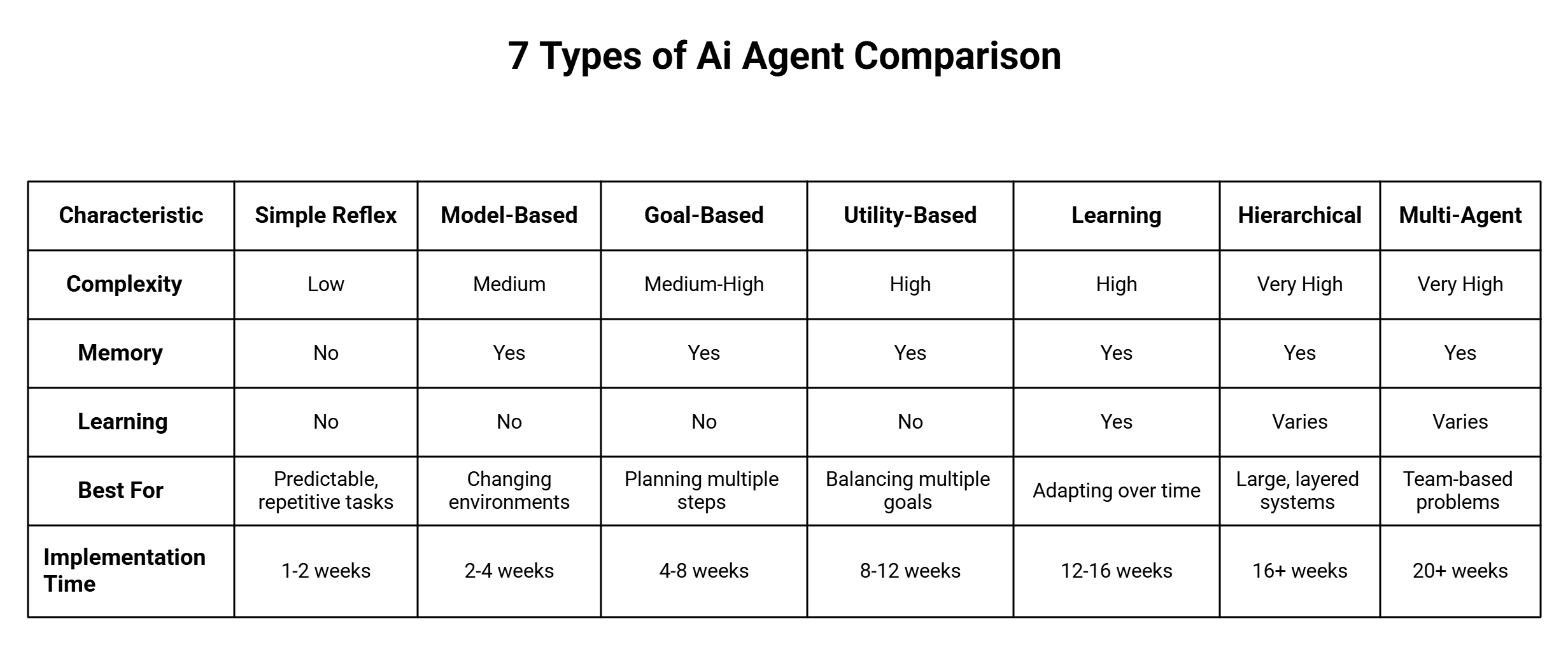
Ans: Implementation timelines vary significantly by agent complexity: Simple Reflex Agents (1-2 weeks for straightforward rules), Model-Based Reflex Agents (2-4 weeks including state modeling), Goal-Based Agents (4-8 weeks with planning algorithms), Utility-Based Agents (8-12 weeks for utility function design), Learning Agents (12-16 weeks including training infrastructure), Hierarchical Agents (16+ weeks for multi-layer coordination), and Multi-Agent Systems (20+ weeks for complex coordination protocols). These estimates assume experienced implementatAns: ion teams; organizations new to AI agents should add 50-100% to timelines for learning curves.
What's the difference between AI agents and chatbots?
Ans: Traditional chatbots follow predetermined conversation scripts, only respond when prompted by users, cannot execute actions beyond the chat interface, and remain limited to text-based interactions without learning capability. In contrast, AI agents make autonomous decisions based on goals and environmental context, can proactively initiate tasks and workflows without human prompting, execute actions across multiple integrated systems and platforms, and continuously learn and improve performance from experience over time. Modern conversational AI blurs these boundaries systems like Ruh AI's solutions combine chatbot interfaces with true agent capabilities for autonomous workflow execution.