
TL: DR / Summary
Single AI agents can't handle your entire sales process effectively. Multi-agent systems are transforming how B2B companies close deals by deploying specialized AI agents that work together like a coordinated sales team.
In this guide, you'll discove, Why multi-agent systems reduce sales cycles by up to 40%, How specialized AI agents handle prospecting, qualification, and follow-ups, Practical implementation steps for your sales team, Real cost analysis and ROI timelines
Ready to see how it all works? Here’s a breakdown of the key elements:
- What is a Multi-Agent System?
- Why Single AI Agents Struggle with Complex Sales
- How Multi-Agent Orchestration Works
- The 4 Multi-Agent Architectures for Sales
- How Multi-Agent Systems Compress Sales Cycles
- Implementation Guide: Your First Multi-Agent System
- Cost-Benefit Analysis: Real ROI Numbers
- Common Implementation Mistakes
- The Hybrid Workforce Model: Humans + AI Agents
- What's Next: Multi-Agent Evolution in 2025-2026
- Getting Started: 30-Day Action Plan
- Key Takeaways
- Ready to Transform Your Sales Process?
- Frequently Asked Questions
What is a Multi-Agent System?
A multi-agent system (MAS) works like a sales team but powered by AI.
Instead of one AI trying to handle everything, you deploy specialized AI agents that each excel at specific tasks. They collaborate, share information, and hand off work seamlessly.
Real-world example:
When a new lead submits a form:
- Research Agent gathers company information and identifies decision-makers
- Qualification Agent scores the lead using BANT, MEDDIC, or CHAMP frameworks
- Outreach Agent creates personalized emails based on research
- Scheduling Agent books meetings automatically when leads respond
- CRM Agent logs all activities without manual data entry
- One lead. Five agents. Zero manual work.
According to Salesforce's State of Sales Report, sales teams using AI report 29% faster sales cycles and 32% higher win rates.
Why Single AI Agents Struggle with Complex Sales
Most AI chatbots are single-agent systems like asking one rep to handle your entire 7-stage sales cycle alone. They break down under complexity.
Critical Problems:
1. Information Overload When one AI accesses your CRM, product catalog, email history, and calendar simultaneously, it experiences the "lost in the middle" effect missing critical details and making tool-selection errors.
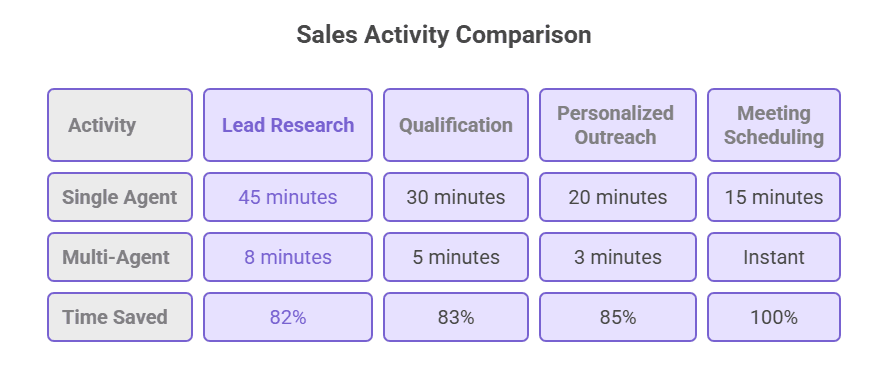
2. Sequential Processing Bottleneck Single agents work step-by-step. While researching one prospect, they can't send follow-ups to others. This creates massive delays across your sales process framework.
3. Generalist Limitations One AI attempting everything becomes mediocre at everything—just like you wouldn't assign your SDR to negotiate enterprise contracts.
How Multi-Agent Orchestration Works
AI orchestration coordinates multiple specialized agents to execute complex workflows. Here's the framework:
Three Core Components:
1. Orchestrator Agent (The Coordinator)
This "manager" agent receives tasks, develops execution plans, and delegates to specialists. It doesn't execute tasks—it coordinates the team.
2. Worker Agents (The Specialists)
Purpose-built agents for specific functions:
Prospector Agent: Enriches lead data from multiple sources Qualifier Agent: Applies your ICP scoring criteria Writer Agent: Generates personalized messaging Researcher Agent: Analyzes company signals and pain points Scheduler Agent: Manages calendar optimization CRM Agent: Maintains data accuracy
3. Communication Protocol
Agents exchange information through structured handoffs. When the Prospector completes research, it passes enriched data to the Qualifier. High-priority leads trigger immediate alerts to the Writer Agent.
Real Implementation: First 72 Hours of Lead Engagement
Hour 1 (Lead Arrives at 9:00 AM)
- Orchestrator receives: "New demo request from Acme Corp"
- Deploys Researcher: Returns company size, tech stack, recent funding news
- Deploys Qualifier: Scores 90/100—matches ICP, high intent
- Deploys Writer: Creates personalized email referencing funding round
- Outreach Agent sends at optimal engagement time (9:15 AM)
Hour 26 (Next Day, 10:30 AM)
- Lead responds: "Interested, can we meet next week?"
- Scheduler Agent checks availability, sends booking options
- Lead books Wednesday 2:00 PM slot
Hour 48 (Meeting Prep)
- Researcher updates: Latest LinkedIn activity, competitor research
- Writer generates meeting brief with tailored talking points
- Sales rep receives prep 24 hours before call
Human involvement: Zero minutes for initial response, research, and scheduling.
Harvard Business Review research shows companies responding within 5 minutes are 21x more likely to qualify leads—precisely what multi-agent systems enable automatically.
The 4 Multi-Agent Architectures for Sales
Different orchestration patterns suit different sales process needs:
1. Hierarchical (Supervisor-Worker)
Structure: Central orchestrator delegates to specialized workers
Best for: Standardized SDR-to-AE handoff processes
Example: Lead qualification pipeline where a coordinator manages prospecting, outreach, and booking agents sequentially
Advantages: Clear accountability, easy management, repeatable workflows
2. Handoff Architecture
Structure: Agents transfer control like a relay race each specialist completes its task before passing to the next
Best for: Multi-stage enterprise sales cycles
Example: SDR Sarah qualifies and hands to AE agent → Demo agent presents → Technical agent handles evaluation → CSM agent manages onboarding
Advantages: Deep specialization at each stage, natural fit for complex sales cycles
3. Swarm (Parallel Processing)
Structure: Multiple agents work simultaneously on different aspects, then synthesize findings
Best for: Enterprise account research and competitive intelligence
Example: Pursuing a strategic account deploys 6 parallel agents:
- Financial analysis agent
- Technology stack agent
- Decision-maker mapping agent
- Competitive positioning agent
- Intent signal monitoring agent
- Risk assessment agent
All work concurrently; orchestrator synthesizes into account strategy.
Advantages: Extremely fast, comprehensive coverage, explores multiple angles
Anthropic's research demonstrates multi-agent systems using parallel processing outperform single agents by 90% on complex research tasks.
4. Cooperative Architecture
Structure: Agents share common objectives and actively collaborate
Best for: Multi-channel account-based campaigns
Example: Coordinating email, LinkedIn, phone, and content:
- Email agent sends personalized sequences
- Social agent engages on LinkedIn
- Content agent recommends relevant resources
- Calling agent schedules phone touches
- All agents share engagement data continuously
Advantages: Unified multi-channel approach, consistent messaging, shared learning
How Multi-Agent Systems Compress Sales Cycles
Speed determines sales outcomes. Inside Sales research shows lead qualification odds drop 10x after just 5 minutes.
Multi-agent systems are engineered for velocity:
Stage 1: Lead Capture → First Contact
Traditional: 4-24 hours (manual queue review, research, email crafting)
Multi-Agent: 2-5 minutes (automated research, qualification, personalized outreach)
Impact: 99% time reduction, 3.5x higher response rates
Stage 2: Qualification → Meeting Booked
Traditional: 3-7 days (email exchanges, scheduling conflicts, multiple reschedules)
Multi-Agent: Same day (automated qualification questions, instant booking links, optimized scheduling)
Impact: 80% faster, 2.4x booking rate
Stage 3: Meeting → Proposal
Traditional: 5-10 days (manual notes, proposal creation, case study search, pricing requests)
Multi-Agent: 1-2 hours (transcription, automated proposal generation, dynamic pricing, relevant case studies)
Impact: 92% time saved, 1.8x proposal acceptance
Documented Results
SaaS Company (50 employees):
- Previous cycle: 45 days
- With multi-agent: 23 days
- Result: 49% faster, 35% more quarterly deals
B2B Manufacturer:
- Previous response: 4 hours
- With multi-agent: 8 minutes
- Result: Lead conversion increased 12% → 31%
Professional Services:
- Previous proposal time: 6 hours
- With multi-agent: 45 minutes
- Result: 40% more opportunities handled per AE
Implementation Guide: Your First Multi-Agent System
Step 1: Process Mapping
Document your current workflow through all 7 stages of your sales cycle:
- Lead capture → CRM entry
- Research requirements
- Qualification criteria
- Handoff points
- Decision-making steps
Step 2: Identify Automation Opportunities
- Target high-volume, repetitive tasks:
- Lead enrichment and research
- Initial outreach personalization
- Follow-up sequence management
- Meeting scheduling
- CRM data entry
These are ideal for AI employee deployment.
Step 3: Choose Your Platform
For Existing CRM Users:
- Salesforce Einstein GPT (integrates natively)
- HubSpot Breeze (built-in automation)
For Custom Workflows:
- Ruh.ai AI SDR (purpose-built for sales teams)
- CrewAI (role-based, easy setup)
- Microsoft AutoGen (enterprise-grade flexibility)
Recommendation: Start with your existing sales stack for fastest deployment and seamless data integration.
Step 4: Start Small—One Workflow
Don't automate everything immediately. Choose your biggest bottleneck:
High-Impact Starter Projects:
- Automated lead research and enrichment (easiest, immediate value)
- Instant first-response system (highest conversion impact)
- Meeting prep automation (saves rep hours)
Step 5: Build Your Core Agent Team
Example: Automated Lead Response System
Research Agent
- Function: Enrich incoming leads with company data, tech stack, employee count, news
- Tools: LinkedIn Sales Navigator API, Clearbit, NewsAPI
- Output: Structured lead profile with key insights
Qualifier Agent
Function: Score against your ICP using proven qualification frameworks
- Tools: Historical conversion data, ICP criteria, scoring model
- Output: Priority classification (Hot/Warm/Cold) with reasoning
Writer Agent
- Function: Generate personalized outreach using research insights
- Tools: Top-performing email templates, voice guidelines, personalization rules
- Output: Ready-to-send email draft
Orchestrator Agent
- Function: Coordinates Research → Qualifier → Writer sequence
- Logic: Only send email if Qualifier scores "Warm" or "Hot"
Step 6: Testing Phase (20-30 Leads)
Review every output before sending. Check:
- Research accuracy and relevance
- Personalization quality
- Brand voice consistency
- Technical errors
Expect initial issues. This is normal. First iterations require refinement.
Step 7: Prompt Optimization
Agent instructions ("prompts") determine output quality. This is critical.
Weak Prompt:
"Research this company and write an email."
Strong Prompt:
"You are an experienced SDR at [Company]. Research {company_name} focusing on: company size, industry, technology stack, recent growth signals. Write a 3-sentence email that: (1) references specific company context, (2) identifies a relevant pain point, (3) offers concrete value based on similar customers. Tone: professional but conversational. Avoid buzzwords and generic claims."
Better prompts = better results. Period.
Step 8: Performance Monitoring
Track essential sales metrics:
Performance Monitoring KPIs
- Lead Response Time : Target: < 5 minutes
- First Contact to Meeting: Target: < 48 hours
- Weekly Meetings Booked: Target: Increase by 30%
- Admin Time per Rep: Target: Decrease by 50%
- Cost per Qualified Lead: Target: Decrease by 40%
Cost-Benefit Analysis: Real ROI Numbers
Current State (10-Person Sales Team)
Weekly time on administrative tasks:
- Research: 50 hours (5 hrs × 10 reps)
- Email writing: 80 hours (8 hrs × 10 reps)
- Data entry: 40 hours (4 hrs × 10 reps)
- Scheduling: 30 hours (3 hrs × 10 reps)
Total: 200 hours/week = $12,000/week at $60/hour fully loaded
Annual cost: $624,000 in rep time on non-selling activities
Multi-Agent System Investment
Understanding AI employee adoption costs:
Platform: $8,000-$18,000/year API usage: $2,000-$4,000/year Initial setup: 60-80 hours Ongoing maintenance: 5 hours/month
Total annual: $22,000-$28,000
Net Impact
Direct savings: $596,000-$602,000 in recovered selling time
Additional benefits:
- 35% more deals closed (faster response)
- 28% higher conversion rates
- 40% increase in pipeline capacity per rep
ROI timeline: Positive returns within 60-75 days for most implementations.
This aligns with broader AI transformation trends showing 3-5x ROI in first year.
Common Implementation Mistakes
Mistake #1: Automating Everything Simultaneously
Problem: System complexity causes frequent failures and team resistance Solution: Master one workflow completely before adding the next. Build confidence through wins.
Mistake #2: Skipping Output Review
Problem: Agents send inaccurate or off-brand messages that damage reputation
Solution: Manually review first 100+ agent interactions. Invest time upfront to refine prompts.
Mistake #3: Generic Agent Instructions
Problem: Messages sound robotic, conversion rates don't improve
Solution: Train agents on your best-performing examples. Feed them your actual winning emails and calls.
Mistake #4: No Escalation Protocols
Problem: Agents mishandle complex situations, frustrating prospects
Solution: Define clear handoff rules: "If pricing exceeds $X, alert human." "If competitor mentioned, loop in AE immediately."
Mistake #5: Data Privacy Gaps
Problem: Sensitive prospect information shared inappropriately or compliance violations Solution: Implement strict access controls. Each agent sees only necessary data. Use SOC 2 certified platforms like Salesforce or Microsoft.
The Hybrid Workforce Model: Humans + AI Agents
The future isn't AI replacing salespeople—it's human-AI collaboration creating superior outcomes.
AI Agents Handle:
- Lead research and enrichment
- Initial outreach and follow-ups
- Meeting scheduling and logistics
- Data entry and CRM hygiene
- Proposal generation drafts
- Performance reporting
Human Reps Focus on:
- Strategic relationship building
- Complex negotiations
- Objection handling requiring empathy
- Custom solution design
- Executive-level conversations
- Deal strategy and closing
This hybrid approach leverages AI efficiency while preserving human judgment where it matters most.
What's Next: Multi-Agent Evolution in 2025-2026
Based on developments from Anthropic, OpenAI, and leading AI labs, expect these advancements:
1. Self-Learning Agent Systems
Agents that analyze top performer behavior and automatically improve their own prompts and strategies without manual updates.
2. Predictive Deal Intelligence
AI orchestration systems that predict close probability with 85%+ accuracy based on engagement patterns and historical data.
3. Autonomous Negotiation Agents
AI agents handling initial pricing discussions and common objections within defined parameters, escalating complex scenarios.
4. Cross-Organization Agent Collaboration
Your scheduler agent communicating directly with prospect's calendar system—instant booking without human coordination.
Learn more about where AI is heading in 2026.
Getting Started: 30-Day Action Plan
Week 1: Assessment
- Map your complete sales process
- Calculate time spent on admin tasks
- Identify top bottleneck for automation
- Secure leadership buy-in
Week 2: Platform Selection
- Review AI employee deployment options
- Choose platform aligned with your tech stack
- Connect CRM and necessary data sources
- Configure initial agent team
Week 3: Testing
- Process 25 test leads through system
- Review all agent outputs
- Refine prompts based on results
- Document performance baseline
Week 4: Pilot Launch
- Deploy to 25% of lead volume
- Monitor key sales metrics daily
- Collect team feedback
- Iterate on agent behavior
Week 5+: Scale & Expand
- Full deployment across all leads
- Train team on monitoring dashboard
- Weekly performance reviews
- Plan next automation workflow
Key Takeaways
Multi-agent systems function like coordinated sales teams:
- Orchestrator delegates specialized tasks
- Expert agents execute focused work
- Seamless handoffs maintain workflow continuity
They accelerate sales cycles through:
- Sub-5-minute lead response times
- Parallel research and qualification
- Automated scheduling and follow-ups
- Elimination of manual data entry
Implementation best practices:
- Start with one high-impact workflow
- Build 3-5 specialized agents
- Test thoroughly before scaling
- Monitor metrics continuously
Expect positive ROI within 60-90 days with proper implementation.
The competitive advantage goes to teams that deploy AI orchestration effectively not those working harder, but those working smarter with specialized AI agents handling repetitive tasks.
Ready to Transform Your Sales Process?
Multi-agent systems represent the next evolution in sales automation—moving beyond simple chatbots to sophisticated AI teams that handle your entire lead-to-meeting workflow.
Next Steps:
- Assess your readiness: Calculate how much rep time you lose to admin tasks
- Explore solutions: Learn how Ruh.ai's AI SDR implements multi-agent orchestration for sales teams
- Start small: Pilot with one workflow to prove ROI
- Scale strategically: Expand to additional stages as you see results
Contact our team to discuss how multi-agent systems can transform your specific sales process, or explore more AI sales insights on our blog.
Frequently Asked Questions
Q: Do I need coding skills to set up a multi-agent system?
A: No. Platforms like Salesforce Einstein, HubSpot Breeze, and Ruh.ai's AI SDR offer no-code configuration through visual interfaces. However, having technical support helps with troubleshooting and advanced customization.
Q: Will AI agents replace my sales team?
A: No. Multi-agent systems handle administrative tasks—research, data entry, scheduling, initial outreach. Your team focuses on relationship-building, complex negotiations, and strategic selling. Learn more about the hybrid workforce model.
Q: How long does implementation take?
A: Basic lead response system: 2-4 weeks. Full sales cycle automation: 2-3 months. Start with one high-impact workflow and expand systematically.
Q: What if an agent sends an incorrect email?
A: During initial testing (first 100 interactions), manually review all agent outputs. Once prompts are refined, error rates typically drop below 2%. Set up approval workflows for high-stakes communications.
Q: Is my customer data secure?
A: Use enterprise platforms that are SOC 2 certified and GDPR/CCPA compliant (Salesforce, Microsoft, HubSpot, Ruh.ai). Never use consumer AI tools for sensitive prospect data. Implement role-based access controls so each agent only sees necessary information.
Q: What's the actual ROI timeline?
A: Most teams achieve positive ROI within 60-90 days. A 10-person sales team typically saves $596,000+ annually in recovered selling time. See detailed AI employee adoption costs breakdown.
Q: Can this work for complex B2B enterprise sales?
A: Yes—especially for complex sales. Multi-agent systems excel at the research-heavy preparation that enterprise deals require. They can process multiple data sources simultaneously, analyze competitive positioning, and generate comprehensive account strategies faster than any human team.
Q: How do multi-agent systems integrate with my existing CRM? A: Modern platforms connect via APIs to Salesforce, HubSpot, Pipedrive, and other major CRMs. Agents read lead data, execute actions, and log activities automatically. Your sales process framework remains intact—agents just accelerate execution.
Q: What metrics should I track to measure success?
A: Focus on these essential sales metrics:
- Lead response time (target: <5 minutes)
- First contact to meeting booked (target: <48 hours)
- Weekly meetings booked (target: +30%)
- Rep time on admin tasks (target: -50%)
- Cost per qualified lead (target: -40%)
Q: How does AI qualification compare to manual qualification?
A: AI agents can apply BANT, MEDDIC, or CHAMP frameworks consistently to every lead within minutes. Manual qualification takes 20-30 minutes per lead and varies by rep experience. AI ensures every lead receives thorough, unbiased evaluation.
Q: What's the difference between single-agent and multi-agent systems?
A: Single agents handle all tasks sequentially slow and prone to errors as complexity grows. Multi-agent systems use specialized agents working in parallel, similar to how your sales cycle vs sales process requires different expertise at each stage.
Q: What happens when an agent encounters something it can't handle?
A: Well-designed systems include escalation protocols. If an agent encounters complex pricing questions, competitor objections, or unusual requests, it immediately alerts the appropriate human team member with full context. This ensures nothing falls through cracks.
Q: What are the biggest challenges in implementation?
A: The three main challenges:
- Prompt engineering - Writing effective agent instructions
- Data quality - Ensuring clean CRM data for agents to work with
- Change management - Getting team buy-in and adoption
Most challenges are overcome within the first 4-6 weeks with proper planning.
Q: How does this fit into the broader AI transformation?
A: Multi-agent systems are a cornerstone of AI transformation in 2025, representing the shift from simple automation to intelligent orchestration. They're part of the evolution toward fully autonomous enterprise operations.