
TL: DR / Summary:
In the rapidly evolving AI landscape, standardized communication protocols are essential for enabling diverse AI agents and tools to work together effectively, overcoming the integration barriers that hinder complex deployments. In this guide, we will discover the three major protocols—MCP for agent-to-tool connections, A2A for multi-agent coordination, and ACP for lightweight messaging—along with a clear framework for choosing the right one, implementation steps, and real-world case studies to future-proof your AI strategy.
Ready to see how it all works? Here’s a breakdown of the key elements:
- Why AI Agent Communication Standards Matter Now
- What Are AI Agent Protocols?
- Why Protocols Are Critical for Enterprise Success
- The Three Major AI Agent Protocols
- MCP vs A2A vs ACP: Decision Framework
- Emerging Protocols Worth Watching
- Implementation Guide: Getting Started
- Security and Compliance Considerations
- Real-World Case Studies
- The Future of AI Agent Protocols (2025-2030)
- Frequently Asked Questions
Why AI Agent Communication Standards Matter Now
The artificial intelligence landscape has reached a critical turning point. Organizations deploying multiple AI agents—from AI SDRs to automated workflow systems—face a fundamental challenge: these agents struggle to communicate with each other effectively.
According to Gartner's 2025 research, 40% of enterprise applications will integrate AI agents by 2026, yet communication barriers remain the primary cause of implementation failures. This is where AI agent protocols become essential.
These protocols establish universal communication standards—creating a common language that allows AI agents to discover, understand, and collaborate regardless of their underlying frameworks or developers. At Ruh AI, we've witnessed firsthand how standardized protocols accelerate deployment and improve agent performance across enterprise environments.
What Are AI Agent Protocols?
AI agent protocols are standardized communication frameworks defining how artificial intelligence agents interact with each other, external tools, and human systems. Think of them as the HTTP of the AI world—universal standards enabling seamless interoperability.
The Core Components
Every AI agent protocol specifies three fundamental elements:
- Message Format: Information structure and encoding (typically JSON or JSON-RPC)
- Communication Patterns: Rules for request-response cycles, streaming, and asynchronous operations
- Discovery Mechanisms: How agents identify each other's capabilities
Why Traditional APIs Fall Short
Traditional REST APIs work well for predefined interactions, but AI agents require more sophisticated communication including:
- Context awareness: Agents sharing situational understanding
- Dynamic capability discovery: Real-time learning of agent capabilities
- Multi-modal communication: Support for text, images, video, and real-time streams
- Autonomous negotiation: Self-directed collaboration without human intervention
Understanding these requirements is crucial for implementing effective goal-based agents that can truly operate autonomously.
Why Protocols Are Critical for Enterprise Success
The business case for standardized agent communication is compelling, backed by industry research:
1. Eliminating Integration Complexity
Without protocols, integrating N agents with M tools requires N×M custom connectors. According to IBM's research, organizations using standardized protocols reduce integration time by 60-70% compared to custom development.
Example: A company with 10 agents and 20 tools would need 200 unique integrations with custom APIs, but only 30 connections using protocols (10+20=30).
2. Preventing Vendor Lock-In
Proprietary frameworks create dependencies. Protocols ensure organizations can:
- Switch between AI providers without rebuilding integrations
- Combine agents from different vendors
- Preserve investments as technology evolves
This flexibility is particularly valuable for teams building self-improving AI agents that need to integrate with evolving toolsets.
3. Enabling Multi-Agent Collaboration
Complex business processes require specialized agents working together. McKinsey's 2025 AI State Report found that organizations using multi-agent systems achieve 3x higher ROI than single-agent implementations.
4. Future-Proofing AI Strategy
Standardized communication ensures existing agents integrate with next-generation capabilities, from advanced reasoning to embodied robots. Understanding how AI agents use APIs is foundational to this interoperability.
The Three Major AI Agent Protocols
The protocol landscape has consolidated around three key standards:
1. Model Context Protocol (MCP): Agent-to-Tool Communication
Created by: Anthropic (November 2024) Governance: Linux Foundation Agentic AI Foundation (December 2025) Primary Use: Connecting agents to external data sources and tools
How MCP Works
MCP solves the "context problem"—enabling AI agents to access external APIs, databases, and tools without custom integrations.
Architecture: User → MCP Host → MCP Client ↔ MCP Server → Tools/Data
Key Features:
- JSON-RPC 2.0 messaging format
- Standardized tool and resource schemas
- Bidirectional client-server connections
- Built-in security with capability tokens
Adoption Statistics (TechCrunch, December 2025):
- 10,000+ active MCP servers globally
- 97 million monthly SDK downloads
- Support from OpenAI, Google DeepMind, Microsoft, AWS
When to Use MCP
MCP excels when:
- A single agent accesses multiple external tools
- Structured context is needed from databases or APIs
- Audit trails are required for compliance
- Tool invocation requires parameter validation
Real-World Application: Legal AI agents using MCP connect to case law databases, document systems, and citation validators through standardized servers—no custom API code required.
For teams exploring AI agent tools, MCP provides the foundational integration layer.
2. Agent2Agent (A2A): Multi-Agent Coordination
Created by: Google Cloud (April 2025) Governance: Linux Foundation (June 2025) Primary Use: Peer-to-peer agent communication and task delegation How A2A Works
A2A enables horizontal communication between autonomous agents, allowing capability discovery, task delegation, and workflow coordination.
Architecture: Agent A ↔ Agent Card Discovery ↔ Agent B with coordinated task management
Key Features:
- Agent Cards: JSON manifests describing capabilities
- Discovery: .well-known/agent.json following RFC 8615
- Communication: HTTP/HTTPS with Server-Sent Events (SSE)
- Security: OAuth 2.0, API keys, and mutual TLS support
- Task Management: Built-in task delegation primitives
Industry Support (Google Developers Blog): 50+ technology partners including Atlassian, Box, Cohere, MongoDB, PayPal, Salesforce, SAP, ServiceNow, and Workday
When to Use A2A
A2A is ideal for:
- Multiple specialized agents collaborating on complex tasks
- Cross-organizational agent communication
- Dynamic task delegation based on capabilities
- Long-running workflows with status updates
Real-World Application: Enterprise supply chain systems where separate agents handle forecasting, inventory, logistics, and supplier communication—all coordinating through A2A.
This architecture supports the kind of sophisticated learning agents that continuously improve through multi-agent feedback loops.
3. Agent Communication Protocol (ACP): Lightweight REST Messaging
Created by: IBM BeeAI (early 2025) Governance: Linux Foundation Primary Use: Simple, HTTP-based agent messaging
How ACP Works
ACP provides a lightweight alternative using familiar REST principles, requiring no special SDKs. Architecture: ACP Client → HTTP POST → ACP Server → Route to Agent → Process Task Key Features:
- REST-based: Standard HTTP verbs (GET, POST, PUT, DELETE)
- No SDK required: Works with curl, Postman, or any HTTP client
- Multi-modal: Supports text, images, audio, video, binary data
- Async-first: Designed for long-running tasks
- Simple discovery: Query endpoints or manifest files
When to Use ACP
ACP works best for:
- Quick prototyping without framework dependencies
- Legacy system integration using standard HTTP
- Lightweight deployments where SDK overhead is problematic
- Teams familiar with REST patterns
Real-World Application: IoT device management where thousands of sensors need simple HTTP communication without heavy protocol libraries.
For organizations implementing agentic browser automation, ACP's simplicity enables rapid deployment.
MCP vs A2A vs ACP: Decision Framework
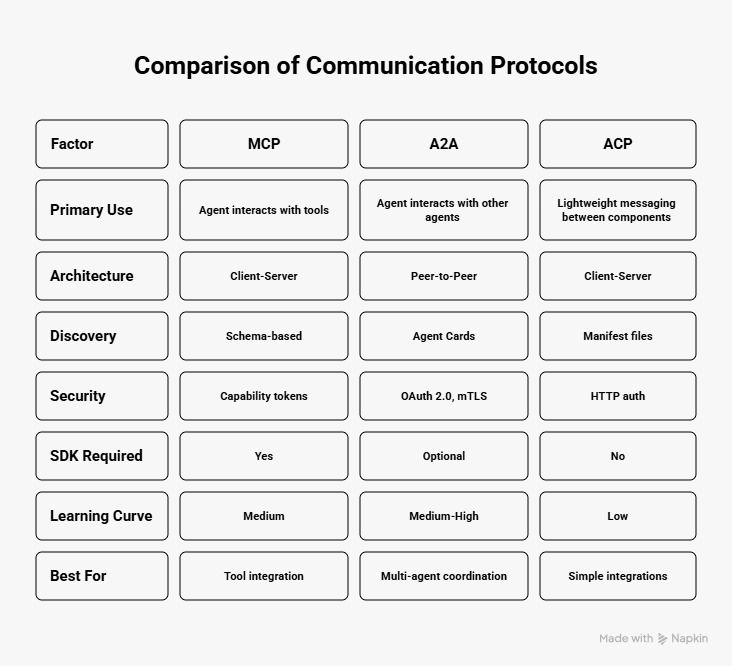
Choosing the right protocol depends on specific use cases:
Quick Selection Guide
Use MCP when:
- Building sophisticated agents accessing many data sources
- Context management is critical
- Compliance and security are paramount
- Maximum ecosystem support is needed
Use A2A when:
- Creating multi-agent workflows
- Agents need dynamic discovery and delegation
- Cross-organizational communication is required
- Vendor-neutral orchestration is essential
Use ACP when:
- Rapid deployment is priority
- Working with legacy systems
- Team prefers REST patterns
- Simplicity outweighs advanced features
Hybrid Approach: Many organizations combine protocols—MCP for tool connections and A2A for agent coordination, delivering comprehensive coverage.
Emerging Protocols Worth Watching
Beyond the major three, several innovative protocols are gaining traction:
Agent Network Protocol (ANP)
Vision: "HTTP for the agentic web era" Key Innovation: Decentralized identity (W3C DID) and end-to-end encryption Status: W3C AI Agent Protocol Community Group active development
Open Agentic Schema Framework (OASF)
Vision: Standardized schemas for agent capabilities Key Innovation: Uniform data representation across vendors Best For: Agent discovery and marketplace ecosystems
W3C Standardization Efforts
The W3C AI Agent Protocol Community Group is working toward official web standards for agent communication, with specifications expected 2026-2027. This could become the definitive standard for the agentic web.
Implementation Guide: Getting Started
Step 1: Assess Your Requirements
Before selecting a protocol, answer these questions:
Agent Architecture:
- How many agents will you deploy?
- What frameworks are you using? (LangChain, AutoGen, CrewAI, custom)
- Do agents need cross-organizational communication?
Integration Needs:
- What external systems must agents access?
- What data types will agents exchange?
- Are real-time responses required?
Technical Constraints:
- What's your team's expertise?
- What infrastructure are you using? (Cloud, on-premise, hybrid)
- What are your latency requirements?
Governance:
- What security standards apply? (SOC 2, HIPAA, GDPR)
- Are audit trails required?
- What authentication mechanisms are needed?
Step 2: Start with a Pilot
Rather than enterprise-wide deployment:
- Choose a low-risk use case with clear ROI
- Select one protocol to learn thoroughly
- Build a minimal implementation (2-3 agents)
- Measure metrics: integration time, reliability, performance
- Gather feedback from developers and users
Example: Deploy MCP to connect a customer service agent to CRM, knowledge base, and ticketing systems. Measure resolution time and satisfaction improvements.
At Ruh AI, our SDR Sarah exemplifies effective protocol implementation, seamlessly integrating with multiple enterprise systems through standardized communication.
Step 3: Monitor and Optimize
Protocol implementations require ongoing attention:
Key Metrics:
- Latency: Message round-trip time
- Throughput: Messages per second
- Error rates: Failed communications and retries
- Security events: Authentication failures
Monitoring Tools:
- OpenTelemetry for distributed tracing
- Prometheus for metrics collection
- Grafana for visualization
Security and Compliance Considerations
Security is foundational to protocol implementation:
Authentication and Authorization
- MCP: Capability-based tokens with specific permissions
- A2A: OAuth 2.0 flows with scoped access
- ACP: Standard HTTP authentication (Bearer tokens, API keys)
Best Practice: Implement least privilege—grant agents only minimum required permissions.
Industry-Specific Compliance
Different sectors have unique requirements:
Healthcare (HIPAA): MCP's audit trails ideal for compliance (Deloitte AI Strategy Report) Finance (SOC 2, PCI DSS): All protocols support required controls European Union (GDPR): Ensure data residency and deletion capabilities
Common Threats and Mitigation
Risks:
- Agent impersonation
- Message tampering
- Denial of service
- Data exfiltration
Mitigation:
- Strong authentication (mTLS, signed tokens)
- Message integrity checks (HMAC signatures)
- Rate limiting and circuit breakers
- Network segmentation and zero-trust architecture
Real-World Case Studies
Healthcare: Multi-Agent Clinical System (MCP)
Challenge: Care coordination across EHR, labs, imaging, pharmacy Solution: MCP-connected agents for patient data aggregation
Results:
- 40% reduction in data retrieval time
- 25% improvement in diagnosis accuracy
- HIPAA-compliant with full audit trails
- 6-month ROI achievement
Logistics: Global Supply Chain (A2A)
Challenge: Coordinating forecasting, inventory, shipping, customs Solution: 8 specialized agents with A2A coordination
Results:
- 30% reduction in inventory costs
- 50% faster disruption response
- Seamless cross-border communication
- Scaled to 15 countries in 12 months
Financial Services: Compliance Monitoring (ACP)
Challenge: Real-time compliance across trading systems Solution: Lightweight ACP with legacy integration Results:
- 99.9% compliance detection accuracy
- Zero SDK compatibility issues
- 80% reduction in review time
- Minimal infrastructure changes
The Future of AI Agent Protocols (2025-2030)
Near-Term (2025-2026)
- Protocol convergence: MCP and A2A establishing clear interop standards
- W3C standardization: Official web standards for agent communication
- Enterprise tooling: Production-grade monitoring and management
- Security enhancements: Advanced threat detection, zero-trust models
Mid-Term (2026-2027)
- Domain-specific protocols: Specialized standards for healthcare, finance, manufacturing
- Edge and IoT: Lightweight protocols for resource-constrained devices
- Quantum-ready: Post-quantum cryptography support
Long-Term (2027-2030)
- Universal standard: Dominant protocol emergence (like HTTP)
- Agent marketplaces: Standardized discovery and purchasing
- Cross-ecosystem collaboration: Seamless communication across platforms
- Regulatory frameworks: Government standards for critical infrastructure
Conclusion: Building the Protocol-Driven Future
AI agent protocols represent the critical infrastructure determining which organizations successfully deploy autonomous AI at scale. Just as HTTP enabled the web's explosive growth, protocols like MCP and A2A are creating the foundation for the agentic AI era.
The evidence is clear: standardization is no longer optional. Organizations adopting protocols now gain:
- Faster time-to-value for AI initiatives
- Greater vendor flexibility
- Reduced technical debt
- Better positioning for emerging capabilities
At Ruh AI, we're committed to helping organizations navigate this transformation. Whether you're deploying your first AI agent or scaling enterprise-wide systems, understanding and implementing the right protocols is essential for success.
Ready to get started? Contact our team to discuss how Ruh AI can accelerate your AI agent deployment with proven protocol implementations.
Frequently Asked Questions
What are AI agent protocols?
AI agent protocols are standardized communication frameworks that define how AI agents interact with each other, external tools, and human systems. They specify message formats, communication patterns, and security requirements—creating a universal language for AI collaboration.
Why are AI agent protocols important?
Protocols solve four critical challenges: integration complexity (reducing N×M custom connections to N+M), vendor lock-in (enabling interoperability), scalability (consistent frameworks), and future-proofing (compatibility with emerging tech).
What are some examples of AI agent protocols?
MCP (Model Context Protocol): Connects agents to tools via JSON-RPC 2.0. Governed by Linux Foundation, supported by OpenAI, Google, Microsoft, AWS.
A2A (Agent2Agent): Enables peer-to-peer coordination using Agent Cards. Launched by Google Cloud with 50+ partner companies.
ACP (Agent Communication Protocol): Lightweight REST-based messaging from IBM BeeAI, requires no SDKs.
What is the difference between A2A and MCP?
MCP focuses on vertical integration (agent-to-tool communication) using client-server architecture—like giving an agent access to multiple tools.
A2A focuses on horizontal coordination (agent-to-agent collaboration) using peer-to-peer architecture—like creating a team of specialized agents.
Best practice: Use both together—MCP for tool access, A2A for coordination. This powers systems like Ruh AI's solutions.
What are the different types of AI agents?
- Simple Reflex: React to inputs with predefined rules (thermostats)
- Model-Based: Track state changes (autonomous vacuums)
- Goal-Based: Achieve specific objectives (route planning)
- Utility-Based: Maximize value across goals (portfolio managers)
- Learning: Improve through feedback (recommendation systems)
The trend is toward multi-agent systems where specialized agents collaborate through protocols to solve enterprise challenges.