
TL;DR/Summary
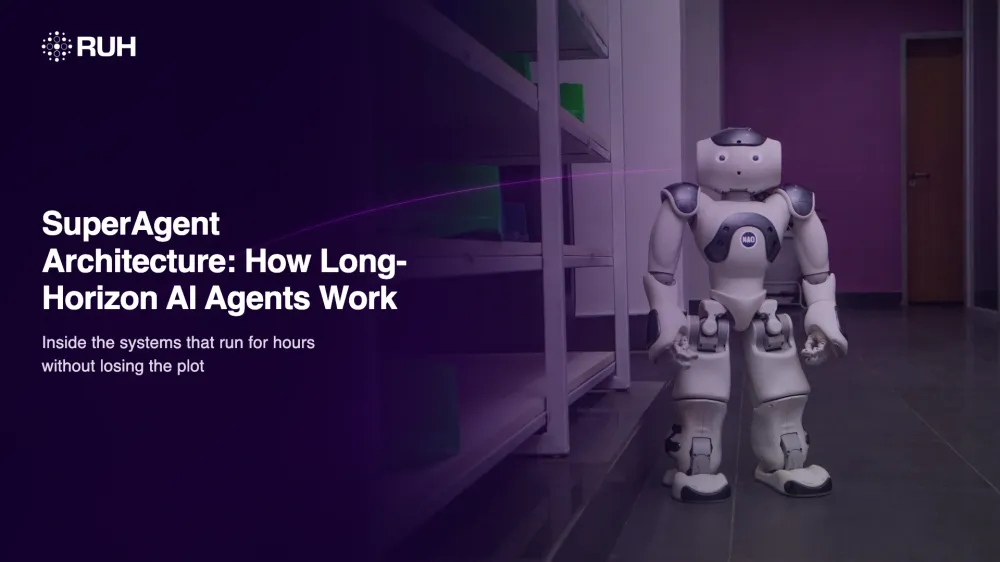
SuperAgent architecture is the engineering framework that lets AI systems break down massive, multi-hour tasks into coordinated sub-tasks — running specialized agents in parallel, backed by persistent memory, sandboxed execution environments, and adaptive feedback loops. Unlike single-turn AI assistants that answer a question and stop, SuperAgents keep working autonomously for minutes, hours, or longer — researching, coding, writing, and iterating without constant human input. If you've ever wished an AI could "just handle it," SuperAgent architecture is what makes that real.
Ready to see how it works:
- From Simple Scripts to Autonomous Powerhouses: The Origin of AI Agents
- What Is a SuperAgent? Defining the Next Generation of AI Workers
- The Anatomy of SuperAgent Architecture: Five Layers That Make It Work
- How DeerFlow by ByteDance Redefines the SuperAgent Standard
- Long-Horizon Tasks in the Real World: What SuperAgents Are Actually Doing
- Five Reasons SuperAgent Architecture Is a Game-Changer
- The Honest Downsides: Limitations You Should Know
- How Ruh AI Is Adapting SuperAgent Architecture for Smarter Results
- Frequently Asked Questions About SuperAgent Architecture
- The Future of Work Is Long-Horizon: What This Means for You
From Simple Scripts to Autonomous Powerhouses: The Origin of AI Agents
The story of AI agents doesn't start with a flashy product launch or a Silicon Valley press release. It starts in 1966 with a chatbot named ELIZA.
ELIZA, created by Joseph Weizenbaum at MIT, was the first widely recognized program that could simulate a conversation with a human being — specifically a therapist. It worked by pattern-matching inputs and reflecting them back as questions. It didn't understand language. It didn't remember context. And it certainly couldn't take action in the world. But it planted an idea: what if software could interact with humans in a meaningful way?
For the next few decades, researchers worked with rule-based systems — programs that followed strict if-then decision trees. These early agents were powerful in narrow domains but brittle everywhere else. They couldn't generalize, adapt, or work beyond their pre-programmed rules.
The term "agent" entered the AI lexicon properly in the 1990s. The emerging consensus was that an agent must do three things: perceive its environment, make decisions based on what it perceives, and take actions toward a goal — autonomously. This definition, pioneered by researchers like Rodney Brooks and formalized through the decade's computational research, became the foundation for everything that followed.
In the 2010s, the rise of machine learning — and particularly deep learning — changed the scale of what was possible. Language models grew from millions of parameters to billions. Then the transformer architecture, introduced by Google researchers in 2017 with the landmark "Attention Is All You Need" paper, opened the door to large language models (LLMs) that could understand and generate human language with startling fluency.
By 2020, researchers had discovered something fascinating: you could give these language models tools — the ability to search the web, run code, call APIs, read and write files — and they could use those tools in sequence to accomplish multi-step goals. This discovery catalyzed the modern agentic AI movement.
The progression moved fast. Rule-based chatbots gave way to conversational AI. Conversational AI gave way to task-oriented agents. Task-oriented agents gave way to agentic AI systems capable of executing complex workflows over extended time periods. And that brings us to the cutting edge: SuperAgent architecture.
What Is a SuperAgent? Defining the Next Generation of AI Workers
A SuperAgent is not just a smarter chatbot. It is a fundamentally different kind of system.
Where a standard AI assistant handles one interaction at a time — you ask, it answers, done — a SuperAgent is designed to own a goal for an extended period. It plans, delegates, executes, monitors, and adapts. It doesn't stop when it hits an obstacle; it reroutes. It doesn't lose track of context as time passes; it stores and retrieves memory. And it doesn't just operate in isolation; it orchestrates a team of specialized sub-agents, each optimized for a specific kind of work.
Think of a SuperAgent as an autonomous project manager with a team of expert workers under it. The project manager (the orchestrator or lead agent) receives the high-level goal, breaks it down into tasks, assigns those tasks to the right specialists, monitors progress, handles errors, and synthesizes everything into a final output.
Salesforce defines superagents as autonomous AI agents that "orchestrate specialized sub-agents to execute complex, multi-step business workflows independently." The emphasis on independence is key. A SuperAgent doesn't need to be hand-held through every decision. It makes judgment calls. It adapts when things go wrong. It keeps going.
The defining characteristic of a SuperAgent is its capacity for long-horizon task completion — the ability to work toward a goal that unfolds across dozens, hundreds, or even thousands of steps, potentially over hours of continuous autonomous operation.
This is not science fiction. ByteDance's DeerFlow 2.0, released in February 2026, demonstrated real SuperAgent behavior: the system autonomously handled research projects requiring processing of 50+ papers, built full software scaffolding from scratch, and ran creative workflows that iterated for hours — all without human intervention at each step.
The Anatomy of SuperAgent Architecture: Five Layers That Make It Work
Understanding why SuperAgents are so powerful requires a look under the hood. The architecture isn't just one clever algorithm — it's a layered system where each component enables the next.
1. The Orchestrator: The Brain of the Operation
At the top of every SuperAgent system sits the orchestrator — also called the lead agent, supervisor agent, or primary agent. This is the component that communicates with the user, receives the high-level goal, and decides how to break it down.
The orchestrator doesn't do the work itself. Its job is task decomposition and delegation. It analyzes the goal, identifies what types of sub-tasks are needed, determines the optimal sequence (and which tasks can run in parallel), assigns those sub-tasks to specialized sub-agents, and collects their outputs for synthesis.
According to Google Cloud's guide on agentic AI architecture, planning enables agents to "decompose complex goals into executable subtasks, determine optimal sequences, and dynamically adapt when circumstances change." That adaptive replanning — adjusting mid-task when a sub-agent hits a dead-end — is what distinguishes SuperAgents from rigid automation pipelines.
2. Sub-Agents: Specialized Workers in Parallel
Below the orchestrator lives a layer of specialized sub-agents, each tuned for a specific type of task. Common sub-agent archetypes include:
- Researcher sub-agents — web search, document retrieval, source synthesis
- Coder sub-agents — writing, executing, debugging, and testing code
- Reporter sub-agents — structuring information into reports, summaries, or documents
- Analyst sub-agents — data processing, pattern recognition, insight generation
In DeerFlow's architecture, for instance, these sub-agents run in parallel when possible. The lead agent dispatches multiple workers simultaneously, dramatically compressing the time needed to complete complex tasks. Each sub-agent operates with its own scoped context and its own set of tools — and reports structured results back to the lead.
The result is a system where work that might take a human team days — spread across research, analysis, coding, and writing — can be compressed into hours or minutes of autonomous machine execution.
3. Memory Systems: Short-Term, Long-Term, and Episodic
Memory is what separates a SuperAgent from a sophisticated one-shot prompt. Without memory, every interaction starts from zero. With memory, the agent compounds knowledge over time.
IBM's research on AI agent memory identifies three critical memory types in advanced agent systems:
- Short-term memory (working memory): Holds immediate context within a session — recent conversation history, current tool outputs, active reasoning steps. This lives within the model's context window.
- Long-term memory: Persists across sessions, storing learned facts, user preferences, completed task outcomes, and accumulated knowledge. Typically implemented via vector databases or structured memory stores.
- Episodic memory: Records specific past experiences — what happened, what worked, what failed. Enables case-based reasoning where agents learn from prior runs.
The key architectural insight is that memory must flow in loops. Every sub-agent's output feeds back into the shared memory store. Every new task draws on what was learned from previous tasks. This feedback loop creates a compounding intelligence effect — the system genuinely gets better at handling similar tasks over time.
4. Tool Use and Sandboxed Execution
SuperAgents are not limited to generating text. They act in the world through tools — and in sophisticated architectures, through sandboxed execution environments.
Tools available to a SuperAgent typically include:
- Web search and browsing for real-time information retrieval
- Code execution in isolated containers where the agent can write, run, and debug code
- File system access for reading inputs and writing outputs
- API integrations for connecting to external services
- MCP (Model Context Protocol) servers for structured communication with external systems
DeerFlow, for example, provides each agent with an actual isolated Docker container — a complete mini-computer with a filesystem, bash terminal, and execution capabilities. This is not simulated tool use. The agent writes real code, runs it, reads the output, and iterates. If it breaks, it fixes it. If a dependency is missing, it installs it.
This sandboxed approach is critical for safety — the agent's actions are contained and auditable — while still enabling genuinely powerful autonomous execution.
5. Message Gateway and Feedback Loops
The final layer is the communication infrastructure — the message gateway that routes information between the orchestrator, sub-agents, memory systems, and tools.
In a well-designed SuperAgent system, the message gateway does more than just pass information. It handles:
- Retry logic — automatically re-attempting failed tasks with modified parameters
- Error propagation — surfacing failures to the orchestrator for intelligent replanning
- Context injection — ensuring every sub-agent has the relevant memory and context it needs before starting
- Result aggregation — collecting and structuring outputs from multiple parallel sub-agents
The Membria SuperAgent Architecture documentation describes this as a "Reasoning Graph" — a dynamic structure where every node represents an agent or memory unit, and every edge represents a flow of information or a delegation relationship. The graph adapts as tasks evolve, new sub-agents are spawned, and completed work flows back to inform what happens next.
How DeerFlow by ByteDance Redefines the SuperAgent Standard
When ByteDance released DeerFlow 2.0 on February 28, 2026, the AI community took notice. The framework earned 2,394 GitHub stars on its launch day and ultimately reached 45,000 stars — making it one of the fastest-growing open-source AI frameworks in history.
DeerFlow (Deep Exploration and Efficient Research Flow) is more than a research tool. It's a production-grade SuperAgent harness that demonstrates what long-horizon AI execution looks like in practice.
Its architecture implements the five-layer model described above with particular elegance:
- Three-tier agent hierarchy: A Lead Agent for decomposition and synthesis, plus Researcher, Coder, and Reporter sub-agents that run in parallel
- Per-thread isolation: Each task runs in its own isolated environment, preventing context contamination between parallel work streams
- Persistent memory across sessions: Agents accumulate knowledge that makes them more effective over time on similar tasks
- Fully sandboxed execution: Real Docker containers with filesystem access and bash terminals — not simulated tool calls
- Model agnosticism: Connects to GPT-4o, Claude, Gemini, or locally-hosted Ollama models — the framework itself is free under the Apache 2.0 license
DeerFlow has been used to autonomously handle tasks that would normally require a team: writing research reports synthesizing dozens of academic papers, building full software applications from a single brief, and running iterative creative workflows that refine outputs over multiple rounds without human prompting.
It's not the only SuperAgent framework — Microsoft's CORPGEN addresses organizational multi-horizon task management, and OpenAI's Codex has demonstrated runs lasting approximately 25 hours with 13 million tokens and 30,000 lines of generated code — but DeerFlow's open-source accessibility has made it the most widely studied real-world SuperAgent implementation to date.
Long-Horizon Tasks in the Real World: What SuperAgents Are Actually Doing
The phrase "long-horizon task" can sound abstract. Here's what it looks like in practice across different domains:
Research and Knowledge Work: A SuperAgent given the brief "produce a competitive analysis of the top 10 AI coding tools" will autonomously search for each tool, browse their documentation, find user reviews, identify pricing, compare feature sets, and produce a structured report — with citations — in the time it would take a human analyst to finish reading just the first three sources.
Software Development: Feed a SuperAgent a product requirement document and it will scaffold a full application: writing the architecture, generating the initial codebase, running tests, identifying failures, fixing them, and producing working software. OpenAI's Codex-based agents have demonstrated this capability in extended autonomous runs without human intervention.
Content Production at Scale: Long-horizon agents are being used to autonomously research a topic, outline an article, write multiple drafts, fact-check against sources, and optimize for SEO — all in one uninterrupted workflow. The human reviews the output rather than managing the process.
Enterprise Automation: Microsoft's CORPGEN research targets organizational work environments — managing dozens of concurrent, interleaved tasks with complex dependencies, mirroring what a digital employee would handle across a full workday. Rather than automating single tasks, these systems automate workflows across workflows.
Scientific Research: SuperAgents are increasingly being used to scan literature, generate hypotheses, design experiments, and synthesize findings — compressing research cycles that once took weeks into hours of autonomous operation.
The AI agent market's projected growth from $5.40 billion in 2024 to $50.31 billion by 2030 reflects not just hype but genuine enterprise adoption. BCG research shows AI-powered agentic workflows cut low-value work time by 35–50% — a number that will only grow as SuperAgent architectures mature.
Five Reasons SuperAgent Architecture Is a Game-Changer
1. It Compresses Days of Work Into Hours
The most immediate value of SuperAgent architecture is time compression. Tasks that require sustained, multi-step effort — research, analysis, coding, writing — are exactly the tasks that bottleneck knowledge workers. A SuperAgent doesn't sleep, doesn't get distracted, and doesn't need a coffee break. It applies full computational capacity to the goal from start to finish.
2. It Scales Expertise Without Scaling Headcount
Today, accessing deep expertise means hiring experts or paying consultants. SuperAgent architecture makes specialized capabilities — advanced data analysis, multilingual research, complex code generation — accessible to anyone who can describe a goal. Organizations can accomplish significantly more without proportional increases in team size.
3. It Handles Complexity Through Decomposition
Human workers often get stuck on complex tasks because the whole problem feels overwhelming. SuperAgents excel precisely because they decompose. The orchestrator sees the big goal, breaks it into manageable pieces, and distributes the pieces to the right specialists. The complexity doesn't disappear — it gets structured and managed.
4. It Learns and Improves With Use
Unlike traditional automation tools that do exactly what they're programmed to do — no more, no less — SuperAgent architectures with episodic memory improve through use. Prior experiences inform future decisions. Successful approaches are retained. Mistakes are logged and avoided. Over time, a well-designed SuperAgent becomes genuinely more effective at the tasks it handles most frequently.
5. It Operates Across Tool Ecosystems
Modern work lives across dozens of tools — CRMs, databases, communication platforms, coding environments, content systems. SuperAgents can be given access to all of these through APIs and MCP integrations, enabling end-to-end workflow automation that doesn't stop at the boundary of one application. This cross-system capability is something no human worker can replicate at scale.
The Honest Downsides: Limitations You Should Know
SuperAgent architecture is genuinely transformative — but it's not magic, and understanding its limitations is essential for deploying it responsibly.
Hallucination and Verification Challenges: LLM-based agents can and do hallucinate — generating confident-sounding information that is factually wrong. In a multi-step SuperAgent system, one hallucinated fact can propagate through subsequent sub-agents, compounding the error. DEV Community analysis notes that "verification is harder than execution for agents" — you need robust fact-checking mechanisms and human oversight for high-stakes outputs.
Context Window Constraints: Despite growing context windows, long-horizon tasks can still exceed what a model holds in active working memory at once. Sophisticated memory architectures help, but context management remains an active engineering challenge — and mistakes in memory retrieval can cause the agent to work from outdated or irrelevant information.
Error Propagation in Multi-Agent Systems: When sub-agents fail, errors can cascade. A researcher sub-agent that returns flawed data will feed that data to the reporter sub-agent, which will produce a flawed report. Robust SuperAgent systems need aggressive error detection, retry logic, and graceful degradation — but building those systems well is non-trivial.
Cost and Latency at Scale: Long-horizon tasks consume significant compute. A 25-hour Codex run using 13 million tokens is powerful — and expensive. For organizations deploying SuperAgents at scale, cost management and efficient model routing become critical architectural considerations.
Trust and Oversight Gaps: As noted in UC Berkeley's Sutardja Center analysis, the autonomous nature of SuperAgents creates real oversight challenges. When a system is making hundreds of decisions per hour without human review, how do you know when it's going wrong? Establishing appropriate checkpoints, approval gates, and audit trails is essential — particularly in regulated industries.
How Ruh AI Is Adapting SuperAgent Architecture for Smarter Results
At Ruh AI, the SuperAgent architecture isn't just something we write about — it's something we're actively building into our platform's core workflow intelligence.
The challenge Ruh AI was designed to solve is a familiar one: SEO and content work is deeply multi-step. A single content strategy engagement might require competitive analysis, keyword research, content gap identification, draft generation, SEO scoring, schema markup, and outreach — each a complex task in its own right, each feeding into the next. Traditional approaches require human coordination at every handoff. That's slow, inconsistent, and doesn't scale.
Ruh AI's approach applies SuperAgent principles directly to this challenge:
Orchestrated Content Pipelines: Rather than treating each SEO task as a standalone function, Ruh AI's system orchestrates them as connected workflows. A user describing a content goal triggers an orchestrator that plans the full pipeline — research, strategy, writing, optimization — and dispatches specialized agents to handle each phase in parallel where possible.
Persistent SEO Memory: Ruh AI maintains memory of your website's content history, past keyword performance, competitor positions, and content audit findings — not just within a session but across them. This means that every new content task benefits from accumulated context, producing more strategically aligned outputs over time.
Tool-Native Execution: Ruh AI agents don't just generate recommendations — they execute. Explore the full suite of Ruh AI's AI-powered tools to see how agents connect to search APIs, content systems, and analytics platforms through MCP integrations — enabling end-to-end autonomous workflows from a single brief.
Purpose-Built Long-Horizon Agents: Perhaps the most direct expression of SuperAgent architecture in the Ruh AI platform is SDR Sarah — a fully autonomous AI SDR agent that doesn't just respond to prompts but independently researches prospects, crafts personalized outreach sequences, monitors engagement, and adapts its approach based on what's working. Sarah isn't a chatbot. She is a long-horizon agent with her own memory, her own tools, and her own goal: building pipeline without human hand-holding at every step.
Human-in-the-Loop at Key Gates: Consistent with responsible SuperAgent design, Ruh AI builds human review checkpoints into its workflows at decision points that matter — strategy approval, final content review, publishing authorization — without requiring human oversight at every micro-step. This preserves both the speed advantages of autonomous operation and the quality assurance that professionals need.
The result: what used to take a content team a week of coordinated effort — from initial research to published, optimized content — can now be compressed into hours of supervised autonomous operation. Ruh AI is designed for the reality that the future of knowledge work is long-horizon, and it's building the infrastructure to make that future practical, reliable, and trusted.
For more on how this shift from automation to autonomy is reshaping the broader technology landscape, read: Agentic AI: Redefining the Tech Industry from Automation to Autonomy. Or browse the full Ruh AI blog for deep dives into AI agents, SEO strategy, and the future of autonomous workflows.
The Future of Work Is Long-Horizon: What This Means for You
We are at an inflection point. For most of AI's history, the practical value has been in acceleration — doing familiar things faster. Better autocomplete. Faster search. Quicker summarization. SuperAgent architecture represents something different: a shift from acceleration to autonomy.
The question is no longer "how can AI help me do this faster?" It's "can AI do this while I focus on something else?"
That shift has profound implications. Industries that rely on sustained, multi-step knowledge work — consulting, research, software development, content marketing, legal analysis, financial modeling — are directly in the crosshairs of SuperAgent adoption. Not because these professions will disappear, but because the ratio of human-hours to output is about to change dramatically.
The agentic AI market is projected to surge from $7.63 billion in 2025 to $182.97 billion by 2033. That's not a niche trend. That's infrastructure. And the organizations that learn to orchestrate these systems now — building the right human-in-the-loop processes, the right memory architectures, the right trust frameworks — will have a decisive advantage over those who wait.
SuperAgent architecture is not a research preview. DeerFlow has 45,000 stars and a growing community of production deployments. Microsoft is embedding multi-horizon agent systems into enterprise infrastructure. OpenAI's agents are writing real code across real codebases in real companies.
The work that used to take hours? It's being done. The question is who's doing it, and how well.
If you're a practitioner, developer, marketer, researcher, or analyst — start experimenting now. The learning curve for working effectively with SuperAgents is steep, and early fluency will matter. If you're building products or platforms, ask yourself where long-horizon autonomous execution changes your user's job to be done. The answer will probably surprise you with how fundamental it is.
And if you're exploring how platforms like Ruh AI are applying SuperAgent principles to specific domains like content strategy and SEO, there's never been a better time to see what autonomous, long-horizon AI workflows can do for the work you're already responsible for. A great starting point: Ruh AI's hands-on guide to building AI agents without writing a single line of code.
The future of work is long-horizon. The infrastructure is ready. Now it's your move.
Frequently Asked Questions About SuperAgent Architecture
What is the difference between an AI agent and a SuperAgent?
Ans: A standard AI agent handles a specific, bounded task — answering a question, retrieving a document, executing a single function. A SuperAgent orchestrates multiple agents working in parallel, maintains persistent memory across sessions, and operates autonomously over extended time horizons — completing complex, multi-step goals that unfold over minutes to hours without constant human input. For a thorough breakdown of this distinction, read Ruh AI's guide: AI Agents vs. Agentic AI: Key Differences Explained.
Do SuperAgents replace human workers?
Ans: Not replace — augment. SuperAgents handle the execution of complex, multi-step workflows, freeing human professionals to focus on strategy, judgment, oversight, and creative direction. Organizations that deploy SuperAgents effectively aren't eliminating roles; they're enabling smaller teams to accomplish what previously required much larger ones.
How does memory work in a SuperAgent system?
Ans: SuperAgents use layered memory architectures: short-term working memory within the active context window, long-term memory stored in vector databases or structured stores that persists across sessions, and episodic memory that records specific past experiences for case-based reasoning. The key is that memory flows in loops — every sub-agent's output enriches the shared knowledge base, and every new task draws on accumulated prior knowledge.
Is SuperAgent architecture safe to use in production environments?
Ans: With appropriate safeguards — yes. Production-grade SuperAgent deployments include sandboxed execution environments, human approval gates at key decision points, audit logs of agent actions, error detection and retry logic, and strict permission scoping that limits what agents can access and modify. The safety comes from the architecture, not from limiting what the agents can do.
What is long-horizon task completion and why does it matter?
Ans: Long-horizon task completion refers to an AI system's ability to work toward a goal that requires many sequential and parallel steps over an extended period — without losing context, drifting off-goal, or requiring human re-direction at each step. It matters because the most valuable knowledge work — research, strategy, software development, content production — is inherently long-horizon. Systems that can only handle short tasks require human coordination to chain tasks together, which bottlenecks speed and introduces inconsistency.
Which organizations are building SuperAgent frameworks?
Ans: Several major organizations are actively building SuperAgent infrastructure. ByteDance released the open-source DeerFlow 2.0 in February 2026. Microsoft Research introduced CORPGEN for organizational multi-horizon task management. OpenAI's Codex demonstrates long-horizon autonomous coding. Google is developing SAGE-based agentic systems. Salesforce has integrated superagent concepts into its Agentforce platform. The space is moving fast and competition is intensifying.