

TL;DR / Summary
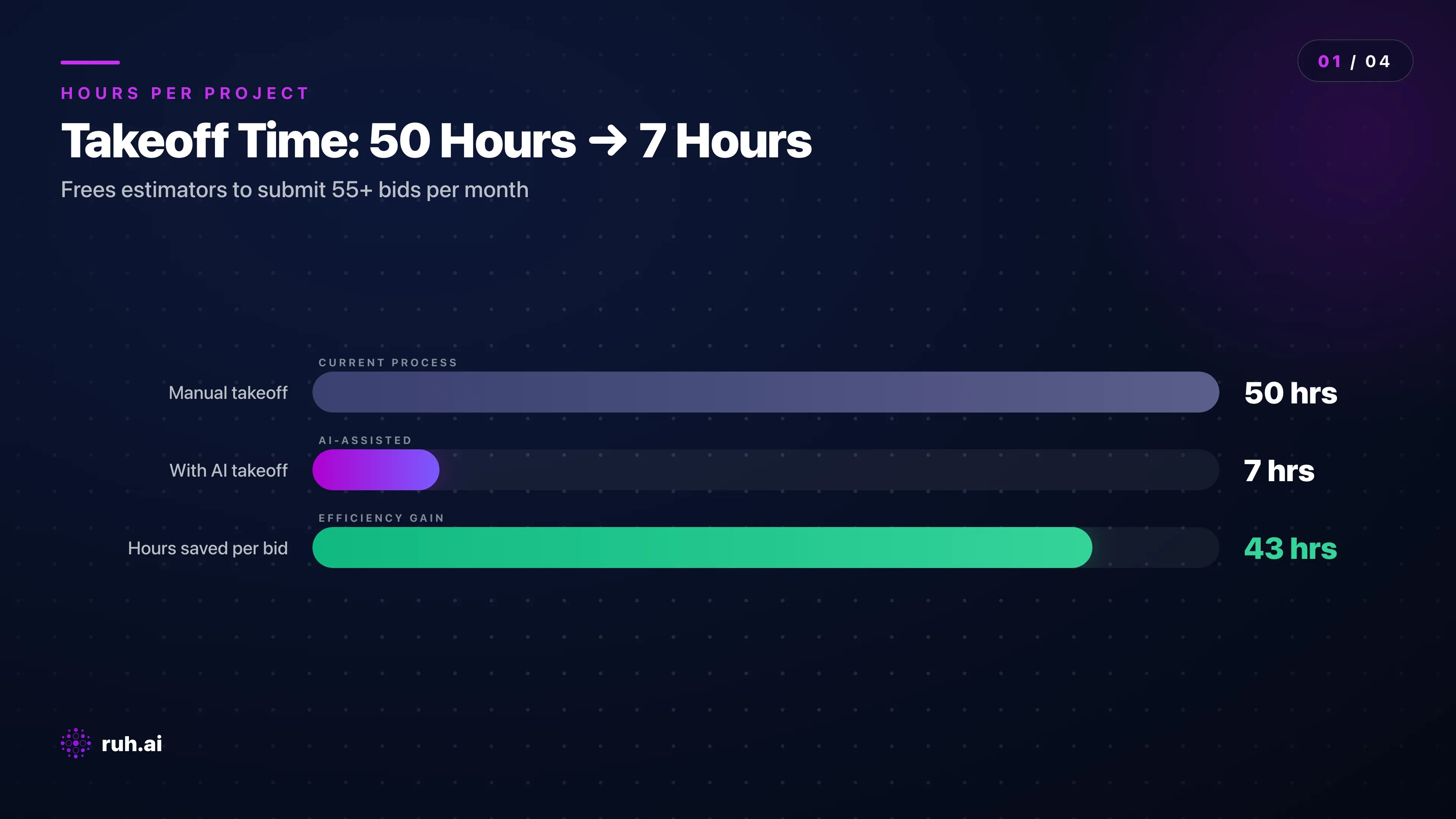
AI takeoff software cuts estimating time from 40-60 hours to 6-8 hours per project, freeing your team to chase 5-10x more bids monthly. The payoff: 22-31% higher win rates when combined with faster pricing and better scope accuracy.
What you'll learn:
- Why manual quantity takeoff eats 1-2 weeks per project and caps your bid volume
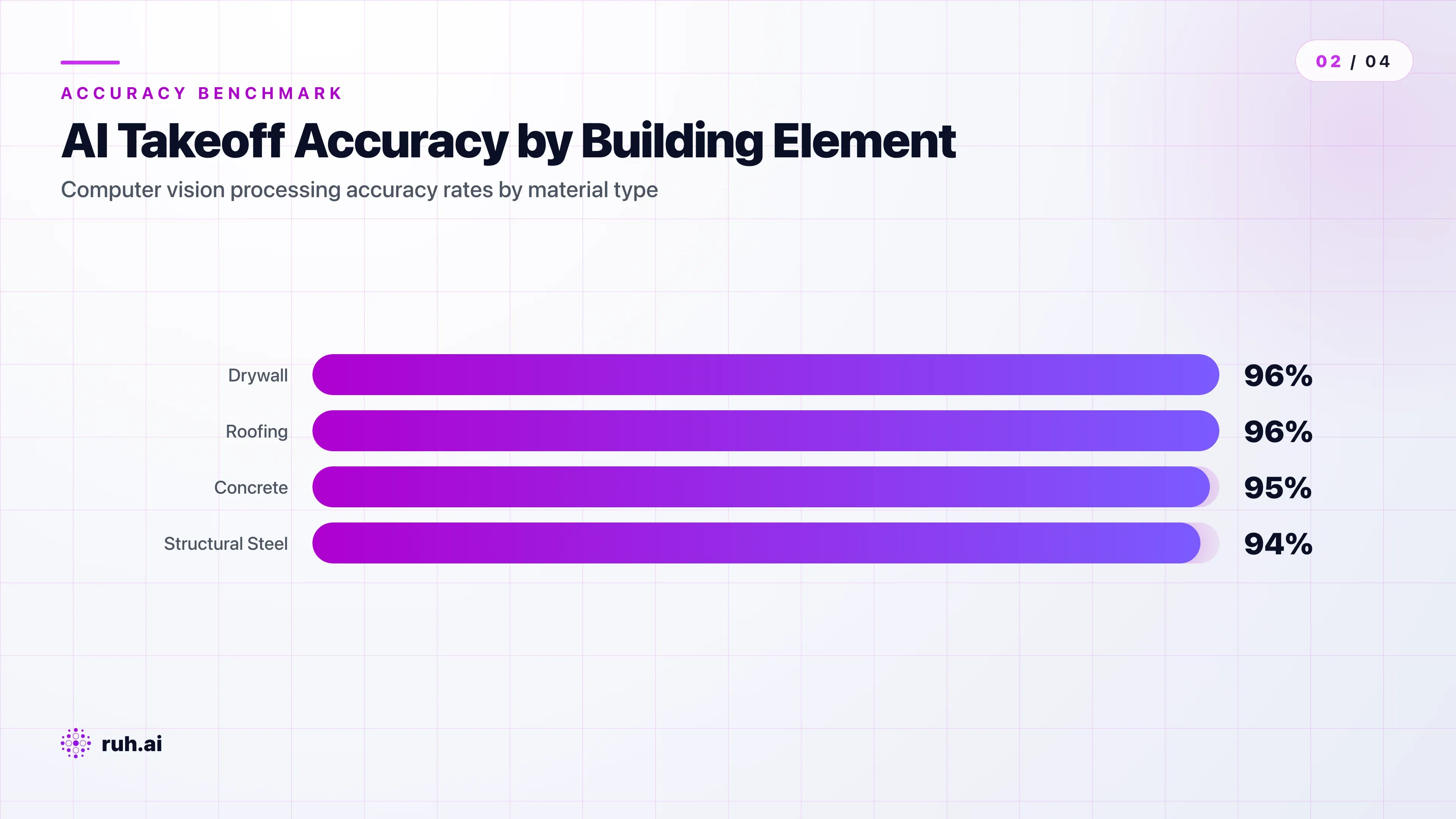
- How computer vision achieves 94-96% accuracy on standard construction elements
- The math behind bid multiplication: fewer hours = more bids = more wins
- Why AI is a co-pilot, not autopilot, and why that distinction matters
- Real pricing and ROI timelines for AI takeoff tools ($260-$2,599/user/year)
- How to evaluate tools and run a pilot that proves the ROI in your shop
The bottom line: A single 50-hour takeoff costs you 5-10 bids per month. Cut it to 8 hours, and that capacity gap closes.
The Hidden Cost of Manual Takeoff
Your estimator just spent three weeks pulling takeoff quantities from a single set of drawings. Forty to 60 hours staring at blueprints, counting walls and mechanical runs, measuring scaled lines, cross-checking against scope notes. One set of drawings. One project. Before pricing starts.
This is the construction estimating baseline, and it hasn't changed in decades.
Manual takeoff is a volume killer. Every hour locked into quantity extraction is an hour not spent chasing the next bid. A typical estimator in a bidding shop can realistically pursue 10-12 bids per month if takeoff runs 40-60 hours per project. Shrink takeoff to 8 hours, and suddenly the same person can chase 50-60 bids per month without working nights or weekends.
Here's the other problem: most shops have no visibility into what a bid actually costs them. In a 2025 survey of 2,000+ construction companies, fewer than 6% tracked their bid-hit ratio. That means you probably don't know if you're winning 1 in 5 bids (20%, common for private work) or 1 in 10 (public/competitive). You don't know which bid types pay for the takeoff effort and which ones don't. And you're leaving money on the table because your bid capacity is capped by the manual grind.
Manual takeoff also introduces error. A misread measurement, a missed scope item, a line item counted twice, these don't surface until post-award, when the field hits material shortages or discovers scope gaps that should have been flagged in the proposal. The RFI cycle, the change order, the margin haircut. All preventable if the initial takeoff had been caught by a second set of eyes before the bid left the office.
How AI Reads Drawings and Generates Quantities
Computer vision doesn't read drawings the way your brain does. It doesn't understand "this is a wall." It detects patterns, pixel clusters, edges, geometric relationships, and maps them to quantities.
The result: AI-powered quantity extraction achieves 94-96% accuracy on standard construction elements, drywall, concrete, roofing, framing, structural steel, mechanical runs, electrical panels. Floor-plan detection alone reaches ~98% accuracy, which means the tool can count walls, openings, and floor areas without manual scaling or measurement.
This is not the future. This is 2026.
What this means in practice: The tool injects a PDF set or image folder, and in minutes it outputs a preliminary quantity list: linear feet of wall, square feet of floor finish, count of doors and windows, linear feet of ductwork, panel quantities. No manual measurement. No spreadsheet of scaled drawings. No uncertainty about whether you counted correctly.
The human still owns the review. An experienced estimator will still catch the edge cases, the owner-supplied materials, the non-standard framing, the scope variations that aren't shown in the standard drawing set. But the routine 95% is handled at machine speed. And that's the time sink.
From Takeoff to Bid: The Time Equation
Here's where the business case becomes obvious.
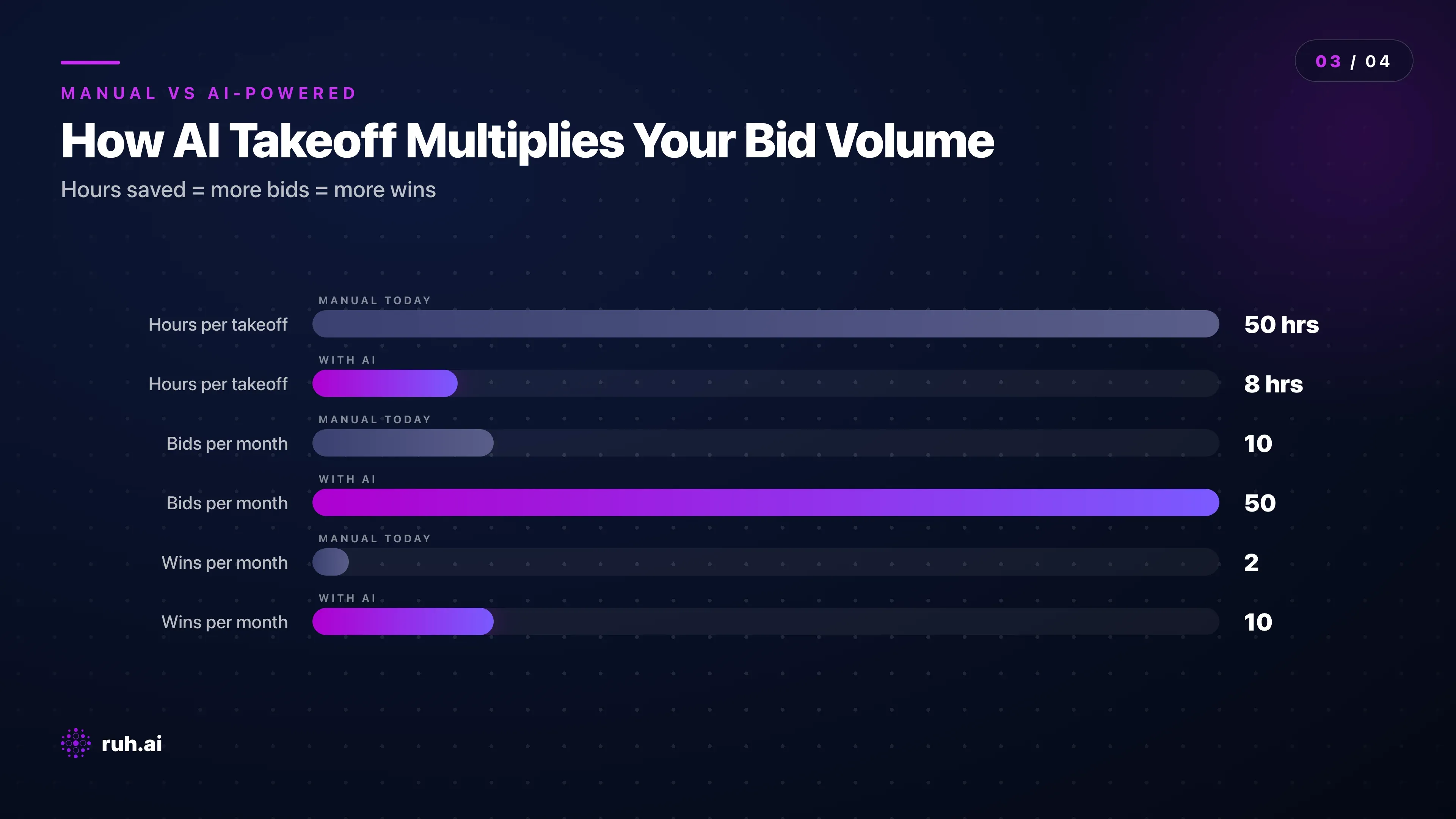
A typical estimator in a high-bid-volume shop chases bids with a 5:1 bid-hit ratio. That means one win per five submissions. If takeoff currently takes 50 hours per bid, they can realistically pursue 10 bids per month. Expected wins: 2 per month.
Now shrink takeoff to 8 hours per bid, a 40-60% time reduction that's real with modern AI tools. Same estimator, same capacity. Now they can chase 50 bids per month. Expected wins: 10 per month. Five times more revenue from the same headcount.
That's not hype. That's arithmetic.
The second part of the equation: faster takeoff means faster pricing. If your estimator has the quantity list in 8 hours instead of 50, your sales team can quote sooner. And sooner matters in construction. First responder wins. A GC that submits a bid 3 days faster than competitors wins more often than one that submits day 10.
The third part: fewer errors in the takeoff mean cleaner bids that match scope. A bid that's missing a wall or doubled a mechanical run isn't just a bad takeoff, it's margin gone once you're under contract. Better accuracy upfront means fewer RFIs, fewer change-order disputes, fewer post-award surprises.
The math is straightforward: more bids chased + faster to quote + fewer errors = more wins + higher margins.
Why AI Wins More Bids
The most surprising finding from shops using AI takeoff: bid win rates jump 22-31%.
This isn't just because they bid more. It's because they bid smarter.
Speed to bid is a competitive advantage. A GC that can quote a set of drawings in 2-3 days instead of 2-3 weeks hits the bid list when the field is still hungry for answers. Being first across the finish line with a clean bid wins more work than being second.
Better accuracy improves bid-win ratios. A bid that matches the actual scope, no missing walls, no doubled mechanical runs, no scope ambiguities, closes more easily. The owner or project manager has fewer objections. The GC wins faster.
AI bid matching goes further. Some platforms now apply predictive scoring: they analyze the bid type, market, scope complexity, and historical win rates in your region and flag high-probability winners. This lets your sales team focus effort on bids you're likely to win instead of chasing everything.
The net effect: more bids chased + higher quality bids + smarter bid selection = more wins. The numbers back it. Teams using AI-assisted takeoff coupled with bid matching report winning 1 in 4 instead of 1 in 5. That's a 22-31% lift.
The Honest Assessment: Where AI Still Falls Short
AI is fast at routine extraction. It's not a decision-maker.
An experienced estimator owns the judgment calls. The scope gaps. The owner-supplied materials. The non-standard framing that's drawn in a note but not in the plan set. The items that don't appear in standard drawing conventions. These are the things that separate a profitable bid from a margin-killer.
Computer vision won't catch the call-out in a note that says "customer to provide all light fixtures." It won't flag that a mechanical note specifies high-efficiency equipment that costs 15% more than standard. It won't know that the project is in a remote location and supply-chain costs need a 8-week lead time buffer.
The highest-performing teams treat AI as a co-pilot. The AI handles the 95% of routine extraction, walls, floors, openings, standard finishes, standard runs. The estimator handles the 5% that matters, scope judgment, edge cases, owner variations, regional cost adjustments, team capacity.
This is not a weakness of AI. It's the correct division of labor. Automation that removes the human from decisions is dangerous. Automation that removes humans from drudgery and gives them time for judgment is smart.
How Ruh AI Fits Into Preconstruction
Point tools like STACK, PlanSwift, and Bluebeam Revu speed up the takeoff step. They're useful. But they own only the takeoff.
Ruh AI builds agents that own the entire loop. Ingest the drawing set, extract quantities, price against your historical cost data, draft the bid, flag the scope gaps a human should check, and surface the likely winners for your sales team to focus on.
The difference: instead of buying a takeoff license and bolting it onto your existing workflow, you deploy an agent that understands your business. It learns from your cost history. It knows which bid types you win. It flags scope variations automatically. It works with the tools you already use, Procore, Bluebeam, your estimating spreadsheet, instead of forcing you into another platform migration.
No per-seat SaaS tax. One agent serves your entire estimating team. You don't buy licenses per person. You deploy once and scale across all your bids.
Most construction automation stops at "faster." Ruh's preconstruction agents go to "smarter", better bids, fewer errors, lower cost of carry, and estimators focused on the judgment work that actually wins.
Deploy an AI preconstruction agent with Ruh Work-Lab →
Evaluating AI Takeoff Tools: What to Look For
If you're comparing options, focus on three dimensions.
First: accuracy on your specific project types. A takeoff tool that's 96% accurate on drywall is great if you're a drywall contractor. If you're doing heavy concrete with complex rebar, test it on your actual projects. Most vendors offer 2-4 week trial periods, use it to run 5-10 real takeoffs and measure how much time the tool actually saves your team and how many hours your estimators still spend reviewing and correcting the AI output.
Second: integration with your existing workflow. Does it work with Bluebeam? Does it output to your estimating spreadsheet or your QuickBid instance? Or does it force you to adopt a new platform? The lower the friction, the faster adoption sticks.
Third: cost structure and true ROI. Pricing varies widely:
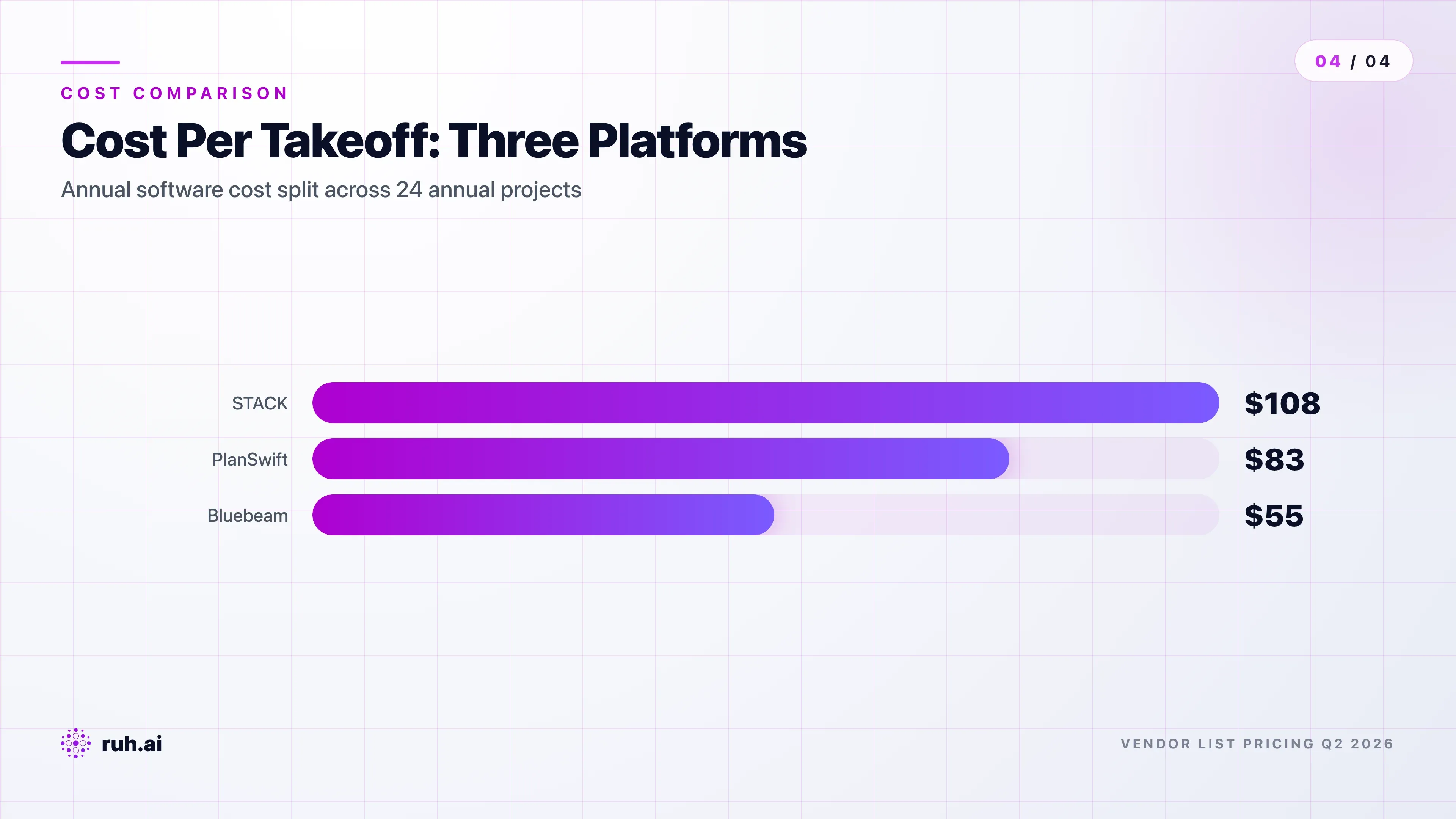
- STACK: $2,499-$2,599/user/year. A 5-person estimating team: $12,500+/year before add-ons.
- PlanSwift: $1,749-$2,000/year (per license, not per user).
- Bluebeam Revu: $260-$440/user/year (a PDF markup tool with takeoff bolted on, not a full estimating system).
The right comparison is cost per takeoff, not cost per user. If STACK saves your team 40 hours per project and you do 24 projects per year, that's 960 hours saved, roughly $12.50 per hour. At $12,500/year, the payback is 12 months. At PlanSwift's $2,000/year, payback is 2 months.
But also ask: what happens after takeoff? Does the tool feed into pricing? Into bid drafting? Into win-rate tracking? Or does it stop at the spreadsheet and force another manual step?
Frequently Asked Questions
Q: Will AI takeoff eliminate estimators? A: No. It eliminates the grinding part. If an estimator spends 60% of their time on routine measurement and 40% on scope judgment and pricing strategy, AI removes the 60%. You get more estimators' time spent on judgment, customer relationships, risk assessment, value engineering. Estimators become more valuable, not redundant.
Q: How accurate is AI takeoff on non-standard or complex drawings? A: 94-96% on standard elements. Accuracy drops on edge cases, owner-supplied materials, non-standard framing details, scope variations not shown in the drawing set. That's why human review is non-negotiable. The tool handles the routine; the estimator handles the exceptions. This is a feature, not a bug.
Q: What's the real cost and payback timeline? A: Pricing ranges $260-$2,500/user/year. True cost is per-takeoff, not per-user. At 20-24 projects per year, payback typically runs 6-12 months if the tool genuinely saves 40-50 hours per project. Most vendors offer 2-4 week trials, run 5-10 real projects during the trial to validate the savings in your shop.
Q: How long does adoption take? A: Basic usage takes 2-4 weeks. Your team learns the interface, establishes a review process, builds confidence. Optimization, integrating AI output into your pricing system, feeding results into bid strategy, takes 2-3 months. Teams that rush adoption without establishing review workflows often see poor accuracy and slow adoption.
Q: What if the tool doesn't integrate with my existing software? A: Most tools integrate with QuickBid, Sage, Bluebeam, and major platforms. If your estimating system is a custom spreadsheet or legacy software, integration gets harder. Ask the vendor for an export format that fits your workflow, typically CSV or Excel. If friction is high, factor in the manual handoff cost when comparing tools.
Q: Can one takeoff tool work for all project types? A: Mostly. General contractors with mixed project types (commercial, industrial, multi-family, light civil) report strong accuracy across all types. Specialized contractors (heavy concrete, complex mechanical, marine structures) sometimes see lower accuracy and need more review. Test on your actual project mix before committing.
The Move: From Takeoff Limiter to Bid Multiplier
Manual takeoff costs you capacity. AI takeoff buys you time. What you do with that time determines ROI.
If you cut takeoff from 50 hours to 8 hours and use the freed-up capacity to bid the same 10-12 projects per month, you've automated a process, nice to have, not transformative. Your throughput stays the same.
If you cut takeoff to 8 hours and use the freed-up capacity to chase 50-60 bids per month, you've multiplied your business. Same headcount. Five times the bid volume. Two-to-five times the wins.
The winning shops are already moving. They're testing AI takeoff on 5-10 projects, measuring the actual time savings in their shop, validating accuracy on their specific project types, and then scaling. Most find payback within 6-12 months.
Start with a vendor trial. Set a bar: cut takeoff time by 40%+ and achieve 95%+ accuracy on your standard elements. If a tool clears that bar, run a 30-day pilot on 10 real projects. Measure every hour saved, every error caught, every bid you chase because you have time.
The business case is simple arithmetic. The only variable is whether you're disciplined enough to redirect the freed-up time toward bid volume instead of just taking it easy.
Book a 15-minute audit of your current takeoff workflow →
Explore Ruh Work-Lab and deploy a preconstruction AI agent today →
Learn how Ruh's AI agents are reshaping construction operations →