

TL: DR / Summary
You own a roofing company. Or maybe a regional law practice. A plumbing outfit. A local accounting firm. Business is real, revenue is real, and the problems keeping you up at night are equally real—leads that go cold overnight, salespeople spending 70% of their time doing research instead of selling, and competitors who somehow respond to prospects in minutes while your team takes hours.
Here's the part nobody tells you: those competitors aren't necessarily smarter, better-funded, or more talented. In most cases, they've simply stopped doing manually what a machine can do better. They've implemented AI not the sci-fi kind, not the "hire a developer" kind but practical, no-code AI systems that handle the repetitive, time-draining parts of running a business.
The roofing company booking 40 appointments a month on a $200 software budget. The solo contractor landing meetings with commercial clients she never would have reached through cold calling. The three-person legal practice automating client intake and follow-up without a single new hire. These aren't startup stories. These are traditional businesses that decided to stop waiting for "the right time to figure out AI."
This guide is built specifically for you the business owner who's heard the buzz, felt the skepticism, and wondered if any of this actually applies to a company like yours. It does. And platforms like Ruh.ai exist precisely to make that transition real, fast, and measurable.
Ready to see how it all works? Here’s a breakdown of the key elements:
- Why Traditional Businesses Are the Biggest Winners in the AI Shift
- The Four Pain Points Holding Traditional Businesses Back
- The "Conductor Not Coder" Mindset: How Traditional Businesses Actually Implement AI
- The Six-Step AI Sales Architecture: How Ruh.ai Builds Your Automated SDR
- What This Actually Costs (And What It Returns)
- Three Business Models for Traditional Companies Ready to Monetize AI Skills
- The 30-Day Implementation Blueprint
- Common Mistakes That Derail AI Implementation (And How to Avoid Them)
- How Ruh.ai Fits Into This Picture
- What Comes Next
- Frequently Asked Questions
Why Traditional Businesses Are the Biggest Winners in the AI Shift
There's a persistent myth that AI is a technology-company advantage. In reality, the businesses seeing the most dramatic ROI from AI adoption aren't SaaS startups, they're plumbers, contractors, accountants, and manufacturers. The reason comes down to one simple truth: traditional businesses have clearer, more repetitive processes.
A SaaS startup is constantly evolving its sales motion. An HVAC company, on the other hand, has a sales workflow that's looked the same for 20 years: find leads, research them, reach out, follow up, book a service call, close. That predictability is exactly what AI automation thrives on.
The Harvard Business Review reports that sales professionals spend just 28% of their working week actually selling. The remaining 72% goes to research, admin, and manual outreach, tasks that AI handles in a fraction of the time and at a fraction of the cost. For a traditional business with 3 salespeople, that's over 100 hours per week being spent on work that doesn't require human judgment.
That's not an inefficiency you accept. That's the inefficiency you automate.
The Four Pain Points Holding Traditional Businesses Back
Before exploring solutions, it's worth naming the specific problems clearly. These are the four most common bottlenecks we see across traditional businesses, and they're costing real revenue every month.
1. Lead Research Eats the Day
Your sales team arrives Monday morning with a list of 50 companies to prospect. By Friday, they've fully researched maybe 20. The rest sit untouched. Each prospect requires 45-60 minutes of manual work: visiting websites, checking LinkedIn for the right contact, guessing email formats, reading recent news to find a relevant angle. It's legitimate work—but it doesn't need to be human work.
AI research agents can process 500 prospects in the time it takes your rep to research 10. They search LinkedIn for decision-maker activity, scrape company websites for recent news, verify email addresses, and identify the technologies a company uses—all automatically, all fed into a clean spreadsheet ready for outreach. Tools like these are at the core of what Ruh.AI's AI SDR system does for businesses every day.
2. Generic Outreach Gets Ignored
The industry average cold email response rate sits at 2-3%. The primary reason isn't the product—it's the message. "Hi [First Name], I wanted to reach out because I thought you might be interested in..." is immediately recognizable as a template, and it gets deleted without a second thought.
Real personalization the kind that references a specific LinkedIn post someone wrote last week, or congratulates a company on their recent expansion announcement—gets responses. Salesforce research confirms personalized emails generate 6x higher transaction rates than generic templates. The problem was never that businesses didn't know personalization mattered. The problem was that writing 200 personalized emails a day was physically impossible. AI makes it possible. Read more about how AI is transforming sales outreach on the Ruh.ai blog.
3. Response Speed Kills Deals
A prospect submits a contact form at 9:47 PM on a Tuesday. Your team sees it Wednesday morning. By then, that prospect has already had a 20-minute conversation with a competitor whose AI chatbot responded in under two minutes. InsideSales.com data shows that responding to a new lead within 5 minutes makes you 9 times more likely to convert. After 30 minutes, that advantage collapses entirely.
This isn't a staffing problem, you can't afford a team member monitoring inboxes at 10 PM. It's an automation problem, and it's one that AI solves completely. See how Ruh.AI's approach to always-on AI has revolutionized customer support metrics for businesses just like yours.
4. Scaling Means Hiring (and Hoping)
Every new salesperson costs $60,000-$80,000 annually before you factor in benefits, training time, ramp-up period, and inevitable turnover. Most traditional businesses are caught in a growth trap: they can't scale sales without hiring, but they can't justify the hire without guaranteed growth. AI breaks that cycle entirely. A properly configured AI sales system handles 10x the volume of a single SDR at roughly 3% of the cost—with no sick days, no quota anxiety, and no Monday morning motivation problem.
The "Conductor Not Coder" Mindset: How Traditional Businesses Actually Implement AI
The number one thing stopping business owners from moving forward with AI is the assumption that implementation requires technical expertise. It doesn't anymore.
Think of yourself less like a developer and more like an orchestra conductor. Your job isn't to play every instrument. Your job is to direct the right specialists to the right tasks at the right time. In AI terms, that means connecting pre-built tools—lead databases, AI writers, automation platforms, CRM systems—into a workflow that runs itself.
This is the exact philosophy behind how Ruh.AI is built. Instead of asking business owners to code, configure APIs, or understand machine learning, Ruh AI acts as the central conductor—deploying specialized AI agents that handle research, outreach, personalization, qualification, and booking under one coordinated system. You define your targets and your tone. The AI handles the rest. You can also explore how multi-agent AI architectures are transforming modern sales teams without requiring any engineering background.
The Five Levels of AI Readiness (And Where You Probably Are)
Level 0 — Exploration: You've tried ChatGPT once or twice, maybe used it to write an email. You're curious but haven't connected it to your business yet.
Level 1 — Prompting: You're regularly using AI assistants for specific tasks—writing, summarizing, brainstorming. You're learning how to communicate with AI precisely.
Level 2 — Multimodal: You're using AI for images, voice, and video—generating graphics, transcribing calls, repurposing content.
Level 3 — Tool Integration: You've connected AI tools to your existing software—CRM, email, calendar. Automations are running in the background.
Level 4 — Agent Deployment: You have AI agents working autonomously on defined workflows—researching leads, sending outreach, qualifying prospects, booking meetings.
Level 5 — AI-Native Operations: AI is embedded in every core business process. You manage outcomes, not tasks.
Most traditional business owners reading this are at Level 0 or Level 1. The goal of this guide is to get you to Level 3 or 4 within 30 days—and platforms like Ruh.AI are specifically designed to accelerate that journey. For context on where AI capabilities are heading, the Ruh.ai breakdown of small language models and efficient AI in 2026 shows just how accessible and lightweight modern AI deployment has become.
The Six-Step AI Sales Architecture: How Ruh.ai Builds Your Automated SDR
Here is the practical, step-by-step system that transforms a traditional business's manual sales process into a partially automated machine. This is the architecture that powers Ruh.ai's AI SDR, and it's designed to be understood and adopted—not just admired from a distance.
Step 1: Define and Find Your Ideal Leads
The first step is identifying exactly who you want to reach. Not "small businesses" or "manufacturing companies"—but something specific: "commercial HVAC contractors with 10-50 employees in the Southeast who are actively hiring service technicians."
That specificity matters because the more precisely you define your Ideal Customer Profile (ICP), the better every downstream step performs. Broader targeting means lower relevance, lower response rates, and wasted effort across the entire system.
AI-powered lead platforms take your ICP definition and do the searching for you. You can input the URL of your best existing customer and let the system find hundreds of similar companies—same industry, same size, same technology stack, similar hiring patterns. Ruh.AI's AI SDR handles ICP matching and contact extraction automatically, surfacing decision-makers with verified contact information so your team never has to guess at an email address or dig through LinkedIn manually again.
Step 2: Set Up Trigger-Based Outreach Logic
Timing is the variable most businesses ignore—and it's one of the most powerful levers available. Outreach sent when nothing notable is happening at a company is background noise. Outreach sent the week a company raises funding, promotes a new VP of Operations, or announces a geographic expansion is a timely, relevant conversation starter.
Gartner research confirms that trigger-based outreach achieves 3x higher response rates than cold outreach with no contextual hook. The logic is simple: "I noticed you just opened a second location—that's exactly the situation where businesses like yours typically need [your solution]" is not a cold email. It's a warm, contextually aware message that demonstrates you've done your homework.
Trigger events worth monitoring include funding announcements, executive hires, office expansions, product launches, technology adoptions, and even job postings (which reveal operational priorities and budget allocation). The right AI system monitors these signals continuously and routes relevant companies into your outreach queue automatically.
Step 3: Deploy Parallel Research Agents
Once you have a qualified lead list, the research phase begins. In a manual system, this is where most of the time goes. Each prospect requires individual investigation—what's their current tech stack, what has the decision-maker posted about recently, what pain points are surfacing in their employee reviews, what's the best email format to use?
A human SDR can thoroughly research 20-25 leads per day. An AI agent fleet working in parallel can research 500 leads in the same window—simultaneously pulling LinkedIn activity, scraping company websites for recent news, verifying email addresses, and identifying competitive signals that inform personalization.
This is one of the core capabilities behind Ruh.ai's AI SDR architecture, where specialized agents handle distinct research tasks in parallel, then consolidate findings into a unified profile for each prospect. The result is a richly populated research brief for every lead—automatically generated, consistently formatted, and ready to feed directly into the personalization engine. Dig deeper into how this works in the Ruh.ai breakdown of the best AI sales agents for business.
Step 4: Build the Personalization Engine
This is where the ROI of AI sales automation becomes undeniable. The research gathered in Step 3 gets fed into a large language model—Claude, GPT-4, or Ruh.ai's own Ruh-R1 model—along with a carefully crafted prompt that instructs the AI to write a personalized email using specific data points from the research.
The difference between a generic AI-generated email and a genuinely personalized one comes down entirely to the quality and specificity of the input data. A prompt that says "write a cold email to a roofing contractor" produces a template. A prompt that says "write a three-sentence email to the owner of Summit Roofing, who posted on LinkedIn two days ago about struggling to manage subcontractors during peak season, and whose company just won a commercial project in downtown Nashville" produces something that reads like it came from a colleague who's been paying attention.
Here's a simplified version of the personalization formula:
Generic Template + Specific Research Signals + LLM Intelligence = Human-Quality Personalization at Scale
The practical result: response rates that consistently land between 12-18% instead of the 2-3% industry average for cold outreach. Sarah, Ruh.ai's AI SDR, applies this exact logic across thousands of outreach touchpoints simultaneously—scaling the personalization that most businesses can only manage for their top 10 accounts.
Step 5: Connect the Workflow with Automation "Glue"
Individual tools—a lead database here, an AI writer there, a CRM somewhere else—don't automatically talk to each other. That connection requires an automation layer: platforms like Make.com, Zapier, or n8n that act as the nervous system linking every component of your sales workflow.
A completed workflow might look like this:
A new lead gets added to your Google Sheet from a lead database → the automation triggers a LinkedIn scraper to pull the decision-maker's recent activity → that data flows to an AI writing tool with your personalization prompt → the generated email lands in a review queue → after a quick human approval, the email gets sent via your CRM → if no reply after three days, a follow-up sequence activates automatically.
That entire sequence runs without anyone manually touching it between the initial setup and the final approved email. It's not magic—it's plumbing. And you don't need to be a plumber to manage a system that handles itself.
Ruh.AI handles the "glue layer" natively, integrating with 50+ tools out of the box so that businesses don't need to hire a technical consultant to stitch together their automation stack. The platform connects your existing CRM, calendar, email, and data sources in a matter of hours—not weeks.
Step 6: Keep Humans in the Loop
The smartest AI implementation isn't the most automated one—it's the one that applies human judgment exactly where it matters and removes humans from the parts that don't require judgment.
Before any email goes out at scale, a brief human review step—looking at a sample of 10-20 messages from a batch—catches the edge cases: the prospect where the AI's personalization missed the mark, the email where a fact got subtly wrong, the message that just doesn't quite sound natural. Five minutes of oversight prevents the kind of embarrassing mistake that damages brand credibility.
After that review, the approved batch moves to sending automatically. Ruh.AI's system builds this human-in-the-loop quality gate into the standard workflow—not as an afterthought, but as a feature. The goal is to augment your team's effectiveness, not to remove your team's judgment. Once leads reply, your human salespeople take over. AI books the meeting; humans close the deal.
Explore the essential metrics to know if your AI sales system is actually working →
What This Actually Costs (And What It Returns)
For many traditional business owners, the economic case for AI adoption is the most important conversation. Here's an honest comparison.
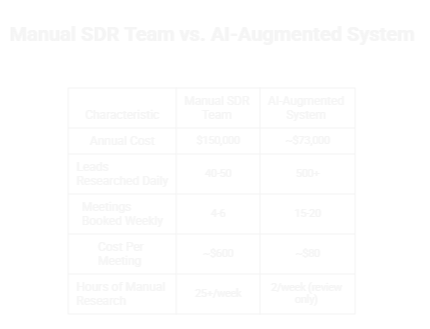
The Manual SDR Model: Two full-time sales development reps at $60,000 each means $120,000 in direct salary. Add management overhead, benefits, and the cost of inevitable turnover, and the true annual cost sits closer to $150,000. Those two reps, working efficiently, research 40-50 leads per day combined and send 30-40 personalized emails. In a good week, they book 4-6 meetings.
The AI-Augmented Model: A typical AI sales stack—lead database, automation platform, AI writing tool, and email sender—costs between $200-300 per month in software. Your existing sales team (or a single SDR) shifts from doing research and writing emails to reviewing AI output and handling replies. The system processes 500+ leads per day, sends 300+ personalized outreach emails, and books 15-20 meetings per week.
The math becomes more meaningful when you connect meetings to revenue. If your close rate is 15% and your average deal is $8,000, those additional 12-15 meetings per week translate directly to $14,000-$18,000 in incremental weekly revenue potential. The system pays for itself inside the first week of operation.
See how Ruh.ai's pricing and outcomes compare for your specific business size →
Three Business Models for Traditional Companies Ready to Monetize AI Skills
Once you've successfully implemented AI automation in your own business, you've built something valuable: proof that it works. That proof opens the door to a second business model—or transforms your primary one.
Model 1: AI-Powered Lead Generation as a Service
Many service businesses—HVAC contractors, insurance agencies, real estate brokers—pay hundreds of dollars per lead for low-quality, shared leads from aggregator platforms. An AI lead generation system built on the architecture above can deliver higher-quality, exclusive leads at a fraction of that cost.
If you build and operate that system for your own business first, you have a working proof of concept that other businesses in your industry will pay for. Starting at $500-800 per month per client, with software costs around $200/month, the math on a 10-client operation is straightforward.
Model 2: Industry-Specific AI Tools (Vibe Coding)
No-code platforms now make it possible to build simple, useful software tools by describing what you want in plain English. A roofing contractor who builds a "photo-to-quote" AI tool that estimates material costs from a smartphone photo has created something their entire industry would pay for. A legal assistant who builds a contract clause summarizer for solo attorneys has a SaaS product.
These aren't complex engineering projects. They're specific solutions to specific problems, built by people who understand the problem firsthand—which is exactly the advantage traditional business owners have over generic tech developers.
Model 3: AI Content Production for Local Businesses
Most local and regional businesses have terrible content operations. They know they should be posting on LinkedIn, sending email newsletters, and publishing helpful blog content—but nobody has time. An AI content workflow that takes a 20-minute recorded conversation and produces a week's worth of social posts, an email newsletter, and a blog draft solves a real, universal problem.
This service can be priced at $500-1,500 per month per client, takes 2-3 hours of setup per client, and runs almost entirely on autopilot afterward.
The 30-Day Implementation Blueprint
Here's a realistic, week-by-week plan for getting your first AI automation running.
Week 1 — Learn the Tools Create free accounts on ChatGPT, Claude, and Make.com. Spend four hours doing real tasks with each—write actual emails, summarize actual documents, research actual prospects. The goal isn't mastery; it's familiarity. Also: document your current sales process in detail. What does a rep do from "new lead" to "booked meeting," step by step?
Week 2 — Build the Core Workflow Sign up for a trial of a lead platform like Apollo.io and export 100 ICP-matched prospects. Set up a basic Make.com scenario that pulls a name and company from a Google Sheet, sends it to ChatGPT with a personalization prompt, and stores the output in a new column. Test it with 10 leads. Review every output manually.
Week 3 — Run Your Pilot Campaign Process 50 leads through your end-to-end workflow. Human-review all 50 emails before sending. Send 25. Monitor daily. Respond to every reply personally. Document what's working and what's not.
Week 4 — Measure and Scale Calculate your metrics: open rate, reply rate, meetings booked, cost per meeting. Compare to your manual baseline. If response rates are above 8% and cost per meeting has dropped meaningfully, you have a working system. Now scale it—process more leads, extend the follow-up sequence, and consider upgrading to a dedicated platform like Ruh.AI to handle the workflow at full commercial volume.
Have questions about what setup is right for your business? Contact the Ruh.ai team →
Common Mistakes That Derail AI Implementation (And How to Avoid Them)
Automating Before Testing
The most expensive mistake is building a complex workflow, skipping the human review step, and sending 5,000 emails before realizing the personalization is off or the emails are hitting spam folders. Always validate with small batches first—50 leads, then 200, then 500. Scale only when the system is performing.
Ignoring Deliverability
A perfectly written, beautifully personalized email that lands in the spam folder is worthless. Email deliverability requires deliberate setup: domain authentication (SPF, DKIM, DMARC records), gradual warm-up of new sending addresses, and ongoing monitoring of bounce and complaint rates. This is infrastructure work, not glamorous—but it determines whether your outreach exists at all.
Treating Personalization as a Template Variable
"Hi [First Name], I noticed your company recently [TRIGGER EVENT]" is not personalization. It's a template with a fill-in-the-blank field. Real personalization references specific content—a particular LinkedIn post, a specific news item, a concrete operational detail visible on the company's website. The AI needs specific data to write a specific email. Vague inputs produce vague outputs.
No Follow-Up Sequence
Research consistently shows that 60% of sales require five or more touchpoints. Sending one email and waiting is the equivalent of making one cold call and never calling back. A proper follow-up sequence—three to five touches over two weeks, each with a different angle—dramatically improves conversion without dramatically increasing effort. HubSpot's research confirms that email sequences convert at 3-4x the rate of single-send campaigns.
Removing Humans Entirely
AI is a force multiplier, not a replacement. The businesses seeing the best results from AI sales automation aren't the ones who've removed humans from the process—they're the ones who've removed humans from the boring parts of the process and redirected that human time toward higher-value activities: relationship building, complex negotiations, creative problem-solving, and genuine customer connection.
How Ruh.ai Fits Into This Picture
Everything described in this guide—the AI SDR workflow, the parallel research agents, the personalization engine, the automation layer, the human-in-the-loop quality gate—is the architecture that Ruh.ai has spent years building and refining.
Sarah, Ruh.ai's AI SDR, is the practical embodiment of this framework. She's an always-on sales development representative—not a chatbot, not a simple automation, but a multi-agent AI system that handles prospecting, research, personalization, outreach, qualification, and meeting booking in a single integrated workflow. Sarah operates 24/7 across time zones, engages thousands of prospects simultaneously, writes hyper-personalized messages at scale, updates your CRM automatically, and books qualified meetings directly onto your calendar—without burning out, taking vacations, or needing a Monday morning pep talk.
The numbers from Ruh.ai deployments tell the story directly: 3x increase in qualified leads, 15% improvement in win rates, 80% reduction in sales development costs, and 55% improvement in response rates compared to manual outreach.
For traditional businesses looking at these numbers and wondering whether it applies to them—whether a regional services company or a small professional firm can actually see ROI like this—the answer is yes. Not because AI is magic, but because the math of labor-intensive, repetitive sales prospecting is the same whether you're selling software subscriptions or commercial HVAC maintenance contracts.
The businesses winning right now aren't waiting until they understand AI completely. They're starting with one use case, proving it works, and building from there. They're treating AI as what it actually is: the most powerful productivity tool to emerge for small and traditional businesses in a generation.
If you're ready to see what that looks like for your specific business, the Ruh.ai team is available for a direct conversation about your situation. And if you want to keep reading before you make any decisions, the Ruh.ai blog publishes practical, honest content about AI implementation every week—no hype, no jargon, just the actionable stuff that business owners actually need.
What Comes Next
AI is not going to become less relevant to traditional businesses over the next five years. The businesses that start building these systems today will have refined, optimized workflows generating predictable pipeline by the time competitors are still figuring out where to begin.
The goal isn't to become a technology company. It's to run your existing business—roofing, accounting, manufacturing, legal services, whatever it may be—with the same operational intelligence that the best-resourced companies in your industry already deploy.
You already understand your customers better than any AI does. You already know the problems worth solving and the relationships worth building. What AI gives you is the capacity to act on that knowledge at a scale that was previously only available to companies with teams ten times your size.
That's the real story of AI in traditional businesses—not disruption, but acceleration. Not replacement, but amplification.
Explore Ruh.ai and see what's possible for your business →
Meet Sarah, the AI SDR designed for exactly this kind of scale →
Frequently Asked Questions
Do I need technical skills to implement AI in my traditional business?
Ans: No. The modern approach to AI implementation is about connecting pre-built tools using visual, no-code platforms rather than writing code. If you can create a flowchart or follow a recipe, you have the cognitive skills required. Platforms like Ruh.ai handle the technical configuration so that you're managing outcomes, not code.
How quickly can a traditional business see results from AI implementation?
Ans: With a focused approach, most businesses can have a working automated outreach workflow running within 2-4 weeks. Meaningful results—measurable improvements in lead volume, response rates, and time savings—typically emerge within 30-60 days of launch.
What's the minimum budget to start with AI automation?
Ans: You can experiment meaningfully with free tiers of ChatGPT, Claude, and Make.com for the first two to four weeks. A properly functioning commercial system typically costs between $200-300 per month in software—less than most businesses spend on a single trade show. Contact Ruh.ai for specific pricing aligned to your volume and use case.
Will AI replace my sales team?
Ans: No, and any vendor promising that is misleading you. AI handles the research, personalization, and initial outreach. Your salespeople handle the conversations, the relationships, and the close. The shift is from your team spending 70% of their time on prep work to spending 70% of their time on actual selling. That's not replacement; that's leverage.
Is AI outreach ethical and compliant?
Ans: Responsible AI outreach is targeted, relevant, and personalized—the opposite of spam. Compliance requires proper domain authentication, honoring unsubscribes immediately, and targeting only appropriate contacts. Ruh.ai builds compliance infrastructure into the platform by default, including enterprise-grade security and data protection standards.
What industries see the best results with AI sales automation?
Ans: The best results consistently come from industries with clear, consultative B2B sales processes: professional services, commercial contractors, SaaS and technology, real estate, insurance, financial services, and healthcare services. If you have a defined ICP, a repeatable outreach process, and a sales cycle longer than one week, AI automation can improve your results.