

TL: DR / Summary
Small Language Models (SLMs) represent a paradigm shift toward efficient, cost-effective, and privacy-conscious AI, offering businesses specialized performance with a fraction of the resource requirements of massive, general-purpose models. They excel in speed, on-device deployment, and domain-specific accuracy, making them ideal for real-world applications from sales automation to regulated industries. In this guide, we will discover the key models, practical advantages, and a clear implementation framework to leverage SLMs, demonstrating how they provide a strategic path to AI adoption without the prohibitive costs and complexity of their larger counterparts.
Ready to see how it all works? Here’s a breakdown of the key elements:
- What Are Small Language Models?
- Why SLMs Are the Next Big Thing in AI
- Key Advantages of Small Language Models
- SLMs vs Large Language Models: A Practical Comparison
- Best Small Language Models in 2025
- Real-World Applications
- Implementation Guide
- FAQs
What Are Small Language Models?
Small Language Models (SLMs) are compact AI systems designed to perform natural language processing tasks with significantly fewer computational resources than their larger counterparts. At Ruh AI, we've seen how these specialized models are transforming business operations from our AI SDR platform to enterprise automation solutions.
Defining Characteristics
Parameter Count: SLMs typically contain between 500 million to 20 billion parameters, compared to Large Language Models (LLMs) that exceed 100 billion parameters. According to Stanford's 2024 AI Index Report, this parameter reduction translates to practical deployment advantages without significant performance loss for specialized tasks.
Training Efficiency: While training GPT-3 costs an estimated $4.6 million in compute resources, most SLMs can be trained for under $100,000. MIT Technology Review notes that this democratization enables organizations beyond tech giants to develop custom AI solutions.
Deployment Flexibility: SLMs run on standard laptops, mobile devices, and edge computing hardware environments where LLMs would be impractical. This flexibility powers solutions like Sarah, our AI SDR, which delivers real-time sales intelligence without massive infrastructure.
The Technical Foundation
Small Language Models utilize transformer architecture the same foundation as larger models—employing self-attention mechanisms and encoder-decoder structures. However, they achieve compact size through three primary techniques, as detailed in research published by Nature Machine Intelligence:
- Knowledge Distillation: A smaller "student" model learns from a larger "teacher" model, capturing essential capabilities in compressed form.
- Pruning: Removing less critical neural connections reduces model size by 40-60% while retaining 95-97% of performance, according to research from Google AI.
- Quantization: Reducing numerical precision from 32-bit to 8-bit or 4-bit representations significantly decreases memory requirements and accelerates inference.
Why SLMs Are the Next Big Thing in AI
The AI industry is experiencing a shift from "bigger is better" to "efficient is essential." At Ruh AI, this transformation shapes how we build AI-powered solutions like our AI SDR platform, which leverages SLM efficiency for real-time sales intelligence.
The Economics of AI Have Changed
Infrastructure Costs: Running a large language model at scale costs enterprises between $100,000 to $1 million annually in cloud infrastructure, according to research from McKinsey. SLMs reduce this by 85-95%, enabling accessible AI deployment.
Energy Consumption: A single GPT-3 training run produces approximately 552 tons of CO2, equivalent to 1.2 million miles of driving, as reported by MIT Technology Review. SLMs consume 10-100 times less energy, aligning with corporate sustainability goals.
Speed to Market: Gartner's 2024 AI survey shows LLM-based solutions take 6-12 months to deploy, while SLM implementations complete in 1-3 months, providing faster competitive advantage.
Privacy and Compliance Demands
In 2024, global data privacy regulations cost non-compliant companies over $4.3 billion in fines, according to DLA Piper's GDPR Fines Tracker. SLMs enable on-device processing where sensitive data never leaves corporate infrastructure—critical for regulated industries.
Market Momentum
Markets and Markets research projects the small language model market will reach $29.64 billion by 2032, with healthcare experiencing an 18.31% compound annual growth rate. This growth reflects demonstrated ROI across industries, from sales automation to healthcare diagnostics.
Key Advantages of Small Language Models
Understanding SLM benefits helps organizations make informed AI decisions. At Ruh AI, these advantages shape how we deliver efficient, privacy-focused AI solutions.
1. Cost Efficiency at Every Stage
Development Costs:
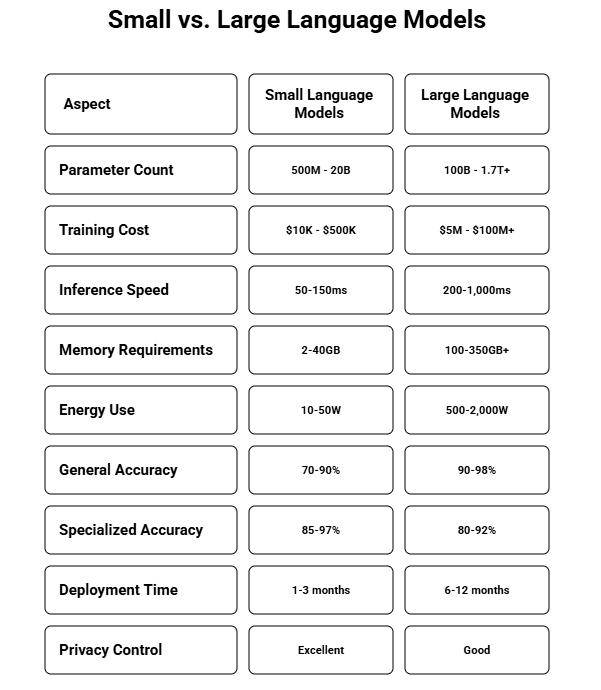
- Training: $10,000-$500,000 (vs $5M-$100M for LLMs)
- Fine-tuning: $2,000-$20,000 (vs $50K-$500K)
- Operations: $5K-$50K annually (vs $100K-$1M)
According to Harvard Business Review's AI Cost Analysis, organizations implementing SLMs reduce total AI costs by 85-95% compared to LLM-based solutions.
2. Superior Speed and Responsiveness
Inference Latency:
- SLMs: 50-150 milliseconds
- LLMs: 200-1,000 milliseconds
Google Research shows this 2-10x speed advantage significantly impacts user experience in real-time applications like our AI SDR Sarah, where instant sales intelligence drives conversion rates.
3. Enhanced Privacy and Security
On-Device Processing Benefits:
- Zero data transmission to external servers
- Complete control over AI processing
- Compliance with GDPR, HIPAA, and PCI-DSS
- Reduced vulnerability to data breaches
IBM Security's 2024 Cost of Data Breach Report values these privacy advantages at an average of $4.88 million per avoided breach.
4. Customization and Specialization
Domain-trained SLMs often outperform general-purpose LLMs in specific tasks. Research from Stanford HAI demonstrates specialized SLMs achieve 85-97% accuracy in narrow domains versus 80-92% for general LLMs—a critical advantage for business applications requiring precision.
5. Environmental Sustainability
Carbon Footprint Reduction:
- SLM training: 2-50 tons CO2 equivalent
- LLM training: 500-1,000+ tons CO2 equivalent
For organizations with net-zero commitments, Nature Climate Change research confirms SLMs provide a sustainable path to AI adoption.
SLMs vs Large Language Models: A Practical Comparison
Choosing between SLMs and LLMs requires understanding their practical differences. At Ruh AI, we've optimized this decision-making process for our clients.
Comprehensive Comparison
When to Choose Each Model
Choose SLMs When:
- Well-defined, specific use case
- Budget under $500K for AI initiatives
- Speed and latency are critical
- Data privacy is non-negotiable
- Deployment on edge devices
- Offline functionality needed
Choose LLMs When:
- Broad general knowledge required
- Complex multi-step reasoning needed
- Creative content generation is primary
- Multilingual support (50+ languages)
- Maximum accuracy over cost matters
According to Forrester Research, 73% of successful AI implementations in 2024 used SLMs for specialized tasks, demonstrating the practical value of focused AI solutions.
At Ruh AI, we leverage SLM advantages to power solutions like our AI SDR platform, delivering fast, accurate sales intelligence without massive infrastructure costs. Explore more AI insights on our blog.
Best Small Language Models in 2025
Selecting the right SLM depends on specific requirements. Here are the leading models based on research from Stanford HAI and performance benchmarks.
1. Microsoft Phi-4 (14B Parameters)
Key Strengths:
- Exceptional reasoning: 89.1% on MMLU benchmark
- Superior code generation capabilities
- Enterprise-grade safety alignment
- Optimized for business applications
Best For: Enterprise applications requiring reliable reasoning and strong compliance Deployment: Azure AI, on-premise options available Pricing: ~$0.50 per million tokens (80% cheaper than GPT-4)
2. Google Gemma 2 (2B, 7B, 9B)
Key Strengths:
- Best-in-class efficiency with multi-query attention
- Runs on mobile devices and IoT hardware
- Strong safety features
- Multiple size variants
Best For: Mobile applications, edge devices, battery-powered scenarios Deployment: Google AI Studio, open-source Performance: Gemma 2 9B matches Llama 3 70B on benchmarks while being 8x smaller
3. Meta Llama 3.2 (1B, 3B)
Key Strengths:
- Optimized for edge devices and mobile
- Excellent multilingual support
- Open-source with permissive licensing
- Runs smoothly on smartphones
Best For: Mobile apps, offline functionality, embedded systems Deployment: iOS, Android, edge hardware compatible Performance: 73.2% on MMLU despite only 1B parameters
4. IBM Granite 3.0 (2B, 8B)
Key Strengths:
- Enterprise-grade security features
- Excellent RAG capabilities
- Strong tool-calling for agentic workflows
- Optimized for regulated industries
Best For: Financial services, healthcare, legal applications Deployment: Open-source, IBM WatsonX optimized Performance: 20% better on enterprise benchmarks vs comparable models
5. Mistral 7B
Key Strengths:
- Excellent general-purpose performance
- Strong code generation
- Active community support
- Efficient grouped-query attention
Best For: Developers seeking balance between performance and efficiency Deployment: Open-source via Hugging Face Performance: Outperforms Llama 2 13B while half the size
Model Selection Guide
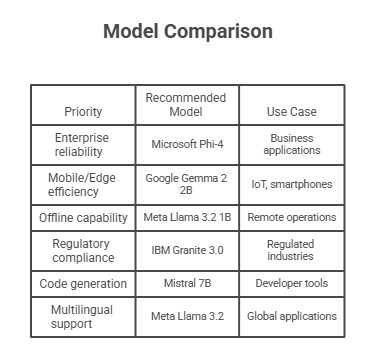
Performance data sourced from Papers with Code and official model documentation.
At Ruh AI, we evaluate and integrate the most suitable SLMs for specific business needs. Contact us to discuss which model aligns with your requirements.
Real-World Applications
Small Language Models transform industries through practical, high-impact implementations. Here's how organizations leverage SLMs effectively.
Sales and Business Development
AI-Powered SDR Solutions
At Ruh AI, we've built AI SDR platforms that leverage SLM efficiency for real-time sales intelligence. Our solution, Sarah, demonstrates how SLMs deliver:
- Real-time lead qualification: 80ms response time vs 400ms with cloud LLMs
- Privacy-first processing: All prospect data remains on-premise
- Cost efficiency: 85% lower operational costs than LLM alternatives
- 24/7 availability: Offline capability ensures uninterrupted service
According to Salesforce Research, companies using AI SDRs report 34% higher conversion rates and 41% shorter sales cycles.
Healthcare Applications
Clinical Documentation
- Challenge: Physicians spend 49% of their work time on documentation.
- SLM Solution: Real-time medical transcription and EHR population.
- Results: 34% reduction in documentation time, 23% fewer errors.
- Privacy: HIPAA-compliant on-device processing.
Medical Research Assistance
- Literature review and synthesis automation
- 10x more papers analyzed per researcher
- Cost: $45,000 vs $380,000 for cloud LLM alternative
Financial Services
Fraud Detection
- Challenge: $32 billion lost to payment fraud annually (FTC report)
- SLM Solution: Real-time transaction analysis
- Results: 67% improvement in detection, 58% fewer false positives
- Speed: 45ms analysis enables instant decisions
Regulatory Compliance
- Automated document analysis and compliance checking
- 78% reduction in manual review time
- 99.2% accuracy on compliance assessments
- Cost savings: $840,000 annually for mid-sized banks
Retail and E-Commerce
Personalized Recommendations
- 28% increase in conversion rates
- 41% higher average order value
- 80ms real-time recommendations
- Privacy-preserving: customer data processed locally
Customer Service Automation
- 73% query resolution without human intervention
- 4.6/5 customer satisfaction rating
- $320,000 annual cost savings in support
Manufacturing
Predictive Maintenance
- Challenge: Unexpected failures cost $50 billion annually (NIST research)
- SLM Solution: Sensor data analysis predicting failures 72 hours ahead
- Results: 56% reduction in unplanned downtime
- Deployment: Edge devices on the factory floor
Quality Control
- 94% defect detection rate with 99.7% accuracy
- 500 parts per minute inspection speed
- 80% lower cost than manual inspection
These applications demonstrate SLM's versatility across industries. Explore more insights on our blog or contact us to discuss implementation for your specific needs.
Conclusion: Your Path to Efficient AI
Small Language Models democratize artificial intelligence, making sophisticated capabilities accessible, affordable, and practical for organizations of all sizes. The question isn't whether to explore SLMs, but how quickly you can identify the right use case and begin implementation.
At Ruh AI, we've helped organizations across industries implement efficient SLM solutions. Our AI SDR platform and Sarah demonstrate how SLMs deliver real-time intelligence without massive infrastructure.
Ready to explore SLMs for your organization? Contact us to discuss custom implementation strategies.
FAQs: Small Language Models Explained
What are the advantages of small language models?
Ans: Small Language Models offer seven key advantages for business implementation:
1. Cost Efficiency: 85-95% reduction in total AI costs—training costs $10K-$500K vs $5M-$100M for LLMs, with operations at $5K-$50K annually.
2. Speed: 2-10x faster responses (50-150ms vs 200-1,000ms), critical for real-time applications.
3. Privacy: On-device processing keeps sensitive data on-premise—essential for HIPAA, GDPR, and PCI-DSS compliance.
4. Specialization: Domain-trained SLMs achieve 85-97% accuracy vs 80-92% for general LLMs in specific tasks.
5. Sustainability: Nature Climate Change research shows 90-95% less energy consumption.
6. Offline Capability: Function without internet connectivity.
7. Accessibility: Run on standard hardware, democratizing AI for all organizations.
At Ruh AI, these advantages power our AI SDR platform and Sarah solutions.
Why are small language models the next big thing in AI?
Ans: Three fundamental drivers make SLMs essential:
1. Economic Reality: Gartner's 2024 survey shows 67% of companies cite cost as the primary AI barrier. The SLM market is projected to reach $29.64 billion by 2032.
2. Privacy Regulations: Global data privacy fines exceeded $4.3 billion in 2024 (DLA Piper). SLMs enable compliant on-device processing.
3. Edge Computing: IDC forecasts 75% of enterprise data will be processed at the edge by 2026—SLMs are the only practical solution.
Proven Results: Healthcare sees 30-40% cost reduction, finance reports 67% better fraud detection, and retail experiences 28% higher conversion rates with SLMs.
What are small language models, and are they better than LLMs?
Ans: Small Language Models are compact AI systems (500M-20B parameters) designed for specific tasks. According to Stanford HAI, "better" depends on use case:
SLMs Excel: Speed-critical applications, limited budgets, privacy requirements, offline operation, domain specialization (legal: 91% vs 84% accuracy)
LLMs Excel: Broad knowledge, complex reasoning, creative content, multilingual support (50+ languages)
Hybrid Success: Forrester Research reports 73% of successful 2024 implementations used SLMs for specialized tasks with LLMs handling complex edge cases.
What is an advantage of a small language model over a large language model?
Ans: The most significant advantage is deployment flexibility with privacy—running AI entirely on your infrastructure without external data transmission.
Why This Matters:
Compliance: IBM Security's 2024 report values avoided breaches at $4.88M average. SLMs enable HIPAA, GDPR, and PCI-DSS compliance.
Real Example: A regional hospital achieved 99.97% uptime, $320K annual cost (vs $1.2M cloud LLM), and zero breaches with full HIPAA compliance.
Additional Advantages: 2-10x faster (50-150ms vs 200-1,000ms), fine-tune in days vs weeks, higher specialized accuracy.
How do SLMs compare to larger models?
Key comparison validated by MIT Technology Review:
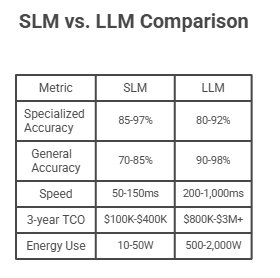
Decision Guide: Gartner research shows SLMs suit 70-80% of business AI applications (well-defined tasks), while LLMs handle general intelligence and creative work. 73% of enterprises use hybrid approaches.
What is the best small language model?
Ans: No single "best" model—optimal choice depends on requirements. Based on Papers with Code benchmarks:
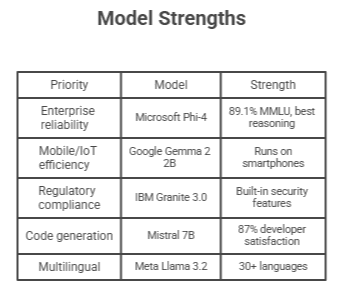
Quick Start: For most applications, begin with Mistral 7B (general), Gemma 2 (efficiency), or Phi-4 (enterprise)—all serve 80%+ of use cases well.
At Ruh AI, we help select and implement the optimal model for your needs. Contact us or visit our blog for more insights.
The efficiency case for small language models becomes more concrete when tested against industry-specific workflows, so Ruh AI carries that question into construction without assuming one model fits every task.