
TL;DR
April 2026 made the managed-vs-DIY AI agent debate real. Anthropic launched Claude Managed Agents, a hosted runtime that provides sandboxed code execution, checkpointing, credential management, scoped permissions, and end-to-end tracing — priced at standard token rates plus $0.08 per active session-hour. Around the same time, the open-source project Multica shipped a vendor-neutral, self-hosted managed-agents platform where coding agents from Claude Code, Codex, Gemini, and Cursor are treated like teammates on a task board and accumulate reusable skills. The two products don't compete on features so much as they frame a choice every engineering leader now has to make: run agents on somebody else's managed runtime, or run them on your own. This guide walks through what each one actually does, where managed agents win, where DIY still wins, and how to pick.
Ready to see how it works:
- The Agent Infrastructure Problem Nobody Is Talking About
- How the Managed vs DIY Split Emerged in AI Agents
- Inside Claude Managed Agents: Anthropic's Bet on Hosted Agent Runtime
- Inside Multica: Open-Source, Self-Hosted, Vendor-Neutral
- Managed Agents vs DIY Agents: Head-to-Head Comparison
- Advantages of Managed AI Agent Platforms
- Honest Downsides of Managed Agents
- When a DIY Agent Stack Still Wins
- How Managed Agents Simplify Real-World Workflows
- How Ruh AI Is Adapting Managed Agents for Smarter Results
- What the Managed-vs-DIY Split Says About the AI Agent Market
- A Practical Decision Framework for Your Team
- Frequently Asked Questions About Managed vs DIY AI Agents
The Agent Infrastructure Problem Nobody Is Talking About
Everyone building with AI agents in 2025 learned the same uncomfortable lesson: writing the agent is the easy part. The hard part is running it.
Shipping a real production agent means building — or buying — a sandboxed execution environment, a checkpointing layer so sessions survive disconnects, a credential vault, a scoped permissions model so the agent can't wander where it shouldn't, and end-to-end tracing so you can figure out what it did and why. That's before you've written a single line of product logic.
By the end of 2025, two patterns had become obvious. First, most teams were reinventing the same agent runtime — over and over, badly. Second, the gap between "cool demo" and "production agent" was measured in months, not weeks, mostly because of infrastructure, not intelligence.
April 2026 is when the market stopped pretending that was fine. Anthropic shipped Claude Managed Agents, and the open-source community shipped Multica. The two products take opposite sides of the same argument, and together they're the clearest signal yet of where the agent market is heading.
How the Managed vs DIY Split Emerged in AI Agents
Every platform category in software history has followed the same arc. You build it yourself. Then someone offers a managed version. Then an open-source self-hosted alternative fills in the parts enterprises can't — or won't — outsource.
Databases went that way. Kubernetes went that way. Machine-learning platforms went that way. Agents are going that way now, just faster because the underlying model capabilities are improving on a six-month cycle.
Through 2024, "agentic" meant wrapping an LLM in a while-loop, giving it a few tools, and hoping it didn't hallucinate a rm -rf. Through 2025, harnesses matured, tool-use accuracy improved, and the first long-running autonomous agents became viable. But deploying them safely still required hand-rolled infrastructure — and, as a growing body of research on AI agents that refuse commands has shown, without that infrastructure agents fail in subtle and dangerous ways.
By spring 2026, two forces converged:
Managed-agent platforms arrived as productized runtimes — purpose-built to run a specific model reliably, at scale, with enterprise-grade guardrails. Claude Managed Agents is the flagship example.
Open-source managed-agents platforms arrived as vendor-neutral, self-hosted alternatives. Multica is the most visible of these, and the first to explicitly frame itself as a task board for human + agent teams.
The choice between them — managed vs DIY — is now the defining architectural decision for anyone building with agents this year.
Inside Claude Managed Agents: Anthropic's Bet on Hosted Agent Runtime
On April 8, 2026, Anthropic launched Claude Managed Agents as a beta cloud service, announced on the Claude blog and covered across SiliconANGLE, The New Stack, and InfoWorld.
What Claude Managed Agents Actually Does
Claude Managed Agents gives you a fully managed environment where Claude runs as an autonomous agent. Instead of building your own agent loop, tool executor, sandbox, and runtime, you hand a task to Anthropic's infrastructure and Claude executes it — reading files, running commands, browsing the web, and executing code inside a purpose-built sandbox.
The product ships with everything you would otherwise have to build yourself:
- Sandboxed code execution so the agent can run code without touching your systems directly.
- Checkpointing so long-running sessions don't restart from zero when something disconnects.
- Credential management and scoped permissions so the agent only touches what you authorize.
- End-to-end tracing so you can see exactly what the agent did and why.
Crucially, sessions persist through network disconnections. A multi-step research or build task can run for hours in the background, and the progress and outputs remain even if the client drops.
How Pricing Works
Pricing is refreshingly simple. You pay standard Claude Platform token rates for the tokens Claude consumes during the session, plus $0.08 per session-hour of active runtime. Runtime is measured to the millisecond and only accrues while the session is in running status. There is no per-agent license, no flat monthly fee, and no separate infrastructure charge on top — the sandbox, state management, and error recovery are all included in that session-hour price. This is confirmed in both Anthropic's docs and secondary pricing analyses from outlets like Pebblous.
Who's Already Using It
Anthropic's launch announcement and SiliconANGLE's coverage name Notion, Rakuten, and Asana among the first customers integrating agents built on Managed Agents into their products. The positioning is explicit: "get to production 10x faster" by removing the infrastructure tax on agent development.
The Engineering Story
Anthropic's own engineering blog on Managed Agents describes the core design decision as "decoupling the brain from the body" — letting the model reason freely while the runtime handles state, isolation, and recovery. That separation is what makes long-running autonomous sessions tractable in production rather than a live-fire demo.
Inside Multica: Open-Source, Self-Hosted, Vendor-Neutral
While Anthropic was building a hosted runtime, a different community was answering the same question with the opposite architecture. Multica is an open-source managed-agents platform that treats coding agents as teammates on a task board, with full support for self-hosting on your own machine or cloud.
What Multica Actually Does
Multica's core move is simple: agents show up on the board alongside humans. You assign an issue to an agent the same way you'd assign it to a colleague. The agent picks it up, writes code, reports blockers, streams progress in real time, and either completes the task or escalates. Every successful solution can be stored as a reusable skill for the whole team, so the team's collective capability compounds over time.
From the project's own README and homepage, the feature set includes:
Unified task lifecycle management — enqueue, claim, execute, complete or fail.
Real-time progress streaming and proactive blocker reports from agents.
Skills library — every solved problem becomes a callable skill other agents can reuse.
Unified runtimes — one dashboard for local daemons and cloud runtimes, with auto-detection of available CLIs.
Vendor-neutral model support — Claude Code, Codex, OpenClaw, OpenCode, Hermes, Gemini, Pi, and Cursor Agent.
Where the Code Actually Runs
This is the architectural point that matters most for enterprises. Agent execution happens on your local daemon or your own cloud infrastructure — not Multica's servers. That is stated explicitly across the project's GitHub repository and its self-hosting docs.
Practically, that means:
No third-party data path for your code or secrets during execution.
Full control over the sandbox — you choose the base image, the network policy, the resource limits.
No lock-in to a single model vendor — you can run Claude today, Gemini tomorrow, and a local open-weight model the day after.
How You Deploy It
Multica ships as Docker Compose plus a CLI. The self-host script clones the repo, starts the services, installs the multica CLI, and points it at localhost. That's the short version of the self-hosting guide. Additional guidance for more complex deployments is in the advanced self-hosting doc.
Managed Agents vs DIY Agents: Head-to-Head Comparison
If you strip away the marketing, the two products are arguing opposite sides of the same architecture decision. Here's a clean read:
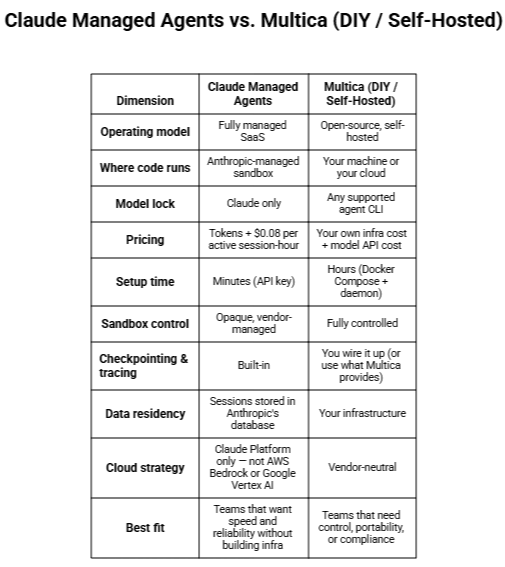
This table is the crux of the whole managed agents vs DIY agents debate. Neither is "better." They're optimized for different jobs.
Advantages of Managed AI Agent Platforms
Across authoritative analyses — including The New Stack's coverage and InfoWorld's launch piece — the same five advantages come up again and again.
1. Dramatically Faster Time to Production
Anthropic positions Claude Managed Agents with the tagline "get to production 10x faster", and the reason is straightforward: the 80% of the work that isn't the agent itself — sandbox, runtime, checkpointing, credentials, tracing — is already done. You wire up the task, you ship.
2. Production-Grade Infrastructure by Default
Sandboxed execution, scoped permissions, credential management, and tracing aren't nice-to-haves for a production agent. They're the difference between "this agent helps us" and "this agent leaked a customer token into a log at 3 a.m." Managed platforms ship these as table stakes.
3. Sessions That Actually Survive Real-World Conditions
Long-running agent sessions disconnect. Clients crash. Networks blip. Claude Managed Agents is explicit that sessions persist through disconnections and that autonomous runs can last hours — the kind of overnight, unattended execution we've explored in depth in AI agents that work while you sleep. That's a capability most DIY stacks never quite get right.
4. Predictable, Usage-Based Pricing
The pricing model — tokens plus $0.08 per active session-hour — is unusually easy to model. There's no per-seat tier, no flat infra charge, and the session-hour meter only runs while the session is actively running. For finance teams evaluating the total cost of ownership, that predictability is itself an advantage.
5. Vendor-Managed Upgrades
Sandbox hardening, runtime improvements, and model-side optimizations ship automatically. You benefit without a migration project. One analyst summarized it bluntly: "Your agent is your moat. Your infra is not."
6. Engineering Focus Stays on the Agent
This is the quiet advantage. When you're not spending Q2 writing a checkpoint layer, you're spending Q2 making the agent smarter at your actual business problem — refining tools, shaping memory, and investing in prompt engineering for autonomous systems that is actually production-ready.
Honest Downsides of Managed Agents
Managed platforms come with real tradeoffs, and the launch coverage — especially VentureBeat's piece on lock-in risk — is clear-eyed about them.
1. Vendor Lock-In Is Real
Session data for Claude Managed Agents is stored in a database managed by Anthropic. The service is currently Claude-only and Claude-Platform-only — it does not support running Claude through AWS Bedrock or Google Vertex AI as a Managed Agents host. For enterprises with a multi-cloud posture, that's a meaningful constraint.
2. Opaque Runtime
You don't control the base image, the exact sandboxing semantics, or the network policy. For many workloads that's a blessing. For regulated workloads — healthcare, finance, defense — it can be a blocker. It also means you're trusting the vendor to handle the edge cases that arise when agents refuse commands or drift from instructions.
3. Session-Hour Costs Compound
$0.08 per session-hour sounds trivial, and for a bursty workload it is. For always-on agents running dozens of concurrent long-lived sessions, it adds up. Do the napkin math before scaling.
4. Platform Risk
Any managed-only stack is only as stable as the provider's pricing, roadmap, and availability. That isn't an argument against managed — it's an argument for having a migration plan you haven't had to use.
When a DIY Agent Stack Still Wins
Managed platforms are the right call for most teams most of the time. DIY still wins in four scenarios, and Multica is the clearest example of what modern DIY looks like.
Compliance and data residency. If your code, data, or secrets cannot leave your infrastructure — for regulatory, contractual, or internal-security reasons — a self-hosted platform like Multica is the only viable option.
Multi-model strategy. If you want to mix Claude, Gemini, Codex, and a local open-weight model in the same workflow, a vendor-neutral platform is a better fit than a model-specific managed runtime.
Deep customization. If your agent needs a bespoke sandbox, a specific base image, or novel tool integrations that no vendor has productized, DIY gives you that ceiling.
Cost optimization at scale. Once you cross a certain volume, owning the runtime is often cheaper than renting it — especially for always-on workloads where session-hour charges dominate.
The counter-argument — that DIY has hidden long-term costs — is also honest. Most organizations underestimate the ongoing maintenance cost of self-built agent platforms. A team focused full-time on agent operations will ship improvements faster than a team doing it on the side. The right DIY decision is one made with eyes open.
How Managed Agents Simplify Real-World Workflows
The abstract case is "you ship faster." The concrete case is more interesting. Here's what managed agents actually change in common workflows:
- Research and reporting agents run for hours without a developer babysitting the session. You come back, the output is persisted, the trace shows what happened.
- Coding agents handle multi-file refactors with checkpointing so a crash mid-run doesn't mean starting over.
- Customer-facing automation runs with scoped credentials — the agent can touch the ticket system but not the payments database.
- Data pipelines get an agent that can read a spec, write the transformation, run it in a sandbox, and surface failures with a full trace.
- Internal tooling gets built by agents that pick tasks off a board (Multica's model) and hand completed work back for review.
None of this is new as a concept. What's new is that a three-person team can now ship it without first becoming a platform engineering team. That's the leverage shift.
How Ruh AI Is Adapting Managed Agents for Smarter Results
At Ruh AI, we've been watching the managed-vs-DIY split not as a hypothetical debate but as a shaping constraint on every agent-powered feature we ship — from our AI SDR product that runs sales outreach autonomously, to Sarah, our always-on AI teammate that lives across our customers' workflows.
Our stance is pragmatic. We believe most teams should not be in the business of maintaining agent infrastructure — and most of our customers agree once they've spent a quarter trying. But we also believe no single managed runtime should own your agents end-to-end. Lock-in is real, and the cost of switching gets harder every month you stay.
So Ruh AI is building on a hybrid posture:
We use managed runtimes like Claude Managed Agents where speed and reliability are the binding constraint — research agents, long-running reports, anything where "get to production 10x faster" is the point. Our AI SDR is a live example: a managed-runtime agent that works prospect lists while your human team sleeps.
We keep the agent's logic, prompts, and skills portable — grounded in the prompt-engineering patterns for production-ready autonomous systems we've published so that if tomorrow's best runtime is a different one, we move in days, not quarters.
We treat skills as first-class assets — the same instinct Multica codified in its open-source platform. Solved problems become reusable skills, which is where long-term compounding actually lives.
We advocate for open, vendor-neutral interfaces between the agent and the runtime, so our customers never have to choose between speed today and optionality tomorrow.
The short version: Ruh AI uses managed agents where they earn their keep, and insists on portability everywhere else. The future we're building for is one where the managed-vs-DIY choice is made per-workload, not once for the whole company. For deeper dives into the patterns above, our full library lives on the Ruh AI blog.
What the Managed-vs-DIY Split Says About the AI Agent Market
Zoom out and the April 2026 launches are a market signal, not just two product announcements.
Gartner projected in August 2025 that 40% of enterprise applications will feature task-specific AI agents by the end of 2026, up from less than 5% in 2025. That's an order-of-magnitude adoption jump in a single year, and it only happens if the infrastructure tax on agents collapses. That is precisely what managed platforms are built to do.
At the same time, the arrival of a credible open-source managed-agents platform — Multica — this early in the category's life is unusual. In most platform categories, open-source self-hosted alternatives trail the managed versions by years. Agents are compressing that timeline because the underlying tooling (Docker, container orchestration, CLI-based coding agents) is already mature.
The market message: agents are crossing the chasm from "clever demo" to "enterprise software category," and buyers now have two legitimate ways to participate — rent a managed runtime, or run your own. Both are defensible. Both are going to grow. And the interesting strategic question has shifted from "should we use agents?" to "which parts of the agent stack do we own, and which do we rent?"
A Practical Decision Framework for Your Team
You don't need a 40-page build-vs-buy analysis. You need five questions. Answer them honestly and the right call is usually obvious.
Is our advantage in the agent, or in the runtime? If the runtime, keep building. If the agent, rent the runtime.
Do we have a platform team that can own this for the next three years? If no, a managed runtime is the safer long-term bet — DIY platforms without a dedicated maintainer rot fast.
Do our workloads have hard data-residency or compliance requirements? If yes, lean toward self-hosted (Multica-style). If no, managed is usually fine.
How many models do we actually want to run? One — managed, model-specific platforms are a clean fit. Many — a vendor-neutral self-hosted platform is worth the setup cost.
What's our worst-case lock-in cost? Estimate what it would cost — in weeks, dollars, and customer risk — to migrate off the managed platform you're about to choose. If that number is acceptable, you have your answer. If it isn't, architect for portability from day one.
The honest conclusion: most teams should start managed, ship something real, and re-evaluate per workload as volume, compliance, or strategy changes. That's the version of the answer that survives contact with production. If you're still shopping for the right runtime, our roundup of the top 10 AI agent tools in 2026 is a useful second read before you commit.
Ready to Move Faster Without Losing Control?
The managed vs DIY agent decision isn't one you make once. It's one you'll make again for every workload, every year, as models change and your own stack matures.
Ruh AI helps teams ship agent-powered products without getting stuck on the infrastructure question. We combine managed-runtime speed with portable, vendor-neutral architecture — so you get to production fast and keep your options open. Browse more practical guides on the Ruh AI blog, meet our always-on teammate Sarah, or see how our AI SDR is already running sales outreach in the managed-agent era.
Talk to us at ruh.ai — bring us a workload, we'll help you figure out whether it belongs on a managed runtime, a self-hosted platform, or a hybrid of both.
Frequently Asked Questions About Managed vs DIY AI Agents
What are managed AI agents?
Ans: Managed AI agents are agents that run on a fully hosted runtime supplied by a vendor. The vendor provides the sandbox, checkpointing, credential management, permissions, and tracing — you provide the task. Claude Managed Agents is a canonical example.
What's the difference between managed agents and DIY agents?
Ans: Managed agents run on someone else's infrastructure and are billed on usage. DIY agents run on infrastructure you own — whether that's your laptop, your data center, or your cloud account — and you own the operational cost and complexity. Multica is an open-source platform that makes DIY agent operations much more tractable without giving up control.
How much do Claude Managed Agents cost?
Ans: Claude Managed Agents is priced on standard Claude Platform token rates plus $0.08 per active session-hour. There is no flat monthly fee, no per-agent license, and no separate infrastructure charge. Runtime is measured to the millisecond and only accrues while the session is running. See Anthropic's official docs for the current terms.
Does Claude Managed Agents work with AWS Bedrock or Google Vertex AI?
Ans: Not currently. As of the April 2026 launch and subsequent VentureBeat analysis, Claude Managed Agents itself is available only on the Claude Platform — it does not run on AWS Bedrock or Google Vertex AI. The Claude SDK supports those platforms for model calls, but the managed-runtime product does not.
Is Multica free?
Ans: Multica is open-source and can be self-hosted on your own infrastructure at no license cost — you pay for the compute and for whatever model APIs your agents call. See the GitHub repository for current license terms and setup.
Which coding agents does Multica support?
Ans: Per Multica's README, supported agents include Claude Code, Codex, OpenClaw, OpenCode, Hermes, Gemini, Pi, and Cursor Agent. Support is extensible because the platform is model-agnostic by design.
When should I pick managed over DIY?
Ans: Pick managed when time-to-production, reliability, and low operational overhead are the binding constraints, and your competitive advantage is in the agent's logic rather than its plumbing. Pick DIY (like a self-hosted Multica deployment) when you have hard data-residency requirements, a multi-model strategy, deep customization needs, or a scale that makes session-hour billing expensive.
Does using managed agents create vendor lock-in?
Ans: Yes, meaningfully. Session data for Claude Managed Agents lives in Anthropic-managed storage, and the product is tied to the Claude Platform. Migrating off is not trivial — which is why the smart pattern is to keep your agent's logic, prompts, and skills portable even while you use a managed runtime.
Is the agent market big enough to matter?
Ans: Yes. Gartner projects that 40% of enterprise applications will feature task-specific AI agents by the end of 2026, up from less than 5% in 2025. That is an order-of-magnitude shift inside a single year, which is why the managed-vs-DIY infrastructure question has suddenly become urgent.
How do I get started with either platform?
Ans: Start with a small, bounded workload — a report generator, a code-refactor agent, or a single internal-tooling task. Run it on a managed platform for a week to get a feel for cost and reliability. Then ask whether the workload needs more control than the managed runtime gives you. If yes, evaluate a self-hosted alternative like Multica. If no, keep shipping.