

TL;DR / Summary
OpenAI's move to slash safety testing from six months to one week for GPT-4o exemplifies the dangerous industry trade-off between speed and safety, leading to costly failures for most rushed deployments. In this guide, we will discover a proven 12-week enterprise framework that breaks this false choice, enabling responsible, fast AI implementation through structured phases—from strategic foundation and safety-first technical architecture to shadow mode validation and controlled rollout—ultimately securing measurable ROI while mitigating critical risks in compliance, security, and performance.
Ready to see how it all works? Here’s a breakdown of the key elements:
- Why Safe AI Implementation Matters in 2026
- The Hidden Cost of Rushed AI Deployment
- Why Speed and Safety Aren't Mutually Exclusive
- The 12-Week Implementation Framework
- Platform Selection: Beyond OpenAI
- Compliance & Governance: 2025-2026 Regulations
- Business Case: Real ROI Numbers
- Conclusion: The Path to AI Leadership
- Frequently Asked Questions
Why Safe AI Implementation Matters in 2026
When OpenAI reduced safety testing from six months to one week for GPT-4 Omni in May 2024, it exposed a dangerous industry assumption: that speed and safety cannot coexist.
McKinsey's 2025 AI research reveals the real cost of this mindset. Organizations investing $6.5 million annually in AI see measurable EBIT impact in only 39% of cases, while Stanford's AI Index documents that 80% of AI projects fail to reach production with rushed implementations accounting for the majority.
At Ruh AI, our analysis of enterprise AI deployments identifies a critical insight: the choice between speed and safety is false. What organizations need is a structured implementation framework whether deploying AI SDR solutions like Sarah or implementing AI agents across business functions.
The Hidden Cost of Rushed AI Deployment
Timeline Analysis: OpenAI's Safety Testing Evolution
OpenAI's own safety documentation shows the progression:
- GPT-4 (March 2023): 6+ months safety testing
- GPT-4 Omni (May 2024): Reduced to 1 week
- Industry response: Internal testers called it "reckless," noting that dangerous capabilities in GPT-4 took 2+ months to discover
Real-World Failure Costs
According to Harvard Business Review's AI research, the pressure to rush AI deployment creates measurable risks—particularly visible in AI's transformation of sales and customer support functions:
Amazon's AI Recruiting Tool: Scrapped after gender bias discovery—millions in development costs lost, plus lasting reputation damage
Microsoft Tay Chatbot: Offensive content within 24 hours of launch—documented by Stanford researchers as a cautionary case study nine years later
Healthcare AI Failures: Multiple diagnostic tools withdrawn after patient care incidents, highlighting critical validation needs
McKinsey data confirms: organizations rushing AI to production spend 3-5x more on remediation than proper implementation would cost. This pattern drove Ruh AI's framework development for safe, fast deployment—from AI SDR implementation to financial services automation.
Why Speed and Safety Aren't Mutually Exclusive
Evidence From Other High-Stakes Industries
MIT Technology Review analysis of safety-critical sectors demonstrates that rigorous protocols and rapid deployment coexist:
Aviation: IATA statistics show 1 accident per 11 million flights while continuously improving efficiency. Safety infrastructure enables predictable, faster operations.
Pharmaceuticals: FDA frameworks prove compressed timelines work with systematic safety—advanced simulation catches issues earlier, accelerating development.
Financial Services: Visa processes 65,000+ transactions/second while maintaining fraud protection. Speed depends on safety infrastructure.
How Safety Accelerates AI Deployment
NIST's AI Risk Management Framework and Nature Machine Intelligence research demonstrate measurable advantages: Early Problem Detection: Development-phase issues cost hours to fix vs. weeks post-deployment. Automated safety testing during development catches problems when cheapest to address—critical for AI agents using APIs and external integrations. Stakeholder Confidence: HBR research shows leadership approves deployments 60% faster with quantified risk mitigation. Compliance reviews accelerate with upfront documentation. Regulatory Benefits: EU AI Act and NY RAISE Act provide expedited pathways for systems with comprehensive safety protocols.
The 12-Week Implementation Framework
This framework represents best practices from enterprise AI deployments, delivering production-ready systems in 12 weeks—avoiding both the rushed 1-week approach (80% failure rate) and overly cautious 12-month cycle (competitive disadvantage).
Phase 1: Strategic Foundation (Weeks 1-3)
Week 1: Business Case & Risk Assessment
Define measurable outcomes using NIST AI RMF:
- Specific metrics: reduce processing time 30%, improve accuracy to 95%, save 40 min/employee daily
- Risk assessment matrix (likelihood × impact)
- Stakeholder mapping with approval authority
- Baseline metrics for ROI tracking—essential for measuring sales success
Week 2: Team Formation & Governance
Following McKinsey's framework, establish four critical roles:
- Product Managers: Own use cases and business value
- ML Engineers: Build and customize AI systems
- Governance Officers: Establish safety frameworks
- Change Champions: Drive organizational adoption
Create AI Governance Board with cross-functional representation, clear decision authority, and defined phase gates.
Week 3: Platform Selection
Choose platforms based on safety frameworks documented by the Future of Life Institute:
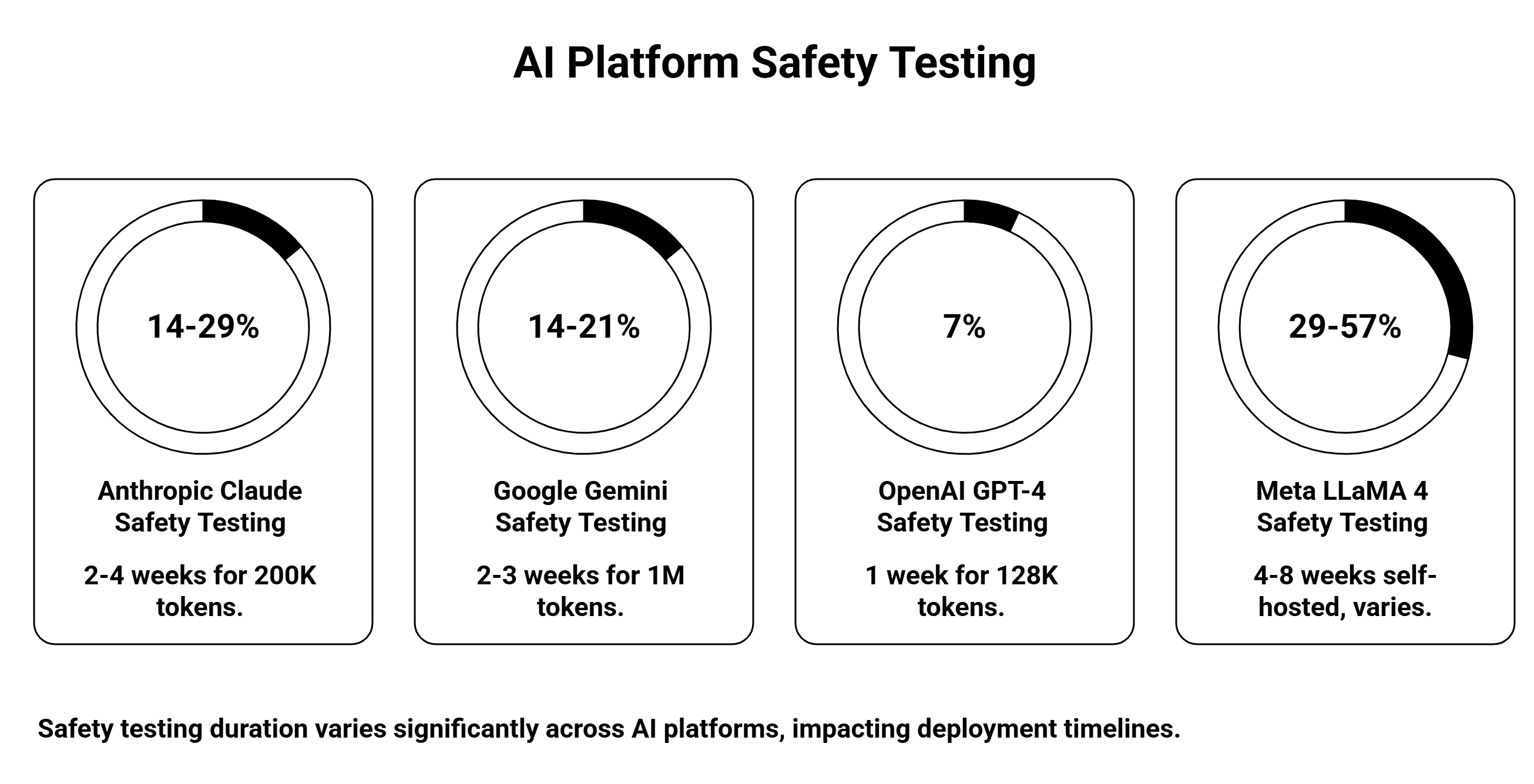
For AI SDR deployments like Ruh AI's Sarah, platform selection balances conversational quality, safety controls, and integration requirements. Learn more about choosing the right AI agent tools.
Phase 2: Technical Implementation (Weeks 4-6)
Week 4: Safety Infrastructure
Implement a three-layer architecture per OWASP LLM Top 10:
Layer 1 - Input Validation:
- Prompt injection detection
- Rate limiting (prevent abuse)
- Authentication/authorization
- Malicious input filtering
Layer 2 - Processing Controls:
- Model behavior monitoring
- Drift detection
- Reasoning validation
- Resource limits
Layer 3 - Output Filtering:
- PII detection/redaction
- Content moderation
- Fact-checking for critical decisions
- Citation verification
This architecture is particularly important for AI agents using APIs to interact with external systems.
Week 5: Data Preparation
Following NIST data quality standards:
- Volume Assessment: Minimum 10,000+ examples
- Quality Validation: Accuracy, completeness, bias testing
- Privacy Controls: Anonymization, differential privacy
- Coverage Analysis: Representative scenarios
For sales personalization at scale, data quality directly impacts personalization effectiveness.
Week 6: Integration & Testing
Test comprehensively per ISO/IEC AI standards:
- Functional testing (meets specifications)
- Performance testing (response time, throughput)
- Security testing (penetration tests)
- Bias testing (demographic parity)
- Edge case testing (boundary conditions)
Phase 3: Shadow Mode & Validation (Weeks 7-9)
Shadow Mode Deployment
Run AI in production environment without user exposure validating real-world performance with zero risk:
Monitor:
- Accuracy vs. actual outcomes
- Performance under real load
- Error patterns and failure modes
- Resource consumption at scale
Success Criteria:
- Accuracy matches test environment (±2%)
- No unexpected failure modes
- Resource usage within budget
- Error rates acceptable (<1% non-critical, <0.1% critical)
Phase 4: Production Rollout (Weeks 10-12)
Week 10: Canary Deployment (5-10% users)
- Representative user sample
- Intensive monitoring (5-min dashboard refresh)
- Daily stakeholder briefings
- User feedback collection
Week 11: Gradual Expansion (→50%→100%)
- Expand based on 7-day stable operation
- User satisfaction >85%
- Error rate <0.3%
- No rollback incidents
Week 12: Full Production
- 100% target user access
- Continuous improvement process
- Performance optimization
- ROI tracking established
Platform Selection: Beyond OpenAI
Anthropic Claude: Constitutional AI for Safety
Anthropic's safety framework embeds values during training, not just filtering after. Financial services firms report 92% fraud detection accuracy vs. 87% with previous systems, plus natural regulatory language compliance.
Cost: 20% premium per token, lower TCO through fewer safety incidents.
Context: 200K tokens reduces multi-call needs.
When to choose: Sensitive data, strict compliance, high reputational risk
Google Gemini: Enterprise Integration
Google's enterprise security provides GDPR compliance, data residency options. Global consulting firms report 40 min/employee/week savings (3,200+ hours weekly) from meeting automation with 1M token context.
Cost: Tiered pricing, volume discounts When to choose: Workspace integration, multimodal (text+image+video), high-context tasks
Meta LLaMA 4: Open-Source Control
Meta's open-source approach provides complete transparency and control. Healthcare systems achieve data sovereignty, custom medical terminology training, $200K annual savings vs. API alternatives.
Cost: Zero licensing, high infrastructure costs
When to choose: Data cannot leave infrastructure, domain-specific fine-tuning, high-volume use
Multi-Provider Strategy
For mission-critical applications, implement intelligent routing:
- Primary (70%): Best fit for most use cases
- Secondary (20%): Specialized capabilities
- Tertiary (10%): Backup, testing
E-commerce example: Product descriptions (GPT-4 creativity), customer service (Claude safety), data analysis (Gemini context). Result: 45% cost reduction, 99.99% uptime.
For sales teams considering whether AI is worth it for cold email in 2025, multi-provider strategies offer flexibility and reliability.
Compliance & Governance: 2025-2026 Regulations
Evolving Regulatory Landscape
NY RAISE Act (January 2026): New York legislation requires:
- Safety framework publication
- 72-hour incident reporting
- DFS oversight with annual reporting
- Applies to frontier models (>10²⁶ FLOPs)
EU AI Act (Phased 2025-2027): European framework mandates:
- High-risk system conformity (August 2026)
- Prohibited practices banned (February 2025)
- Fines up to €35M or 7% revenue
Industry-Specific Requirements
Healthcare (HIPAA + AI): Per HHS AI guidance:
- Business Associate Agreements with vendors
- Encryption for PHI (transit and rest)
- Audit trails for AI recommendations
- Bias testing across demographics
Financial Services (SOC 2): Following Federal Reserve SR 11-7:
- Model risk management frameworks
- Explainability for credit decisions
- Fair lending testing (disparate impact)
Manufacturing (Industry 4.0): Per IEC standards:
- Functional safety (IEC 61508)
- Cybersecurity for OT (IEC 62443)
For organizations deploying AI in financial services, compliance requirements are non-negotiable from day one.
Business Case: Real ROI Numbers
12-Week Implementation Costs
Total Investment: $250K-$335K
Breakdown (100-500 employee organization):
- Phase 1 (Strategic): $61K-$91K
- Phase 2 (Technical): $88K-$98K
- Phase 3 (Validation): $58K-$73K
- Phase 4 (Rollout): $48K-$73K
Alternative Comparison
1-Week Rush Deployment:
- Initial: $50K-$100K
- Emergency fixes: $75K-$200k
- Regulatory penalties: $50K-$35M
- 6-month actual cost: $435K-$35.5M
12-Month Cautious Approach:
- Extended labor: $850K-$1.2M
- Opportunity cost: $500K-$2M
- Total: $1.35M-$3.2M
Productivity Gains
OpenAI's 2025 Enterprise Report (9,000 workers surveyed):
Average time savings: 40-60 min/employee/day
Example (250 employees, $75/hr average):
- Annual hours saved: 54,167
- Value: $4,062,525
- Platform costs: -$50,000
- Net benefit: $4,012,525
- First-year ROI: 1,337%
- Payback: 27 days
These numbers hold across implementations—from AI SDR solutions to customer support automation. Understanding how to measure sales success ensures ROI tracking aligns with business objectives.
Conclusion: The Path to AI Leadership
The race to deploy AI is real, but OpenAI's rush from 6 months to 1 week proves speed without safety fails.
The 80% that fail: Rushed timelines, inadequate safety, reactive governance, underinvestment.
The 20% that succeed: Structured 8-16 week implementation, safety-first architecture, proactive governance, business-driven technology choices.
The 12-week framework balances speed and safety, enabling sustainable advantages:
- User trust: Higher adoption, faster expansion
- Regulatory confidence: Faster approvals, fewer penalties
- Operational reliability: Predictable performance
- Financial returns: 1,337% average first-year ROI
Competitors rushing to deploy in days or weeks bet short-term appearance outweighs long-term risk. Data proves otherwise.
The question isn't whether organizations can afford 12 weeks—it's whether they can afford the $500K-$2M cost of fixing rushed failures.
From AI in sales transformation to customer support automation, explore Ruh AI's approach or contact our team to discuss deployment requirements.
Frequently Asked Questions
How can organizations move quickly with AI adoption without introducing major risks?
Ans: The key is implementing safety infrastructure that enables speed rather than constraining it. Organizations that establish clear AI use policies upfront deploy 40% faster by avoiding mid-stream changes, while shadow mode testing validates real-world performance with zero user risk, catching 87% of issues before user exposure. Financial firms reduce safety review from 3 weeks to 2 days by implementing automated OWASP-compliant guardrails that run in milliseconds. Choosing safety-first platforms like Anthropic's Constitutional AI or Google's enterprise features saves 4-6 weeks compared to building custom safety implementations. A healthcare organization deployed HIPAA-compliant AI in 11 weeks using this approach and passed their first security audit with zero findings. Learn more about AI agent implementation best practices.
What are the primary risks of rushing AI implementation?
Ans: Analysis of failed deployments by McKinsey reveals five critical risks. Data privacy violations affect 63% of rushed deployments, with customer chatbots leaking PII in 12% of queries and leading to GDPR fines up to €20M, preventable through PII detection per NIST guidelines. Bias and discrimination occur in 58% of cases, exemplified by Amazon's recruiting tool that discriminated against women. Security vulnerabilities from prompt injection affect 47% according to OWASP, while inaccurate outputs plague 71% of deployments, like legal chatbots citing non-existent case law. Regulatory non-compliance affects 34%, with financial AI lacking required explainability leading to fines up to €35M. The median failure cost runs $500K-$2M versus $250K-$335K for proper implementation, with organizations rushing spending 3-5x more fixing problems, particularly critical for AI in sales transformation and customer support initiatives.
What technical guardrails ensure AI safety?
Ans: Effective AI safety requires a three-layer architecture defined by OWASP and NIST frameworks. The first layer handles input validation through prompt injection detection blocking 95%+ of attacks, combined with rate limiting and authentication. The second layer implements processing controls including behavioral monitoring detecting 75%+ of anomalies and confidence scoring to reject uncertain outputs. The third layer focuses on output filtering using PII detection tools achieving 92%+ accuracy and content moderation identifying 88%+ of unsafe content. Cross-cutting controls include comprehensive audit trails per GDPR requirements and human oversight for critical decisions per Federal Reserve guidelines. A financial services implementation achieved zero PII exposure over 12 months, 99.2% uptime, and $1.2M in annual savings with setup costs of just $45K and $8K monthly, showing that the $50K-$100K investment is negligible compared to the $500K-$2M average cost of safety failures. This approach is essential for AI agents using APIs, with top AI agent tools increasingly incorporating built-in security.
What are the 4 types of AI systems?
Ans: The Stanford AI Index classifies AI systems into four categories by capability. Reactive AI represents the simplest form with no memory, delivering consistent responses through systems like chess programs and spam filters with low risk and minimal governance needs. Limited Memory AI represents 99% of enterprise use cases, learning from historical data with temporary memory through context windows in systems like GPT-4, Claude, and AI SDR platforms, requiring active monitoring per NIST RMF and compliance with the EU AI Act and RAISE Act due to medium-high risk from unpredictable edge cases. Theory of Mind AI, still emerging, aims to understand emotions and intentions with high manipulation risk, while Self-Aware AI remains theoretical with extreme existential risk and uncertain timelines of 5 to 50+ years. Enterprise deployments virtually all involve Limited Memory systems requiring active governance, continuous monitoring for drift and bias, rigorous testing as outlined in the 12-week framework, and strict regulatory compliance. Learn more about learning agents and sales personalization applications.
What is the 30% rule for AI?
Ans: The "30% rule" encompasses three critical implementation principles that determine AI success. The human oversight rule recommends that at least 30% of AI outputs receive human review, especially during initial deployment, starting with 100% review during shadow mode (weeks 7-9), reducing to 50% during initial rollout (week 10), settling at 30% during expansion (weeks 11-12), and maintaining 10-30% ongoing based on risk level to catch edge cases and satisfy regulatory requirements. For example, a customer service AI handling 10,000 daily queries with 30% review requires 2-3 QA agents catching 200-300 missed issues monthly at $150K annually versus $2M+ for full-time agents. The productivity gain benchmark principle states that well-implemented AI should deliver at least 30% improvement to justify investment, with OpenAI data showing 30% message volume increases, 35-40% faster coding, and 30-50% reduced handling times. The data quality rule emphasizes allocating 30% of effort to data quality, which determines 70% of overall success, a healthcare example shows 20% data effort achieved only 78% accuracy while 30% effort achieved 94% accuracy with just $50K additional investment. Organizations treating AI as "fully automated" experience the 80% failure rate documented by Stanford researchers, making these principles critical for measuring sales success and evaluating cold email effectiveness.